
Your Newborn Is Not Difficult, They Are Communicating
You Are Not Just Raising A Child, You Are Nurturing A Soul

The first three months are not about getting it “right”, they are about meeting a tiny human with steady mercy, so their body learns safety and their soul learns trust.

It is 2:13 a.m.
You are standing in that half light, swaying without thinking, holding a baby who looks impossibly small and somehow impossibly loud. Your shirt smells like milk. Your eyes burn. You check the diaper again even though you just checked it. You whisper, “Please, please,” to no one in particular.
And then the guilt tries to slip in.
Why can’t I calm my own baby
Why do they keep crying
Why am I not enjoying this
If you are in those early weeks, I want you to hear this gently.
Nothing is wrong with you. Nothing is wrong with your baby. This is a tender beginning.
Your baby arrived knowing nothing, and that is not a weakness
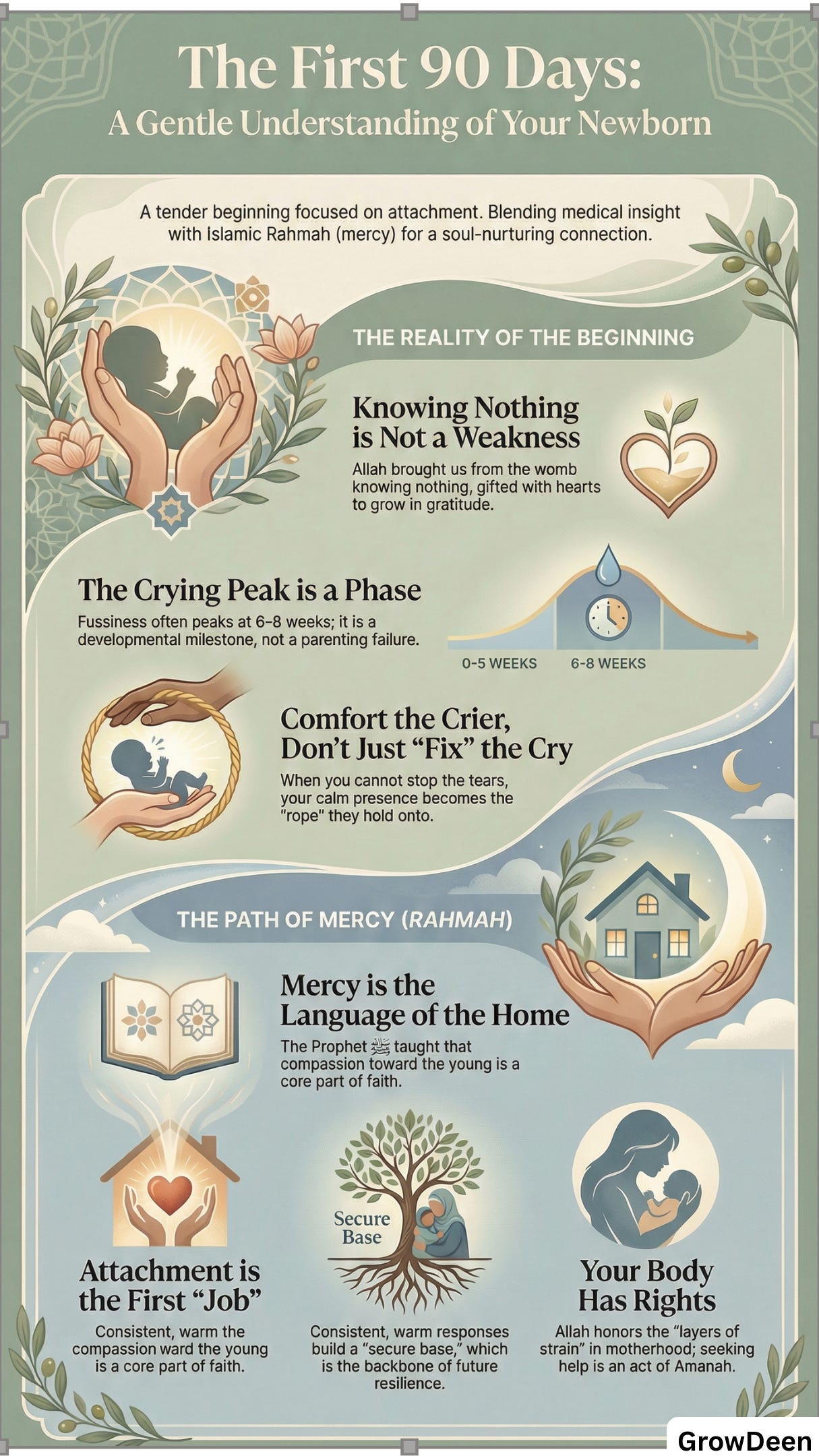
Allah tells us He brought us out of our mothers’ wombs knowing nothing, and then gifted us hearing, sight, and hearts so we can grow and become grateful [1]. Your newborn is living that ayah in real time.
In the first three months, your baby’s world is very small. Safety. Nourishment. Warmth. Your voice. Your scent. A familiar chest to rest on.
Those early responses quietly shape brain development and emotional security [2]. In simple terms, when you keep showing up, your baby learns: the world answers me.
The first “job” is attachment, not independence
Newborn behaviour revolves around three simple aims: staying close to you, expressing needs, and taking in the world through the senses [2]. That is it.
Some babies come soft and sleepy. Others come alert, intense, and quick to startle. Temperament varies, and it is not a sign you are failing. It is your baby’s wiring.
When you respond consistently, you are not creating a “clingy baby.” You are building a secure base. That security becomes the quiet backbone of resilience later on.
Mercy is the language of the early weeks
Bonding begins immediately. You will notice tiny signals: a pause when they hear your voice, a brief look toward your face, the way their body loosens on your chest.
When caregivers offer warm touch and calm presence, the baby’s stress system settles and attachment strengthens [3].
And our deen honours this deeply.
The Prophet Muhammad ﷺ taught that the one who does not show mercy to the young is not from us [4]. That is not a pressure statement. It is a direction of the heart. Be a person of rahmah in your home.
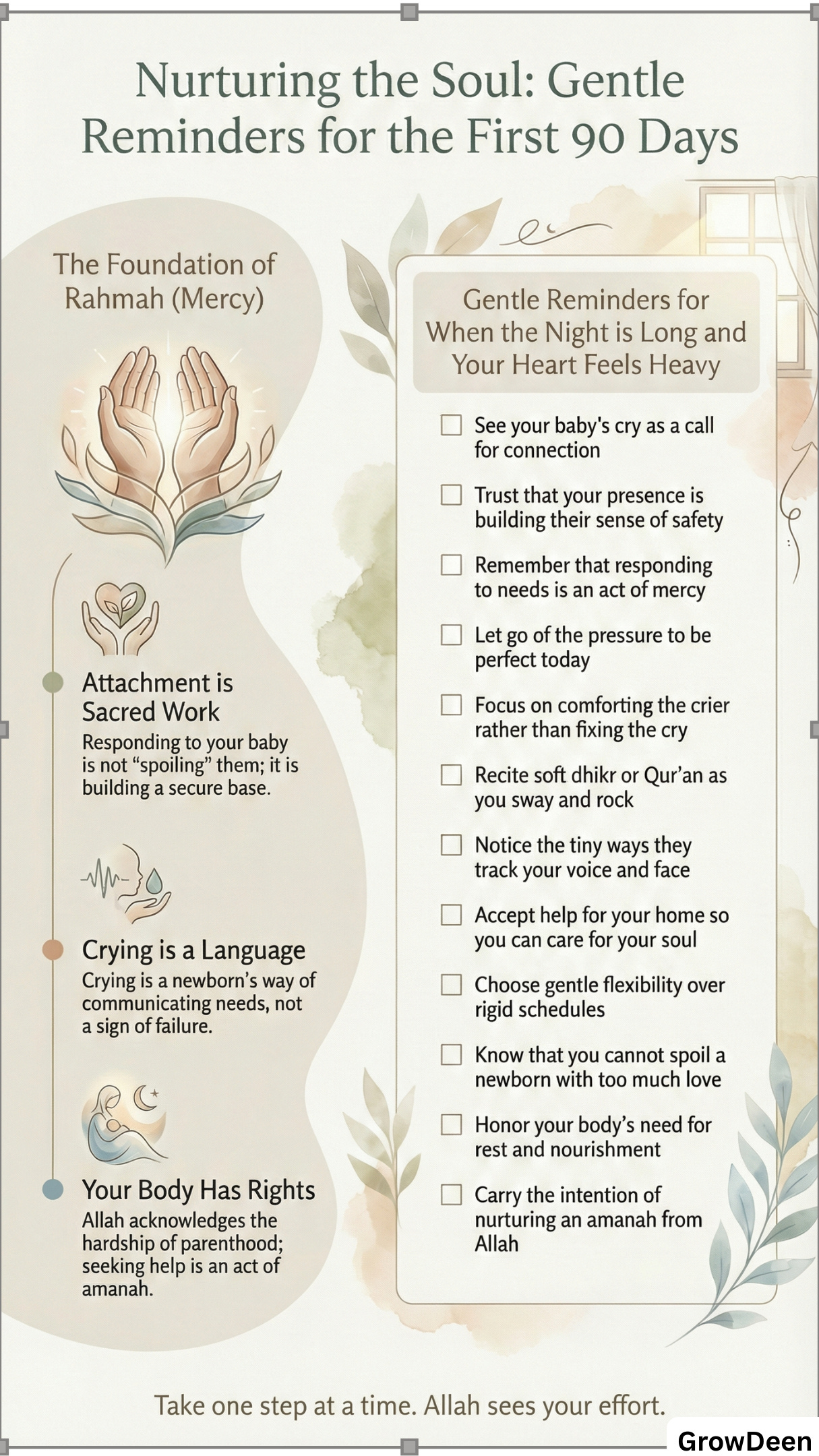
Early responsiveness is not “spoiling.” It is mercy in action.
When the crying peaks, it does not mean you are doing it wrong
Crying is your baby’s main language right now. Hunger. Discomfort. Fatigue. Pain. Wanting closeness. Sometimes even “I have had enough of being a person today.”
Research shows newborns can cry or fuss for hours a day, and fussiness often peaks around six to eight weeks [5]. Late afternoon and evening can feel especially hard.
Sometimes there is ongoing crying with no clear cause, often labelled colic. It is worth checking in with a clinician to rule out medical issues [6].
But here is what I want you to remember in the moment: your job is not always to “fix” the crying. Your job is to comfort the crier.
Hold them. Walk. Rock. Lower the lights. Speak softly. Let your voice be a rope they can grab onto.
Studies show a parent’s voice and touch can reduce distress and support bonding [7].
And if you are whispering Qur’an while you sway, that is not only soothing, it is also a home being filled with remembrance. Keep it gentle. Keep it simple.
Tiny signs of learning are happening right in your arms
Even when your baby seems like they do nothing but eat, cry, and sleep, their brain is moving fast [2].
In these months you may notice:
At around the first month: brief head lifts, turning toward familiar voices.
Around the second month: tracking movement, early social smiles.
By the third month: hands opening and closing, reaching, early joy and curiosity.
The learning is relational. Face to face moments. A calm voice. A simple song. A few words while you change a diaper. This is not “teaching,” it is connection, and connection builds the brain.
Periods of social and sensory deprivation have been associated with harm to early development, which is one reason loving human presence matters so much [8].
Somewhere around here, if you find these reflections helpful, I invite you to subscribe for free. Not because you “should,” but so you have a steady place to return to when the nights are long and you need someone to remind you that you are not alone.
Sleep and feeding are not schedules yet, they are needs
Newborn sleep is often broken into short cycles. Many babies sleep about 14 to 17 hours over a day, waking every two to four hours because their stomachs are tiny [9].
This is why flexibility matters. Cues over rigid routines.
Feeding, too, is more than nutrition. It is safety. It is closeness. It is your baby learning trust, one calm feed at a time.
The Qur’an speaks about nursing and provision, placing care and responsibility where it belongs, with fairness and mercy [10]. This is sacred work, even when it feels repetitive.
You are a caregiver, and you are also a human being
If the crying feels unmanageable, if feeding or sleep feels unusual, if your baby is hard to soothe, or if you feel overwhelmed, reach out. Support is not weakness. It is amanah.
Parents who are carrying too much deserve care too, and maternal wellbeing has real effects on bonding and a child’s social emotional outcomes [11].
Our Prophet ﷺ taught that the body has rights [12]. If your body is breaking down, you are allowed to take care of it. Rest when you can. Ask someone to hold the baby while you shower. Eat something warm. Say out loud, “I need help,” to a trusted person.
Allah also names the hardship of motherhood, the layers of weakness and strain, and He does it with honour [13]. He sees the night wakings. He sees the tears you wipe quickly so no one notices.
You are not only raising a child.
You are nurturing a soul.
And if you want a dua to hold onto in these early days, let this be one you repeat softly:
Our Lord, grant us from our spouses and our children comfort to our eyes, and make us an example for the righteous [14].
In the first three months, your newborn depends on you for safety, nourishment, comfort, and emotional connection. Those early interactions quietly shape the baby’s developing brain, their sense of security, and their ability to trust [2]. From an Islamic perspective, this care is an amanah from Allah, and every act of gentleness becomes deeply meaningful when you do it with sincere intention.
Allah reminds us that He brings a child into the world knowing nothing, then grants hearing, sight, and hearts so that awareness and gratitude can grow over time [1]. Your baby’s behaviour in this season is not random. It is built around attachment, expressing basic needs like hunger and comfort, and discovering the world through the senses. Consistent, loving responses help your baby feel safe and support healthy emotional and cognitive development [2].
Bonding begins immediately after birth. Newborns seek connection through brief eye contact, soft sounds, relaxed posture, and later, small smiles. When you respond with warmth and touch, the baby’s stress responses settle and attachment strengthens [3]. Islam anchors this with mercy. The Prophet ﷺ taught that compassion toward the young is part of who we are as believers [4]. Responding quickly does not spoil a baby. It builds a secure foundation.
Crying is your baby’s main way to communicate hunger, fatigue, discomfort, pain, or the need for closeness. Many newborns cry or fuss for long stretches, and fussiness often peaks around six to eight weeks [5]. If crying is persistent with no clear cause, a medical check is wise to rule out underlying issues [6]. Even when you cannot identify the cause, comforting still matters. Gentle holding, rocking, walking, a soft voice, and calm recitation can help regulate infant stress, and a caregiver’s voice has been shown to reduce distress and strengthen bonding [7]. Allah acknowledges the hardship of nurturing children, especially in early life [13], and every moment of patience carries reward.
Your baby is also learning rapidly. Across these months you may notice head lifting, turning toward voices, tracking movement, social smiles, reaching, and early curiosity [2]. This learning happens through interaction, not instruction, so your face, your voice, and your presence are the “play.”
Newborn sleep is typically 14 to 17 hours across a day in short cycles, with frequent waking due to small stomach capacity [9]. Feeding usually occurs every two to four hours early on, and feeding is also emotional bonding. The Qur’an highlights nourishment and provision as responsibilities handled with fairness and mercy [10]. If you feel overwhelmed, seek support. Parental wellbeing affects bonding, and maternal mental health has meaningful links with child outcomes [11]. Islam encourages balance and self care, reminding us that the body has rights [12]. Rest, accept help, and share the load.
Reflection and Action Gifts
If you’ve reached this part of the page, it tells me something meaningful about you.
You weren’t just skimming words or passing time. You stayed because something here mattered to you.
Because you’re hoping, quietly, that life can feel a little lighter, a little clearer, a little more grounded than it does right now.
That’s why we prepared these Reflection and Action Gifts for you. Not as decorations.
But as tools we intentionally created with care, time, and dua, so what you just read doesn’t stay on the page, but gently finds its way into your daily life. These resources were made slowly and thoughtfully, with parents like you in mind.
You’re welcome to save them, print them, revisit them, or place them somewhere you’ll see often.
You can use them quietly on your own, or share them with your family if that feels right.
Our only hope is that they bring you comfort, clarity, and small moments of steadiness in the middle of real life.
May Allah place barakah in your effort, accept your intention, and make what you’re trying to do easier than it feels right now.
📥Download your Reflection and Action Gifts
This gift pack includes👇:
Gentle Understanding Card
Gentle Reminders Card
Everyday Reflections Card
Dua Card
If these resources support you even in a small way, I’d love to continue walking alongside you. Please subscribe for free, to allow me to be with you helping you at every step inshaAllah.
References
[1] Qur’an 16:78. Quran.com: Surah An Nahl, Ayah 78
[2] Berk, L. E. (2013). Child Development (9th ed.). Pearson. Google Books: Child Development (9th ed.)
[3] Dudek, J., Colasante, T., Zuffianò, A., & Haley, D. W. (2020). Changes in cortical sensitivity to infant facial cues from pregnancy to motherhood predict mother infant bonding. Child Development, 91(1), e198 to e217. PubMed: Article record
[4] Sunan Abi Dawud 4943. Sunnah.com: Hadith 4943
[5] Wolke, D., Bilgin, A., & Samara, M. (2017). Fussing and crying durations and prevalence of colic in infants. The Journal of Pediatrics, 185, 55 to 61. PubMed: Article record
[6] Camilleri, M., Park, S. Y., Scarpato, E., & Staiano, A. (2017). Exploring hypotheses and rationale for causes of infantile colic. Neurogastroenterology & Motility, 29(2), e12943. PubMed Central: Full text
[7] Yu, W. C., et al. (2022). Effects of maternal voice on pain and mother infant bonding in premature infants: A randomized controlled trial. Journal of Pediatric Nursing, 63, e136 to e142. PubMed: Article record
[8] Purpura, G., et al. (2023). Effects of social and sensory deprivation in newborns. Early Human Development, 185, 105853. PubMed: Article record
[9] Raising Children Network (Australia). Newborn sleep: what to expect. Newborn sleep guide
[10] Qur’an 2:233. Quran.com: Surah Al Baqarah, Ayah 233
[11] Rusanen, E., et al. (2024). A longitudinal study of maternal postnatal bonding and psychosocial factors that contribute to social emotional development. Child Psychiatry & Human Development, 55(1), 274 to 286. PubMed: Article record
[12] Sahih al Bukhari 1968. Sunnah.com: Hadith 1968
[13] Qur’an 31:14. Quran.com: Surah Luqman, Ayah 14
[14] Qur’an 25:74. Quran.com: Surah Al Furqan, Ayah 74