
Your Face Is One of Your Baby’s First Homes
Your Baby’s Smile Is A Question And Your Face Is The Answer

Babies often begin true social smiling in the early weeks, and your warm smile back becomes one of the first ways they feel seen, safe, and deeply connected to you.
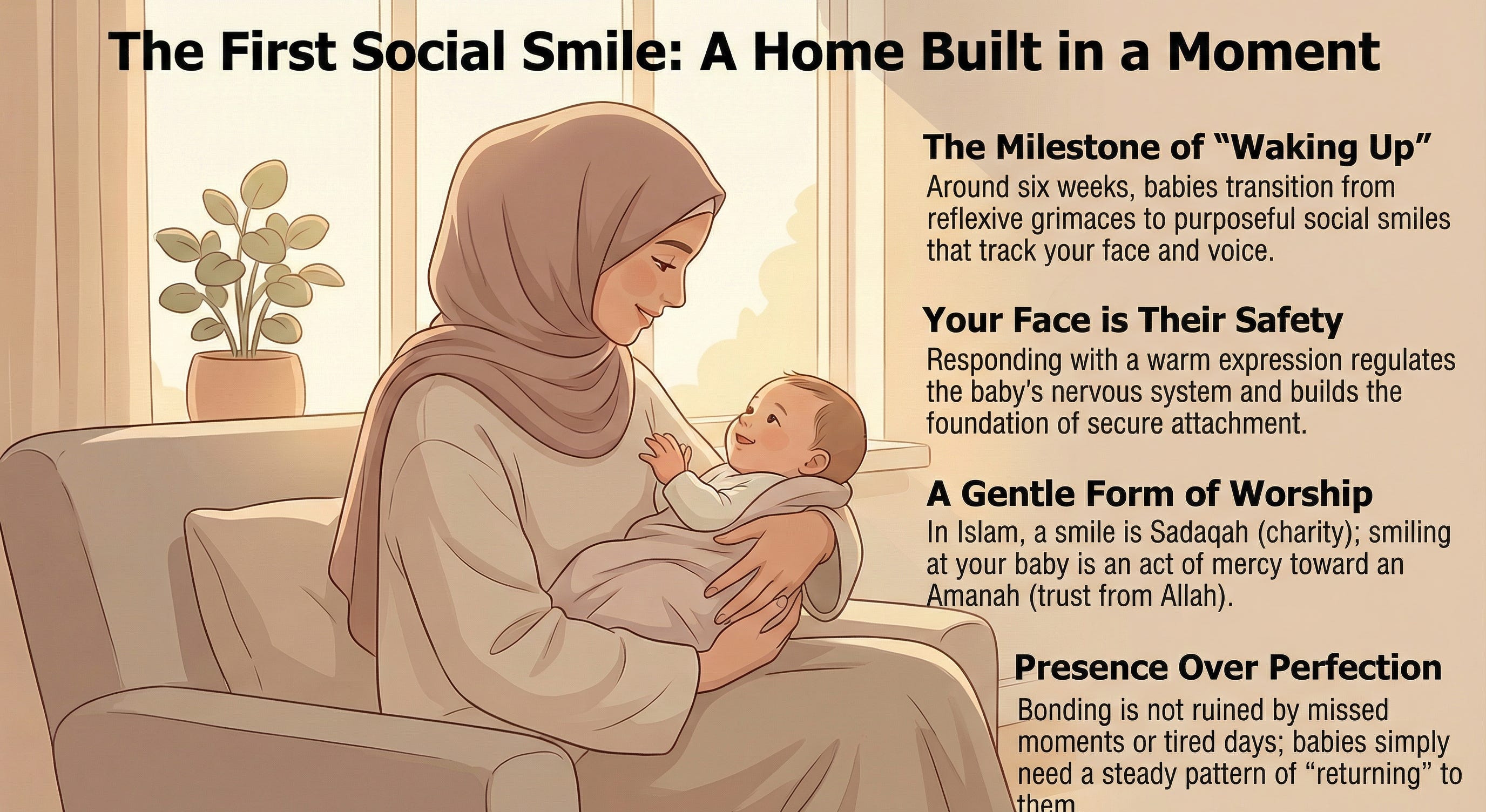
You are holding your baby in that strange early light, the kind that makes time feel blurry.
Your shirt has a milk stain you forgot to change.
Your eyes burn.
Your mind is doing two things at once
trying to stay gentle, and trying to stay awake.
And then your baby’s face shifts.
Not the quick grimace that comes with gas.
Not the half smile that disappears as soon as it appears.
This one stays.
It gathers in the cheeks, softens the eyes, and somehow lands straight on you.
For a second, everything inside you quiets.
You smile back without thinking.
Almost like your body knew what to do before your brain caught up.
That first real smile is not just cute
Many babies begin to show social smiling around six weeks. [5]
It can start suddenly, then vanish again for a few days, then return more often. Over the next weeks, it usually becomes clearer and more purposeful. By two to three months, many babies track your face and seem to enjoy the little back and forth you do together. [5]
By three to four months, you may notice more emotion in that smile. Your baby might light up at a familiar voice, a favourite face, or a comforting routine. [5]
It can feel like your baby is waking up into the relationship.
And in a way, they are.
Your smile back is one of their first safe places
Most parents smile at babies automatically.
But it is not only instinct.
It is communication.
When you smile back, you are telling your baby, without words, I see you. I’m here. You’re safe with me.
Those early exchanges support bonding and the beginnings of secure attachment. [1] Over time, patterns of warm, responsive interaction are also linked to how children come to see themselves and how confidently they move in social spaces later. [2]
This is why your face matters so much.
Your baby is not simply looking at you.
They are learning the world through you.
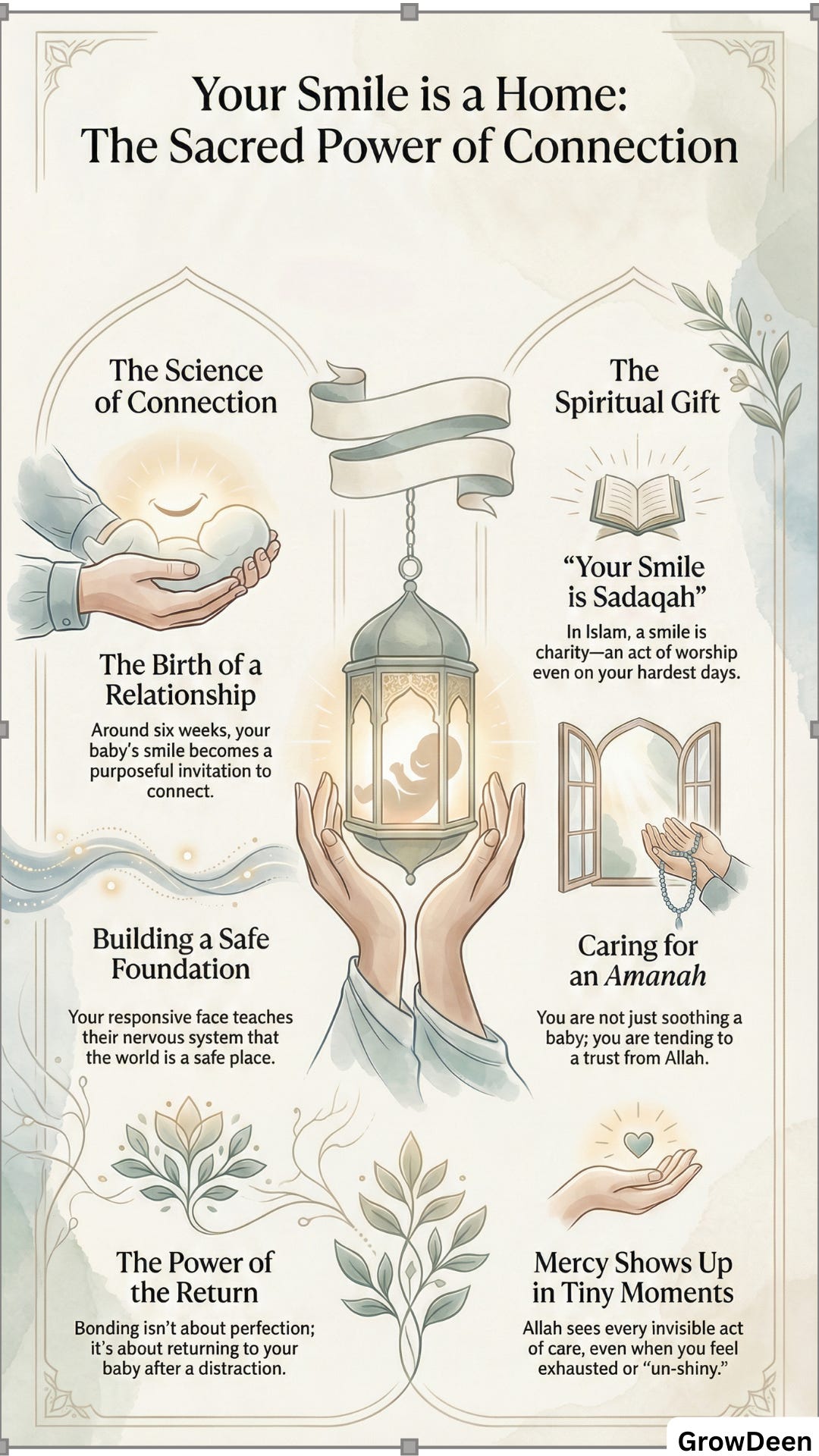
And if you are reading this while feeling numb, tired, or emotionally flat, please do not panic.
Love does not always arrive as fireworks.
Sometimes love arrives as showing up again.
Sometimes it arrives as a small smile even when you do not feel shiny inside.
Allah’s Mercy shows up in tiny moments too
In an Islamic home, these small moments carry weight.
You are not only soothing a baby.
You are caring for an amanah.
The Prophet ﷺ connected mercy with being shown mercy. [8] Parenting can feel like a thousand invisible acts, but none of them are invisible to Allah.
And even the smile itself has value in Islam.
The Prophet ﷺ taught that a smile is charity. [9]
So when you smile at your baby, it is not just parenting.
It can be sadaqah.
A kindness.
A soft offering.
And what a gentle form of worship it is
a tired parent smiling anyway.
The science behind why your baby keeps searching your face
A baby’s earliest conversations are often facial.
Long before they speak, they communicate with expressions. Smiles and frowns are among the first social signals they use. [5]
When you respond warmly, your baby’s body registers that safety. Positive interaction is associated with shifts in stress and calming systems, while longer and repeated stress responses can interfere with learning and wellbeing when they stay elevated. [7]
This is not about making you responsible for every emotion your baby ever has.
It is simply why responsiveness matters.
The nervous system develops in relationship.
Even repair is part of relationship.
You look away.
Your baby fusses.
You come back.
That return is part of what teaches safety.
Modern life can thin out these moments without anyone meaning to. Even short distractions, like checking a phone during feeding, can reduce face to face engagement in the moment, and research has explored how this can affect interaction and responsiveness during breastfeeding. [3]
This is not a reason for guilt.
It is a gentle reminder of what your baby values most.
Your face.
Your voice.
Your presence.
If you find this kind of reminder helpful, you can subscribe for free. It simply means these small, practical pieces of support come to you without you needing to search for them, especially in seasons when you are running on very little sleep.
No smile is wasted, even on your hardest day
Sometimes your baby smiles and you miss it.
You are changing a diaper.
You are wiping spit up.
You are trying to remember if you ate anything.
That does not ruin bonding.
Babies do not need perfect responsiveness.
They need a steady pattern.
And they need a parent who returns.
If you notice your baby watching you and you can offer even a small soft expression, you are giving something bigger than you realise.
You are telling them they are welcome.
That they belong.
That you are glad they exist.
It is one of the earliest ways a baby learns their worth.
And if today is not a smiling day for you, it is still okay.
Hold your baby close.
Let your voice be gentle.
Let your touch be calm.
The smile will come again, inshaAllah.
When you smile back, you are building a future you cannot see yet
It is easy to think these moments do not matter because they are so small.
But small is how babies live.
A baby’s whole world is small
a warm chest, a familiar scent, a voice that returns, a face that softens.
This is the kind of love that becomes a foundation.
Not glamorous.
Not always easy.
But real.
And when your baby smiles at you, they are inviting you into that foundation.
You do not need to earn it.
You just meet it.
Gently.
Again and again.
Gifts For You, Dear Parent
If you’ve reached this part of the page, it tells me something meaningful about you.
You weren’t just skimming or passing time. You stayed because something here felt relevant to your real life.
Because you care.
Because you want to do things with more awareness.
Because you’re trying, even when it feels overwhelming.
That is not small.
So I didn’t want this article to remain just words on a page. I wanted it to gently step into your daily life in practical ways. That’s why we prepared these Life Gifts for you.
Not as extras.
Not as decorations.
But as simple tools to help you hold onto what mattered most in what you just read.
Here’s what you’ll find inside:
Gentle Understanding Card
A clear and simplified summary of the core concept from this article, so you can revisit the main idea anytime without rereading everything.
Heartfelt Dua Card
A carefully chosen dua connected to this stage of life, because we know that real strength and ease ultimately come from Allah’s help.
Gentle Actions Card
Practical examples to help you translate knowledge into action, so what you learned becomes part of your daily rhythm.
Gentle Reminders Card
Short, steady reminders drawn from the key points, designed to be printed or saved and placed somewhere you’ll see often.
These were designed slowly and thoughtfully, with time, care, and sincere dua. We created them because we genuinely want to walk alongside you, not just through one article, but through every stage of this lifelong journey.
If these gifts support you even in a small way, I would love for you to continue receiving them.
Subscribe so that each new Gift arrives directly in your inbox whenever we release the next stage. That way, you won’t miss the tools designed to support you right where you are.
May Allah place barakah in your effort, accept your intention, and make this path easier and more rewarding than it feels right now.
Please share it with a family/friend who may benefit from this knowledge.
In the comments, what is one moment recently where your baby looked for your face, and what did you notice in yourself when you met them?
References
[1] Ahn, Y.A., Martin, K., Prince, E.B., Chow, S., Cohn, J.F., Wang, J., Simpson, E.A., and Messinger, D.S. (2024). How still? Parent infant interaction during the still face and later infant attachment. Infant and Child Development, 33(4).
[2] Ata, S., and Yağan Güder, S. (2020). Parents’ attachment to their children and their level of interest in them in predicting children’s self concepts. Early Child Development and Care, 190(2), 161–174.
[3] Inoue, C., Hashimoto, Y., Nakatani, Y., and Ohira, M. (2022). Smartphone use during breastfeeding and its impact on mother infant interaction and maternal responsiveness: Within subject design. Nursing and Health Sciences, 24(1), 224–235.
[4] Kammermeier, M., and Paulus, M. (2023). Infants’ responses to masked and unmasked smiling faces: A longitudinal investigation of social interaction during Covid 19. Infant Behavior and Development, 73, 101873.
[5] Kärtner, J., Schwick, M., Wefers, H., and Nomikou, I. (2022). Interactional preludes to infants’ affective climax: Mother infant interaction around infant smiling in two cultures. Infant Behavior and Development, 67, 101715.
[6] Pezzotti, E., Provenzi, L., Naboni, C., Capelli, E., Ghirardello, S., Borgatti, R., and Orcesi, S. (2024). Masked or not, I smile to you: Exploring full term and preterm infants’ social smiles to adults wearing a protective facemask. Infant Behavior and Development, 75, 101947.
[7] Snow, L. (2021). Facemasks during COVID 19 and the importance of smiles in developmental assessment. Archives of Disease in Childhood, 107(3), e8.