
Your Child’s Play Might Be Opening More Than You Think
For the Parent Wondering How to Teach Without Pressing Too Hard

Free gift for you! A practical companion resource is waiting for you near the end of this article to help you remember, apply, and benefit from what you read. Don’t forget to download!
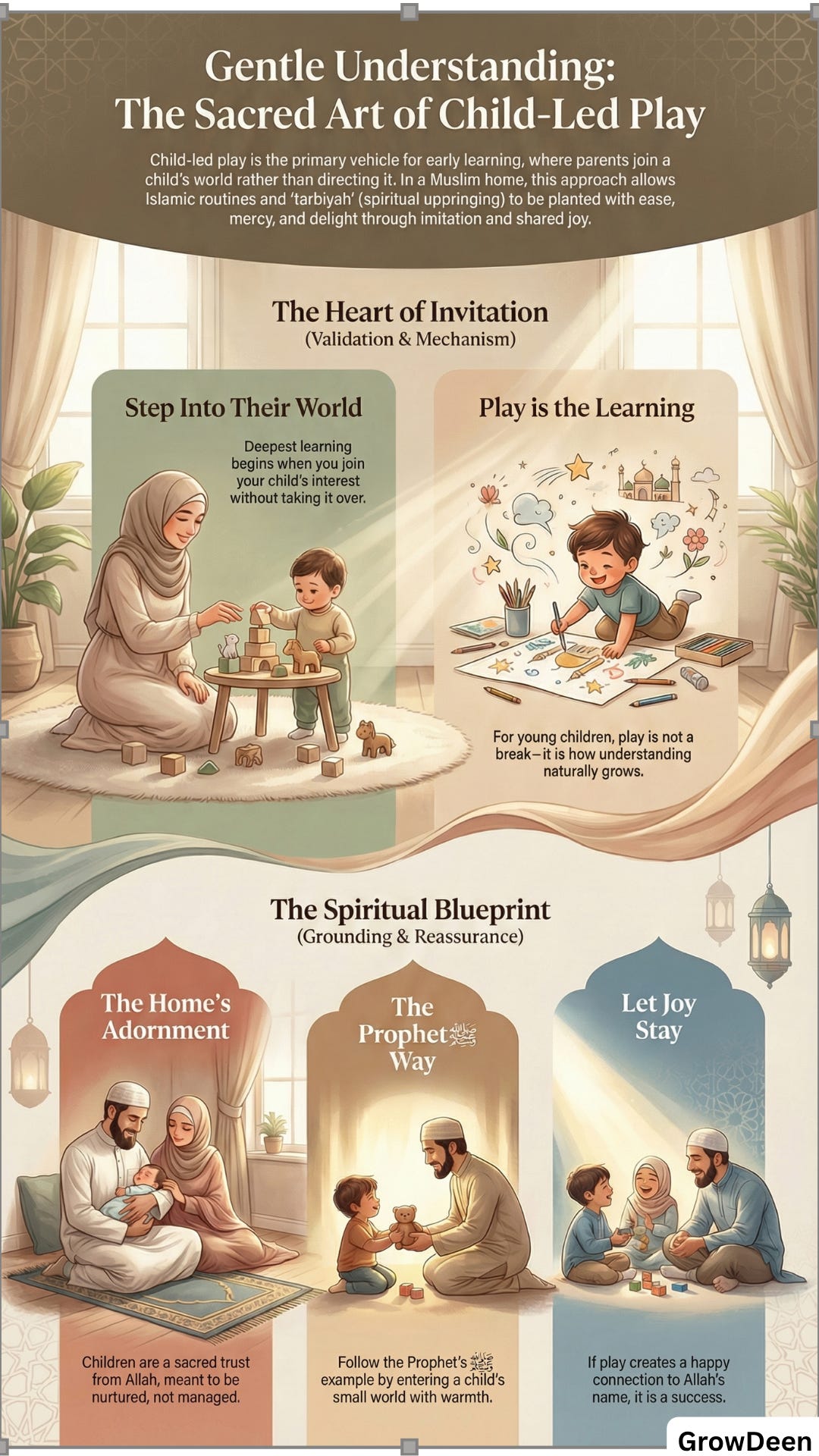
Child led play helps young children learn through the things they already love, and in a Muslim home that natural play can gently carry Islamic words, routines, stories, and worship into everyday life.
Your child is busy with something very serious.
A cushion has become a mountain. A spoon is now a microphone. A few blocks are somehow a masjid, and no one is allowed to touch the front wall because that part is apparently important.
You were not planning a lesson. You were just nearby. But then your child looks at you with that full hearted invitation children have, the kind that says, come into my world for a minute.
And that is often where the deepest learning begins.
Play is not what happens after learning
For young children, play is not a break from learning. It is one of the main ways learning happens. When a child is interested, emotionally connected, and free to explore with a responsive adult nearby, attention settles and understanding grows more naturally. The American Academy of Pediatrics describes play as essential to healthy development, and WHO’s nurturing care framework places responsive caregiving and early learning right near the centre of healthy early childhood growth.
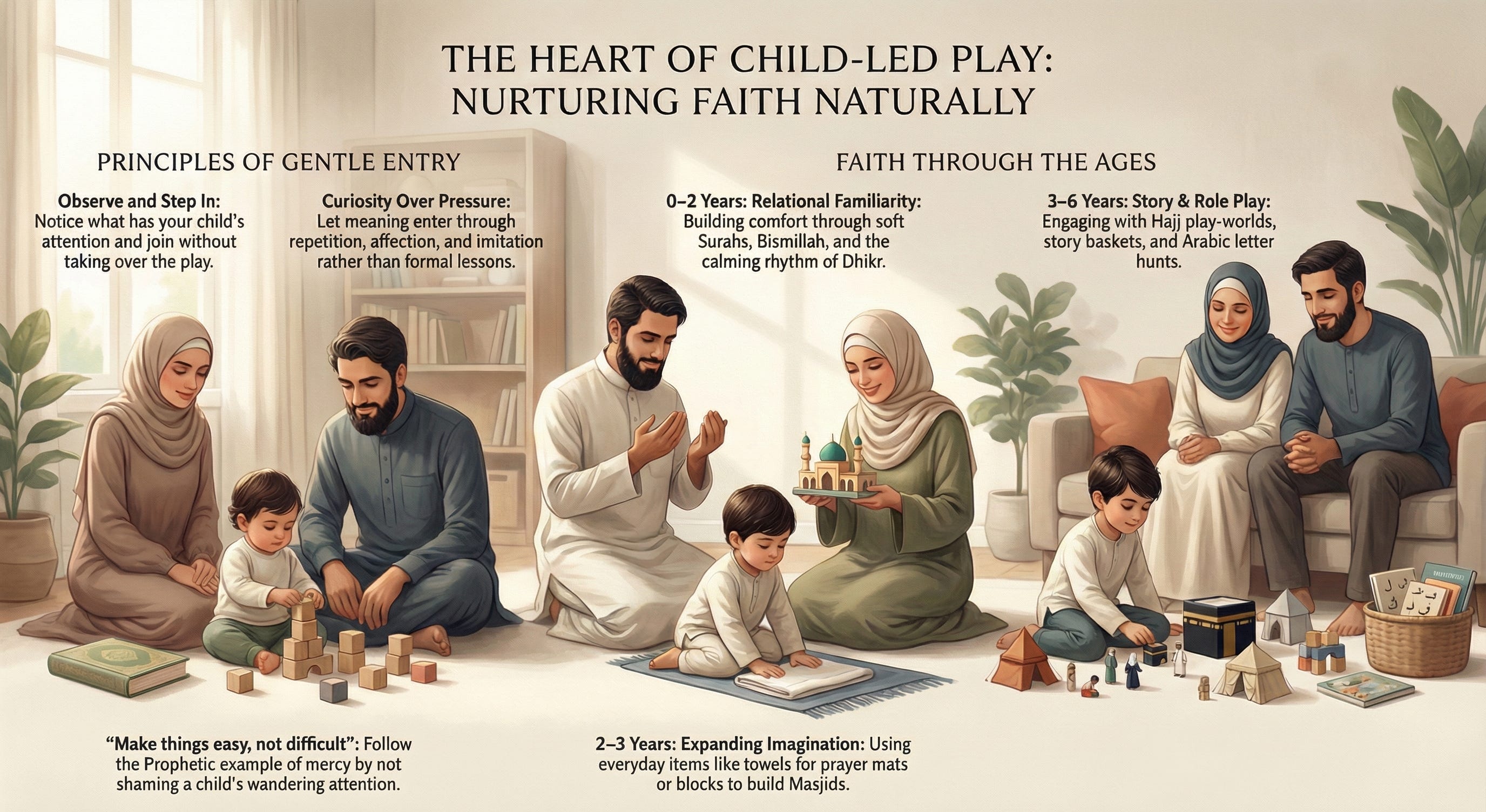
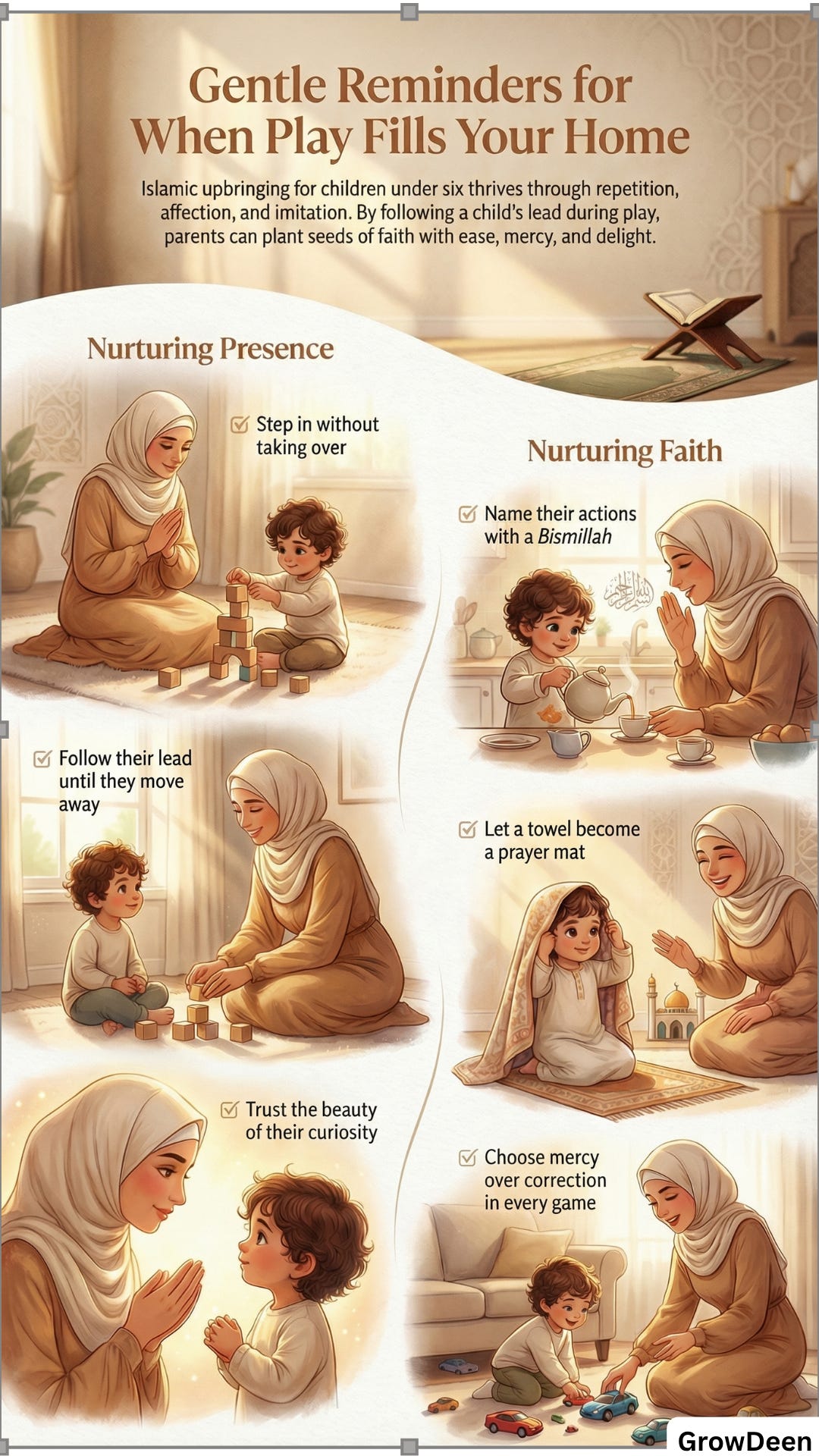
That is what makes child led play so valuable. It means you notice what already has your child’s attention, and you step into that moment without taking it over. You might name what they are doing. Add one gentle idea. Ask one warm question. Or simply follow their lead long enough for the moment to open. ZERO TO THREE’s parent guidance says to follow your child’s lead, go slowly, and read their signals, which is very close to what many parents already feel in their bones when they stop rushing.
The adornment Allah placed in your home
In a Muslim home, this matters even more than people sometimes realise.
Islamic upbringing does not need to begin as formal instruction, especially under six. For little children, meaning often enters through repetition, affection, imitation, sound, routine, and shared delight. That is why child led play can serve tarbiyah so beautifully. It lets Islamic meaning enter through curiosity instead of pressure. This framing comes directly from your source text, and I’ve kept it central here.
Allah says, “Wealth and children are the adornment of worldly life.” [13] A child is not only another task to manage. A child is a trust, a beauty, a living part of the home Allah placed in your care. When you see play through that lens, it stops looking like wasted time. It starts to look like nurturing.
You are not stepping back, you are stepping in differently
Sometimes parents hear “child led” and think it means standing back and letting children do whatever they want.
It does not.
It means watching more carefully. Joining more gently. Controlling less. A responsive adult is still there, still shaping the environment, still protecting, still guiding. But the adult is not flattening the moment with too much direction too early. That kind of responsive play supports communication, imagination, confidence, social attention, and problem solving. It also helps children feel that their actions matter in the world, which is part of how learning becomes personal.
The Prophet ﷺ had this kind of attentiveness with children. In the hadith of Abu ‘Umayr, he entered a child’s small world with warmth and playfulness, asking about the little bird that mattered to him. It is such a small moment, but it teaches something large. Children should not be treated as interruptions. Their world deserves gentle entry. [17]
What this can look like from babyhood to age six
For babies, child led play is mostly relational. Your face. Your tone. Your pauses. Your calm repetition. A baby is not ready for structured Islamic teaching, but they are ready for familiarity. A warm salaam. A soft Bismillah before feeding. A short surah recited gently. A soothing rhythm of SubhanAllah or Alhamdulillah while being held. The point is not memorisation. It is comfort, attachment, and a home where the remembrance of Allah is part of the air. This also aligns with ZERO TO THREE’s guidance that for babies, play is built through back and forth interaction more than toys.
From around one to two, many toddlers learn through movement, repetition, and imitation. They carry, stack, open, close, bang, pour, and copy. This is a lovely age for very simple Islamic play. A few board books. Moon and star shapes. Soft Arabic letter cards. Rolling a ball while saying simple words like Allah, masjid, moon, book. Water play that becomes mini wudu play without pressure. If the child moves away, the play is over. That is not failure. That is the point.
From about two to three, pretend play starts opening. Cushions become mountains. A towel becomes a prayer mat. A toy basin becomes wudu. A stuffed animal can be tucked in after a bedtime dua. A block corner can become a masjid. ZERO TO THREE notes that from 24 to 36 months, imagination expands quickly through play, routines, and relationships, which is exactly why gentle faith themes can begin to sit more naturally inside it.
If you enjoy gentle, Islamically grounded parenting reflections like this, subscribe for free so the next article reaches you quietly, right when a real life moment makes it useful.
From about three to six, role play and story play become richer. A child might enjoy a little Hajj play world, a masjid corner, an Arabic letter hunt, simple manners games, mosque building with blocks, or story baskets around themes from the prophets. At this age, some families also use Islamic toys and sound books already available in the market. These can be genuinely helpful, but only when they stay in their proper place. The AAP warns that even educational toys should not replace open ended play and real human interaction. The healthiest use of an Islamic toy is usually as a doorway into shared play, not as a parent substitute.
Wisdom feels different with little children
Allah says, “Invite to the way of your Lord with wisdom and good instruction.” [15] And He says, “Command your family to pray and remain steadfast in it.” [14] For little children, wisdom usually looks gentle, concrete, and well timed. Not too much. Not too early. Not every play moment needs a lesson attached to it. Sometimes wisdom means joining the child and letting one Islamic word or image sit softly inside the moment.
The Prophet ﷺ also said, “Whoever does not show mercy will not be shown mercy.” [18] Mercy in play means not shaming wandering attention. Not turning every game into correction. Not expecting a child to hold an adult kind of focus. It means leaving room for delight. And the hadith, “Make things easy and do not make them difficult,” [19] can save a parent from a lot of unnecessary strain here.
Let joy stay in the room
There is something else worth protecting here.
Joy.
If an activity helps your child feel love, familiarity, and happy connection to Islamic words, routines, stories, or worship, it is probably on a good path. If it becomes rigid, noisy, screen heavy, or parent replacing, it may be moving away from the heart of both healthy play and healthy tarbiyah. For children with diverse abilities, this child led principle becomes even more valuable, because some children lead through movement, some through gaze, some through repetition, some through quiet return to the same object again and again. The adult still starts the same way. Notice what the child is already reaching toward, and build from there. That reflects both the developmental guidance in your source and the AAP’s emphasis on toys and play that support real parent child interaction, including for children with special needs.
In the end, letting your child lead does not mean leaving Islam out. It means entering your child’s world carefully enough that Islamic meaning can be planted there with ease, mercy, and delight. That is slower. Softer. And often much deeper.
GIFTS FOR YOU, DEAR PARENT
If you’ve reached this part of the page, it tells me something meaningful about you.
You weren’t just skimming or passing time. You stayed because something here felt relevant to your real life.
Because you care.
Because you want to do things with more awareness.
Because you’re trying, even when it feels overwhelming.
That is not small.
So I didn’t want this article to remain just words on a page. I wanted it to gently step into your daily life in practical ways. That’s why we prepared these Life Gifts for you.
Not as extras.
Not as decorations.
But as simple tools to help you hold onto what mattered most in what you just read.
Here’s what you’ll find inside:
Gentle Understanding Card
A clear and simplified summary of the core concept from this article, so you can revisit the main idea anytime without rereading everything.
Heartfelt Dua Card
A carefully chosen dua connected to this stage of life, because we know that real strength and ease ultimately come from Allah’s help.
Gentle Actions Card
Practical examples to help you translate knowledge into action, so what you learned becomes part of your daily rhythm.
Gentle Reminders Card
Short, steady reminders drawn from the key points, designed to be printed or saved and placed somewhere you’ll see often.
These were designed slowly and thoughtfully, with time, care, and sincere dua. We created them because we genuinely want to walk alongside you, not just through one article, but through every stage of this lifelong journey.
If these gifts support you even in a small way, I would love for you to continue receiving them.
Subscribe so that each new Gift arrives directly in your inbox whenever we release the next stage. That way, you won’t miss the tools designed to support you right where you are.
May Allah place barakah in your effort, accept your intention, and make this path easier and more rewarding than it feels right now.
Please share it with a family or friend who may benefit from this knowledge.
What is one moment with your child that feels hardest lately, and what kind of support would make it feel lighter?
Subscribe for free if you want more gentle, practical, Islamically grounded support for the real moments of parenting.
References
[1] American Academy of Pediatrics. The Power of Play: How Fun and Games Help Children Thrive.
[2] World Health Organization. Nurturing care for early childhood development.
[3] ZERO TO THREE. Tips on Playing with Babies and Toddlers.
[4] ZERO TO THREE. Stages of Play from 24–36 Months: The World of Imagination.
[5] American Academy of Pediatrics. Toy Buying Tips for Babies & Young Children: AAP Report Explained.
[6] American Academy of Pediatrics. Pretend Play: Ways Children Can Exercise Their Imagination.
[7] Yaqeen Institute. When He Would Play With Your Kids.
[8] Suhartini, W. Islamic-Based Play Learning for Early Childhood Cognitive Development: A Conceptual Literature Review.
[9] Salaam Mummy. How To Teach The Arabic Letters: 11 Fun Ways.
[10] My Salah Mat. Official Website.
[11] Joy and Jannah. Wooden Kaaba and Peg Doll Set – Hajj Toy for Muslim Kids.
[12] Darussalam Canada. Sound Books.
[13] The Qur’an, Surah Al-Kahf 18:46
[14] The Qur’an, Surah Ta Ha 20:132
[15] The Qur’an, Surah An-Nahl 16:125
[16] Sahih al-Bukhari 6130, dolls and child play
[17] Sahih al-Bukhari 6129, Abu ‘Umayr and the little bird
[18] Sahih Muslim 2318a, mercy toward children
[19] Sahih al-Bukhari 6125, make things easy and do not make them difficult