
Your Child Is Learning the World From the Way You Respond
A Child Grows in the Space Between Your Words and Your Tone

In the early years, your child’s ability to learn, relate, cope, and communicate is shaped most by warm responsiveness and shared play, and even small moments of gentleness and repair become lasting building blocks.
You’re on the floor again.
The same puzzle pieces. The same toy car. The same little hand grabbing your sleeve like it’s an emergency.
You try to be patient. You really do.
But your mind is loud today.
Am I doing enough.
Am I doing it right.
Is this helping them grow, or are we just passing time.
And then your child looks up at you with that face that says, Stay with me.
Not teach me.
Stay.
The part nobody told you about development
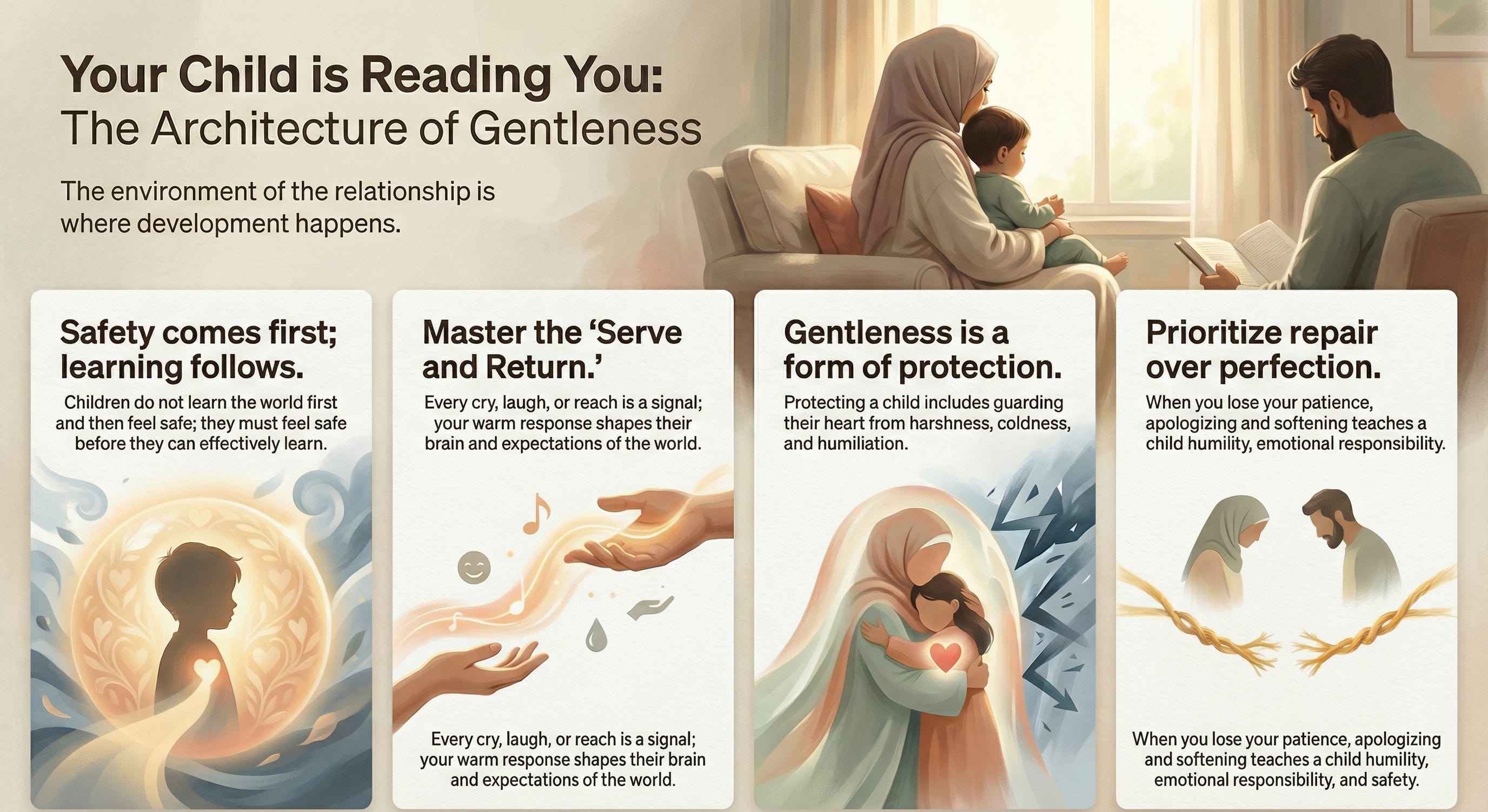
In the early years, children do not learn the world first and then feel safe in it.
Usually it happens the other way around.
Safety comes first, and learning rides on top of it.
So when researchers keep repeating that relationships are not background noise but the environment where development happens, they are naming what you already feel in your bones. Your child’s growth is not only inside their brain. It is inside the back and forth between you. [1] [7] [12]
If that feels like pressure, breathe.
It can also feel like relief.
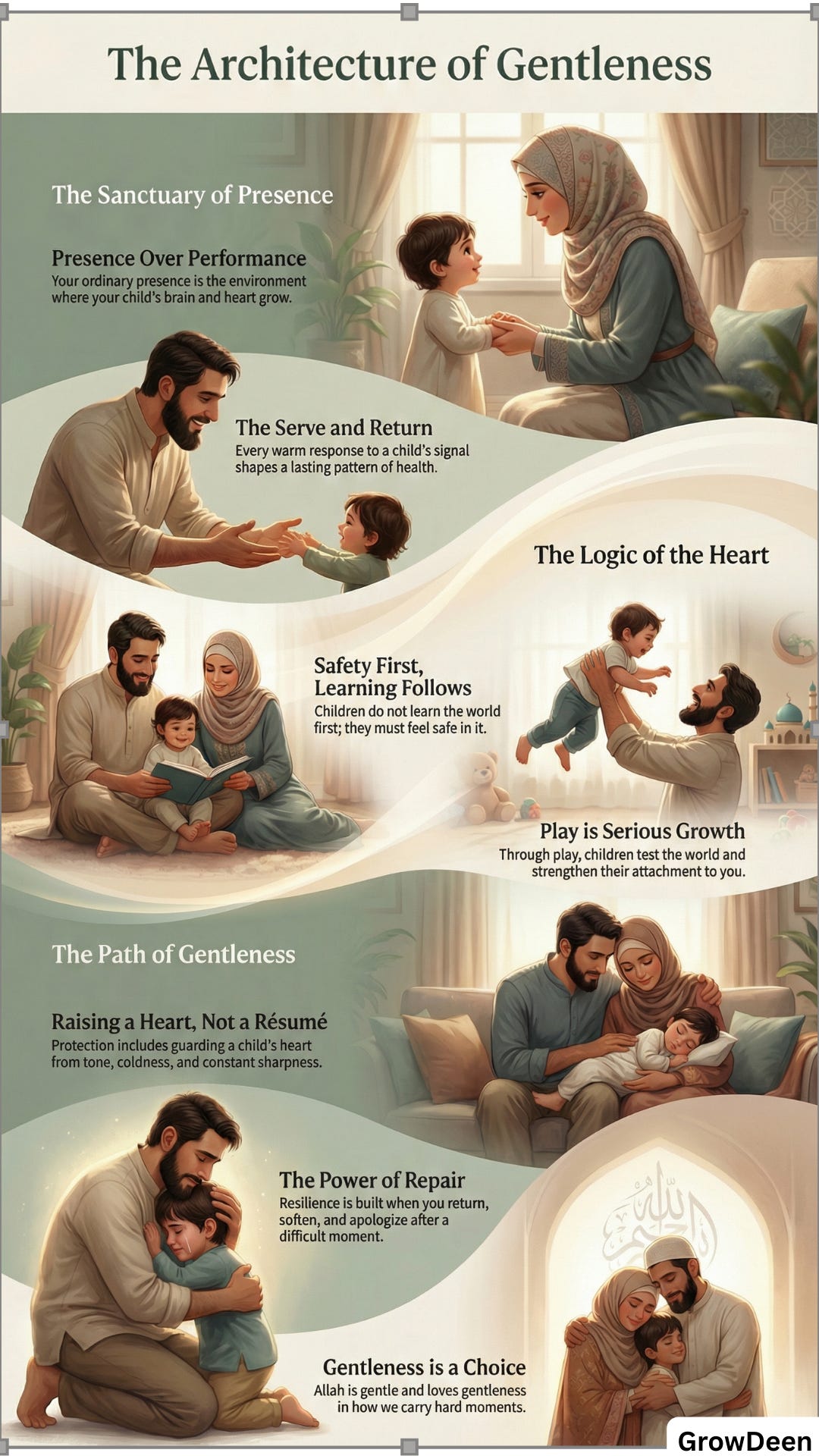
Because it means your ordinary presence matters.
A child “sends” something out and waits for what returns
Your toddler is always sending signals.
A cry. A laugh. A reach. A refusal. A question asked twenty times.
Then they watch what comes back.
Your face. Your tone. Your hands. Your patience. Your irritation. Your repair.
Those returns slowly teach them what relationships are like, what communication does, and what they should expect from the world. [3] [7]
And when you respond warmly, you are not only soothing a moment. You are shaping a pattern.
Relational health research keeps pointing to this same gentle truth. Warm responsiveness supports a child across many areas at once, emotions, behaviour, language, and connection. [3] [7]
Over time, a child who feels steadier with you often becomes freer to explore, and exploration is where so much learning happens. [7] [11]
The protection Allah asks for includes the heart
As Muslim parents, we talk about amanah a lot. But it helps to say it plainly.
You are not raising a résumé.
You are raising a heart.
Allah tells us to protect ourselves and our families. [13] That protection is not only about what enters the house through screens or doors. It is also about what enters through tone, humiliation, coldness, constant sharpness.
This does not mean you never get frustrated.
It means you come back.
You soften.
You repair.
That is part of protection too.
Allah’s gentleness is something you can bring into the room
The Prophet ﷺ taught that Allah is gentle and loves gentleness. [14]
Gentleness is not pretending everything is fine.
Gentleness is how you carry the hard moments.
It is saying, No, without crushing.
It is correcting without shaming.
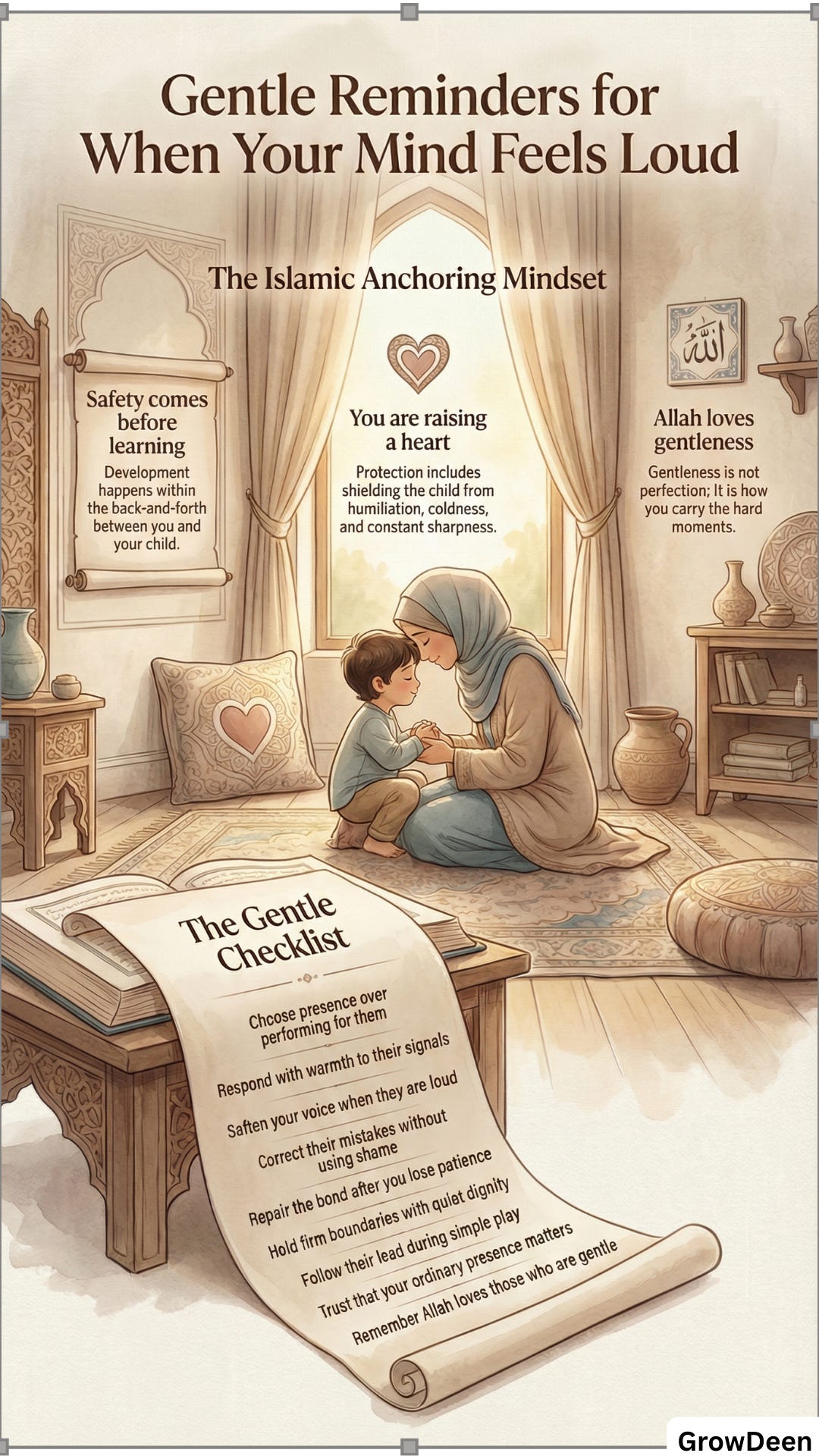
It is slowing your voice when your child’s emotions are loud.
Here is a tiny self talk shift that can change a whole afternoon.
Instead of: They are trying to make my life hard.
Try: They are having a hard time, and I am the safe place.
You can still hold boundaries. You just hold them with dignity.
A simple script that often helps in toddler years is this:
I will not let you hit. I am here. You are allowed to be upset.
Then you breathe. And you mean it.
Not as a performance. As a choice.
Play is not extra, it is where the bond becomes strong
Play looks like fun because it is fun.
But in the early years, play is also how children test the world, practise skills, and try out emotions without being lectured. Pediatric and development work has treated play as a serious driver of healthy development for a long time. [11] [7]
Pretend play is especially powerful. It gives children a low pressure space to explore roles, feelings, and ideas. [10]
And when you follow your child’s lead in play, you are giving a message that lands deep.
I see you. I enjoy you. I am with you.
That is not small.
It is one of the ways attachment becomes sturdier, and sturdier attachment supports resilience later. [6] [7]
Language grows here too. All those little back and forth moments during play, the naming, the responding, the shared attention, they shape early language within the whole ecology of the child’s day. [2]
If your child has developmental differences, play and engagement still matter. And measuring “good engagement” is not always as simple as counting how many times they do something. Recent work on early intervention for autistic children highlights this need for care and nuance. [9]
What your child learns from how you treat other people
Your child is watching you even when you think they are not.
How you speak to your spouse.
How you handle a family disagreement.
How you treat a neighbour.
Those moments become your child’s early script for relationships. [7]
You do not have to be perfect.
But when you make a mistake, let your child see repair.
I raised my voice. That was not right. I am sorry. I will try again.
That one sentence teaches humility, safety, and emotional responsibility.
It also quietly fits with the Islamic idea of excellence. Allah has prescribed excellence in all things. [15] In the home, excellence often looks like character, not performance.
If you want more gentle support like this, you can subscribe for free. Not because you “should,” but because it helps to have a calm place to return to when parenting feels noisy. One reminder at the right time can change the whole day.
Fathers matter, and so does shared tenderness
Some families carry parenting mostly on one set of shoulders, and it gets heavy fast.
Fathers matter here too. Research and practice guidance has highlighted how father involvement, including play, can support children’s wellbeing and mental health. [8] [12]
This is not to shame anyone. It is to widen the circle of support.
Even one small habit can help.
A ten minute “dad and child” play routine after work.
A nightly story.
A weekend walk where the phone stays in the pocket.
Tiny does not mean trivial.
When you feel like you are failing, remember what resilience is built from
Some days your child melts down, and you feel like all your efforts disappear.
But resilience is not built in a life with no struggle.
It is built through supportive relationships and active skill building, again and again, especially when things are hard. [6]
Even large scale research with children who experienced early deprivation has underlined how much consistent caregiver interaction shapes outcomes. [5]
So if today was messy, it does not erase the love you have been giving for months.
Come back to what you can do now.
A calmer voice.
A cuddle.
A glass of water.
A restart.
And when you need a spiritual handhold, remember this.
Mercy toward children is part of faith. The Prophet ﷺ showed compassion openly, and he made it clear that a heart without mercy is missing something precious. [16]
And the deeds you do inside your home count with Allah, because actions are judged by intentions. [17]
You are not unseen.
Allah does not burden a soul beyond its capacity. [18]
And whoever relies upon Allah, He is sufficient for them. [19]
A short du’a for your heart.
O Allah, make our homes places of sakinah, and make our children coolness to our eyes. [19]
GIFTS FOR YOU, DEAR PARENT
If you’ve reached this part of the page, it tells me something meaningful about you.
You weren’t just skimming or passing time. You stayed because something here felt relevant to your real life.
Because you care.
Because you want to do things with more awareness.
Because you’re trying, even when it feels overwhelming.
That is not small.
So I didn’t want this article to remain just words on a page. I wanted it to gently step into your daily life in practical ways. That’s why we prepared these Life Gifts for you.
Not as extras.
Not as decorations.
But as simple tools to help you hold onto what mattered most in what you just read.
Here’s what you’ll find inside:
Gentle Understanding Card
A clear and simplified summary of the core concept from this article, so you can revisit the main idea anytime without rereading everything.
Heartfelt Dua Card
A carefully chosen dua connected to this stage of life, because we know that real strength and ease ultimately come from Allah’s help.
Gentle Actions Card
Practical examples to help you translate knowledge into action, so what you learned becomes part of your daily rhythm.
Gentle Reminders Card
Short, steady reminders drawn from the key points, designed to be printed or saved and placed somewhere you’ll see often.
These were designed slowly and thoughtfully, with time, care, and sincere dua. We created them because we genuinely want to walk alongside you, not just through one article, but through every stage of this lifelong journey.
If these gifts support you even in a small way, I would love for you to continue receiving them.
Subscribe so that each new Gift arrives directly in your inbox whenever we release the next stage. That way, you won’t miss the tools designed to support you right where you are.
May Allah place barakah in your effort, accept your intention, and make this path easier and more rewarding than it feels right now.
Please share it with a family/friend who may benefit from this knowledge.
Comment question
What is one small moment of connection with your child that you want to repeat this week?
References
[1] Center on the Developing Child at Harvard University. Three principles to improve outcomes for children and families, 2021 update. https://developingchild.harvard.edu/resources/report/three-principles-to-improve-outcomes-for-children-and-families/
[2] Ford, A. L. B., Elmquist, M., Merbler, A. M., Kriese, A., Will, K. K., and McConnell, S. R. (2020). Toward an ecobehavioral model of early language development. Early Childhood Research Quarterly, 50(Part 1), 246 to 258. https://doi.org/10.1016/j.ecresq.2018.11.004
[3] Frosch, C. A., Schoppe Sullivan, S. J., and O’Banion, D. D. (2019). Parenting and child development: A relational health perspective. American Journal of Lifestyle Medicine, 15(1), 45 to 59. https://doi.org/10.1177/1559827619849028
[4] Julian, M. M., Lawler, J. M., and Rosenblum, K. L. (2017). Caregiver child relationships in early childhood: Interventions to promote well being and reduce risk for psychopathology. Current Behavioral Neuroscience Reports, 4, 87 to 98. https://doi.org/10.1007/s40473-017-0110-0
[5] McCall, R. B., Groark, C. J., Hawk, B. N., Julian, M. M., Merz, E. C., Rosas, J. M., Muhamedrahimov, R. J., Palmov, O. I., and Nikiforova, N. V. (2019). Early caregiver child interaction and children’s development: Lessons from the St. Petersburg USA orphanage intervention research project. Clinical Child and Family Psychology Review, 22, 208 to 224. https://doi.org/10.1007/s10567-018-0270-9
[6] National Scientific Council on the Developing Child. (2015). Supportive relationships and active skill building strengthen the foundations of resilience: Working Paper No. 13. Center on the Developing Child at Harvard University. https://developingchild.harvard.edu/resources/supportive-relationships-and-active-skill-building-strengthen-the-foundations-of-resilience/
[7] National Scientific Council on the Developing Child. (2004, updated 2009). Young children develop in an environment of relationships: Working Paper No. 1. Center on the Developing Child at Harvard University. http://developingchild.harvard.edu/resources/wp1/
[8] Parenting Research Centre. (2009). Fathers matter. https://ds.org.au/wp-content/uploads/2019/03/fathersmatter2009.pdf
[9] Raulston, T. J., Ousley, C. L., Hinton, E. M., and Ramirez, A. M. (2024). Beyond trial counts: Considerations for measuring play and engagement during early intervention for autistic children. Behavior Analysis in Practice, 17(4), 1216 to 1227. https://doi.org/10.1007/s40617-024-01002-3
[10] Skolnick Weisburg, D. (2015). Pretend play. WIREs Cognitive Science, 6(3), 249 to 261. https://doi.org/10.1002/wcs.1341
[11] Shonkoff, J. P., and Phillips, D. A. (2000). From neurons to neighbourhoods: The science of early childhood development. National Academies Press. https://nap.nationalacademies.org/catalog/9824/from-neurons-to-neighborhoods-the-science-of-early-childhood-development
[12] Willoughby, M., Truong, M., Strawa, C., and Mancini, V. (2024). How fathers can positively influence children’s mental health through play. Australian Institute of Family Studies. https://aifs.gov.au/resources/practice-guides/how-fathers-can-positively-influence-childrens-mental-health-through-play
[13] Qur’an, Surah At Tahrim 66:6. https://quran.com/66/6
[14] Sahih Muslim 2593. Allah is gentle and loves gentleness. https://sunnah.com/muslim:2593
[15] Sahih Muslim 1955. Allah has prescribed excellence in all things. https://sunnah.com/muslim:1955
[16] Sahih al Bukhari 5997 and Sahih Muslim 2318. Mercy to children. https://sunnah.com/bukhari:5997 and https://sunnah.com/muslim:2318
[17] Sahih al Bukhari 1 and Sahih Muslim 1907. Actions are judged by intentions. https://sunnah.com/bukhari:1 and https://sunnah.com/muslim:1907a
[18] Qur’an, Surah Al Baqarah 2:286. https://quran.com/2/286
[19] Qur’an, Surah At Talaq 65:3. https://quran.com/65/3