
Your Child Does Not Need More Rules, They Need More You
The Quiet Way Children Learn They Matter

Warm, interested attention in everyday moments helps your child feel seen, safe, and valued, so connection becomes more common than correction and security has room to grow.
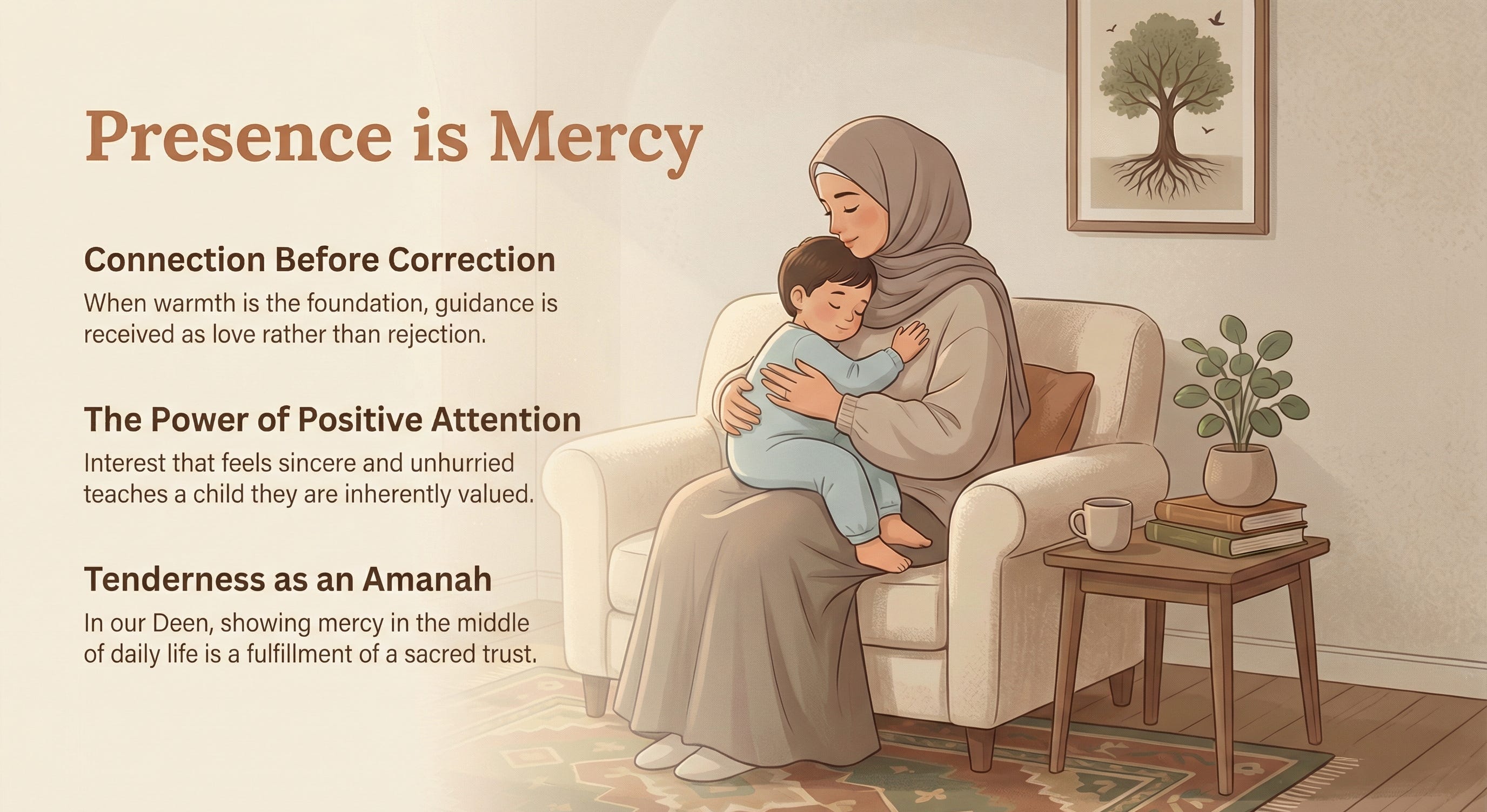
You are standing in the kitchen, trying to get one simple thing done.
Your child is talking. Then talking louder. Then calling your name again, with that edge in their voice that makes your shoulders rise before you even turn around.
Part of you wants to say, please, not right now.
Part of you wants to correct the tone. To fix the behaviour.
And part of you knows, deep down, that what they are really asking for is not a lecture. It is you.
Not your perfection. Not your full schedule. Just your attention.
The kind of attention that says you matter
Positive attention is not a reward system. It is not a gold star for good behaviour.
It is the daily habit of turning toward your child with warmth, even in ordinary moments.
A real smile when they enter the room.
Your face lifting when they start to share something tiny.
Your body making space beside you on the couch.
Interest that feels sincere, not rushed.
Children build their sense of self through repeated experiences. Little moments where they feel noticed and welcomed, then another moment, then another. Over time, that becomes an inner belief that they are valued. [3] [4]
That belief is not small. It shapes confidence, learning, and relationships.
Security is built in the small moments, not the big speeches
A child who feels emotionally safe does not need to fight as hard for your presence.
When home feels warm, correction lands differently. It feels like guidance inside love, not rejection.
Research on early development keeps returning to the same idea. Children grow best in an environment of relationships. Warm, responsive connection is not extra. It is the setting where development happens. [4]
And in everyday family life, positive emotion often continues through very simple things. Smiling, touch, shared play, a parent joining in for a minute. These are small actions that keep a child’s good feelings alive. [1]
This is one reason “quality time” is not always about a long outing. Sometimes it is about how you show up during the time you already have. [2]
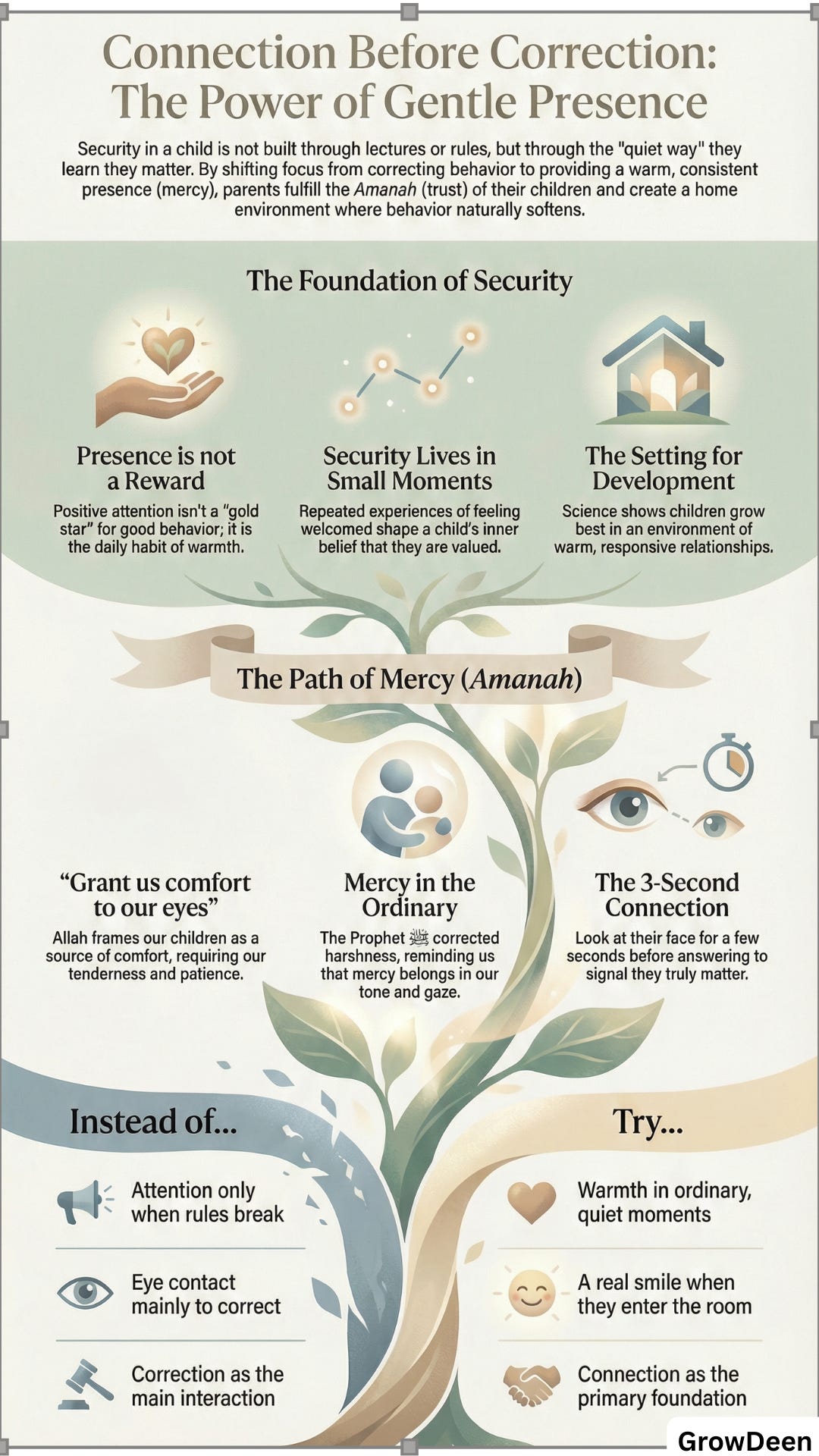
Ar Rahman’s Mercy inside ordinary parenting
In our deen, tenderness with children is not weakness. It is mercy.
Your child is an amanah. A trust.
Allah teaches us to ask for comfort through our families.
Our Lord, grant us from our spouses and our offspring comfort to our eyes. [6]
And the Prophet ﷺ did not hide his affection. He showed it openly. He corrected harshness, not softness.
Whoever does not show mercy will not be shown mercy. [7]
That hadith is not there to scare you. It is there to soften you.
It reminds you that mercy belongs in the middle of daily life. Not only in big sacrifices. It belongs in your tone, your patience, your willingness to look up and say, I see you.
When correction becomes the main kind of attention
Many loving parents fall into a painful pattern without meaning to.
They give attention when a problem happens.
They give correction when a rule is broken.
They give eye contact mainly when something needs to stop.
So the child learns, without anyone saying it out loud, that the fastest way to get a parent’s full focus is to act up.
This is why positive attention matters even when behaviour is not perfect.
Not because you are ignoring wrong actions.
Because you are teaching a deeper lesson first.
You do not have to earn my warmth.
You belong here.
When positive attention becomes more common than correction, the relationship feels safer. And children tend to need less dramatic behaviour to feel connected. [3] [4]
If you would like more gentle reminders like this, you can subscribe for free. Not because you need more reading to feel guilty, but because you deserve steady support that brings you back to what works when parenting gets noisy.
A few ways to turn toward your child today
Start small. Make it almost embarrassingly simple.
When your child speaks, look at their face for a few seconds before answering.
When you have to say no, keep your tone warm so the boundary does not feel like rejection.
When you notice effort, name it in a way that feels true.
I saw you trying even when it was hard.
When you walk into the room and they are there, greet them like you are glad.
Some days you will forget. Some days you will be tired and reactive. You are human.
Come back anyway.
When warmth feels hard to access
Sometimes the hardest part is not knowing what to do. It is not having the emotional capacity to do it.
If most interactions with your child feel tense right now, pause and treat that as a signal, not a shame.
Stress, burnout, postpartum exhaustion, financial pressure, loneliness, all of it can drain warmth from a parent’s voice.
Support matters. When families are supported, children do better, and parents can show up more steadily. [3]
If you need help, reach out to someone trustworthy. A counsellor, a community support service. Getting support is not a failure. It is part of fulfilling an amanah.
Ending, gently
Your child does not need a parent who gets it right all day.
They need a parent who returns.
Who notices them, often.
Who gives warmth not only as a reward, but as a foundation.
And when you build that foundation, something beautiful happens.
Your child stops scanning the house for proof they matter.
Because they already know.
Gifts For You, Dear Parent
If you made it this far, I want you to notice what that says about you.
You were not only filling time. You stayed because something here felt close to your real life.
Because you care.
Because you want to parent with more awareness, even when you are tired.
Because you are still trying, even on the days that feel heavy.
That is not small.
So I did not want this to remain only words you read once and move on from. I wanted it to gently follow you into your week in a practical way. That is why we prepared these Life Gifts for you.
Not as extras.
Not as decoration.
As simple tools that help you hold onto what mattered most in what you just read.
Inside, you will find four pieces.
The Gentle Understanding Card
A clear, simplified reminder of the heart of this article, so you can revisit the main idea in seconds without rereading everything.
The Heartfelt Dua Card
A carefully chosen dua that matches this stage of parenting, because we know real strength and ease ultimately come from Allah’s help.
The Gentle Actions Card
Practical examples that help you turn understanding into real life steps, so this becomes part of your daily rhythm.
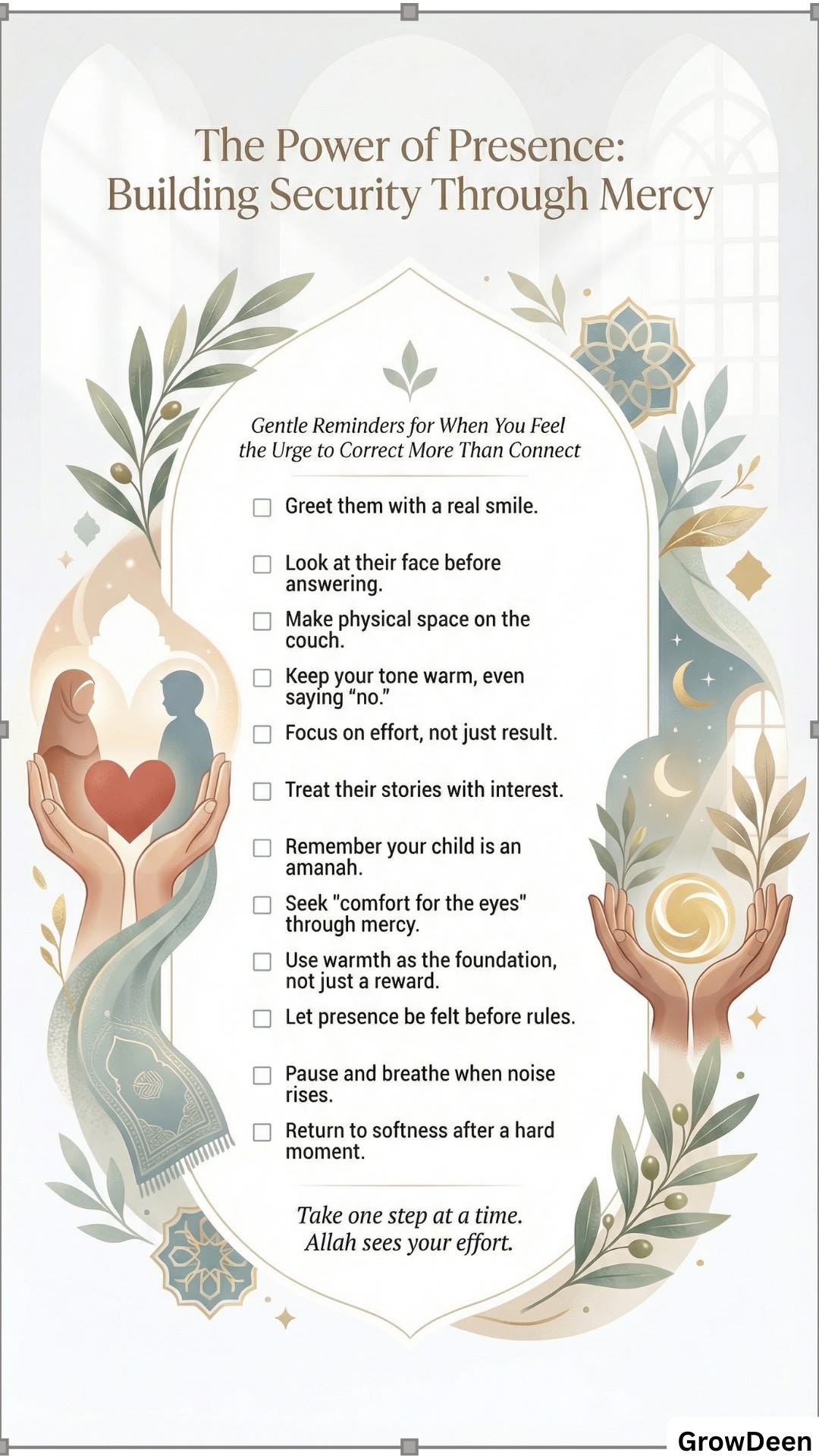
The Gentle Reminders Card
Short, steady reminders drawn from the key points, made to be saved or printed and placed somewhere you will see often.
These were made slowly and thoughtfully, with care, time, and sincere dua. We created them because we genuinely want to walk alongside you, not only through one article, but through every stage of this lifelong journey.
If these gifts support you even a little, I would love for you to keep receiving them.
Subscribe so each new Gift arrives directly in your inbox whenever we release the next stage, so you do not miss the tools designed to support you right where you are.
May Allah place barakah in your effort, accept your intention, and make this path easier and more rewarding than it feels right now.
Please share this with a family member or friend who would feel lighter after reading it.
What is one moment with your child that feels hardest lately, and what kind of support would make it feel lighter.
References
[1] Bai, S., Repetti, R.L., and Sperling, J.B. (2016). Children’s expressions of positive emotion are sustained by smiling, touching, and playing with parents and siblings: A naturalistic observational study of family life. Developmental Psychology, 52(1), 88–101.
[2] Kalenkoski, C.M., and Foster, G. (2008). The quality of time spent with children in Australian households. Review of Economics of the Household, 6(3), 243–266.
[3] Mullan, K., and Higgins, D. (2014). A safe and supportive family environment for children: Key components and links to child outcomes. Australian Government Department of Social Services.
[4] National Scientific Council on the Developing Child. (2004). Young children develop in an environment of relationships. Working Paper No. 1. Center on the Developing Child, Harvard University.
[5] Vallorani, A., Brown, K.M., Fu, X., Gunther, K.E., MacNeill, L.A., Ermanni, B., Hallquist, M.N., and Pérez Edgar, K. (2022). Relations between social attention, expressed positive affect and behavioral inhibition during play. Developmental Psychology, 58(11), 2036–2048.
[6] Qur’an 25:74.