
Your Baby Is Talking Long Before Words
The Day You Realize Crying Was Communication Too

Your child is communicating from the very beginning, and warm back and forth talk, reading, humming, and gentle turn taking help language grow steadily through babyhood and the toddler years.
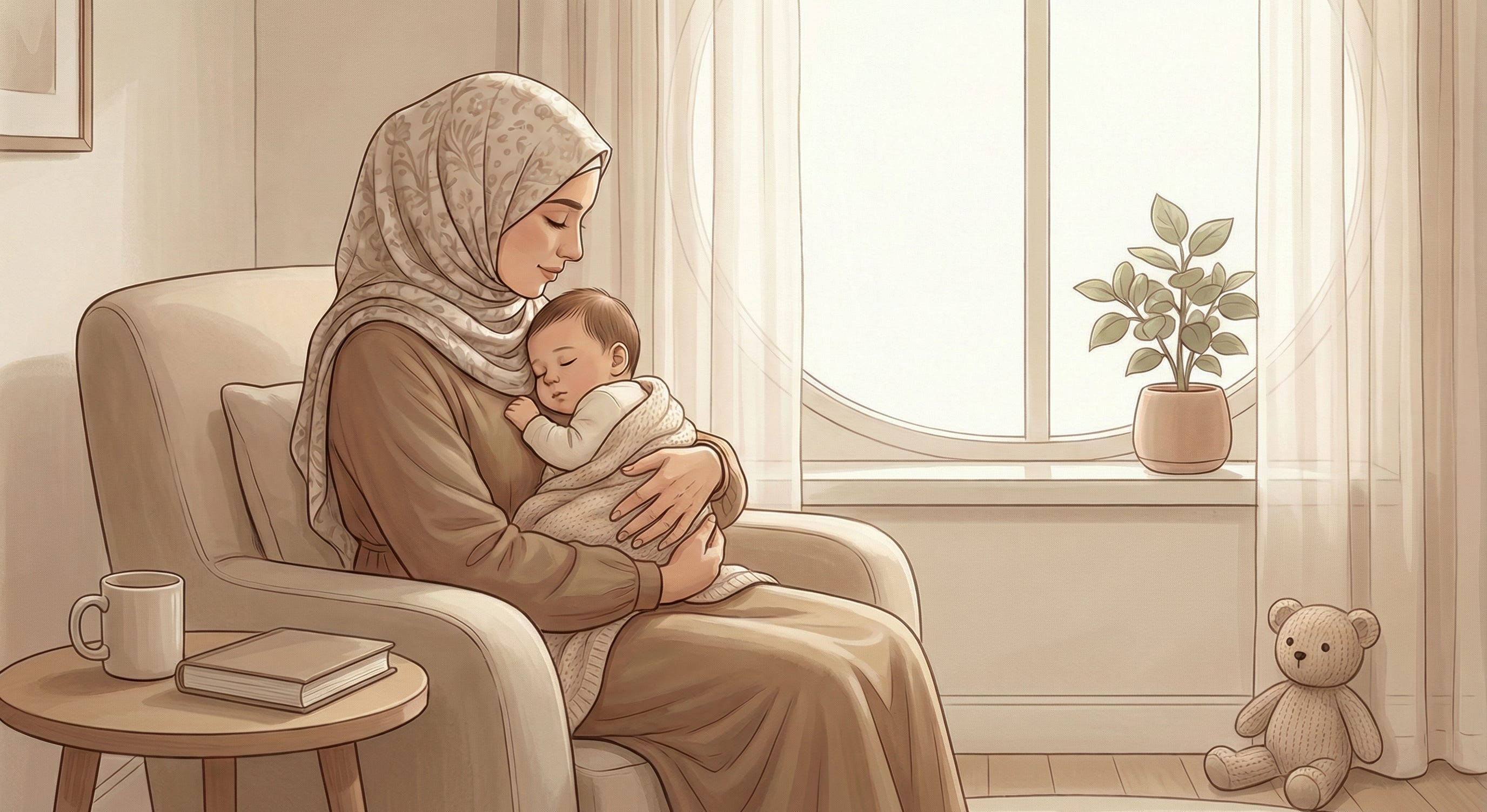
It is 2:17 a.m. again.
You are holding your baby in the dim light, trying to remember what you have already tried.
Fed.
Changed.
Burped.
Rocked.
And still that cry keeps rising, like your baby is knocking on a door you cannot find.
Then, later that day, everything looks different.
A pause.
A tiny sound.
A mouth that almost shapes a smile.
Eyes that hold yours for one extra second.
You catch yourself thinking, Are we talking already?
Yes, you are.
Not with words yet.
But with real communication.
From day one.
Crying is a language, not a character flaw
In the beginning, babies do not have polite ways to say what they need. They have one strong tool, and they use it.
Crying can mean hunger, discomfort, pain, gas, over stimulation, or simply I need you close.
Sometimes you will search and search and still not find the reason. That does not mean your baby is difficult. It means babies are learning how to live in a body and a world that still feels huge.
Research describes infants as ready for connection very early, and early communication is built through interaction, not instruction. [4] When you respond to your baby’s signals with steadiness, you are teaching something that matters even before vocabulary.
My voice reaches someone.
My face matters to someone.
Someone comes.
The first conversations are made of faces and timing
In the early weeks, your baby’s whole body is part of communication. You will see it in bright eyes, soft coos, movements that get bigger when they are interested, and that calm settling when they feel safe.
Over time, something that looks like conversation begins to appear.
You look.
They look back.
You speak.
They pause, then answer with a sound or a tiny expression.
This early back and forth is part of how babies learn the rhythm of communication. [4] It is not only about words. It is about turn taking, attention, and the feeling of being met.
As your baby gets older, gesture and voice start developing together. Pointing, reaching, touching, and trying to pull you toward what they want you to notice are meaningful communication, not just movement. [2]
Allah’s Care is in the gentleness of your voice
There is something quietly beautiful about how Islam treats speech.
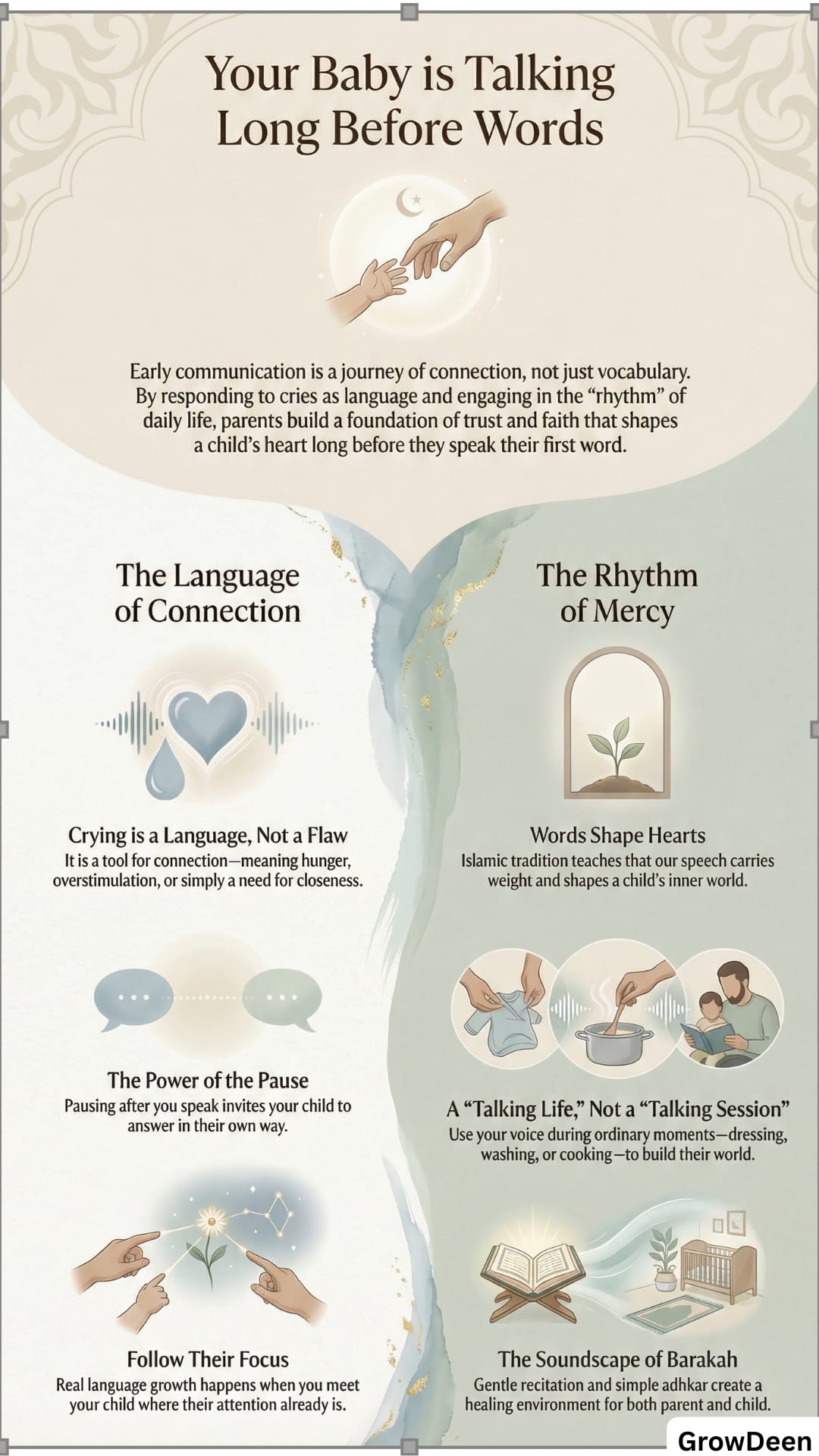
Allah tells us that our words are not weightless. [7] They shape hearts. They shape homes. They shape who a child becomes inside.
So when you speak gently to your baby, when you respond to babbles like they matter, you are doing more than building language.
You are building trust.
You are carrying an amanah with your tongue and your tone.
And that counts, even if the only audience right now is a toddler holding a spoon like it is treasure.
You do not need a talking session, you need a talking life
Many parents hear, Talk to your child more, and immediately feel tired.
So let me soften that.
You do not need a special routine that makes you feel like you are failing when you miss it.
You can simply bring your child into your day with your voice.
While you dress them.
While you wash hands.
While you open the curtains.
While you stir the pot.
Children learn language by hearing lots of real language, especially when it is connected to what is happening around them. [6]
The most helpful kind of talking is often the simplest.
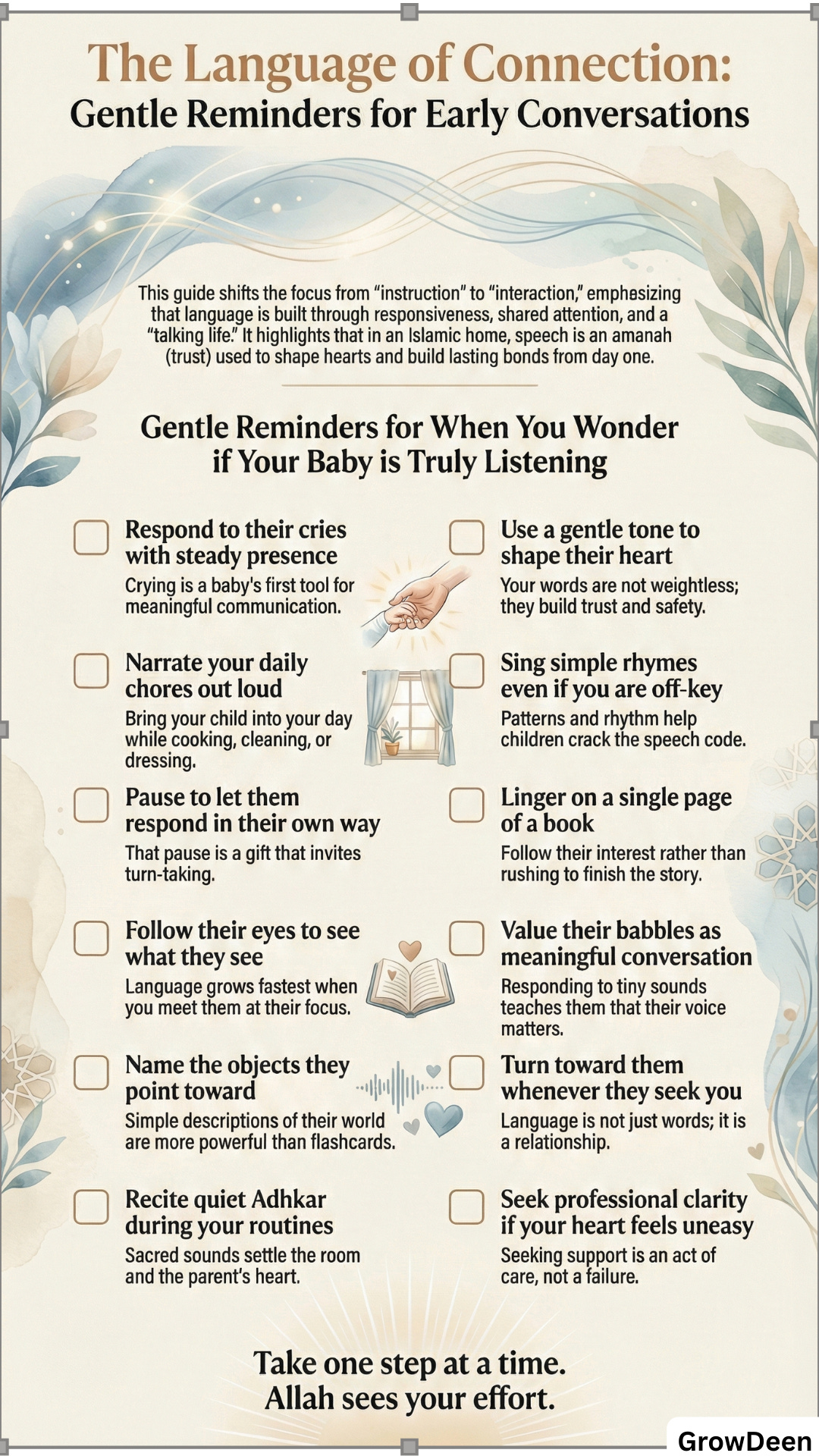
Name what they are looking at.
Name what you are doing.
Name what they are trying to do.
Then pause, just for a moment, so your child has space to answer in their own way.
That pause is a gift.
It invites turn taking. [4]
And it tells your child, I am listening.
If you want more gentle reminders like this, written for real life and real tiredness, you can subscribe for free. It just means these pieces land in your inbox when you need them, instead of you having to hunt for them.
Follow their attention and let that lead the words
One of the strongest engines of language growth is not fancy vocabulary.
It is responsiveness.
It is noticing what your child is focused on and meeting them there. [6]
Your toddler points at a cat.
You say, Cat.
You pause.
They squeal.
You say, Soft cat.
Or maybe, The cat is walking.
That is it.
That is how conversation begins.
It can feel almost too simple, but it is powerful. Shared attention and back and forth interaction shape how children learn to communicate with meaning. [6]
Shared book reading works in a similar way when it becomes interactive instead of rushed. Research on storybook reading interventions and shared book reading shows benefits for language and social communication, especially when adults talk about what is on the page and engage with the child. [1] Shared book reading also contributes uniquely to adult child language interaction. [3]
So if your toddler wants to stare at one picture for five minutes, let them.
Stay there with them.
Describe it.
Let them point again.
Let them try a sound.
You are not behind.
You are building.
Let it be simple. Let it be imperfect.
Your voice does not have to be polished to matter.
Babies learn language through repetition and tone. When you gently repeat short adhkar, softly recite a small surah, or hum familiar phrases in a calm voice, your baby hears patterns. They hear stretched sounds. They begin to recognize familiar syllables. The predictability itself is comforting.
Even if your voice trembles a little, even if you feel unsure, the consistency still helps. Your baby is not measuring perfection. They are absorbing warmth.
And fathers matter here too. Research shows that infants respond to their father’s voice, and that a father’s engagement contributes meaningfully to a rich early communication environment. When a father softly recites a short surah, repeats simple dhikr like SubhanAllah or Alhamdulillah, or speaks gently during routines, it builds connection and language together.
If your home carries more than one language, using both is a gift. Speak one language while holding your baby. Repeat adhkar in another. Let them hear the natural flow of each. Regular exposure, even in small daily moments, supports understanding over time.
In many Muslim homes, Qur’an recitation becomes part of the soundscape of childhood. Allah describes the Qur’an as healing and mercy for the believers [9]. Quiet recitation during feeding, rocking, or settling for sleep often softens the room. Many parents notice that it steadies their own hearts too.
You do not need a performance.
You need presence.
Repeat short phrases.
Recite gently.
Let your baby hear the calm in your voice.
Keep it simple.
Keep it gentle.
When worry comes, do not carry it alone
Children develop differently. Some are talkers early. Some are watchers. Some have a burst of words, then a quiet stretch.
A slower start does not automatically mean something is wrong.
But if you feel uneasy about your child’s responsiveness, babbling, hearing, or progress, it is okay to ask a professional. Talk to your doctor or a child health professional.
If someone tells you to relax, but your worry does not settle, it is also okay to ask again.
Part of parenting is learning when to wait, and when to seek clarity.
Neither is a failure.
Both can be care.
And if you are a parent who has been speaking, reciting, reading, pausing, responding, and still feels like, Why is this not moving faster, please remember this.
Language is not only words.
It is relationship.
And you are building that every time you turn toward your child.
May Allah place barakah in your efforts, even the ones that feel ordinary, and make your home a place where hearts soften and words grow with mercy.
Gifts For You, Dear Parent
If you’ve reached this part of the page, it tells me something meaningful about you.
You weren’t just skimming or passing time. You stayed because something here felt relevant to your real life.
Because you care.
Because you want to do things with more awareness.
Because you’re trying, even when it feels overwhelming.
That is not small.
So I didn’t want this article to remain just words on a page. I wanted it to gently step into your daily life in practical ways. That’s why we prepared these Life Gifts for you.
Not as extras.
Not as decorations.
But as simple tools to help you hold onto what mattered most in what you just read.
Here’s what you’ll find inside:
Gentle Understanding Card
A clear and simplified summary of the core concept from this article, so you can revisit the main idea anytime without rereading everything.
Heartfelt Dua Card
A carefully chosen dua connected to this stage of life, because we know that real strength and ease ultimately come from Allah’s help.
Gentle Actions Card
Practical examples to help you translate knowledge into action, so what you learned becomes part of your daily rhythm.
Gentle Reminders Card
Short, steady reminders drawn from the key points, designed to be printed or saved and placed somewhere you’ll see often.
These were designed slowly and thoughtfully, with time, care, and sincere dua. We created them because we genuinely want to walk alongside you, not just through one article, but through every stage of this lifelong journey.
If these gifts support you even in a small way, I would love for you to continue receiving them.
Subscribe so that each new Gift arrives directly in your inbox whenever we release the next stage. That way, you won’t miss the tools designed to support you right where you are.
May Allah place barakah in your effort, accept your intention, and make this path easier and more rewarding than it feels right now.
Please share it with a family or friend who may benefit from this knowledge.
In the comments, what is one small sound, gesture, or look from your child that feels like real communication to you lately?
References
[1] Brown, M.I., Westerveld, M.F., Trembath, D., and Gillon, G.T. (2018). Promoting language and social communication development in babies through an early storybook reading intervention. International Journal of Speech Language Pathology, 20(3), 337–349.
[2] Burkhardt Reed, M.M., Long, H.L., Bowman, D.D., Bene, E.R., and Oller, D.K. (2021). The origin of language and relative roles of voice and gesture in early communication development. Infant Behavior and Development, 65, 101648.
[3] Clemens, L.F., and Kegel, C. (2021). Unique contribution of shared book reading on adult child language interaction. Journal of Child Language, 48(2), 373–386.
[4] Gratier, M., and Devouche, E. (2017). The development of infant participation in communication. In M. Fillipa, P. Kuhn, and B. Westrup (Eds.), Early vocal contact and pre term infant communication (pp. 55–68). Springer.
[5] Jasin, L.R., and Newnam, K.M. (2023). The response of the infant to the father’s voice: An evidence based review. Advances in Neonatal Care, 23(4), 348–354.
[6] Kuhl, P.K. (2004). Early language acquisition: Cracking the speech code. Nature Reviews Neuroscience, 5(11), 831–843.
[7] Qur’an 50:18.
[8] Sahih al Bukhari 893.sing
[9] Qur’an 17:82.