
You Are Not Making A Bad Habit, You Are Making A Safe Baby
When You Pick Them Up, Something In Their Brain Softens

You cannot spoil a newborn by responding to crying, because your calm, consistent care is how your baby learns safety, builds secure attachment, and settles into the world.

It is one of those evenings where the crying feels louder than it should.
You have already fed the baby. The nappy is clean. You have walked the hallway twice. You have bounced. You have whispered. You have tried that one shush that worked yesterday.
And then someone’s voice pops into your mind.
Do not pick them up so much. You will spoil them.
So you stand there, frozen, staring at a tiny face that is red and trembling and asking for you in the only way they know how.
If you are in that moment, let me be gentle and very clear.
You are not spoiling your baby by responding.
Your baby is not being difficult, your baby is being new
A newborn cries because something is happening inside their body or around them, and they have no other way to tell you.
Hunger. Wind. Cold. Too much noise. A sharp need for closeness. Sometimes it is pain. Sometimes it is simply overwhelm.
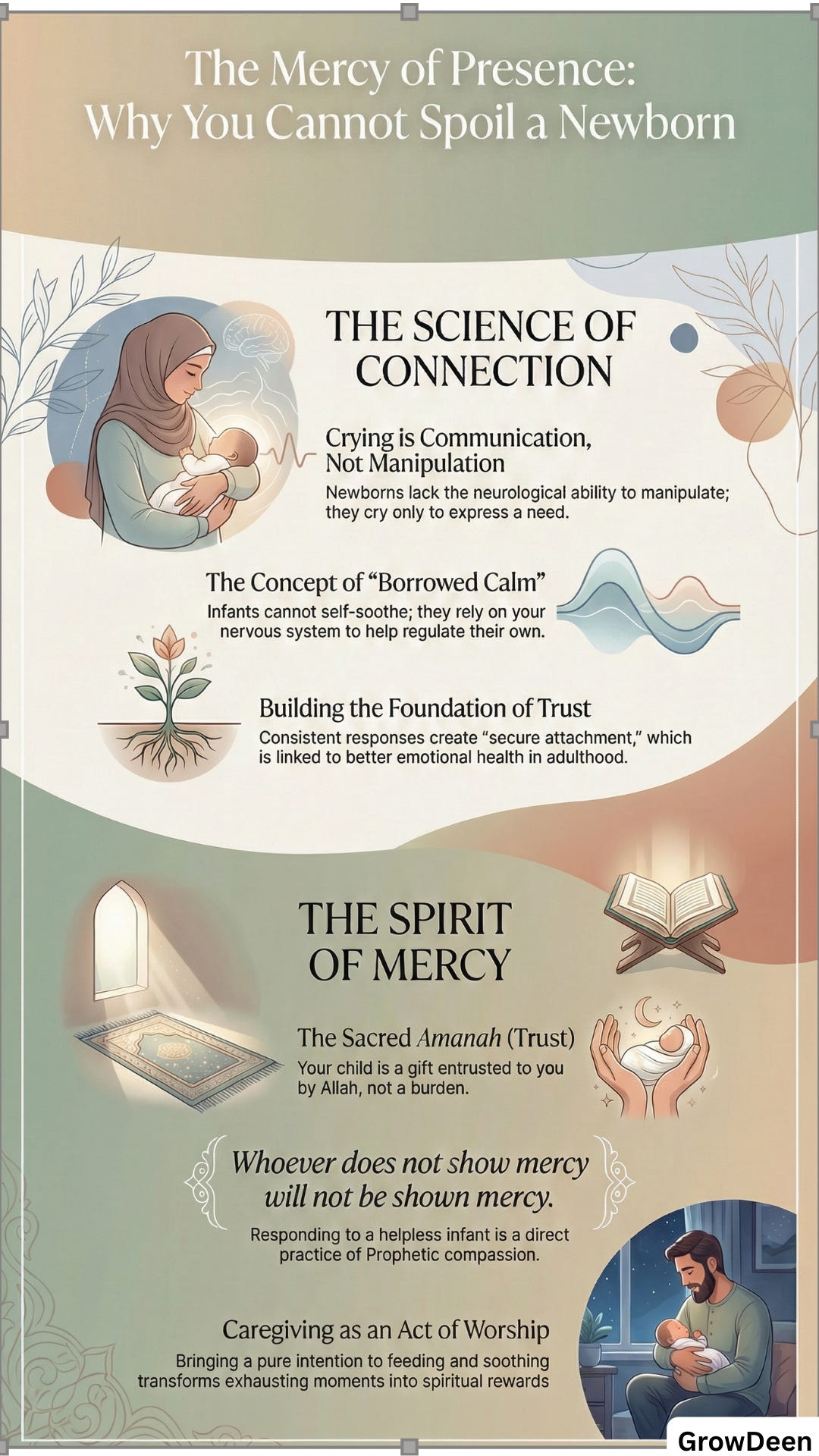
Newborns do not have the ability to calm themselves yet. They borrow your calm. They lean on your nervous system until their own matures. That is not a bad habit. That is human development.
When you respond, again and again, your baby learns something before they can understand any words.
Someone comes. Someone cares. The world is not random. [1] [2]
That lesson becomes a quiet foundation they carry forward.
The small pattern that builds a big kind of trust
People sometimes use bonding and attachment as if they are the same, but they are not quite.
Bonding is your relationship forming with your baby.
Attachment is the emotional safety your baby builds with you over time, through repeated experiences of being cared for with warmth and consistency. [1]
Sensitive, responsive caregiving is strongly linked with secure attachment in infancy. [1] And secure attachment is not only about comfort today. It has been associated with better coping as children grow, including emotional and behavioural outcomes, and how parenting stress and child behaviour can interact. [7]
There are also long term findings that suggest early attachment patterns can relate to later physical health outcomes in adulthood. [5]
I know that can sound like pressure. I do not want it to land that way.
This is not about getting everything right.
This is about understanding that your presence matters, and it matters most in the simple, repeatable way you keep returning.
Ar Rahim’s Mercy in the middle of the night
In an Islamic home, there is a deeper softness to all of this.
Your baby is an amanah. Not a burden. Not a test you are failing. A trust that Allah sees you carrying.
And mercy is not optional in our deen.
The Prophet ﷺ said, “Whoever does not show mercy will not be shown mercy.” [8]
That does not mean you never feel overwhelmed.
It means you keep turning back toward mercy anyway.
When you pick up your crying newborn, when you soothe, when you check what they need, you are not weakening them. You are teaching their body what safety feels like. You are showing mercy to someone who cannot help themselves yet.
And Allah loves mercy.
What happens when you do not respond
Sometimes people say ignoring a baby teaches independence.
But a young baby cannot practise independence. They cannot think, I will calm myself now. They cannot manipulate you. They cannot plan a lesson for you.
When a distressed newborn is left alone, they are not learning strength. They are simply alone with a feeling too big for their body. [1] [4]
This is why responding is not “extra attention.”
It is the job.
You are not creating a problem by comforting your baby. You are meeting a need your baby cannot meet without you.
If you have been holding back because of fear of spoiling, it is okay. Many parents have been told this. You are not foolish for listening. You are just trying to do the right thing.
Now you can let that fear go.
When sleep feels like the real reason you are doubting yourself
For many parents, the worry about “spoiling” is really a sleep worry.
Newborn sleep is not adult sleep. It comes in pieces. Short stretches. Frequent waking. A rhythm that feels messy, especially in the early weeks. [6]
Responsive settling approaches, the kind where you comfort your baby while gradually supporting sleep over time, are commonly discussed as realistic in this stage. [4] [6]
So if you are thinking, I keep responding and they still wake, it must be making it worse, please hear me.
Waking is often normal in newborn life.
Responding is not the cause of the waking. Responding is what keeps your baby feeling safe during it.
There will be moments when you cannot work out what they need. That happens to everyone. Your presence still counts, even before you solve anything. [4]
If you want a gentle phrase to hold in your mind at 3 a.m., try this.
My baby is not trying to control me. My baby is asking for help.
Feeding is not only food, it is regulation
Sometimes a baby cries because they want to feed. Sometimes they want to feed again right after they fed.
In the early weeks, many babies feed every 2 to 4 hours, and often more. That is not always hunger the way adults mean it. Feeding is also closeness and calming. [2] [4] [6]
This is why it can feel like your baby is “always” on you.
You are not imagining it.
And you are not doing anything wrong.
A calm feeding time can become one of the few quiet places in a day. Your baby’s body softens. Their breathing changes. They settle against you. That is not spoiling. That is safety being built in real time. [2]
If you are breastfeeding, if you are bottle feeding, if you are doing both, you can bring your intention into it.
The Prophet ﷺ taught that actions are judged by intentions. [9]
You are feeding a child Allah entrusted to you. That can be worship.
You do not have to be the only safe person
One more thing I want to say, because it matters for your survival too.
It is normal and healthy for other trusted adults to help. Babies can build safety with more than one familiar, loving caregiver. [4]
When a baby is cared for warmly by more than one safe person, it can widen their sense of security, and it can give you a break that allows you to return with more steadiness. [4]
That is not you “passing off” your baby.
That is you protecting your ability to show mercy.
If you would like to keep receiving gentle, evidence based reminders like this, you can subscribe for free. These are the kinds of words many parents need on the exact day they think they are doing it wrong.
Final thoughts
You cannot spoil a newborn by responding.
You can only teach them, through your arms and your voice and your returning, that the world is safe enough to live in.
Some days you will respond with full softness.
Some days you will respond while tired and shaky and doing your best.
Your baby still learns the same lesson.
Someone comes.
May Allah put sakinah in your home, increase the mercy between your hearts, and make your care heavy on your scale of good.
Rabbana hab lana min azwajina wa dhurriyyatina qurrata a yun, waj alna lil muttaqina imama. [10]
Gifts For You, Dear Parent
If you have reached this part of the page, it tells me something precious about you.
You did not only skim and move on. You stayed, because something here touched your real life.
Because you care.
Because you want to move through parenthood with more awareness.
Because you are trying, even when your body is tired and your heart feels stretched.
That is not small.
So I did not want this article to remain only words you read once and forget. I wanted it to gently step into your day in practical ways. That is why we prepared these Life Gifts for you.
Not as extra fluff.
Not as decoration.
But as simple tools to help you hold onto what mattered most in what you just read.
Here is what you will find inside.
Gentle Understanding Card
A clear, simplified reminder of the core idea, so you can come back to it in seconds without rereading the whole article.
Heartfelt Dua Card
A carefully chosen dua for this stage, because real strength and ease ultimately come from Allah’s help.
Gentle Actions Card
Practical examples that help you translate understanding into action, so this becomes part of your daily rhythm.
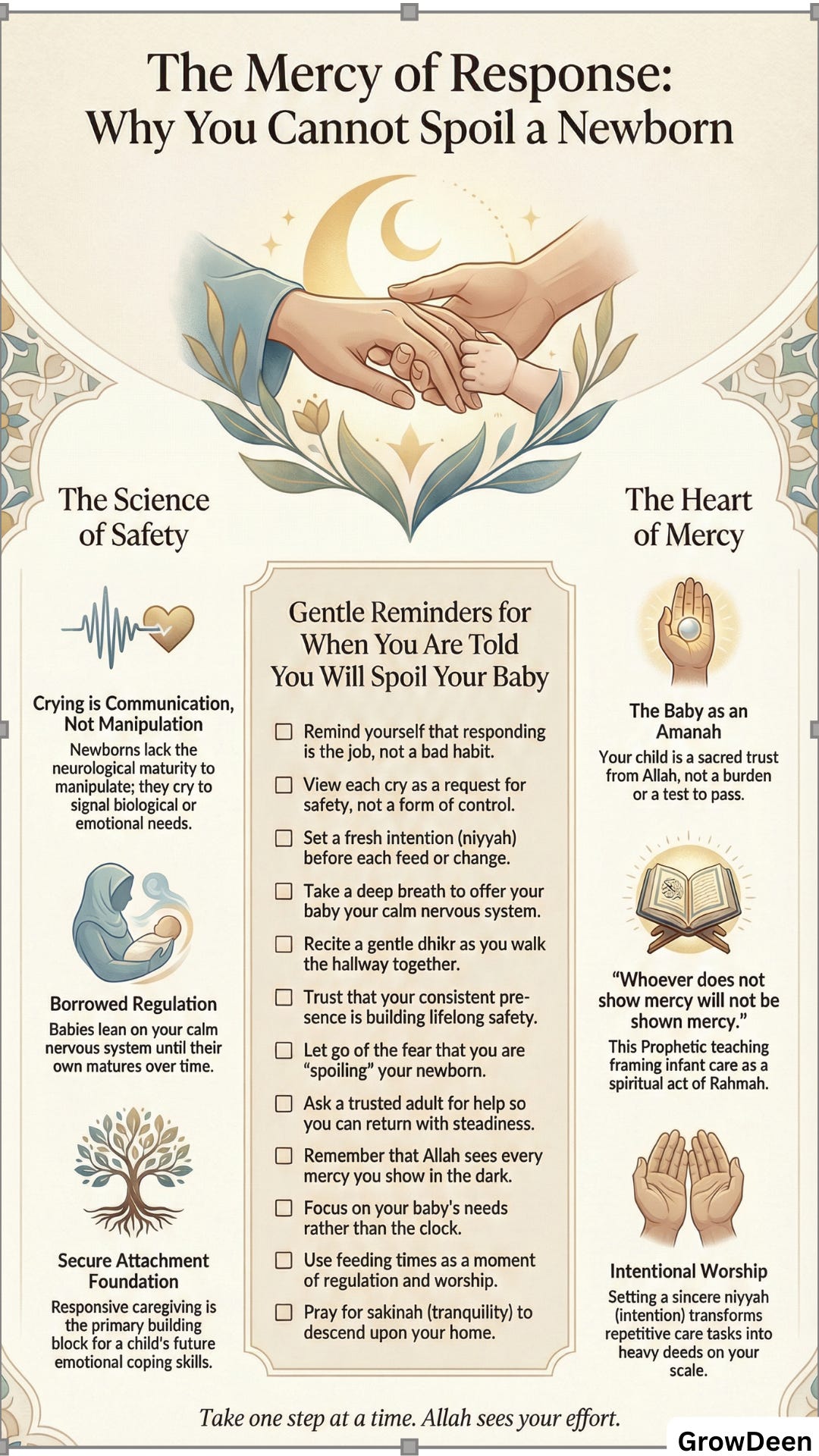
Gentle Reminders Card
Short, steady reminders drawn from the key points, made to be saved or printed and placed somewhere you will see often.
These were made slowly and thoughtfully, with care, time, and sincere dua. We created them because we genuinely want to walk alongside you, not only through one article, but through every stage of this lifelong journey.
If these gifts support you even a little, I would love for you to keep receiving them.
Subscribe so each new Gift arrives directly in your inbox whenever we release the next stage, so you do not miss the tools designed to support you right where you are.
May Allah place barakah in your effort, accept your intention, and make this path easier and more rewarding than it feels right now.
Please share this with a family member or friend who may feel lighter after reading it.
In the comments, what is one sentence you wish someone would say to you on your hardest night with your baby.
References
[1] De Wolff, M.S., and van IJzendoorn, M.H. (1997). Sensitivity and attachment: A meta analysis on parental antecedents of infant attachment. Child Development, 68(4), 571–591.
[2] Le Bas, G., Youssef, G., Macdonald, J.A., Teague, S., Mattick, R., Honan, I., McIntosh, J.E., Khor, S., Rossen, L., Elliott, E.J., and Allsop, S. (2022). The role of antenatal and postnatal maternal bonding in infant development. Journal of the American Academy of Child and Adolescent Psychiatry, 61(6), 820–829.
[3] Liu, C.H., Hyun, S., Mittal, L., and Erdei, C. (2022). Psychological risks to mother infant bonding during the COVID 19 pandemic. Pediatric Research, 91(4), 853–861.
[4] McDonald, P. (2021). The Discontented Little Baby Book (revised edition). University of Queensland Press.
[5] Puig, J., Englund, M.M., Simpson, J.A., and Collins, W.A. (2013). Predicting adult physical illness from infant attachment: A prospective longitudinal study. Health Psychology, 32(4), 409–417.
[6] Sharma, A., and Cockerill, H. (2021). Mary Sheridan’s From Birth to Five Years: Children’s Developmental Progress (5th edition). Routledge.
[7] Tharner, A., Luijk, M.P.C.M., van IJzendoorn, M.H., Bakermans Kranenburg, M.J., Jaddoe, V.W.V., Hofman, A., Verhulst, F.C., and Tiemeier, H. (2012). Infant attachment, parenting stress, and child emotional and behavioral problems at age 3 years. Parenting: Science and Practice, 12(4), 261–281.
[8] Sahih al Bukhari 7376. Whoever does not show mercy will not be shown mercy.