
Why Your Newborn Doesn’t Need a Schedule
(And What They Need Instead)

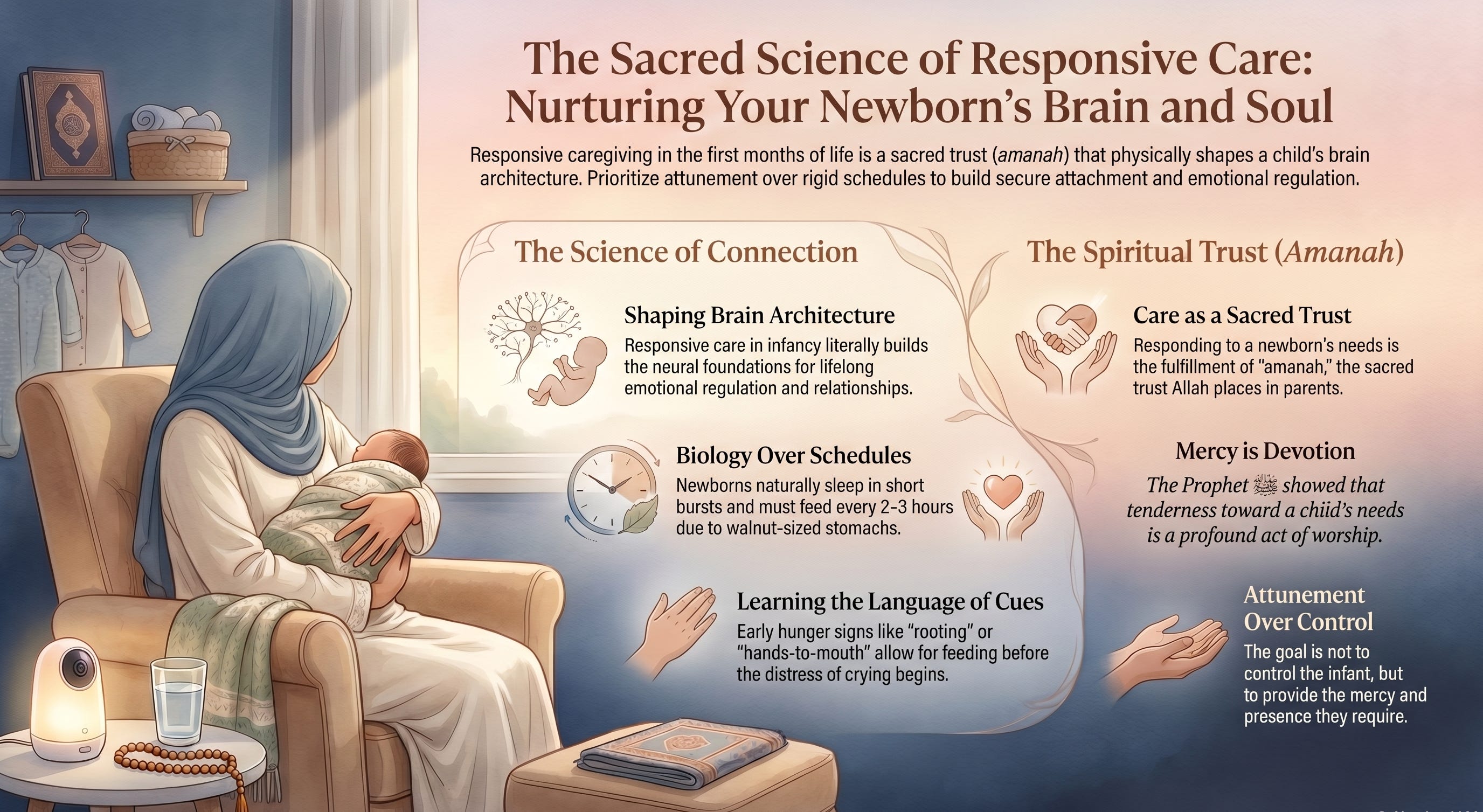
Research from Harvard’s Center on the Developing Child shows that responsive care-giving in the first months shapes brain architecture and emotional regulation for life. [1] This guide shows you how to read your baby’s cues and respond in ways that build secure attachment—without rigid routines that fight your baby’s natural rhythms.
It’s 3 AM. Again.
Your newborn is crying, and you’re scrolling through conflicting advice about schedules and sleep training and whether you’re creating bad habits by picking them up. Someone told you babies need routine. Someone else said feed on demand. Your mother-in-law mentioned letting them cry.
Here’s what I wish someone had told me in those bleary first weeks: your baby doesn’t need a schedule. Not yet.
What your baby needs is you—responsive, present, learning their language one cry at a time. When I studied the research from Harvard’s Center on the Developing Child, one finding stopped me: responsive caregiving in infancy literally shapes brain architecture. [1] Every time you answer your baby’s call, you’re not just meeting a need. You’re building the foundation for how they’ll regulate emotions, form relationships, and move through the world.
Your baby is teaching you their language. The question is whether you’re ready to listen.
Why This Guide Is Different From Generic Baby Sleep Advice
It combines brain science with Islamic wisdom. Every recommendation is backed by current pediatric research and grounded in the concept of amanah—the sacred trust Allah places in your hands when He gives you a child.
It respects your baby’s individuality. Generic schedules ignore what research shows: newborns have wildly different sleep and feeding needs, and forcing uniformity can increase parental stress without improving outcomes. [2]
It includes a practical companion pack. You’ll get a free Newborn Cues & Responsive Care Guide—a 2-page reference designed to stay visible in your home during those moments when you can’t remember if your baby is tired or hungry.
What Newborns Actually Need (And It’s Simpler Than You Think)
Most newborns sleep 14 to 17 hours in every 24-hour period. [3] But here’s what the baby books don’t always say clearly: those hours don’t come in convenient blocks.
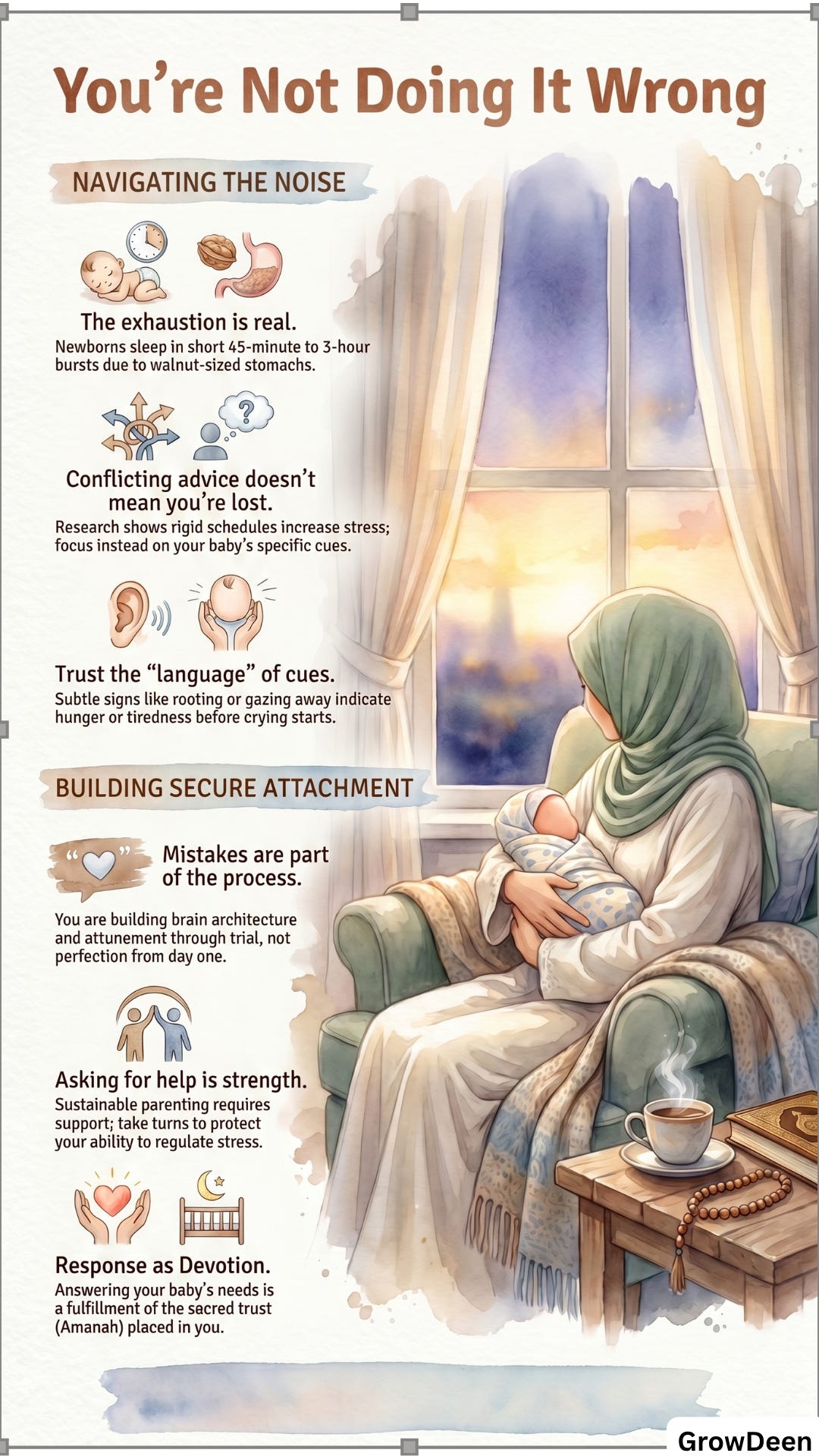
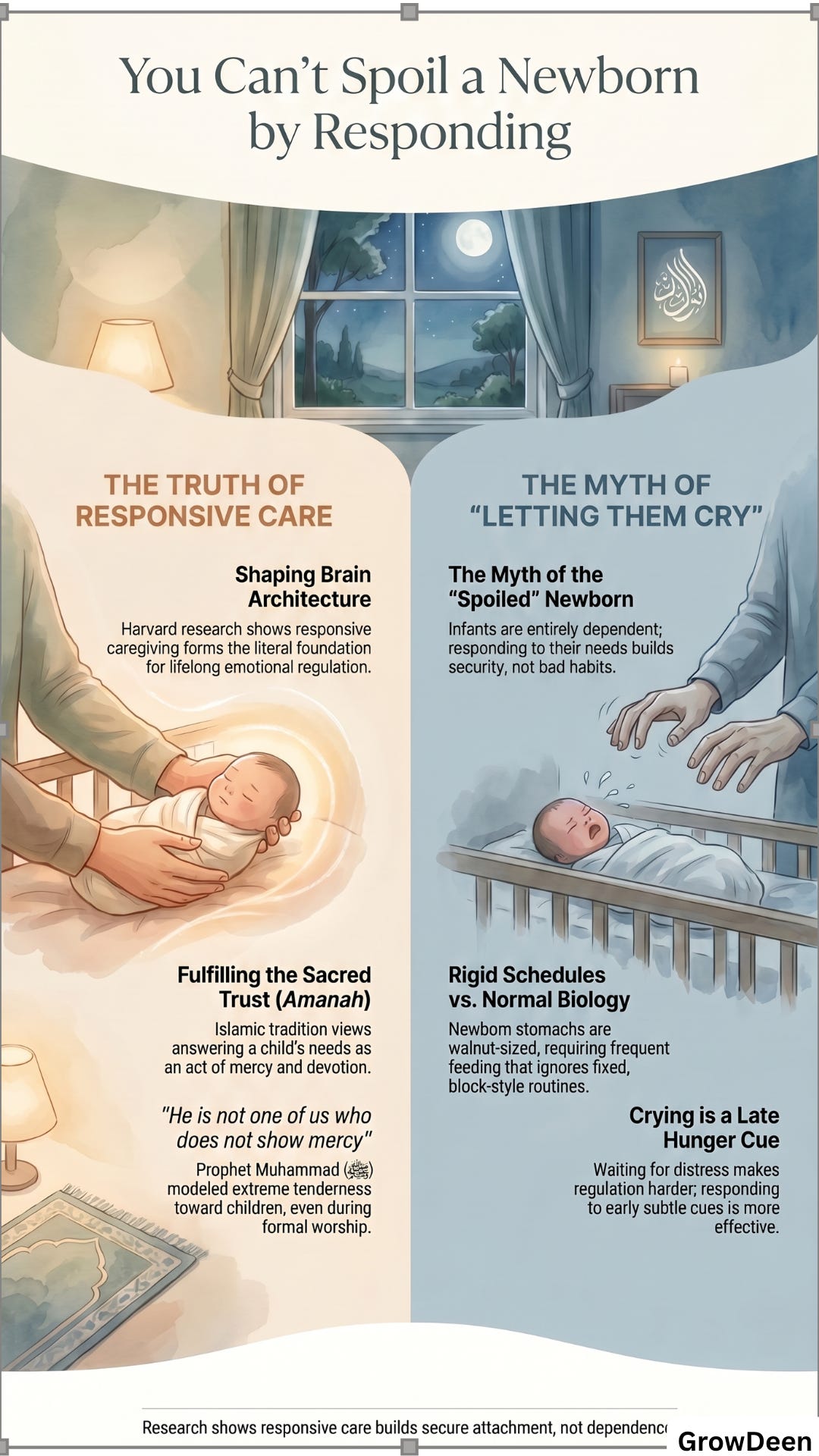
Your baby will sleep in bursts. Two hours. Three hours. Sometimes 45 minutes. Then they’ll wake hungry, because their stomach is roughly the size of a walnut and empties fast. They’ll need to feed every two to three hours, sometimes more frequently. [4]
This isn’t a problem to fix. It’s normal biology.
Between feeds and sleep, there’s play—though newborn play looks nothing like what you’d expect. It might be lying on a blanket, arms and legs moving in the air. It might be watching your face as you talk softly. It might be ten quiet minutes of skin-to-skin contact. Some newborns tire quickly. Others stay alert longer. Both are fine.
The work in these early weeks isn’t imposing order. It’s learning to read the signs your baby is already giving you.
How to Understand What Your Baby Is Telling You
Your baby is already communicating. The challenge is learning their specific language, because every baby speaks it slightly differently.
Hunger cues start subtle. Rooting—turning their head and opening their mouth when something brushes their cheek. Hands to mouth. Small sounds. If you catch these early signs, you can feed before the crying starts. Crying is actually a late hunger cue, and by that point your baby is already distressed. [5]
Tired signs can be easy to miss. Your baby might get quieter, gaze away from you, develop a slightly glazed look. Some yawn or rub their eyes. Others fuss or cry. When you see these signs, it’s time to help them settle—even if they just woke up an hour ago.
Sometimes they just need you. Not food. Not sleep. Just closeness. Maybe they’re overwhelmed by noise or light. Maybe they have gas. Maybe they simply want the reassurance that you’re there.
You won’t always know which need they’re expressing. That’s okay. You’re both learning.
A Gentle Feed-Play-Sleep Flow (When It Works)
Some parents find comfort in a loose rhythm: feed when your baby wakes, change their nappy, offer gentle interaction, then help them settle when tired signs appear.
But here’s the critical part: this is a flexible guide, not a rigid rule.
If your baby shows tired signs right after feeding, skip the play. If they’re hungry again after an hour, feed them. If they sleep longer than usual, let them—unless your doctor has specifically told you to wake them for medical reasons.
At night, keep it simple. Feed, change if needed, settle back to sleep. Keep lights dim and voices quiet. This won’t make your baby sleep through the night (that comes later, developmentally), but it helps them learn the difference between day and night. [6]
The goal isn’t control. It’s attunement.
When You Can’t Tell What They Need
There will be moments when you’ve checked everything—fed them, changed them, checked for discomfort—and they’re still crying.
First, rule out pain or illness. Check for anything uncomfortable: tight clothing, a hair wrapped around a finger or toe, fever, unusual lethargy.
If they’re well but inconsolable, they might need comfort. Hold them close. Walk slowly while supporting their head. Offer gentle rhythmic movement. Sometimes a change of environment—stepping outside, moving to a quieter room—can help.
Research shows that crying peaks around six weeks and gradually decreases. [7] Even healthy, well-fed babies can cry for hours daily during this period. It doesn’t mean you’re failing.
But it does mean you need to protect yourself. If frustration is building, put your baby down safely and step away for five minutes. Breathe. Make wudu. Recite something short. The ability to regulate your own stress makes you a better caregiver.
And if you can, ask for help. Your spouse. A family member. A friend. Taking turns isn’t weakness—it’s strategy.
I know this feels like a lot to track, especially when you’re running on fragmented sleep. That’s why I’ve created a free Newborn Cues & Responsive Care Guide—a printable 2-page reference with visual cues for hunger, tiredness, and overstimulation, plus a simple decision tree for those moments when you can’t tell what your baby needs. Keep reading to download it at the end of this article. It’s designed to stay visible right where you need it most—maybe on your fridge, maybe near the changing table—so you’re not trying to remember everything while your baby cries.
The Islamic Lens: Responding as Amanah
When Allah entrusts you with a child, He gives you an amanah—a sacred trust. The Prophet ﷺ said, “Each of you is a shepherd, and each of you is responsible for his flock.” [8]
Your newborn cannot meet their own needs. When you respond to their cries, feed them when hungry, comfort them when distressed, you’re fulfilling that trust. The Qur’an says, “Mothers may nurse their children for two complete years for whoever wishes to complete the nursing” [9], acknowledging that the feeding relationship follows need, not a schedule.
There’s a hadith where the Prophet ﷺ was leading prayer when his grandson climbed on his back during prostration. He stayed down longer than usual so the child wouldn’t fall. [10] Tenderness toward a child’s needs, even during worship, isn’t at odds with devotion—it is devotion.
The Prophet ﷺ also said, “He is not one of us who does not show mercy to our young ones.” [11] Answering your baby’s cry at 2 AM for the fifth time isn’t indulgence. It’s mercy. And Allah sees every unwitnessed act of care you offer in these quiet hours.
Your Free Newborn Cues & Responsive Care Guide
If you’ve read this far, you’re the kind of parent who wants to get this right—not perfectly, but thoughtfully. That tells me something about you.
Inside the Newborn Cues & Responsive Care Guide (one comprehensive PDF, 2 pages):
Page 1: Visual Cue Recognition Chart — Clear illustrations showing hunger cues, tired signs, and overstimulation signals, designed like a laminated reference card you can keep near your changing table or on your fridge.
Page 2: Quick Decision Tree — A simple flowchart for when you can’t tell what your baby needs, organized by “Have you tried...?” so you can work through possibilities when your brain is too tired to think.
This isn’t just a PDF to download and forget. It’s a tool designed for 3 AM when you’re holding a crying baby and can’t remember whether that movement means hunger or tiredness.
This guide is what every GrowDeen subscriber receives with each article. We cover the full journey of raising Muslim children, all backed by research and rooted in Islamic wisdom.
If you’re a Muslim parent who wants both evidence-based guidance and spiritual grounding, subscribe for free so future resources arrive in your inbox before you need them.
You’ll receive one article when it’s ready—no daily emails, no clutter, just guidance when there’s something worth sharing.
Before you keep scrolling, do this: the next time your baby cries, pause before rushing in with a solution. Take three seconds to observe. What does their cry sound like? What are their hands doing? Are they rooting, or rubbing their eyes, or just looking around?
You’re learning their language. Give yourself permission to watch and learn.
May Allah grant you patience in the exhaustion, clarity when you’re uncertain, and barakah in every unwitnessed hour you spend answering your baby’s needs.
Share This With Someone Who Needs It
Think of one person right now: a friend who just had a baby and looks more exhausted each time you see her, a sister who’s drowning in conflicting advice about schedules, a cousin in her third trimester who’s already anxious about doing everything right.
This article could ease their burden. Share it with them today—not as advice-giving, but as support. Sometimes the most loving thing we can do is pass along what helped us breathe easier.
Frequently Asked Questions
Q: How do I know if my baby is getting enough sleep?
A: Most newborns sleep 14-17 hours total in 24 hours, but it’s in short bursts. [3] If your baby seems content when awake, is feeding well, and has appropriate wet/dirty nappies, they’re likely getting enough sleep. If you’re concerned about specific sleep issues, speak with your healthcare provider.
Q: Should I wake my baby to feed?
A: Unless your doctor has specifically told you to wake your baby for feeds (usually due to weight gain concerns or jaundice), let them sleep. Newborns are generally good at waking when hungry. [4] If your baby sleeps longer than usual occasionally, that’s normal—they’re growing.
Q: Is it normal for my baby to want to feed every hour?
A: Yes, especially during growth spurts or cluster feeding periods (usually in the evening). Their stomach is small and breast milk digests quickly. [4] If this is happening round-the-clock for several days or your baby seems unsatisfied, check with a lactation consultant or your healthcare provider.
Q: How can I tell the difference between tired crying and hungry crying?
A: Timing helps—if it’s been less than an hour since a full feed, they’re more likely tired or needing comfort. Hungry cries often come with rooting, hand-to-mouth movements, and sucking motions. [5] Tired cries can sound more whiny or come with eye rubbing and yawning. For more detail, see “How to Understand What Your Baby Is Telling You” above.
Q: Will responding to every cry spoil my newborn?
A: No. Research is clear: you cannot spoil a newborn by responding to their needs. [1] Responsive caregiving builds secure attachment and healthy brain development. The concept of “spoiling” doesn’t apply to infants who are entirely dependent on caregivers.
Q: When will my baby sleep through the night?
A: “Sleeping through the night” (usually defined as 6-8 hours) typically doesn’t happen until 3-6 months at the earliest, and many healthy babies don’t achieve this until later. [6] Night waking for feeds is developmentally normal in the newborn period. For more on this, see “A Gentle Feed-Play-Sleep Flow (When It Works)” above.
References
[1] National Scientific Council on the Developing Child. (2004). Young children develop in an environment of relationships. Working Paper No. 1. Center on the Developing Child, Harvard University.
[2] Douglas, P.S., & Hill, P.S. (2013). Behavioral sleep interventions in the first six months of life do not improve outcomes for mothers and infants: A systematic review. Journal of Developmental & Behavioral Pediatrics, 34, 497-507. https://doi.org/10.1097/DBP.0b013e31829cafa6
[3] Armstrong, K.L., Quinn, R.A., & Dadds, M.R. (1994). The sleep patterns of normal children. The Medical Journal of Australia, 161, 202-206. https://doi.org/10.5694/j.1326-5377.1994.tb127383.x
[4] National Health and Medical Research Council (NHMRC). (2012). Infant feeding guidelines. NHMRC. Retrieved from https://www.nhmrc.gov.au/about-us/publications/infant-feeding-guidelines-information-health-workers
[5] Tham, E.K., Schneider, N., & Broekman, B.F. (2017). Infant sleep and its relation with cognition and growth: A narrative review. Nature and Science of Sleep, 9, Article 135. https://doi.org/10.2147/NSS.S125992
[6] Voltaire, S.T., & Teti, D.M. (2018). Early nighttime parental interventions and infant sleep regulation across the first year. Sleep Medicine, 52, 107-115. https://doi.org/10.1016/j.sleep.2018.07.013
[7] Douglas, P., & Hill, P. (2011). Managing infants who cry excessively in the first few months of life. BMJ, 343, 1265-1269. https://doi.org/10.1136/bmj.d7772
[8] Sahih al-Bukhari 2554, Sahih Muslim 1829
[9] Qur’an, Surah Al-Baqarah 2:233
[10] Sunan an-Nasa’i 1141 (Sahih)
[11] Jami’ at-Tirmidhi 1919 (Hasan)