
Why Can’t I Talk To Allah The Way I Used To?
If Turning To Allah Feels Heavy Right Now Read This

If du‘a feels strangely hard postpartum, that heaviness can be a tired nervous system and a crowded mind, not a dead heart, and even a broken “Ya Allah” is still worship.
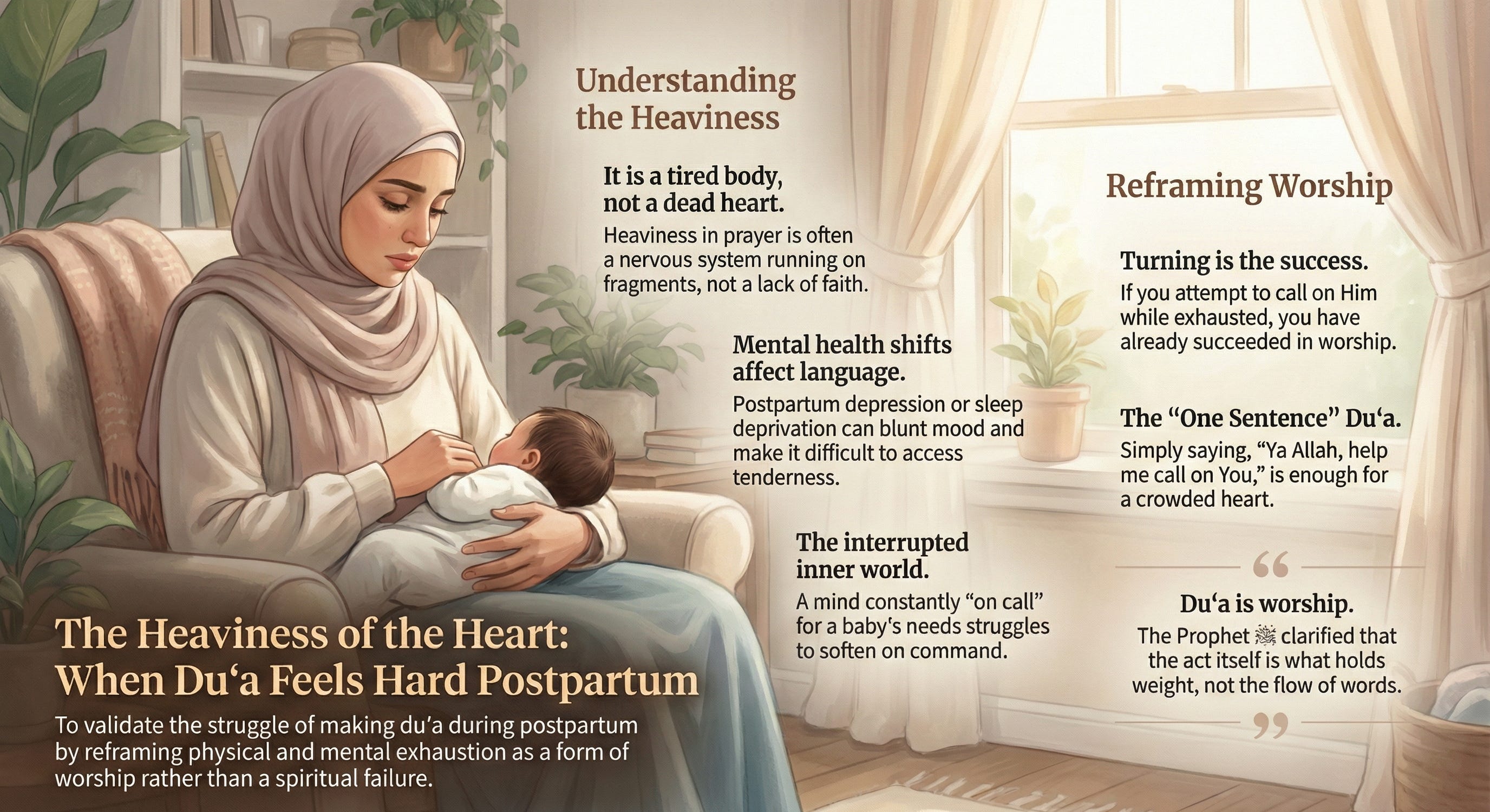
[The baby is on you.
Warm and heavy. That exact weight that makes your arms ache and your heart soften at the same time.
Or the baby is finally asleep and you are scared to move, because sleep is fragile and you do not want to crack it.
You think, now.
Now I will make du‘a.
Not a big du‘a. Just something small. Something honest.
You turn inward, reaching for that familiar handle, and it feels slippery. Not gone. Just harder to grip.
You whisper, “Ya Allah…”
And then the sentence ends right there.
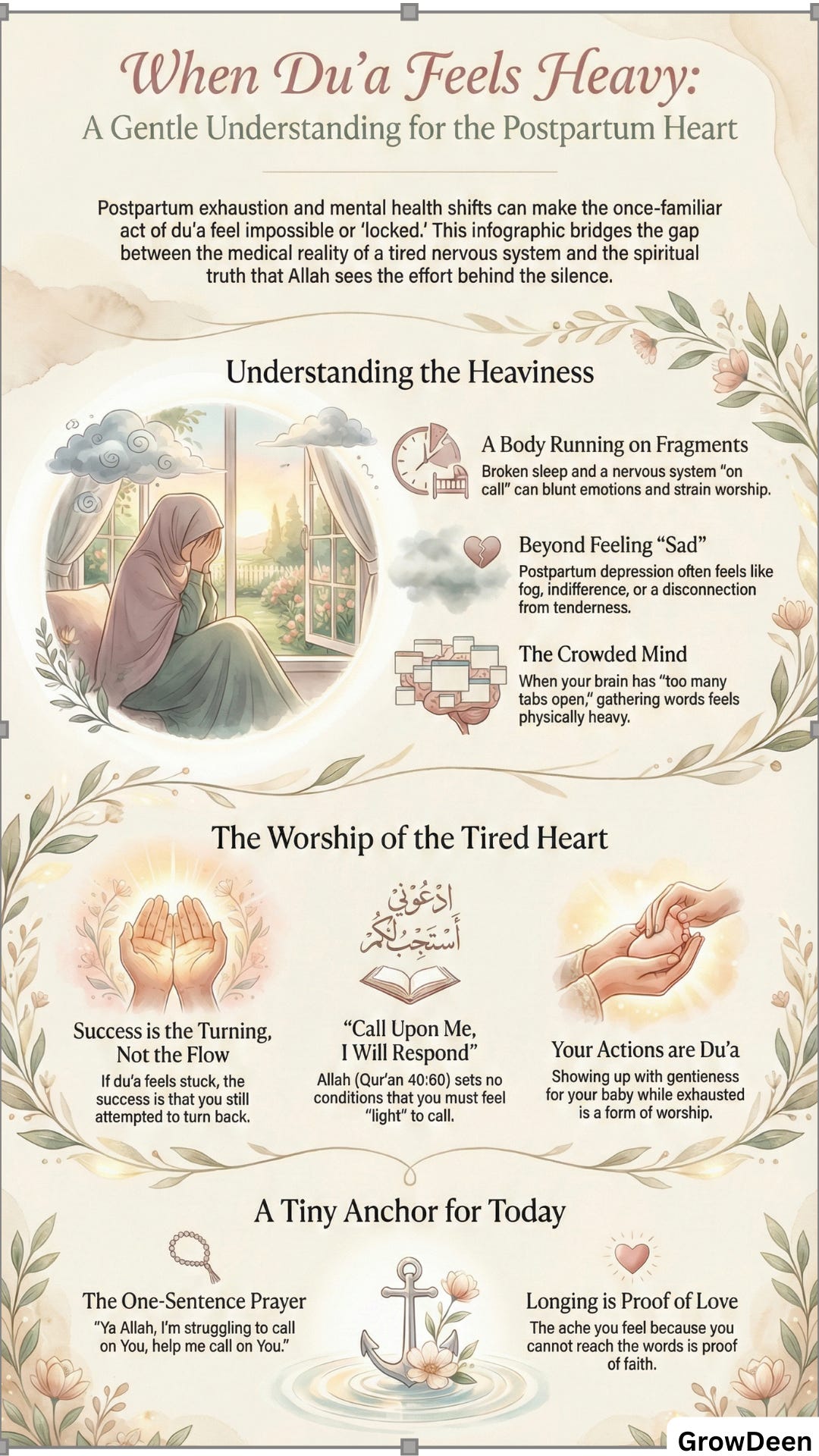
Not because you do not have needs. You have a thousand needs. You just cannot gather them into words. Your brain feels like it has too many tabs open. Your heart feels tired in a way that does not sound poetic.
You try again and the attempt itself feels heavy.
And the thought arrives, almost offended.
Why is it harder now.
When the easiest doorway suddenly feels locked
Du‘a is supposed to be the easiest doorway.
You do not need a clean house. You do not need perfect timing. You do not need to be standing. Your hands can be full. Your hair can be a mess. Your voice can shake.
Allah hears you.
So when turning feels hard, it does not feel like a normal struggle.
It can feel like failing at the one thing that should always be there.
And postpartum life does not help.
Everything is interrupted. Even your inner world is interrupted. Two minutes here. Thirty seconds there. A half thought before the baby stirs. A du‘a cut off by a sound from the other room.
You are constantly listening for needs, even in your own body. A nervous system that is always on call does not always know how to soften on command.
So yes, it hurts.
Not because you stopped wanting Allah.
Because you want Him, and you cannot reach the words that used to carry you.
The hidden reason your heart feels crowded
There is a piece we do not always say out loud.
Sometimes after birth, your mental health shifts the way words come.
Some mothers do not feel “sad,” so they assume they are fine. Yet they feel foggy, flat, overwhelmed, unable to concentrate, unable to access tenderness.
Perinatal and postpartum depression can look like emptiness and disconnection, and it can happen during pregnancy or within the first year after birth. [6] [10]
The APA describes peripartum depression in ways that include indifference and changes in sleep and energy, which can feel more familiar than the word “sad.” [8]
ACOG’s clinical guidance emphasizes screening for mental health conditions during pregnancy and postpartum, including depression and anxiety, because these shifts are common and treatable. [7]
Even without depression, broken sleep alone can blunt mood and strain emotional regulation. It can make everything feel heavier, including worship. [9]
So sometimes this hard du‘a is not a spiritual mystery.
It is a human body running on fragments.
And still, I know, you do not want to be told, “You are human.”
You want to feel Him.
The moment you stop measuring du‘a by flow
Here is the quiet shift that changes the whole room.
Sometimes du‘a feels hard because you have been asking all day already, just not in neat sentences.
You have been making du‘a with your rocking.
With the way you keep showing up when your body is begging you to lie down.
With the way you choose gentleness when you could choose sharpness.
With the way fear and love braid together when you look at your baby, and you keep going anyway.
So when you finally try to speak and it feels heavy, maybe the success is not “pouring out.”
Maybe the success is that you still turned.
Allah says, “Call upon Me, I will respond to you.” (Qur’an 40:60) [1]
No conditions tucked inside the sentence. No demand that you feel light first.
And the Prophet ﷺ said, “Du‘a is worship.” [3]
So even your stuck du‘a, your “Ya Allah” with nothing after it, has weight with Allah.
Worship is not only what flows.
Sometimes worship is what you drag yourself toward.
If this kind of gentle reframing helps you breathe, you can subscribe for free. These are short, lived moments turned into words, so you feel less alone in the stage you are actually in.
Ar Rahman does not shame a tired caller
When the fear shows up, maybe Allah is annoyed with me, I want you to hold something warmer than fear.
The Prophet ﷺ said, “Indeed your Lord is shy and generous. He is shy that when His servant raises his hands to Him, He would return them empty.” [4]
Postpartum sometimes means your hands are full.
Fine.
Let your heart raise what your hands cannot.
And if you are scared that heaviness means distance, remember what Allah already said about Himself.
“And when My servants ask you concerning Me, indeed I am near. I respond to the call of the caller when he calls upon Me.” (Qur’an 2:186) [2]
Near does not always arrive as sweetness in the chest.
Near can be quiet.
Near can be present while you feel flat.
The Prophet ﷺ also said, “Nothing is more honorable to Allah than du‘a.” [5]
So when you feel blocked and still attempt it, when you still want to call even though it is hard, you are not doing something small. You are reaching for something honored.
A single sentence du‘a for the days you cannot form words
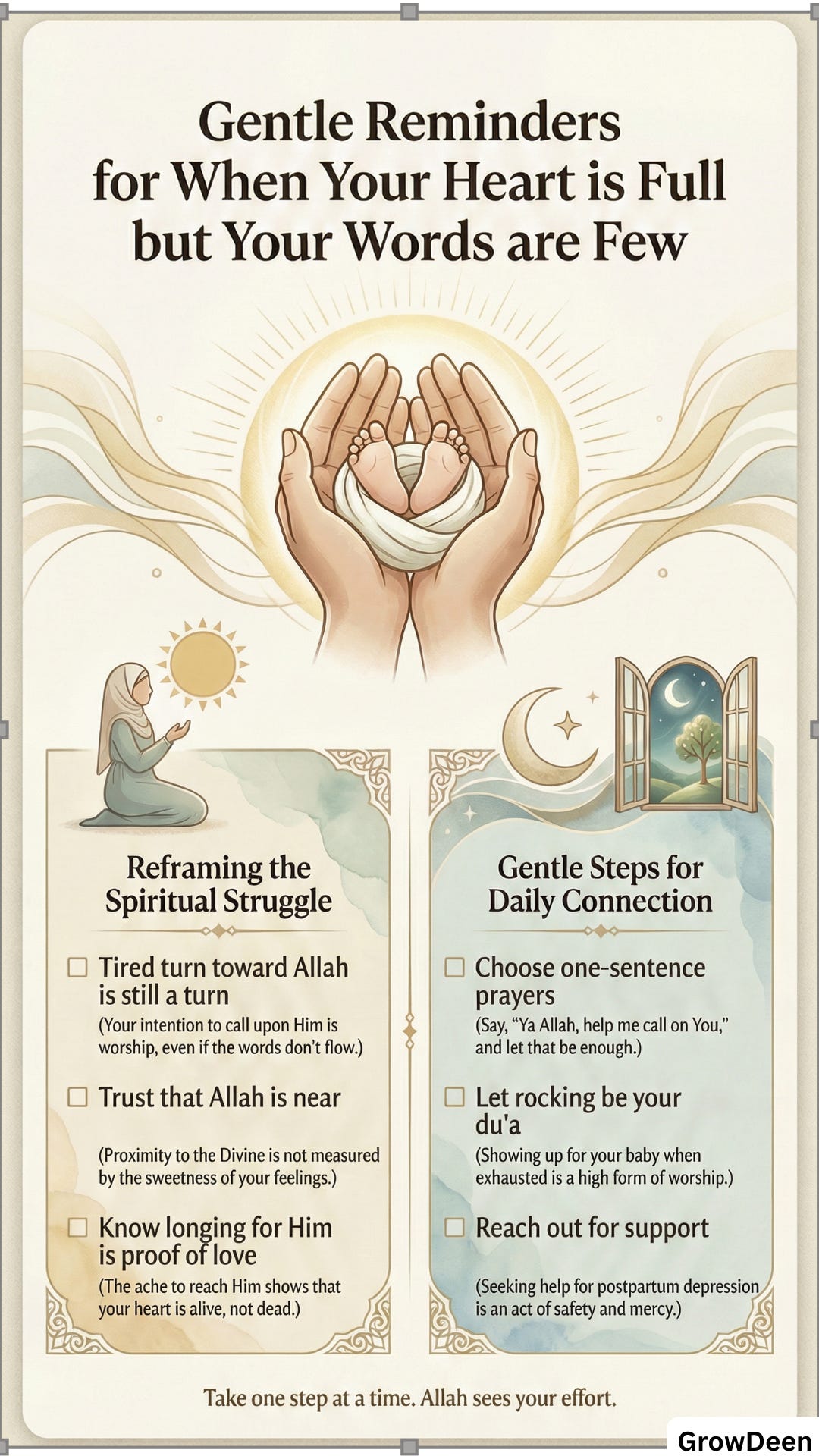
The next time it happens, do not force a long du‘a.
Do not lecture yourself. Do not try to earn softness.
Say one sentence. One.
“Ya Allah, I’m struggling to call on You, help me call on You.”
Then stop.
Let that be enough for that moment.
If you want a tiny anchor from Qur’an, read Qur’an 40:60 once, slowly, like you are letting Allah speak first. [1]
And if this hard du‘a is sitting alongside weeks of numbness, panic, hopelessness, or feeling unlike yourself, please do not carry it alone.
Postpartum depression and anxiety are real and treatable. Seeking support is not a betrayal of faith. It is care for the person Allah entrusted to you. [6] [11] [7]
If you ever have thoughts of self harm or feel unsafe, seek urgent help through local emergency services or a crisis line and contact your healthcare provider. This is safety. This is mercy. [6] [11]
The ending you deserve to hear tonight
This stage messes with time. It messes with emotions. It messes with language.
But it does not erase your relationship with Allah.
A tired turn is still a turn.
A half formed du‘a is still du‘a.
And the longing under the heaviness is not proof of distance.
It is proof of love.
Reflection and Action Gifts
If you’ve reached this part of the page, it tells me something meaningful about you.
You weren’t just skimming words or passing time. You stayed because something here mattered to you.
Because you’re hoping, quietly, that life can feel a little lighter, a little clearer, a little more grounded than it does right now.
That’s why we prepared these Reflection and Action Gifts for you. Not as content. Not as decoration.
But as tools we intentionally created with care, time, and dua, so what you just read doesn’t stay on the page, but gently finds its way into your daily life. These resources were made slowly and thoughtfully, with parents like you in mind.
You’re welcome to save them, print them, revisit them, or place them somewhere you’ll see often.
You can use them quietly on your own, or share them with your family if that feels right.
Our only hope is that they bring you comfort, clarity, and small moments of steadiness in the middle of real life.
May Allah place barakah in your effort, accept your intention, and make what you’re trying to do easier than it feels right now.
📥 Download your Reflection and Action Gifts
This gift pack includes: 👇
Gentle Understanding Card
Gentle Reminders Card
Everyday Reflections Card
Dua Card
If these resources support you even in a small way, I’d love to continue walking alongside you.
When you subscribe, you’ll receive future reflections and practical resources like these, completely free, delivered gently to your inbox as they’re created.
And if you know another parent or mother who might need this right now, please feel free to share or restack this so the benefit can reach them too.
You’re not meant to carry this alone.
Subscribe for free to receive gentle, practical support for real postpartum moments, especially the ones you do not know how to explain out loud.
What makes du‘a feel hardest for you right now, lack of words, fear of being distant, or simple exhaustion.
References
Jami` at-Tirmidhi 3370, “Nothing is more honorable to Allah than du‘a.”
ACOG, Screening and Diagnosis of Mental Health Conditions During Pregnancy and Postpartum
APA, What is Perinatal Peripartum Depression
Tomaso et al., The effect of sleep deprivation and restriction on mood, emotion, and emotion regulation