
When Your Child Says Nothing But Means Everything
Your Response Today Becomes Their Confidence Tomorrow

Warm, attentive communication, listening, and sensitive responses help children feel secure, build strong relationships, and develop communication skills for life.
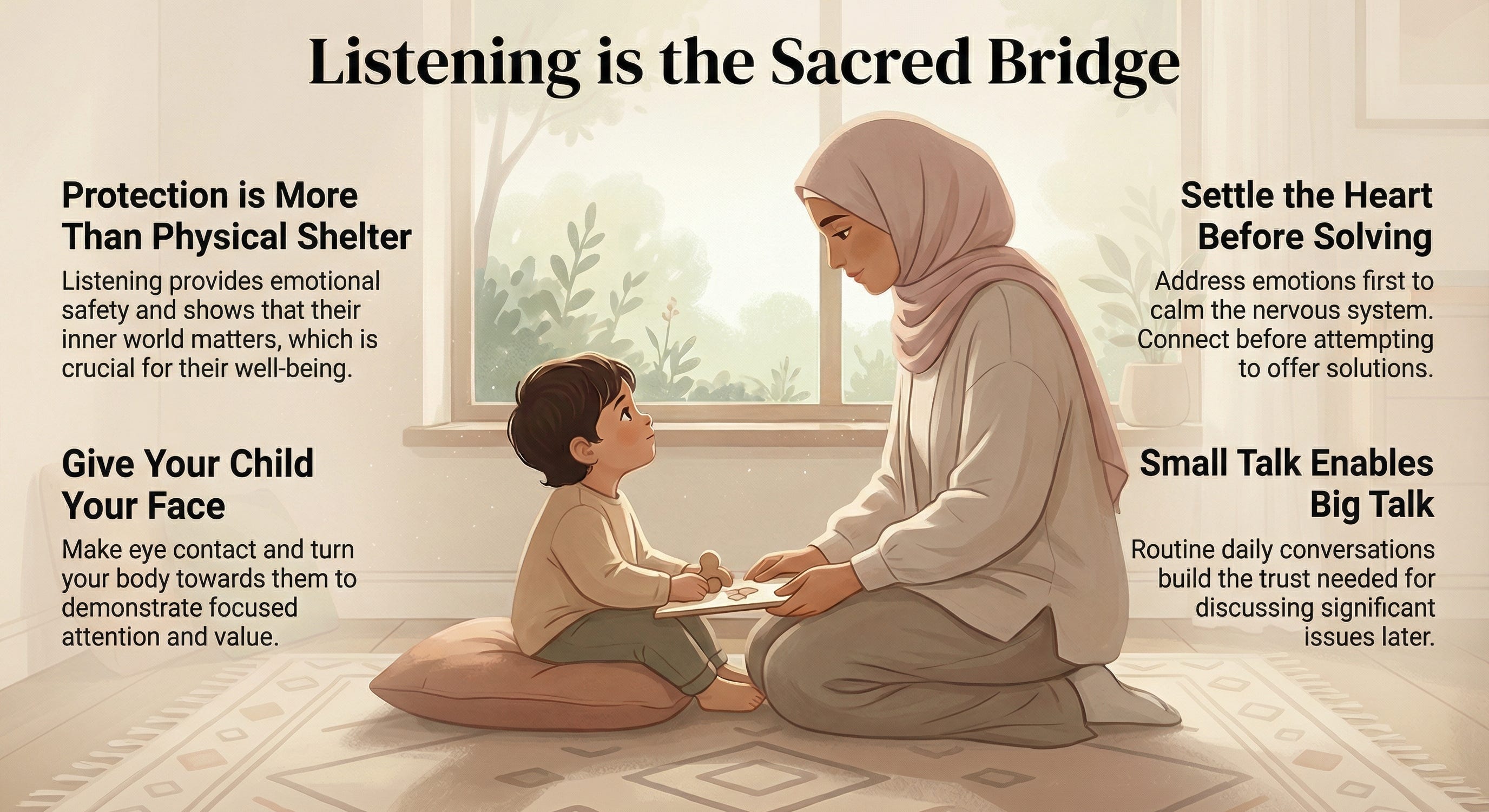
You are halfway through something.
A pot on the stove.
A message you need to answer.
A load of laundry that smells like it will never end.
And your child appears in the doorway with that look.
They start talking, but it comes out tangled.
Or they do not talk at all.
They hover.
They shrug.
They say, Nothing, and you can feel it is not nothing.
You try to respond while your mind is still split into ten pieces.
You nod too quickly.
You say, In a minute.
You say, Not now.
And later, when the house finally quiets down, you remember their face and think, I missed something.
You are not a bad parent for that.
You are just living inside a full life.
But communication is not decoration in family life.
It is the bridge.
It is how your child learns they are safe with you, even when the day is messy.
It is never only about the words
Children communicate from the day they are born. At first it is crying, turning away, reaching, clinging. Later it becomes half sentences, big opinions, awkward pauses, and sometimes silence that has a whole story inside it.
When a child is met with warmth and responsiveness over time, something settles in them. The world feels more predictable. People feel more trustworthy. That felt safety supports development and strengthens the parent child relationship. [2]
This is why the same child can act completely different with different adults. It is not only personality. It is whether they feel held emotionally.
Even when they are testing limits.
Even when they are irritated.
Even when they are acting like they do not care.
Allah’s Protection includes emotional safety
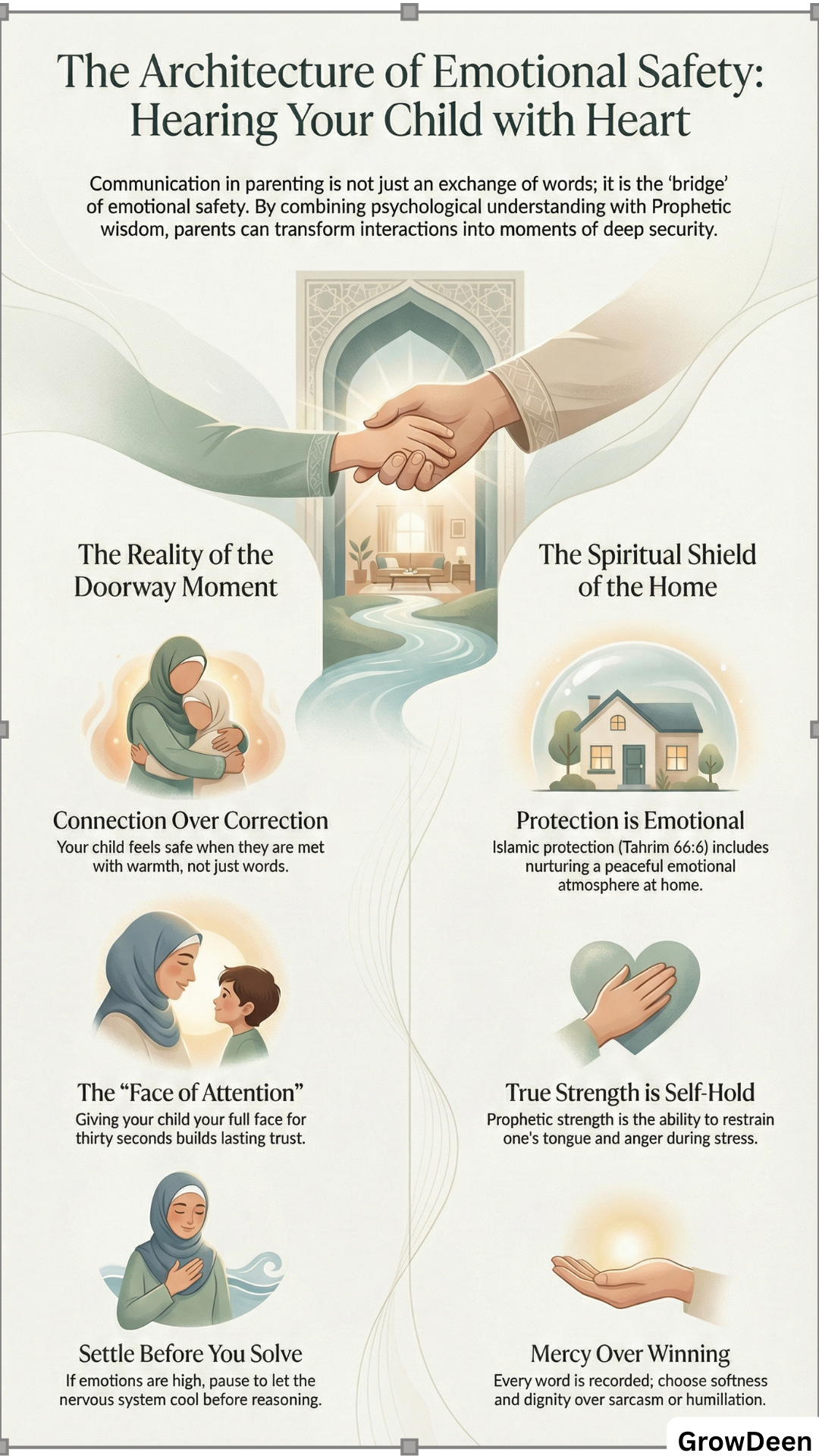
In Islam, caring for your family is not limited to food, clothing, and a roof. Allah commands us to protect our families. [5] That protection includes the emotional atmosphere inside the home.
How you speak.
How you respond to distress.
How you handle anger.
Children learn safety through tone long before they understand logic.
The Prophet ﷺ gave us a definition of real strength that is surprisingly practical for parenting. Strength is not overpowering someone. It is holding yourself when anger rises. [7]
That is communication.
It is not only what you say.
It is what your child feels in your presence.
It is how you say.
Prophet ﷺ said that the most beloved to him and the closest to him on the Day of Resurrection are those with the best character [8]. Good character does not start in public. It starts at home, in the way we speak when no one is clapping for us.
The child who feels heard starts believing in themselves
When a child is listened to with respect, they quietly start collecting an inner message.
I matter.
My feelings make sense.
I can speak and be heard. [2] [3]
That message becomes resilience later. Children who grow up with supportive communication learn how to name feelings, ask for help, and recover after conflict. [2]
They also learn how to speak to others. A child who experiences kindness at home has a stronger blueprint for kindness outside.
Emotion talk matters here too. When parents make room for naming feelings and reflecting them back, children build emotional vocabulary and understanding. [1] [4] They become more able to say, I feel hurt, instead of only showing it through behavior.
The small habits that quietly change everything
Good communication is not a perfect script.
It is a set of small choices you return to, especially on ordinary days.
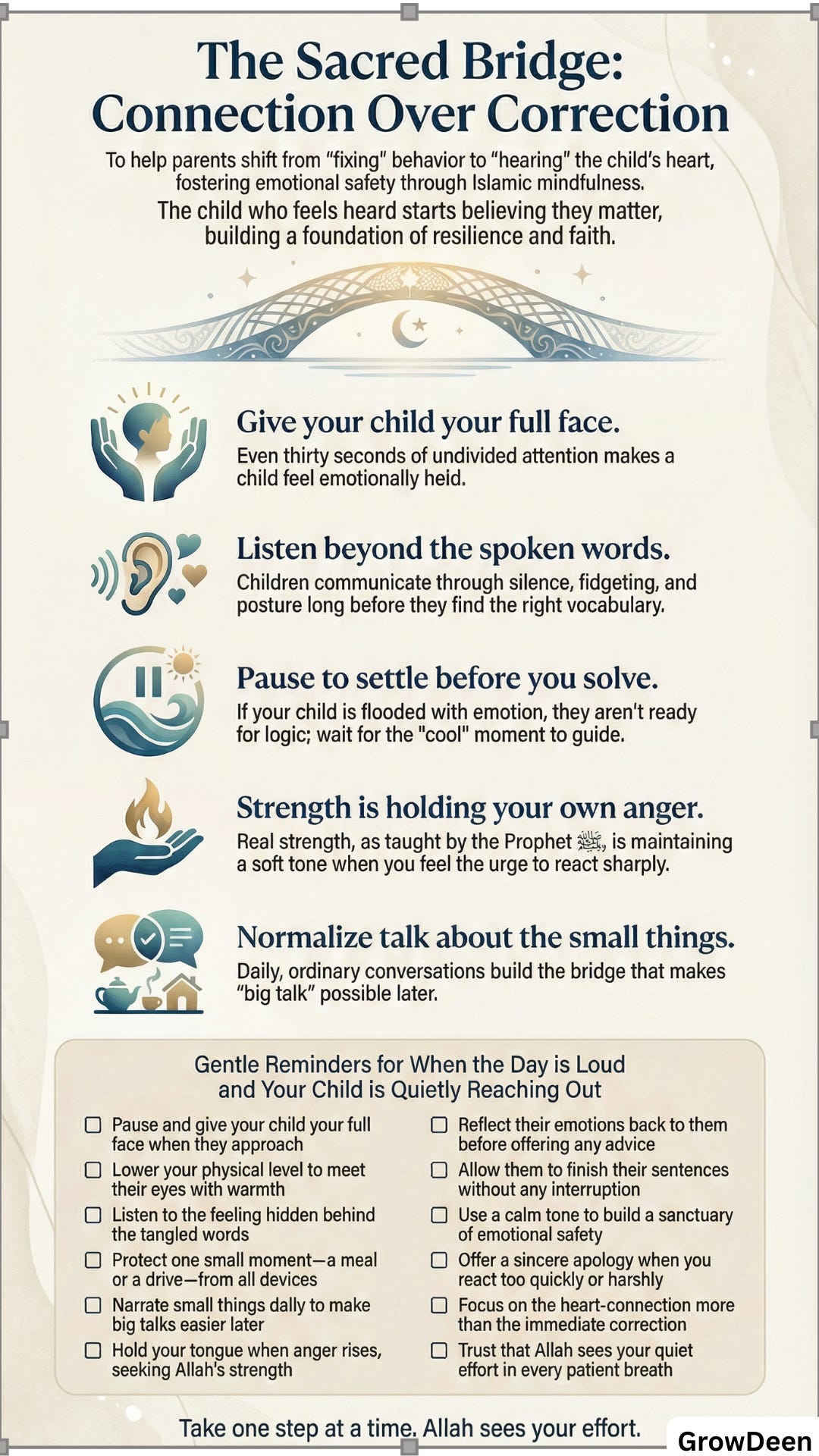
One of the simplest is giving your child your face.
A child can tell when you are half listening. They can also tell when you are truly there, even for thirty seconds.
Family routines can become gentle places for this. Mealtimes, for example, are naturally suited for conversation, but devices can pull attention away and thin out connection even when everyone is sitting together. [6]
This is not a call for guilt. Most parents are trying to survive the day.
But if you choose one moment, one meal, one car ride, one bedtime, and protect it a little, it can become a place where your child starts opening up again.
And there is another habit that matters.
Talk about small things regularly.
When everyday talk is normal, big talk becomes possible.
A child who hears you commenting on the world while cooking or walking is more likely to bring you their own thoughts later, without feeling like it is a dramatic event.
If you want more gentle, realistic support like this, you can subscribe for free. It is simply a way to receive these reminders at the right time, without having to search for them when you are already tired.
When emotions rise, do not solve, settle
There is a moment many parents recognize.
Your child says something sharp.
Or cries loudly.
Or throws a complaint at you like a stone.
And your body wants to respond quickly, to fix, to lecture, or to win.
This is where pausing becomes a form of mercy.
If you are angry, let it cool before you try to solve anything.
If your child is flooded with emotion, they are not ready for reasoning yet.
This is not modern psychology trying to replace faith.
It is simply how Allah created the nervous system.
And our tradition already points us to restraint. The Prophet ﷺ taught about controlling anger and not letting it drive the tongue. [7]
Sometimes the best first response is small and calm.
I see you are upset.
I am here.
We will talk when we are calmer.
That is not permissive. It is protective.
Listening that makes a child soften
Active listening is not complicated, but it is easy to lose when life is loud.
It starts with your body.
Turn toward them.
Lower yourself to their level when you can.
Let your face show attention.
Then listen beyond the words.
Some children speak clearly.
Others communicate through posture, silence, fidgeting, or humor that feels a little too loud.
You can use small prompts that do not take over.
Go on.
Tell me more.
Then reflect what you think you heard.
It sounds like you felt left out.
If you are wrong, let them correct you. That correction is part of their emotional growth.
Try not to interrupt or finish their sentences. Give them time to find words.
And if you can, resist rushing into solutions.
Many children do not want advice first.
They want to feel understood first.
Parents who practice listening and empathy often find that guidance lands more easily because the relationship is warm. [3]
Teaching your child to listen starts with how you listen
Children learn listening by being listened to.
That is not a slogan. It is lived.
If you want your child to pause and hear you, show them what that looks like.
Let them finish.
Respond to the feeling, not only the behavior.
Use language they understand.
Keep instructions clear and age appropriate. One step at a time for younger children.
When correction is needed, keep it inside warmth. Children absorb praise more easily than blame, and positive connection helps correction feel like guidance, not rejection. [2] [3]
And keep the spiritual awareness close, gently, not fearfully.
Allah reminds us that every word is recorded. [10]
That does not mean you become tense.
It means you become careful.
Softness over sarcasm.
Dignity over humiliation.
Mercy over winning.
You will still have hard moments.
You will still say the wrong thing sometimes.
Repair is part of communication too.
A sincere apology to a child can heal more than a long explanation.
And if you find that warmth feels hard to access lately, or most of your interactions are tense, it is worth seeking support from a health professional or counsellor. Getting help is not failure. It is care.
Allah’s Gentleness meets you in your imperfect efforts
There is something I want you to hold close before you scroll away.
If you are trying to communicate well with your child, you are already doing something brave.
Because it requires patience.
It requires humility.
It requires you to notice yourself.
And Allah does not burden a soul beyond what it can bear. [9]
Some days you will do beautifully.
Some days you will do barely enough.
Both days can still be accepted by Allah when you keep returning with sincerity.
May Allah place barakah in your words, soften your home, and make your child a comfort to your eyes. Ameen.
Gifts For You, Dear Parent
If you’ve reached this part of the page, it tells me something meaningful about you.
You weren’t just skimming or passing time. You stayed because something here felt relevant to your real life.
Because you care.
Because you want to do things with more awareness.
Because you’re trying, even when it feels overwhelming.
That is not small.
So I didn’t want this article to remain just words on a page. I wanted it to gently step into your daily life in practical ways. That’s why we prepared these Life Gifts for you.
Not as extras.
Not as decorations.
But as simple tools to help you hold onto what mattered most in what you just read.
Here’s what you’ll find inside:
Gentle Understanding Card
A clear and simplified summary of the core concept from this article, so you can revisit the main idea anytime without rereading everything.
Heartfelt Dua Card
A carefully chosen dua connected to this stage of life, because we know that real strength and ease ultimately come from Allah’s help.
Gentle Actions Card
Practical examples to help you translate knowledge into action, so what you learned becomes part of your daily rhythm.
Gentle Reminders Card
Short, steady reminders drawn from the key points, designed to be printed or saved and placed somewhere you’ll see often.
These were designed slowly and thoughtfully, with time, care, and sincere dua. We created them because we genuinely want to walk alongside you, not just through one article, but through every stage of this lifelong journey.
If these gifts support you even in a small way, I would love for you to continue receiving them.
Subscribe so that each new Gift arrives directly in your inbox whenever we release the next stage. That way, you won’t miss the tools designed to support you right where you are.
May Allah(swt) place barakah in your effort, accept your intention, and make this path easier and more rewarding than it feels right now.
Please share it with a family or friend who may benefit from this knowledge.
In the comments, what is one small change in your listening that you feel ready to try this week?
References
[1] Bayley, R., and Margetts, K. (2011). Exploring emotions: How you can help children to recognise and talk about their feelings. MA Education.
[2] Brooks, R.B. (2023). The power of parenting. In S. Goldstein and R.B. Brooks (Eds.), Handbook of resilience in children (pp. 297–314). Springer, Cham.
[3] Faber, A., and Mazlish, E. (2012). How to talk so kids will listen and how to listen so kids will talk. Simon and Schuster.
[4] Hernandez, E., Carmichael, K., and Dunsmore, J.C. (2021). Toward integrating research on parent child emotion talk and linguistic theory: A spotlight on parents’ (in)direct communication. Social Development, 30(1), 38–56.
[5] Qur’an 66:6.
[6] Chitakunye, P., and Takhar, A. (2014). Consuming family quality time: The role of technological devices at mealtimes. British Food Journal, 116(7), 1162–1179.
[7] Sahih al Bukhari 6114. and Sahih Muslim 2609.
[9] Qur’an 2:286.
[10] Qur’an 50:18.