
When Your Child Is Not Naughty, Just Overloaded
Your Child Does Not Need A Lecture, They Need A Reset

Overstimulation is often a child’s overwhelmed nervous system, and with calm breaks, predictable rhythms, and gentle parenting, they slowly learn how to return to steady again.
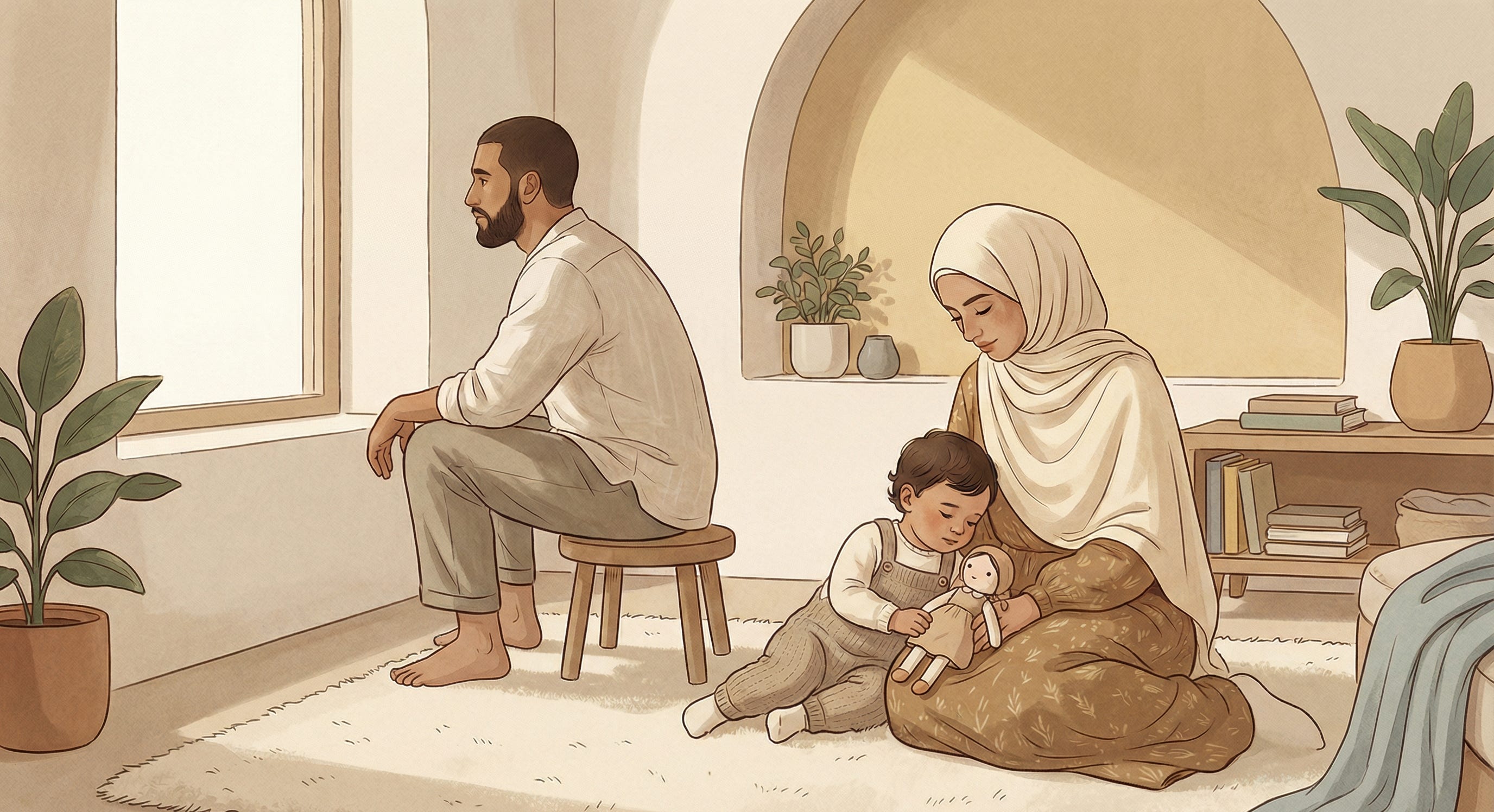
It happens right when you least expect it.
The outing was fine. The visit was fine. The child was even smiling.
Then you walk through your front door and it is as if everything collapses at once.
Shoes feel impossible. Dinner feels like an insult. A simple question sets off tears or shouting. Your baby cries the moment you try to put them down. Your toddler melts onto the floor like their bones disappeared. Your older child looks at you with that hard, prickly face and suddenly nobody is okay.
If you have ever thought, what just happened, I want to sit with you for a moment.
Sometimes it is not bad behaviour.
Sometimes it is too much.
It was too much before you noticed
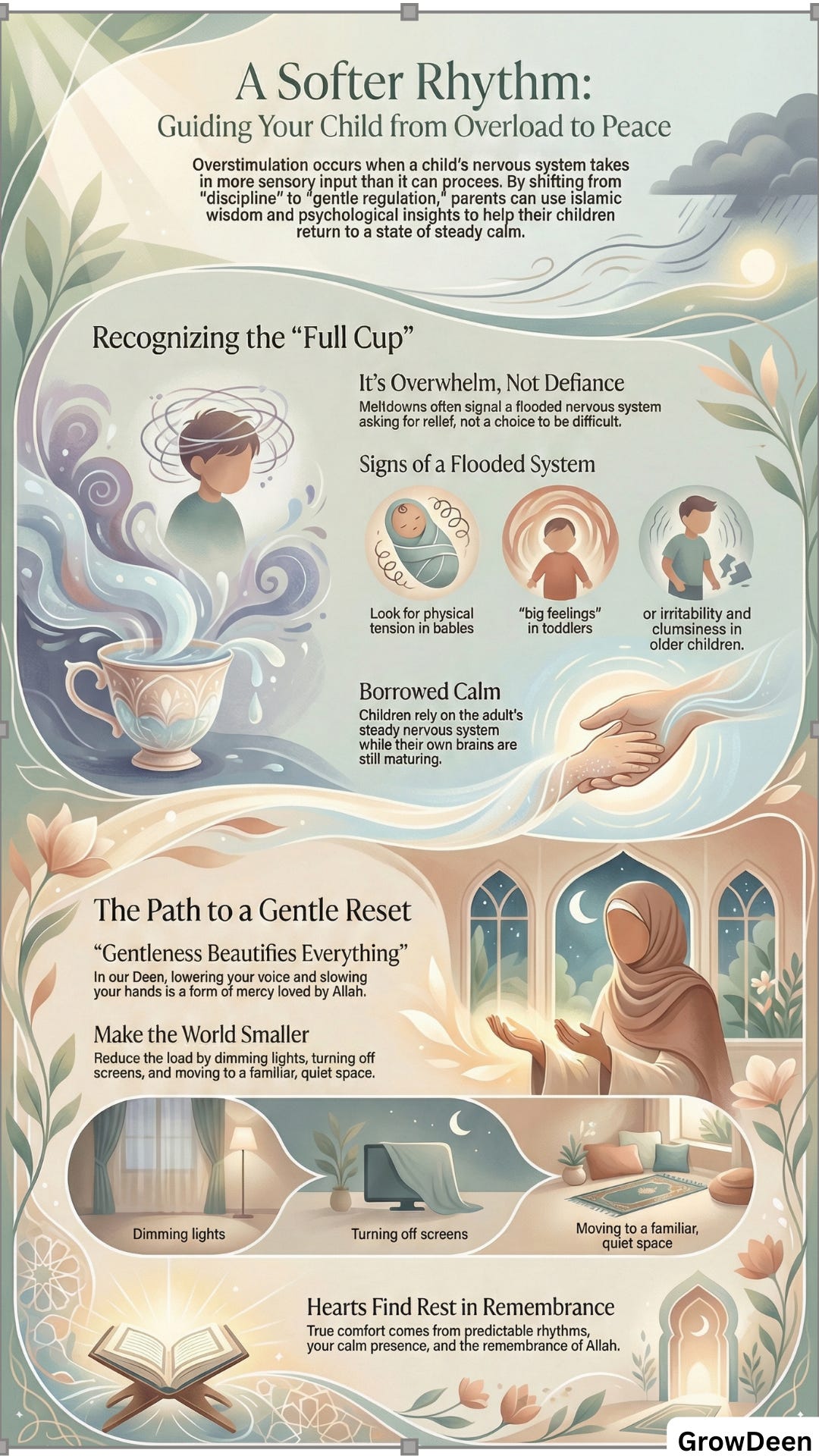
Overstimulation is what happens when a child takes in more input than their little system can hold.
Noise. movement. faces. errands. bright lights. lessons. screens. transitions. even excitement.
A child can look happy while their cup is filling, then fall apart when the body finally says, I cannot take in one more thing.
A newborn might manage the first few minutes of being passed around, then suddenly cry in a way that keeps climbing.
A toddler might cope during a busy outing, then explode in the car seat or at home.
A school age child might come home from school and become clumsy, irritable, or unusually needy.
They are not always trying to be difficult.
Their nervous system is asking for relief and it does not have better words.
Early childhood development texts and infant mental health work both describe how regulation is still forming in these early years, and how children borrow calm from the adults around them while their brains mature through experience [1] [2].
Allah loves gentleness when things get messy
There is a kind of mercy that looks like lowering your own voice.
Slowing your hands.
Changing the environment instead of correcting the child.
In our deen, gentleness is not a soft personality trait. It is something loved by Allah and something that beautifies what it touches [3].
Overstimulation moments are exactly where gentleness matters, because the child is already flooded.
You do not need to win the moment.
You need to guide the nervous system back to steady.
The signs look different in every age
You will learn your own child’s signals with time, but there are some patterns that show up again and again.
With babies, the signs are often physical.
Turning the head away. looking tired but unable to settle. jerky movements. clenched fists. frantic kicking. crying that feels sharp and escalating [4].
With toddlers and preschoolers, it often looks like big feelings with tiny language.
Refusing shoes. screaming at the seatbelt. collapsing on the floor. hitting. throwing. insisting on something that makes no sense. not because they are plotting, but because they are flooded [2].
With school age children, it can be quieter.
More irritability. more mistakes. more spills. more arguing over small things. sudden clinginess. complaining about food. wanting screens but acting worse afterward. moving from room to room like they cannot land.
A child can be overstimulated even when they are not loud.
Sometimes the loudness comes later.
What children need when the cup spills
When a child is overloaded, they usually need a softer world.
Not a lecture.
Not a long explanation.
Not more input.
Quiet. familiarity. predictable steps. your calm presence.
This is where the skill is not in clever parenting.
It is in reducing the load.
If you want a simple internal script for yourself, keep this one close.
This is not defiance.
This is overwhelm.
My job is to make the world smaller for a moment.
Babies: soften everything you can
With babies, start small.
Lower your voice.
Slow your movements.
Bring your face closer, not louder.
If you are out, move your baby to a quieter spot. If people are passing them around, it is okay to say no. You can smile and say, we need a little break right now.
At home, dim the room. reduce handling. keep things steady.
Some babies calm with an appropriate wrap or swaddle, as long as it is used safely and stopped when they show signs of rolling.
Some calm best with closeness in a carrier against your body while you move gently through the house.
For many babies, your steadiness becomes a kind of support system their body cannot create yet [2] [4].
Toddlers: calm first, words later
This age can feel like living with a storm.
Their feelings arrive faster than their language, and when they are overstimulated, even a small request can feel like pressure.
If you can do one thing, let it be this.
Steady yourself first.
Not perfectly. just enough.
Then reduce input.
Turn off screens. lower noise. move away from crowds. get to a familiar space.
Some toddlers settle with closeness. sitting beside them. holding them. rubbing their back.
Some need space but still need to know you are near.
When the intensity begins to drop, you can name it simply, like you are adding subtitles.
That was a lot today.
Too many things at once.
We need quiet now.
Not as a lesson. as comfort.
After they settle, do not rush back into demands. Give them a little time to be alone with a toy or a book, to come back into their body at their own pace [2].
Screens deserve a gentle mention too. Some children look quiet on a screen but their brains stay switched on. Studies on technology and play describe how screens can change the way children engage and regulate, and many parents notice overstimulation effects especially close to bedtime [5].
If you see that pattern, you are not imagining it.
School age kids: teach the reset, not the shame
Older children can start learning their own signals.
But they still need you to show them that needing a reset is normal.
You might say:
You seem a bit overloaded.
Want ten quiet minutes before we talk about anything.
Do you want alone time or together time.
A predictable reset helps. a snack. a shower. a quiet corner. a book. building something. simple movement outside.
Some families like mindfulness style practices, and some school programs show benefits for stress and wellbeing in children [6]. If you use it, keep it light and optional. Not as a performance. Just as a tool.
The real goal is not a perfect calm child.
It is a child who learns, slowly, what helps them return to steady.
Building a wiser rhythm for your specific child
Different children tolerate different levels of stimulation. temperament plays a role.
Your job is not to turn your child into someone else.
Your job is to notice what this child can hold, and build a wise rhythm around it.
That means daily quiet time that is separate from sleep, especially for younger children.
It means fewer transitions when possible.
It means leaving the gathering before they break, not after.
It means choosing one or two activities they truly enjoy, instead of stacking their week until they cannot breathe.
This is not spoiling.
This is parenting with insight.
Mary Sheridan’s developmental work emphasizes both stimulation and the need for settling and integration in early childhood development. children need input and they need recovery [1].
And as Muslim parents, we already understand something similar. hearts do not stay steady without returning.
Allah tells us, “Surely in the remembrance of Allah do hearts find comfort.” [7]
A child’s version of that comfort might be a dim room, your calm voice, the same bedtime routine, a familiar book, or simply sitting near you while nothing much happens.
If you want to keep receiving gentle, practical parenting support like this for real life moments, you are welcome to subscribe for free. Not because you need one more thing to do, but because it helps to have words like this waiting for you before the next hard moment.
A quiet ending, for the parent who tries
If you are reading this after a meltdown, please do not judge the whole day by the hardest ten minutes.
Overstimulation does not mean your child is broken.
It means their cup was full.
And you are learning how to notice sooner, soften sooner, and reset together.
May Allah give you insight into your child’s needs, and gentleness in your hands and voice.
Rabbana hablana min azwajina wa dhurriyyatina qurrata a yun, waj alna lil muttaqina imama [8].
Gifts for You, Dear Parent
If you’ve reached this part of the page, it tells me something meaningful about you.
You weren’t just skimming or passing time. You stayed because something here felt relevant to your real life.
Because you care.
Because you want to do things with more awareness.
Because you’re trying, even when it feels overwhelming.
That is not small.
So I didn’t want this article to remain just words on a page. I wanted it to gently step into your daily life in practical ways. That’s why we prepared these Life Gifts for you.
Not as extras.
Not as decorations.
But as simple tools to help you hold onto what mattered most in what you just read.
Here’s what you’ll find inside:
Gentle Understanding Card
A clear and simplified summary of the core concept from this article, so you can revisit the main idea anytime without rereading everything.
Heartfelt Dua Card
A carefully chosen dua connected to this stage of life, because we know that real strength and ease ultimately come from Allah’s help.
Gentle Actions Card
Practical examples to help you translate knowledge into action, so what you learned becomes part of your daily rhythm.
Gentle Reminders Card
Short, steady reminders drawn from the key points, designed to be printed or saved and placed somewhere you’ll see often.
These were designed slowly and thoughtfully, with time, care, and sincere dua. We created them because we genuinely want to walk alongside you, not just through one article, but through every stage of this lifelong journey.
If these gifts support you even in a small way, I would love for you to continue receiving them.
Subscribe so that each new Gift arrives directly in your inbox whenever we release the next stage. That way, you won’t miss the tools designed to support you right where you are.
May Allah place barakah in your effort, accept your intention, and make this path easier and more rewarding than it feels right now.
Please share it with a family or friend who may benefit from this knowledge.
What is one moment with your child that feels hardest lately, and what kind of support would make it feel lighter?
References
[1] Sharma, A., Cockerill, H., & Sanctuary, L. (2023). Mary Sheridan’s From Birth to Five Years: Children’s Developmental Progress (5th edn). Routledge. https://www.routledge.com/Mary-Sheridans-From-Birth-to-Five-Years-Childrens-Developmental-Progress/Sharma-Cockerill-Sanctuary/p/book/9780367522513
[2] Mares, S., Newman, L., & Warren, B. (2011). An Introduction to Clinical Skills in Infant Mental Health: The First Three Years (2nd edn). Australian Council for Educational Research. https://search.informit.org/doi/10.3316/INFORMIT.9780864319661
[3] Sahih Muslim 2594a. Kindness adds beauty and its absence leaves things flawed. https://sunnah.com/muslim:2594a
[4] Douglas, P. (2014). The Discontented Little Baby Book (revised edn). University of Queensland Press. https://www.uqp.com.au/books/the-discontented-little-baby-book-revised-edition
[5] Slutsky, R., & DeShetler, L. M. (2016). How technology is transforming the ways in which children play. Early Child Development and Care. https://www.tandfonline.com/doi/full/10.1080/03004430.2016.1157790
[6] Weijer Bergsma, E., Langenberg, G., Brandsma, R., Oort, F., & Bögels, J. (2014). School based mindfulness training to prevent stress in elementary school children. Mindfulness, 5(3), 238 to 248. https://doi.org/10.1007/s12671-012-0171-9
[7] Qur’an 13:28. https://quran.com/en/ar-rad/28
[8] Qur’an 25:74. https://quran.com/25/74