
When Your Baby Starts Looking at You Like They Know You
What Your Baby Is Really Learning In These Early Weeks

Between two and three months, babies become more socially expressive, more physically active, and more responsive to faces, voices, and play, while still needing steady comfort, safety, and early support when concerns appear.
One day you notice it.
Your baby looks at you, and it does not feel random anymore.
There is a pause. A little stare. A tiny sound that seems to come after your voice, not before it. Maybe even the beginning of a smile.
And your heart softens for a second.
Then, five minutes later, the fussing starts again. The tiredness hits again. The house still feels upside down. You are still carrying a baby who needs you for almost everything.
This stage is like that.
More sweetness. More signs. More personality.
And still, a lot of crying. A lot of repetition. A lot of you giving from a body that is still tired.
Your baby is more “there” now
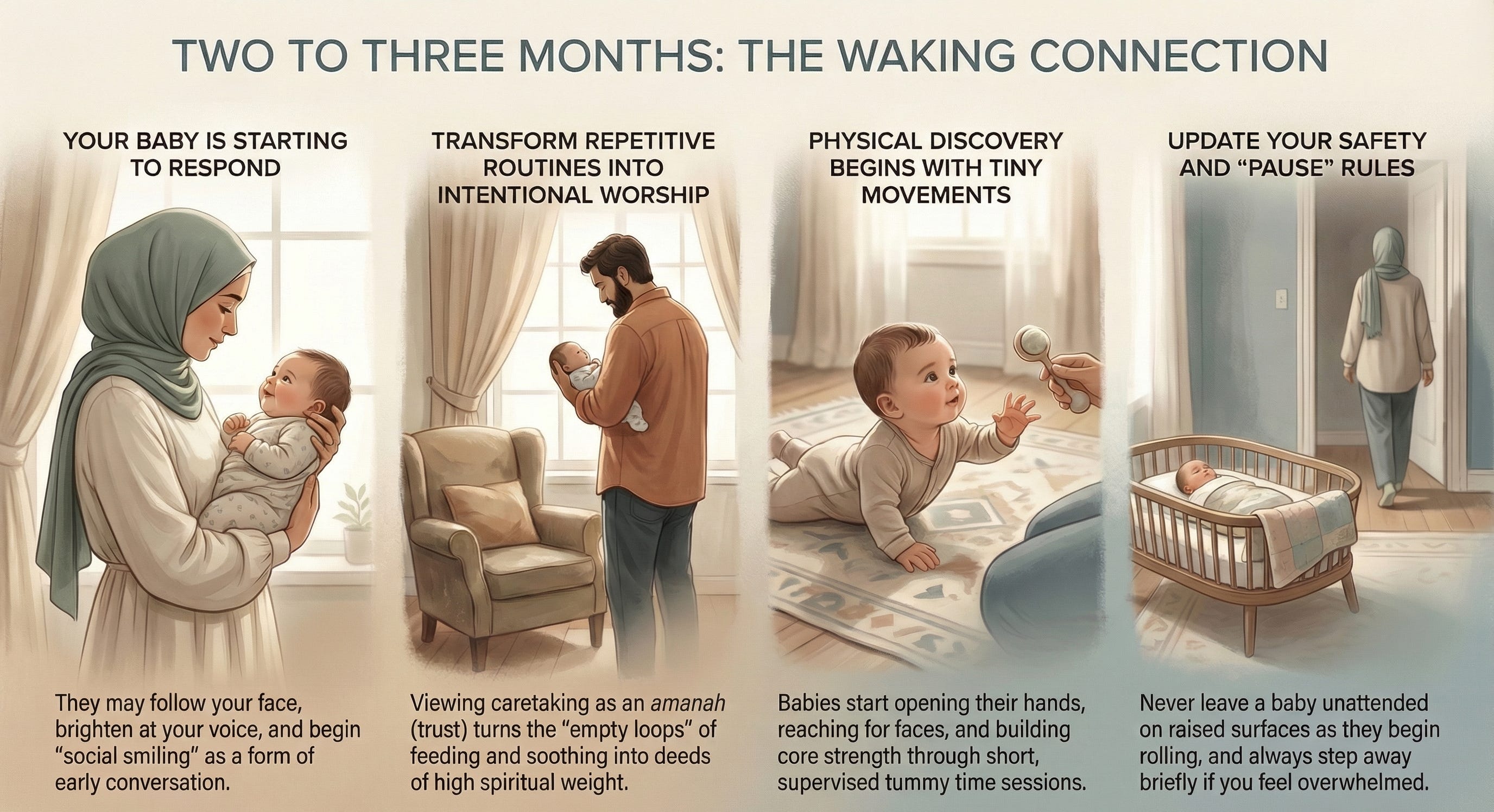
By two to three months, many babies feel more present.
They are not only drifting between feeds and sleep anymore. They look more. React more. Kick more. Make more little noises that feel strangely personal. [1] [2]
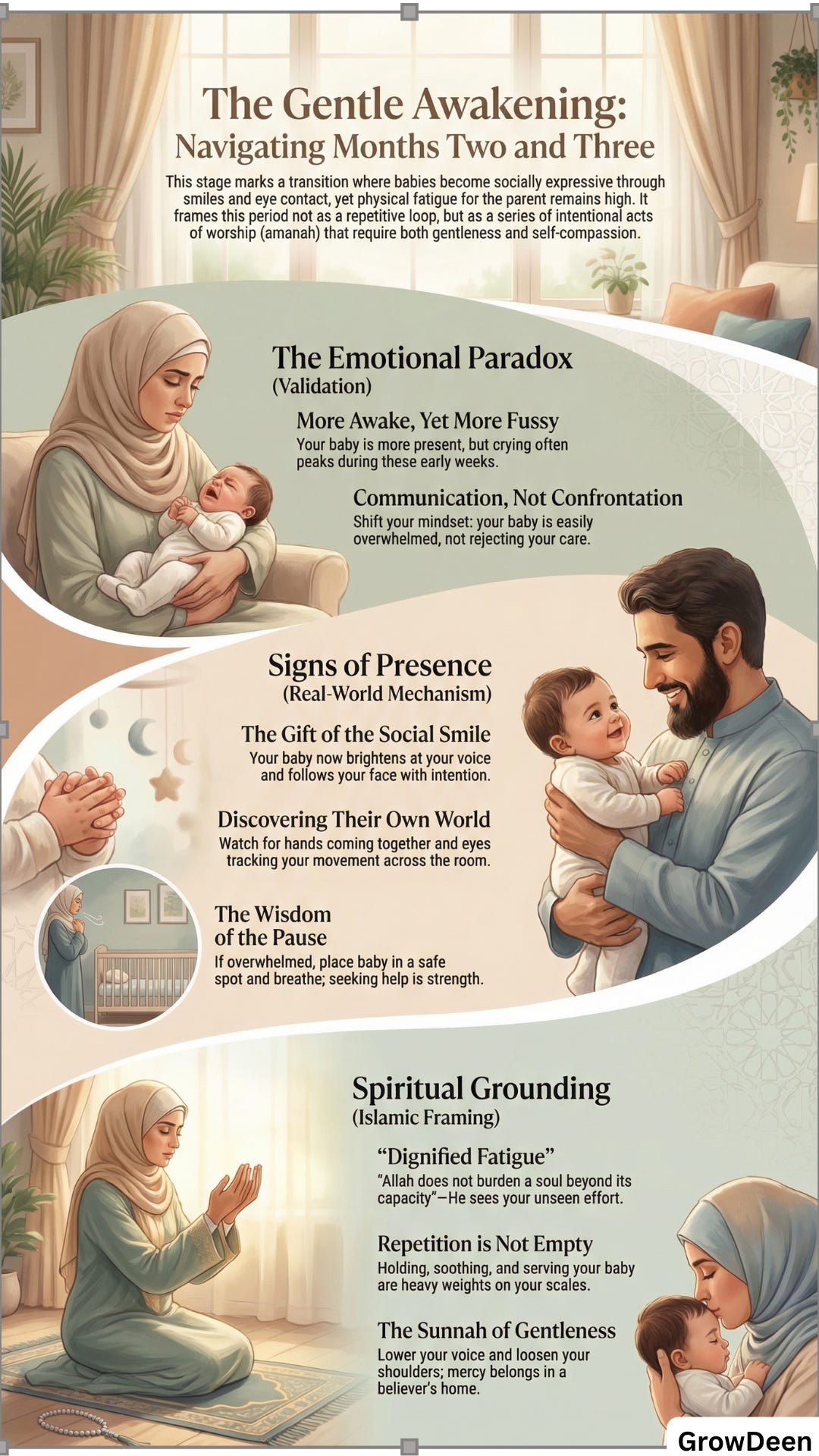
They may follow your face with their eyes. They may brighten when they hear your voice. Some babies start smiling socially around this period, and those moments can feel like a gift after some very long weeks. [2] [3]
That does not mean life suddenly becomes easy.
It just means the connection becomes easier to see.
The crying can still be hard, and still be normal
A lot of parents get discouraged here because the baby seems more awake, but also more fussy.
That makes sense.
Crying can still be intense around this age. For many babies, fussiness peaks earlier, around six to eight weeks, then starts easing over the following weeks. [4] Knowing that does not magically make the crying light. But sometimes it helps a parent stop blaming themselves.
This is one of those places where a gentle mindset shift matters.
Not, My baby is rejecting everything.
More like, My baby is still very young, still overwhelmed easily, still learning how to be in the world.
That shift protects your heart.
Allah’s mercy is in the repetition too
These days can feel so repetitive that you almost stop seeing them.
Feed. Hold. Soothe. Burp. Rock. Try again.
But for a Muslim parent, these are not empty loops.
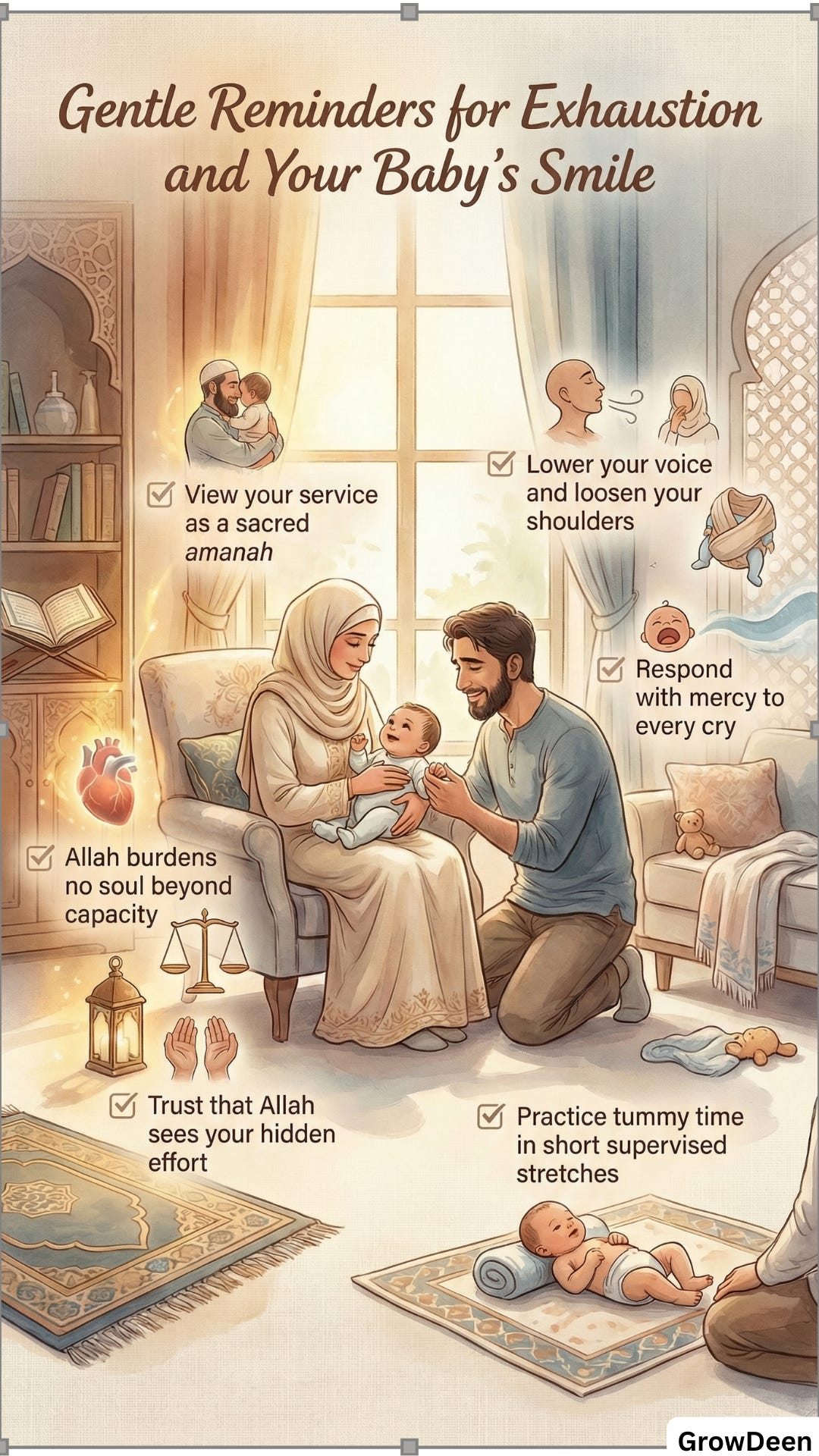
The Prophet ﷺ taught that actions are judged by intentions. [5] So if you are holding your baby with mercy, serving them as an amanah, and trying again for Allah’s sake, then even these quiet routines carry weight.
And when you feel like you are near your edge, Allah’s words remain true whether your room is peaceful or full of crying.
Allah does not burden a soul beyond its capacity. [6]
That verse does not deny your exhaustion.
It dignifies it.
The tiny things that build a baby
At this age, development still grows through very simple things.
Holding your baby helps them feel safe. Talking to them helps them soak in sounds and rhythms. Smiling at them strengthens connection. Reading, singing, and even repeating the same silly phrase each day all become part of their emotional world. [1] [7]
Tummy time still matters too. Short, supervised stretches help build the head, neck, shoulder, and upper body strength your baby will need later. [2] [3] [7]
And eye contact is not “just sweet.” When your baby watches your face or follows your movement, they are building attention, early social connection, and visual tracking. [2] [3]
Some babies also begin opening their hands more, bringing both hands together, staring at their fingers, or reaching toward your face. Their body is slowly discovering itself. [2] [3] [7]
You do not need a complicated routine for this season.
You need steadiness.
You need simple play.
You need enough softness to notice when your baby is saying, That is enough for now.
Looking away, fussing harder, going still, arching, those cues matter. When you respond to them, your baby learns something very deep.
My needs reach someone.
If reminders like this would help you on tired days, you can subscribe for free so each new article arrives quietly in your inbox when you need it most.
Gentleness is not weakness in this stage
The Qur’an speaks of gentle speech even in hard situations. Allah told Musa and Harun to speak gently even to Fir‘awn. [8]
So what about a tiny baby who is not being difficult, only overwhelmed.
Gentleness belongs here even more.
That does not mean you never feel frustrated. It means frustration is not the one in charge.
A simple self talk line for this stage can be:
My baby is communicating, not attacking me.
And a simple action step when you feel your body tightening can be:
Lower your voice. Loosen your shoulders. Put one hand on your baby gently before you do anything else.
These little resets matter.
The Prophet ﷺ showed tenderness to children, and he made it clear that mercy belongs in the believer’s life. [9]
Safety changes faster than parents expect
If your baby has started rolling, even partly, or twisting more strongly than before, safety changes immediately.
A sofa. A bed. A change table. A moment of “just for a second.”
That is sometimes all it takes.
Never leave your baby unattended on a raised surface.
And another safety line needs to stay plain and clear. Never shake a baby.
If you feel overwhelmed, put your baby in a safe place and step away briefly. Breathe. Make a call. Ask for help. The Prophet ﷺ said there should be neither harming nor reciprocating harm. [10]
Sometimes the safest parent is not the calmest one.
It is the one who knows when to pause.
Trust your concern before it turns into silent worry
You know your baby best.
If something feels off, it is worth paying attention. Early developmental surveillance exists for exactly this reason, so families do not have to sit for months with silent concern. [2]
At around three months, it is worth speaking to your nurse, GP, or doctor if your baby does not look into your eyes even briefly, does not pay attention to faces, does not make sounds when you speak, does not react to loud noises, is not feeding well, seems unusually tired, does not smile when spoken to, or feels very floppy or very stiff. [2] [3] [7]
And if your baby loses a skill they once seemed to have, that deserves attention too. [3] [7]
Please do not overlook yourself in this.
If you are dealing with postnatal anxiety or depression, that matters deeply. Support for the parent is support for the baby too. [1]
Seeking help is not weak tawakkul. It is part of taking the means and then trusting Allah. [11]
And through all of this, patience is not passive. It is steady, faithful effort.
Indeed, Allah is with the patient. [12]
So if these weeks feel both beautiful and heavy, that does not mean you are doing it wrong.
It means you are in it.
And Allah sees the work no one else fully sees.
GIFTS FOR YOU, DEAR PARENT
If you’ve reached this part of the page, it tells me something meaningful about you.
You weren’t just skimming or passing time. You stayed because something here felt relevant to your real life.
Because you care.
Because you want to do things with more awareness.
Because you’re trying, even when it feels overwhelming.
That is not small.
So I didn’t want this article to remain just words on a page. I wanted it to gently step into your daily life in practical ways. That’s why we prepared these Life Gifts for you.
Not as extras.
Not as decorations.
But as simple tools to help you hold onto what mattered most in what you just read.
Here’s what you’ll find inside:
Gentle Understanding Card
A clear and simplified summary of the core concept from this article, so you can revisit the main idea anytime without rereading everything.
Heartfelt Dua Card
A carefully chosen dua connected to this stage of life, because we know that real strength and ease ultimately come from Allah’s help.
Gentle Actions Card
Practical examples to help you translate knowledge into action, so what you learned becomes part of your daily rhythm.
Gentle Reminders Card
Short, steady reminders drawn from the key points, designed to be printed or saved and placed somewhere you’ll see often.
These were designed slowly and thoughtfully, with time, care, and sincere dua. We created them because we genuinely want to walk alongside you, not just through one article, but through every stage of this lifelong journey.
If these gifts support you even in a small way, I would love for you to continue receiving them.
Subscribe so that each new Gift arrives directly in your inbox whenever we release the next stage. That way, you won’t miss the tools designed to support you right where you are.
May Allah place barakah in your effort, accept your intention, and make this path easier and more rewarding than it feels right now.
Please share it with a family/friend who may benefit from this knowledge.
What is one moment with your child that feels hardest lately, and what kind of support would make it feel lighter?
If you would like gentle, benefit focused support for the newborn months, subscribe for free so the next article and the next set of Gifts arrive quietly in your inbox.
References
[1] Center on the Developing Child at Harvard University. Three Principles to Improve Outcomes for Children and Families, 2021 Update. Link
[2] Centers for Disease Control and Prevention (CDC). Important Milestones: Your Baby by Four Months. Link
[3] Duderstadt, K.G., & Keeton, V.F. (2024). Pediatric Physical Examination (4th ed.). Elsevier.
[4] The Royal Children’s Hospital (RCH). Crying and Unsettled Babies, Colic. Link
[5] Hadith: Sahih al-Bukhari 1; Sahih Muslim 1907. Actions are judged by intentions. Bukhari link Muslim link
[6] Qur’an: Surah Al-Baqarah 2:286. Link
[7] World Health Organization (WHO). Improving Early Childhood Development: WHO Guideline: Summary. Link
[8] Qur’an: Surah Taha 20:44. Link
[9] Hadith: Sahih al-Bukhari 5997; Sahih Muslim 2318. Mercy to children. Bukhari link Muslim link
[10] Hadith: Sunan Ibn Majah 2340. There should be neither harming nor reciprocating harm. Link
[11] Hadith: Jami at-Tirmidhi 2517. Tie your camel and trust in Allah. Link
[12] Qur’an: Surah Al-Baqarah 2:153. Link
[13] Kliegman, R.M., & Marcdante, K.J. (2019). Nelson Essentials of Pediatrics (8th ed.). Elsevier.
[14] Sharma, A., & Cockerill, H. (2022). From Birth to Five Years: Practical Developmental Examination (2nd ed.). Routledge.
[15] Sharma, A., Cockerill, H., & Sanctuary, L. (2022). Mary Sheridan’s From Birth to Five Years: Children’s Developmental Progress (5th ed.). Routledge.
[16] Zubler, J.M., Wiggins, L.D., Macias, M.M., Whitaker, T.M., Shaw, J.S., Squires, J.K., Pajek, J.A., Wolf, R.B., Slaughter, K.S., Broughton, A.S., Gerndt, K.L., Mlodoch, B.J., & Lipkin, P.H. (2022). Evidence-informed milestones for developmental surveillance tools. Pediatrics, 149(3), Article e2021052138. Link