
When Your Baby Keeps Slipping Off, It Is Not Your Fault
The Latch Is Not A Talent, It Is Something You Learn Together

A comfortable latch is not about doing everything perfectly, it is about helping your baby take a deeper mouthful so feeding feels gentler for you and more effective for them, with support when you need it.
It is late.
The house is quiet in that newborn way, quiet but not restful.
You finally sit down to feed, and for a second you think, maybe this time it will feel easier.
Then your baby latches and you feel it again. That sharp, toe curling pinch. Your shoulders rise. You hold your breath. You tell yourself to endure it because you just want the baby to eat.
If that is you, I want to say something gently.
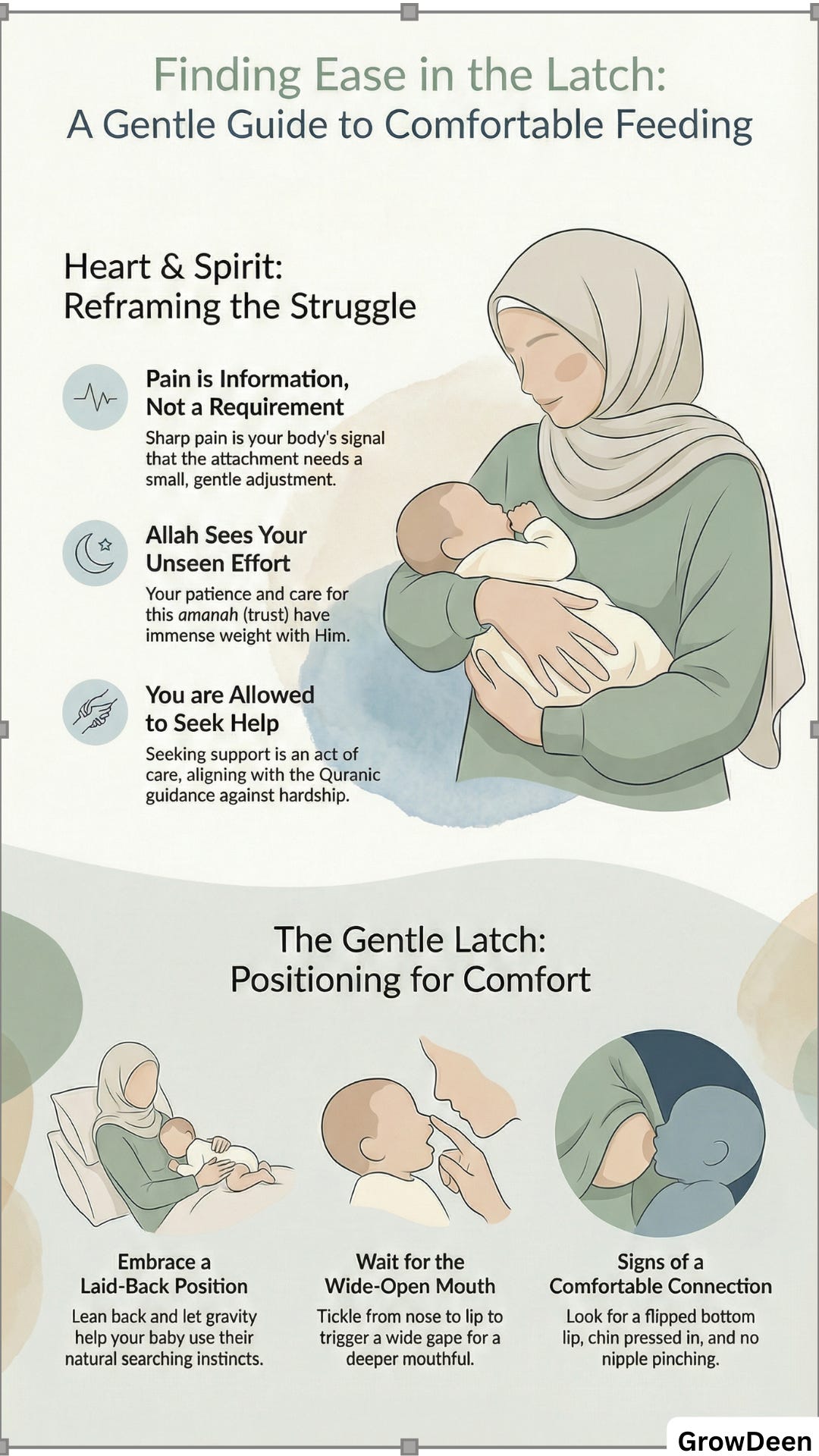
Pain is information.
And you do not have to suffer through it to be a good mother.
A comfortable latch is something you can learn, and most of the time the change is smaller than you think. [2] [3] [7]
The part nobody tells you at the start
Breastfeeding is not just feeding.
It is you and your baby learning each other in real time. On broken sleep. With hormones shifting. With a body still healing.
So if attachment feels confusing, or if you keep thinking, why can’t I just do this naturally, please know this is common.
When the latch is deeper and more comfortable, milk transfer is usually easier, your nipples stay healthier, and feeds often become calmer for both of you. [2] [3] [7]
And if you want help, you are allowed to ask. A midwife, child and family health nurse, GP, or lactation consultant can watch one feed and notice tiny things you cannot see from your own angle. [3] [7] The Australian Breastfeeding Association also has gentle, practical guidance and support options. [2]
Allah sees the unseen effort
In the newborn days, so much of your work happens in quiet corners.
Feeding. Settling. Trying again. Washing up. Starting over.
Allah does not treat that as small.
He reminds us of the mother’s hardship and honour in carrying, giving birth, and raising. “His mother carried him with hardship and gave birth to him with hardship…” [9]
So if you are doing this with the intention to care for the amanah Allah placed in your arms, then your patience, your gentleness, your persistence, all of it has weight with Him, even when nobody claps for it.
When babies lead, sometimes it gets softer
Some mothers find relief when they stop trying to “place” the baby and instead let the baby’s instincts do more of the work.
This is often called baby led attachment. You create the conditions, and your baby searches, nudges, opens wide, and attaches with less forcing from you. [7]
It is often connected to laid back feeding and biological nurturing. Research has found this approach can improve early breastfeeding problems for some mother and baby pairs. [8]
It can also help reduce issues linked to shallow latch, like sore nipples and engorgement. [6] [7]
This is not magic. It is just a different way of beginning.
A slower way.
A gentler way.
How to try baby led attachment without making it a big project
Start by lowering the pressure.
You do not need a perfect setup. You need a comfortable one.
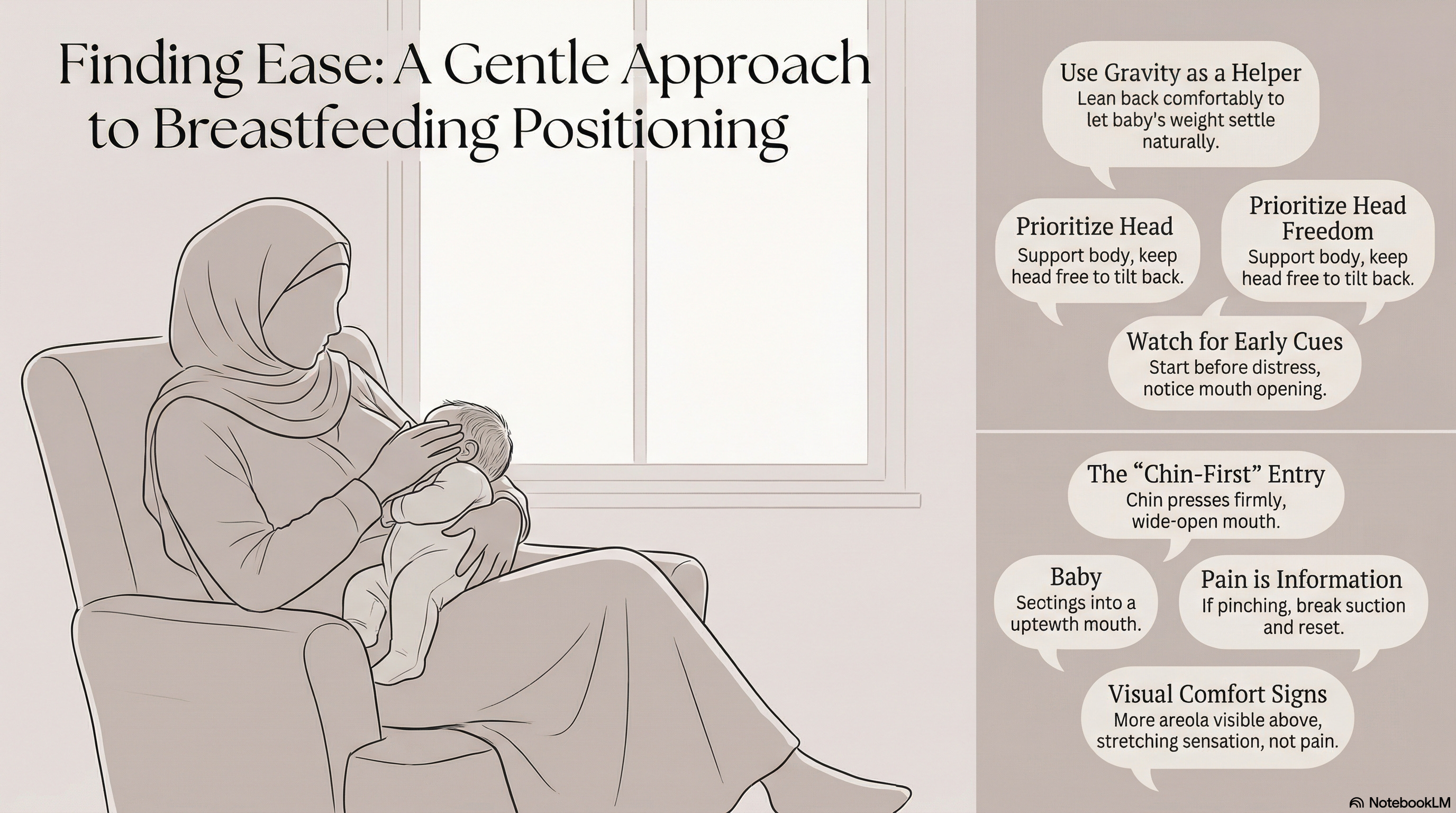
If you can, have your chest accessible, skin to skin helps. Watch for early hunger cues like mouth opening, sucking sounds, head turning. Starting then is often easier than starting when the baby is already crying. [3] [7]
Lean back rather than sitting bolt upright. Many mothers find gravity becomes their quiet helper. [8]
Place your baby on your chest, facing you, between your breasts. Support their shoulders and body, but do not hold their head tightly. Babies need their head free to tip back and open wide. [7]
Many babies come in chin first, then open their mouth wide and take a deeper mouthful.
If your baby latches, lets go, then tries again, that can be normal. They are improving their grip.
And if you feel pain that does not fade quickly, do not push through it. Slip your little finger into the corner of their mouth to break suction, lift them off gently, and try again. [7]
If you had a caesarean, you can shift your baby more to the side so their legs do not press on your wound, and use pillows to support their body. [7]
If you prefer to guide the latch, you still can
Some mothers feel calmer with a more directed approach, and that is completely fine.
Sit upright with your back supported. Use a pillow so your baby is brought up to you, not you bending down to the baby. [7]
Hold your baby close, chest to chest, body facing you. Let their head be free to tilt back.
Bring the baby to the breast, not the breast to the baby.
A gentle cue that often helps is brushing your nipple from the baby’s nose down toward their lips. This often triggers a wide open mouth. When the mouth opens wide, bring your baby in quickly and aim the nipple toward the roof of the mouth. [7]
Again, if it hurts, pause and reset. Pain that continues is usually a sign the attachment needs adjusting. [6] [7]
How to tell if the latch is working, without overthinking it
The first sign is usually comfort.
Feeding should feel like pulling or stretching, not sharp pain. [6] [7]
You may hear or see swallowing. You may notice deep, regular sucking with pauses. [7]
Often you will see more areola above the top lip than below the bottom lip. The chin is pressed into the breast. The bottom lip is flanged outward, not tucked in. [7]
After the feed, your breast may feel softer.
And your nipple should not come out creased, pinched, or flattened. If it does, that is your body telling you the latch was shallow. [6] [7]
Sometimes the fix is one simple thing, bringing your baby in closer so their chin presses more firmly into the breast.
And sometimes you need another set of eyes because you are tired, your baby is squirming, and you cannot troubleshoot while you are in it. That is normal. [3] [7]
If this kind of gentle support would help you in the newborn stage, you are welcome to subscribe for free. It makes it easier to find the next piece when you are feeding at odd hours and your brain feels foggy.
The little practical moments people forget to mention
If you need to remove your baby from the breast, avoid pulling. Break suction first with your finger in the corner of the mouth, then lift off gently. [7]
Some babies burp after each side, some barely burp at all. A few minutes upright and a gentle back rub is enough. [7]
Spit up is often normal in small amounts. If it is large amounts often, check in with a health professional. [7]
Feed length varies wildly. Early feeds can take a long time. Later, some babies become efficient and finish in minutes. [7]
And which breast to offer first, there is flexibility. Some babies take one side only. Some take both. You can alternate feeds, or follow your baby’s cues and your comfort. [7]
One more tender reminder from Allah, in the middle of all this. In the verses about nursing, He says a mother and father should not be harmed because of their child. [10]
So if you are being harmed by pain, by pressure, by pushing through something that keeps hurting, it is not weakness to seek help.
It is care.
You are allowed to learn slowly
You are not failing because you are learning.
Your baby is learning too.
Sometimes the whole breakthrough is one quiet adjustment, and suddenly your shoulders drop and you realize you can breathe again.
May Allah make breastfeeding gentle for you, heal what is sore, strengthen what feels tired, and place barakah in the care you give when nobody else is awake.
Gifts for You, Dear Parent
If you’ve reached this part of the page, it tells me something meaningful about you.
You weren’t just skimming or passing time. You stayed because something here felt relevant to your real life.
Because you care.
Because you want to do things with more awareness.
Because you’re trying, even when it feels overwhelming.
That is not small.
So I didn’t want this article to remain just words on a page. I wanted it to gently step into your daily life in practical ways. That’s why we prepared these Life Gifts for you.
Not as extras.
Not as decorations.
But as simple tools to help you hold onto what mattered most in what you just read.
Here’s what you’ll find inside:
Gentle Understanding Card
A clear and simplified summary of the core concept from this article, so you can revisit the main idea anytime without rereading everything.
Heartfelt Dua Card
A carefully chosen dua connected to this stage of life, because we know that real strength and ease ultimately comes from Allah’s help.
Gentle Actions Card
Practical examples to help you translate knowledge into action, so what you learned becomes part of your daily rhythm.
Gentle Reminders Card
Short, steady reminders drawn from the key points, designed to be printed or saved and placed somewhere you’ll see often.
These were designed slowly and thoughtfully, with time, care, and sincere dua. We created them because we genuinely want to walk alongside you, not just through one article, but through every stage of this lifelong journey.
If these gifts support you even in a small way, I would love for you to continue receiving them.
Subscribe so that each new Gift arrives directly in your inbox whenever we release the next stage. That way, you won’t miss the tools designed to support you right where you are.
May Allah place barakah in your effort, accept your intention, and make this path easier and more rewarding than it feels right now.
Please share it with a family or friend who may benefit from this knowledge.
What is one moment with your child that feels hardest lately, and what kind of support would make it feel lighter?
If you would like more gentle newborn support like this, you are welcome to subscribe for free so you do not have to search for the next piece when you are tired.
What part of feeding feels hardest for you right now, pain, positioning, or the constant frequency?
References
[1] Akkoca Z, Yigit D, Acikgoz A (2022). The effect of neonates’ exposure to their mother’s scent on weight gain: A randomized controlled study. Breastfeeding Medicine, 17(1), 79 to 84
[2] Australian Breastfeeding Association (2023). Attachment, a closer look
[3] Brodribb W (Ed.). (2019). Breastfeeding management in Australia (5th edn). Australian Breastfeeding Association.
[4] Çamur Z, Erdoğan Ç (2022). The effects of breastfeeding and breast milk taste or smell on mitigating painful procedures in newborns: Systematic review and meta analysis. Breastfeeding Medicine, 17(10), 793 to 804
[5] Brown A, Jones W (Eds.). (2019). A guide to supporting breastfeeding for the medical profession (1st edn). Routledge.
[6] Douglas P (2022). Re thinking lactation related nipple pain and damage. Women’s Health, 18
[7] Lawrence RA, Lawrence RM. (2021). Breastfeeding: A guide for the medical profession (9th edn). Elsevier.
[8] Milinco M et al. (2020). Effectiveness of biological nurturing on early breastfeeding problems: A randomized controlled trial. International Breastfeeding Journal, 15, 21