
When Your Baby Cries Before the Nappy Is Even Off
A Gentle Way Through Nappy Rash Without Panic

Nappy rash can make a baby miserable very quickly, but with gentle care, frequent changes, barrier protection, and timely review when needed, the skin usually settles and the parent can breathe again.
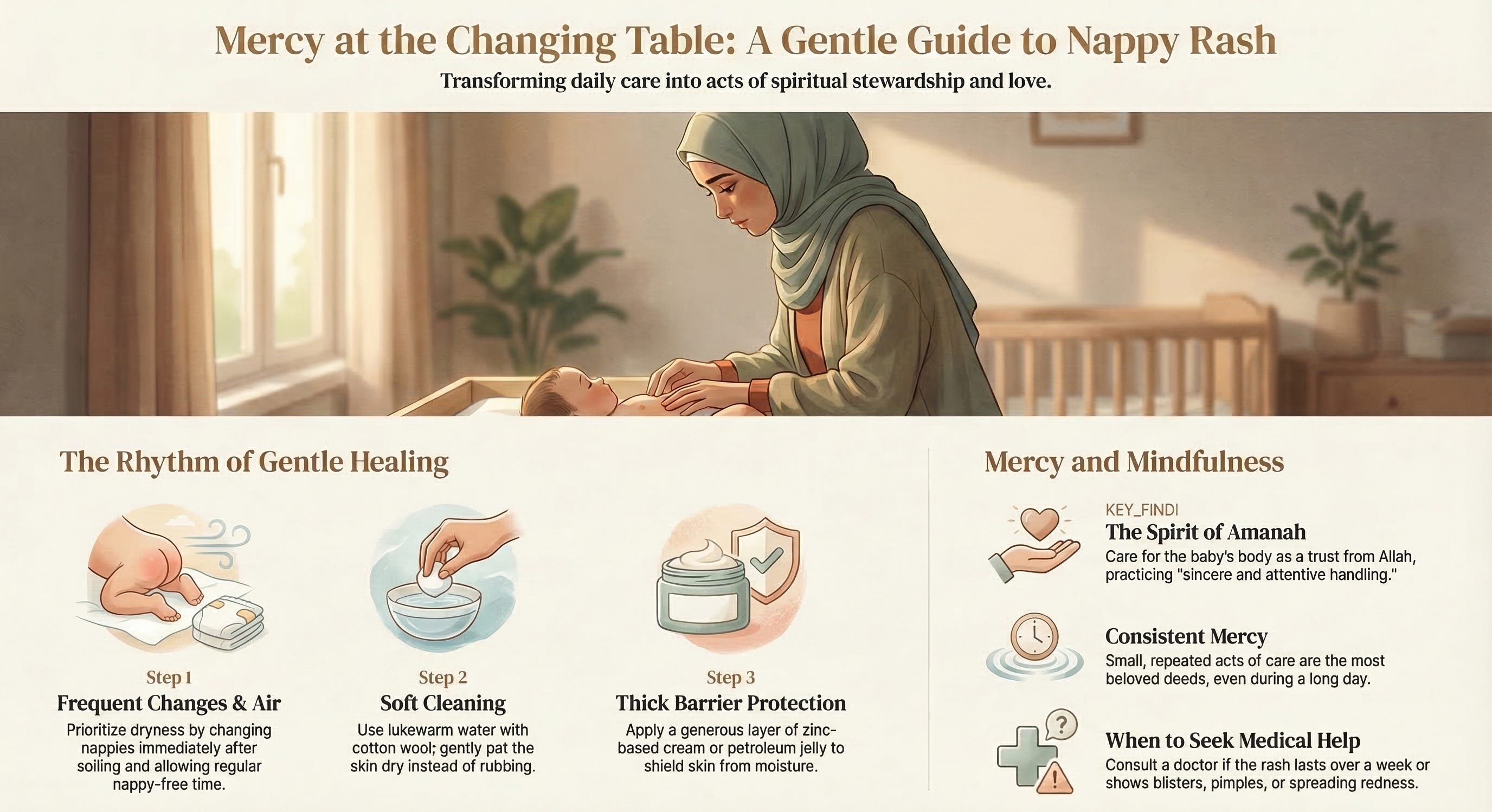
You open the nappy and your heart sinks a little.
The skin looks sore. Red, or maybe darker and inflamed in a way that still clearly says pain. Your baby squirms as soon as you touch the area. Maybe they cry before the wipe even reaches them. Maybe you have already been through three difficult changes today, and now you are standing there wondering if you missed something, if this is normal, if it hurts more than it looks.
These baby days are already full. So when a rash shows up in such a tender place, it can feel bigger than people realize.
When tiny skin starts carrying too much
Nappy rash is common. Very common. But when it is your baby, that does not make it feel small.
Usually it begins in a simple way. Too much dampness. Too much contact with urine or stool. Too much rubbing against skin that has already become vulnerable. [2] [5] [6] [7] [8] [9] [10] [11]
And once the skin is irritated, other things can make it worse. Trapped moisture. Soap residue. Fragrance. Harsh products. Even certain wipes in some cases. [3] [4] [5] [6] [7] [8] [9] [10] [11]
There is a kind of sadness in it, because babies cannot explain what hurts. They only show you with their body. With their crying. With the way they tense up when the nappy comes off.
It is not “just a rash” when your baby is hurting
Nappy rash usually affects the skin around the bottom and genitals. On some babies it looks red. On others it may look brown, purple, or grey. Sometimes the skin looks puffy or raised. Sometimes it begins to look raw. In more severe cases, there can be small breaks or ulcers in the skin. [2] [5] [6] [7] [8] [9] [10] [11]
One small detail can help parents notice what kind of rash they may be dealing with. Simple irritant nappy rash often affects the more exposed skin and may spare the folds a bit. But if the folds are involved too, especially with bright inflamed patches or little spots beyond the main rash, thrush may be part of the picture. [6] [7] [8] [9] [10] [11]
That does not mean you need to stare at the skin and diagnose everything yourself. It just means your concern is not silly. You are seeing something real.
Allah’s mercy is present in ordinary care
A baby’s body is an amanah.
That word softens me every time I think about it. Trust. Something placed in your care by Allah, not for perfect handling, but for sincere handling. For attentive handling.
The Prophet ﷺ said, “Your body has a right over you.” [12]
A baby’s body has rights too. The right to be cleaned gently. The right to have pain noticed. The right to be protected before a small irritation becomes a deeper wound.
We often think of mercy in the big moments. But mercy lives here too. In warm water. In slower hands. In not making a rough moment rougher.
The simple things that usually help most
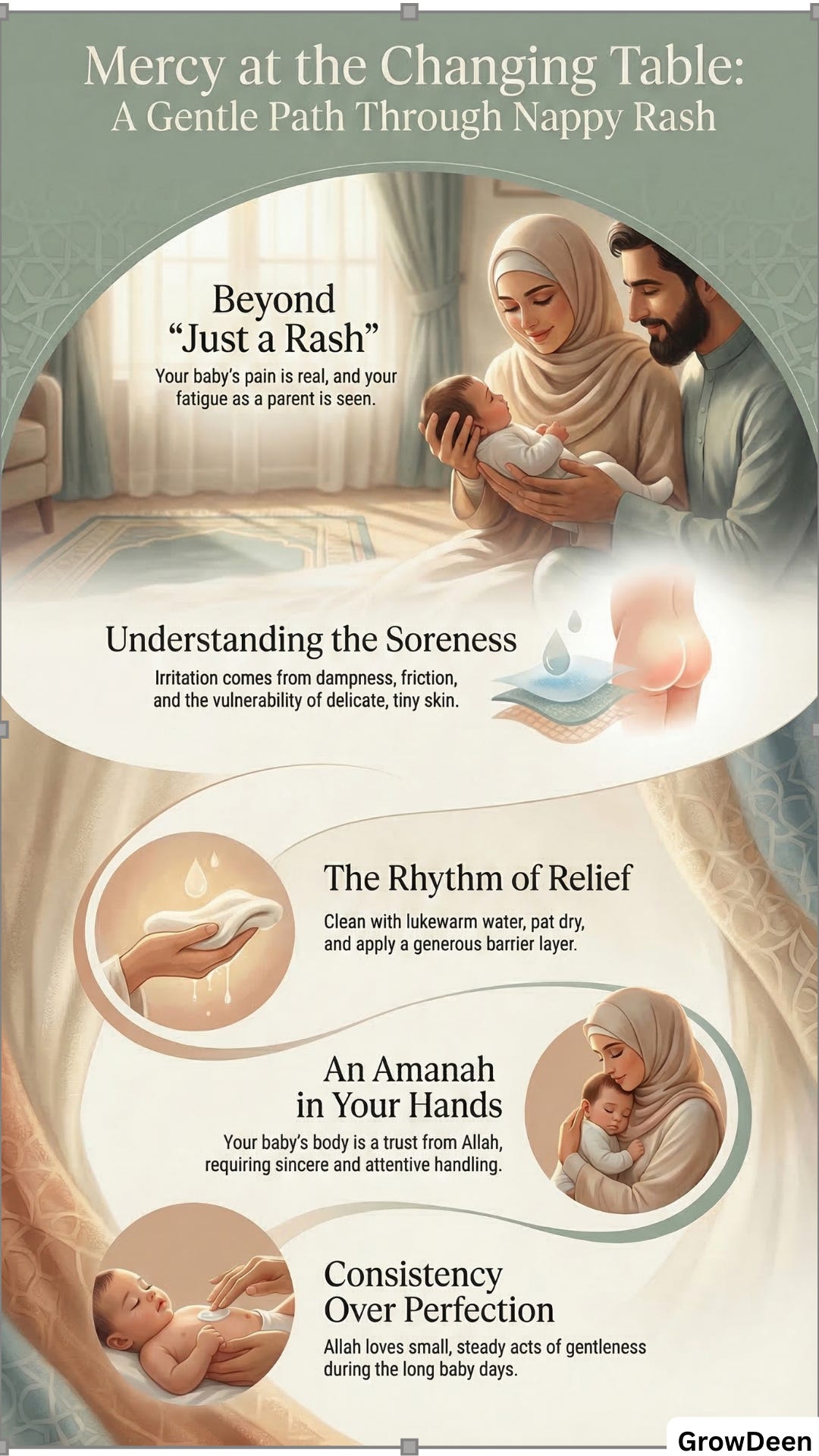
When skin is sore, basic care matters more than fancy care.
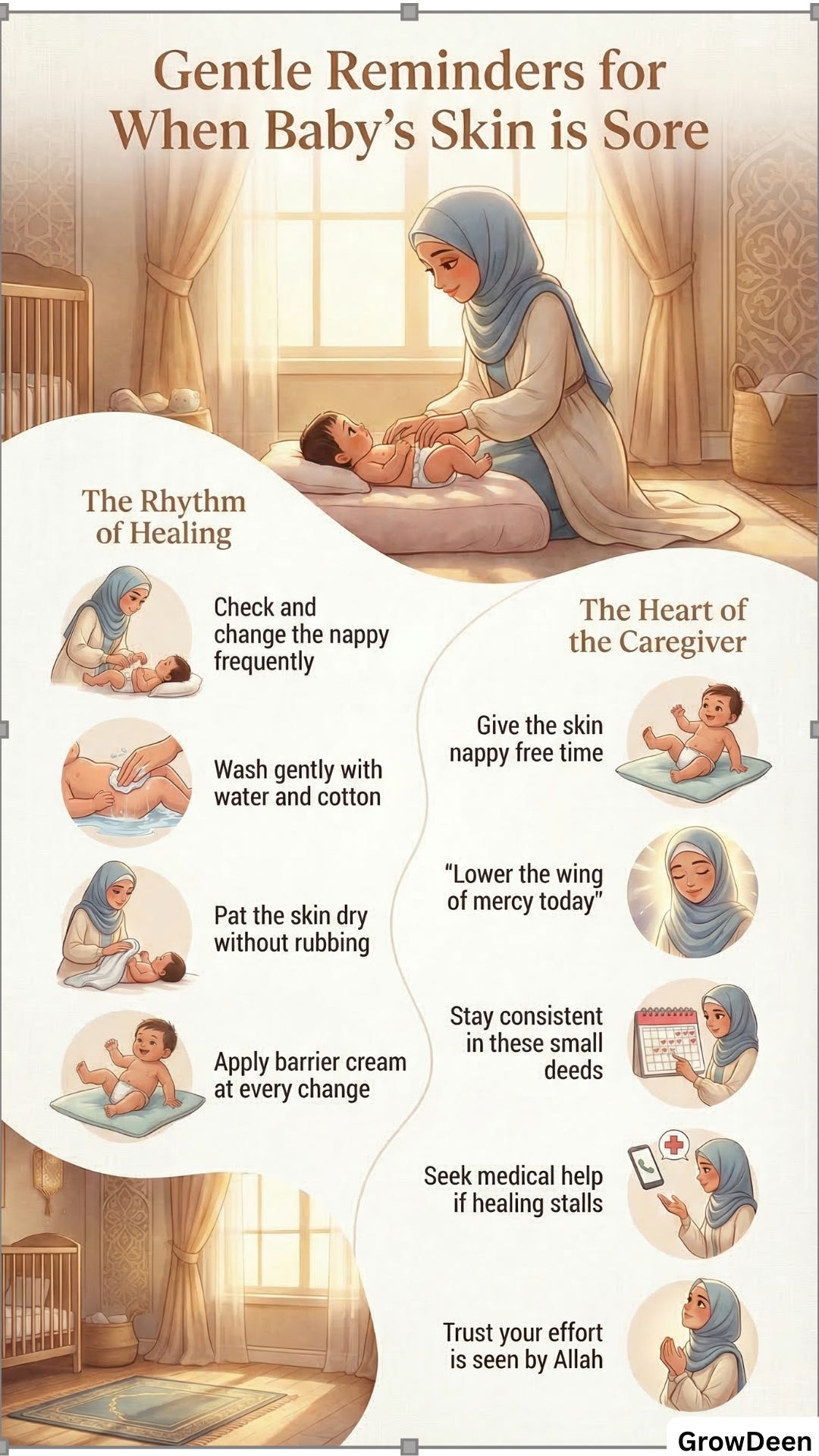
Frequent nappy changes are one of the biggest helps. Not leaving the skin sitting in wetness. Not waiting too long after a dirty nappy. During an active rash, regular checking can make a real difference because healing skin needs dryness and relief. [2] [6] [7] [8] [9] [10] [11]
Cleaning also needs to become gentler, not more aggressive. Lukewarm water with cotton wool or a soft cloth is often enough. The area should be patted dry, not rubbed. A soap free wash during bath time is usually better than stronger products. [5] [6] [7] [8] [9] [10] [11]
Then comes the protective layer. Barrier cream is not a small extra. It helps stand between the skin and the moisture that keeps irritating it. Zinc based creams or petroleum jelly are commonly used for this, and they work best when applied generously enough that a bit is still there at the next change. [1] [2] [5] [6] [7] [8] [9] [10] [11]
A little nappy free time helps too. Air matters. Less rubbing matters. Even a slightly looser nappy can sometimes help the area breathe. [6] [7] [10] [11]
If this kind of gentle, practical support helps you feel more steady in the baby years, subscribe for free so each new article and life gift reaches you right when you need it.
When consistency matters more than intensity
Sometimes a parent tries many things in one day and still feels discouraged by evening.
I understand that feeling.
But nappy rash often improves through repetition more than through one dramatic fix. Change. Clean. Dry. Protect. Then do it again a little later. The improvement is often gradual. Quiet. [1] [2] [5] [6] [7] [8] [9] [10] [11]
The Prophet ﷺ taught that the most beloved deeds to Allah are the consistent ones, even if they are small. [14]
That wisdom reaches into parenting so naturally. You do not need a perfect day. You need a faithful one. A day where you kept returning to care.
If your child wears cloth nappies, it may also help to switch temporarily to disposable ones while the skin heals, since they usually absorb moisture better. Cloth nappies need very thorough rinsing so no soap or bleach residue remains, and plastic overpants are best avoided because they trap dampness. [2] [5] [6] [7] [8] [10] [11]
When the rash is asking for more help
Some rashes do not behave like simple irritation.
If the rash is not improving after about a week of good care, or if you notice blisters, crusting, pimples, swelling, spreading redness, obvious pain, fever, or your child seems unwell, it is time for a doctor to take a look. [6] [7] [8] [9] [10] [11]
Thrush is one common complication. It often looks more sharply defined and may involve the folds, with little satellite spots nearby. It usually needs antifungal treatment rather than ordinary barrier care alone. [6] [7] [8] [9] [10] [11]
Some children with more severe inflammation may need a short course of treatment prescribed by a GP, such as mild hydrocortisone or medicine for fungal or bacterial infection, depending on what is going on. [5] [6] [8] [9] [10] [11]
Seeking help is not fussing. It is care.
The Prophet ﷺ said, “There should be neither harming nor reciprocating harm.” [13]
Sometimes the loving thing is not to keep trying alone.
You are not failing because this happened
Some babies get nappy rash less often than others. Breastfed babies may be less prone because their stools are often less irritating to the skin. Cloth nappies may be linked with more rash because they tend to be less breathable and less absorbent than disposables. [2] [5] [6] [10] [11]
But even when you do many things right, rashes still happen.
That matters to say plainly.
This is not always a sign that you were careless. Baby skin is delicate. Life is busy. Nights are long. Sometimes you are doing your best inside a tired body and a crowded day.
Allah says, “Allah does not burden a soul beyond its capacity.” [15]
So take that in gently. The goal is not to become a parent who never misses a wet nappy or never sees a rash. The goal is to notice, respond, and keep showing up with mercy.
And mercy counts.
The Prophet ﷺ said, “Allah is gentle and loves gentleness in all matters.” [16]
Even this matter.
Even at the changing table.
Even in the middle of a tired afternoon when your baby is crying and you are trying to stay soft.
GIFTS FOR YOU, DEAR PARENT
If you’ve reached this part of the page, it tells me something meaningful about you.
You weren’t just skimming or passing time. You stayed because something here felt relevant to your real life.
Because you care.
Because you want to do things with more awareness.
Because you’re trying, even when it feels overwhelming.
That is not small.
So I didn’t want this article to remain just words on a page. I wanted it to gently step into your daily life in practical ways. That’s why we prepared these Life Gifts for you.
Not as extras.
Not as decorations.
But as simple tools to help you hold onto what mattered most in what you just read.
Here’s what you’ll find inside:
Gentle Understanding Card
A clear and simplified summary of the core concept from this article, so you can revisit the main idea anytime without rereading everything.
Heartfelt Dua Card
A carefully chosen dua connected to this stage of life, because we know that real strength and ease ultimately come from Allah’s help.
Gentle Actions Card
Practical examples to help you translate knowledge into action, so what you learned becomes part of your daily rhythm.
Gentle Reminders Card
Short, steady reminders drawn from the key points, designed to be printed or saved and placed somewhere you’ll see often.
These were designed slowly and thoughtfully, with time, care, and sincere dua. We created them because we genuinely want to walk alongside you, not just through one article, but through every stage of this lifelong journey.
If these gifts support you even in a small way, I would love for you to continue receiving them.
Subscribe so that each new Gift arrives directly in your inbox whenever we release the next stage. That way, you won’t miss the tools designed to support you right where you are.
May Allah place barakah in your effort, accept your intention, and make this path easier and more rewarding than it feels right now.
Please share it with a family/friend who may benefit from this knowledge.
What is one moment with your child that feels hardest lately, and what kind of support would make it feel lighter?
Subscribe for free to keep receiving gentle, Islamically grounded, research rooted support for the real moments that fill your parenting days.
References
[1] Alonso, C., Larburu, I., Bon, E., González, M.M., Iglesias, M.T., Urreta, I., & Emparanza, J.I. (2013). Efficacy of petrolatum jelly for the prevention of diaper rash: A randomized clinical trial. Journal for Specialists in Pediatric Nursing, 18(2), 123 to 132.
[2] Baer, E.L., Davies, M.W., & Easterbrook, K. (2006). Disposable nappies for preventing napkin dermatitis in infants. Cochrane Database of Systematic Reviews, 2006(3), CD004262.
[3] Bender, N.R., & Chiu, Y.E. (2019). The skin: Eczematous disorders. In R. Kliegman, J. St Geme, N. Blum, S. Shah, R. Tasker & K. Wilson (Eds), Nelson textbook of pediatrics (21st edn, pp. 3491 to 3496). Elsevier.
[4] Boyapati, A., Tam, M., Tate, B., Lee, A., Palmer, A., & Nixon, R. (2013). Allergic contact dermatitis to methylisothiazolinone: Exposure from baby wipes causing hand dermatitis. Australasian Journal of Dermatology, 54(4), 264 to 267.
[5] Davies, M.W., Dore, A.J., & Perissinotto, K.L. (2005). Topical vitamin A, or its derivatives, for treating and preventing napkin dermatitis in infants. Cochrane Database of Systematic Reviews, 2005(4), CD004300.
[6] Dermatology Expert Group. (2015). Therapeutic guidelines: Dermatology. Version 4. Therapeutic Guidelines Limited.
[7] Oakley, A., & Gomez, J. (2017). Napkin dermatitis. DermNet NZ.
[8] Phillips, R., & Orchard, D. (2020). Dermatologic conditions. In K. Harding, D. Mason & D. Efron (Eds), Paediatric handbook (10th edn, pp. 250 to 264). Wiley Blackwell.
[9] Prok, L.D., & Torres-Zegarra, C.X. (2022). Skin. In M. Bunk, W. Hay, M. Levin, R. Deterding & M. Abzug (Eds), Current diagnosis and treatment: Pediatrics (26th edn, Chapter 15). McGraw Hill Education.
[10] The Royal Children’s Hospital (RCH). (2020). Clinical practice guidelines: Nappy rash.
[11] Varol, A. (2019). Nappy rash. Australasian College of Dermatologists.
[12] Hadith: Sahih al-Bukhari 5199
[13] Hadith: Sunan Ibn Majah 2340
[14] Hadith: Sahih al-Bukhari 6464; Sahih Muslim 782
[15] Qur’an: Surah Al-Baqarah 2:286
[16] Hadith: Sahih Muslim 2593