
The Night Your Newborn Would Not Settle: What To Do First
When Your Baby Cries and If You Feel Like You Might Break, Then This Is For You

When your baby cries, the safest path is to check for illness or discomfort, try gentle soothing, and protect your own steadiness so you and your baby never reach a breaking point.

It starts as a small cry.
Then it swells.
You bounce. You shush. You offer milk. You check the nappy. You pace the hallway until your feet feel heavy.
Nothing holds.
And in the middle of all that sound, a quieter fear slips in.
What if I cannot do this
What if something is wrong
What if I lose my patience
Dear sister, come close.
All babies cry. Not because you are doing something wrong. Because crying is how they speak right now.
And when the crying is intense, your job is both simple and heavy.
Make sure your baby is not sick, hurt, or uncomfortable.
Try gentle soothing.
Then take care of yourself, because you are part of your baby’s safety.
Ar Rahman sees you in the tunnel of these weeks
Some nights feel like a tunnel. You cannot see the end while you are inside it.
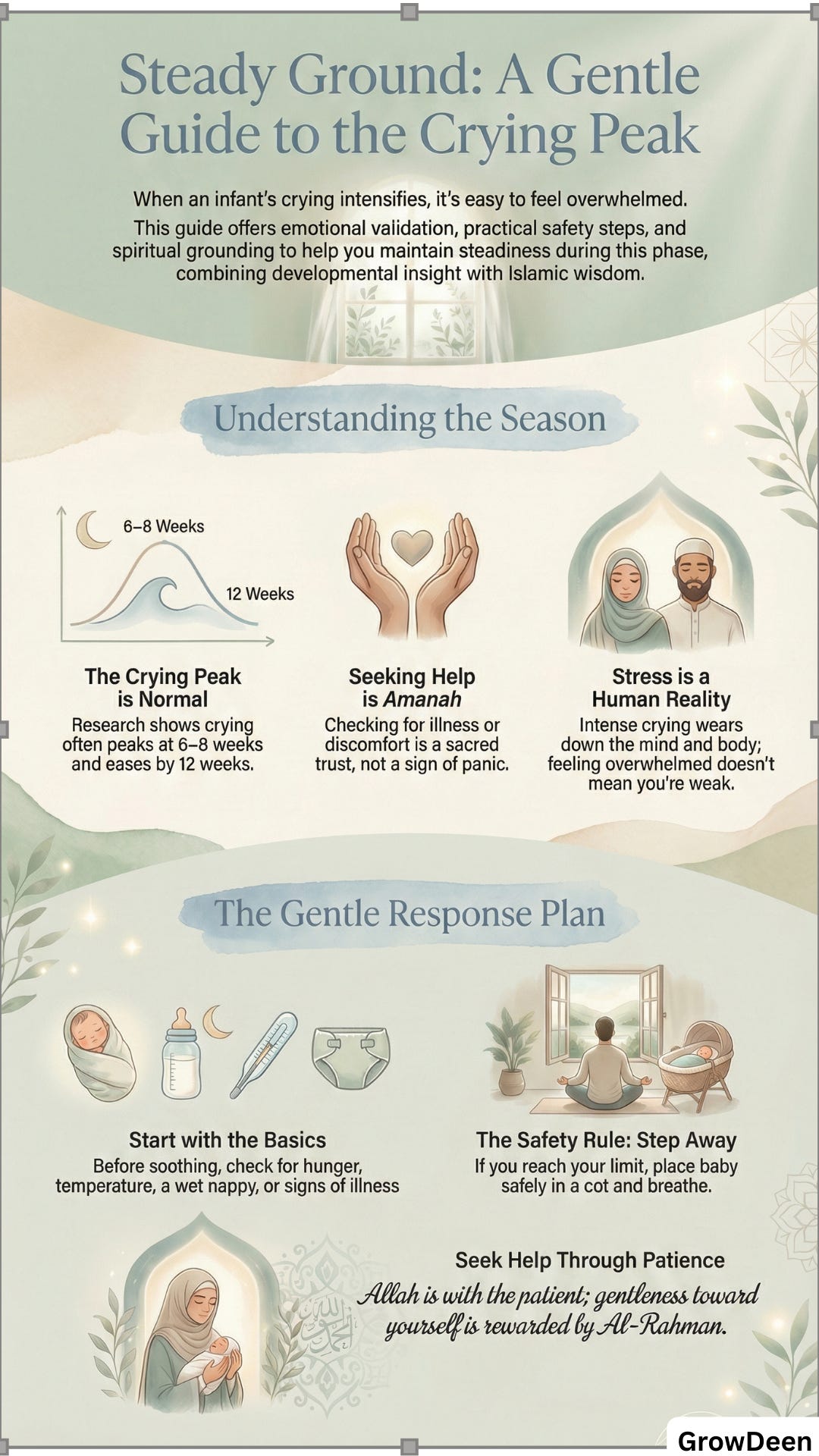
Research that tracked crying patterns in infancy shows that crying and fussing is common in the first months, and many families live through long stretches of it [2]. For many babies, crying rises to a peak around six to eight weeks, then gradually eases by around twelve weeks [3].
Not for every baby. But for many.
Knowing this does not make the crying pleasant.
It simply helps you understand that this season can be intense even in a loving home, with a loving parent.
If your baby feels off to you, or you cannot tell what is going on, it is completely reasonable to book a check with your GP or speak to a child and family health nurse.
That is not panic.
That is amanah.
The first job is not soothing, it is checking
When your baby cries, begin with the basics.
Are they hungry
Are they tired
Are they too hot or too cold
Is their nappy wet
Is something rubbing or poking
Do they seem unwell
Sometimes it really is one of those.
And sometimes you will do all of it, twice, and the crying still keeps coming.
That is when many parents start blaming themselves.
Please do not.
Research has described how persistent crying can wear down a parent’s body and mind, even when love is deep [1]. That stress is real. It does not mean you are weak. It means you are human.
If something still feels wrong, trust that feeling and get your baby checked. You do not need a perfect explanation to ask for support.
Your baby is not trying to control you, they are trying to settle
Babies cry when they are hungry, tired, wet, in pain, or unwell.
Sometimes they cry because the world is bright or loud and their body needs help calming down.
Sometimes they cry because they want to know you are there. Not as a habit. As a need.
Soothing is not about stopping crying like it is a bad behaviour.
Soothing is a way of saying, I am here, I will help you find the ground again.
Try a small soothing loop, not twenty strategies at once.
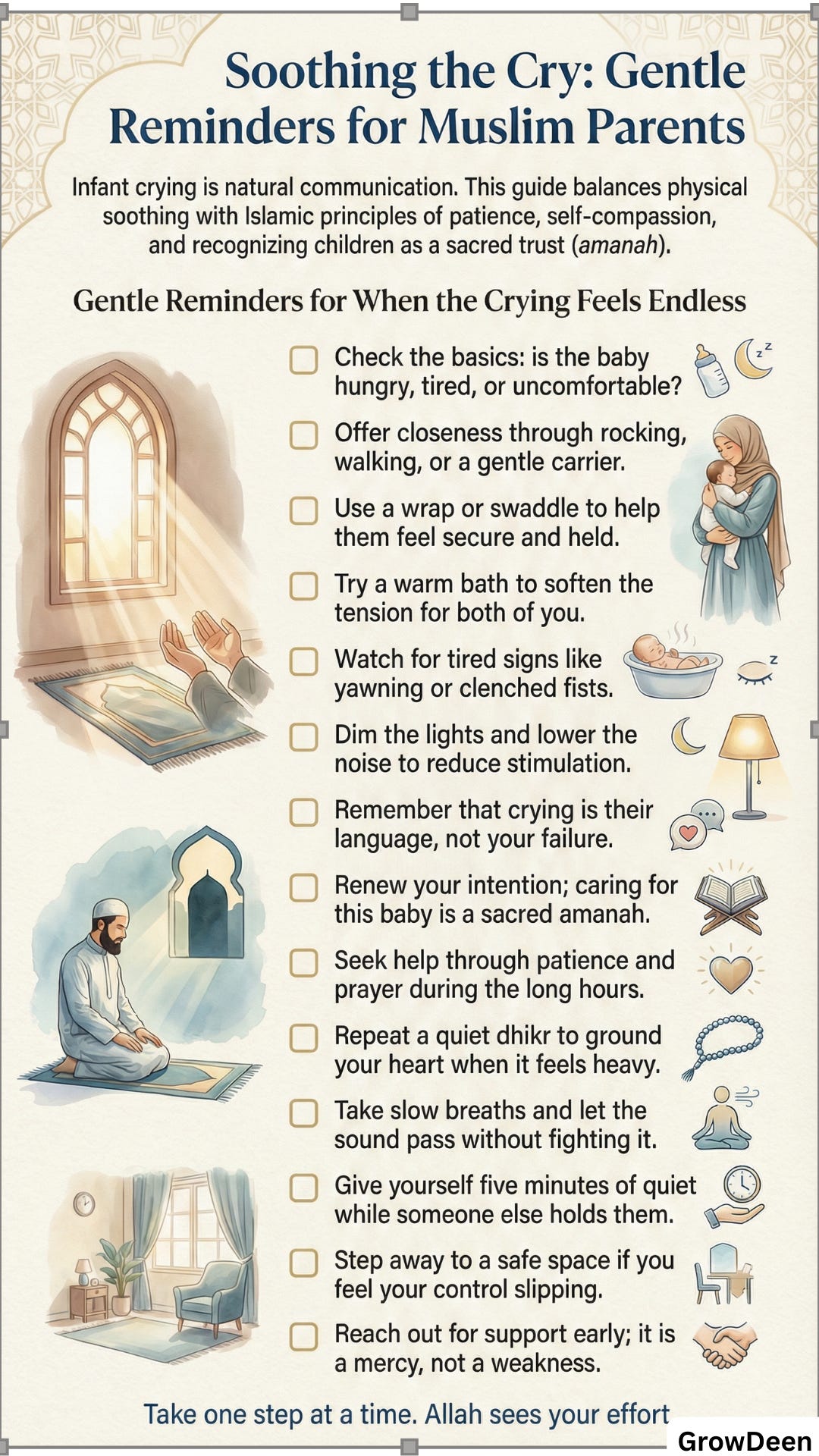
Hold your baby close.
Add gentle movement.
Rocking. Walking. A carrier or sling.
Warmth, pressure, and rhythm can be calming for many babies.
If you feel steady enough, a short walk can help too. If your baby falls asleep, place them on their back on a safe sleep surface.
A warm bath sometimes softens tension for both of you.
Gentle baby massage can help some babies settle, and it can support bonding too [5]. If you are unsure, ask a nurse to show you. It is meant to be simple.
Lower stimulation if the room feels busy.
Dim the lights.
Reduce noise.
Slow your movements.
Some babies settle with a soft voice, humming, or gentle singing.
Some respond to steady background sound, like white noise.
Some want to suck even when they are not hungry, through breastfeeding or a dummy, or later, their fingers.
None of this is a rule.
It is you learning your baby.
Allah helps you stay patient in the loud moments
There is a moment many parents do not talk about.
The moment the crying starts to hurt your nervous system.
Your jaw tightens.
Your heart races.
You feel panic, anger, hopelessness, even for a second.
That does not mean you do not love your baby.
It means you are reaching your limit.
In those moments, choose one small thing that helps you stay steady.
Slow breaths.
A quiet dhikr under your breath.
Earplugs to reduce the edge of the sound while you still respond.
A sentence you repeat to yourself, like a lifeline.
My baby is having a hard time.
I can be the calm.
And when you are trying to hold yourself together, remember this.
Allah tells the believers to seek help through patience and prayer, and He is with those who are patient [6]. Not because patience makes the crying vanish. Because patience keeps you from falling apart inside it.
The Prophet ﷺ taught that Allah is gentle and loves gentleness, and that gentleness is rewarded in a way harshness is not [7]. That includes your hands, your voice, and the way you speak to yourself when you are at the edge.
The safety rule that matters more than anything
Never shake a baby.
Shaking can cause bleeding in the brain and may lead to permanent brain damage.
So here is the rule for the hardest moments.
If you feel like you might lose control, put your baby in a safe place, like a cot, and step into another room.
Breathe.
Splash water on your face.
Call someone.
Ask for help immediately.
This is not abandoning your baby.
This is protecting your baby.
The Prophet ﷺ said each of you is a guardian and responsible for those under your care [8]. Sometimes that responsibility looks like rocking and singing.
Sometimes it looks like putting the baby down safely for a minute so you do not do something you would regret.
Support is not a luxury, it is part of the plan
If your baby cries a lot, your self care is not extra.
It is part of safety.
Even five minutes matters.
A short shower.
A cup of tea while someone holds the baby.
A quick walk outside for air.
If you have a partner or co parent, trade breaks like it is a serious job, because it is.
If you do not, a trusted friend or relative can be a lifeline.
Parents dealing with excessive crying describe how much it helps to have a clear plan and real support, not only reassurance [5]. Support matters most when it comes early.
If you are struggling emotionally, speak to your GP or nurse. There are interventions aimed at reducing early infant sleep and crying problems while also reducing risk of postnatal depression [4]. You do not have to push through alone.
And if you notice signs of postnatal depression in a birthing mother or a non birthing parent, such as persistent sadness, frequent crying with no clear reason, irritability, intense anxiety, or feeling unable to cope, please reach out for professional support.
Let me say this softly.
You are not the only parent who has been pushed to the edge by a crying baby.
Reach out early.
It is a mercy, not a weakness.
If you would like more calm, practical support for the hardest newborn moments, you are welcome to subscribe for free. That way, you have gentle guidance waiting in your inbox before the next hard night arrives.
Gifts for You, Dear Parent
If you’ve reached this part of the page, it tells me something meaningful about you.
You weren’t just skimming words or passing time. You stayed because something here mattered to your real life.
Because you care.
Because you want to respond with more awareness.
Because you’re trying, even when you feel tired and stretched thin.
That is not small.
So I didn’t want this to stay only as an article you read once. I wanted it to step into your home in simple, practical ways. That’s why we prepared these Life Gifts for you.
Not as extras.
Not as decoration.
But as small tools to help you hold onto what mattered most in what you just read.
Here is what you will find inside.
Gentle Understanding Card
A clear, simplified presentation of the core idea, so you can return to it without rereading everything.
Heartfelt Dua Card
A carefully chosen dua for this stage, because real ease ultimately comes from Allah’s help.
Gentle Action Card
Practical examples that help you turn knowledge into small daily actions, especially on the hard days.
Gentle Reminder Card
Short steady reminders drawn from the key points, designed to be printed or saved and placed where you will see them.
These were created slowly and thoughtfully, with care and sincere dua. We made them because we genuinely want to walk alongside you, not only through one article, but through every stage of this lifelong journey.
If these gifts support you even a little, I would love for you to keep receiving them.
Subscribe so each new Gift arrives in your inbox whenever we release the next stage, so you do not miss the tools meant to support you right where you are.
May Allah place barakah in your effort, accept your intention, and make this path easier and more rewarding than it feels right now.
Share it with friends and families so they benefit too.
What part of the crying feels hardest for you right now, the sound, the worry, the exhaustion, or feeling alone in it?
References
[1] Barr, R. G. (1998). Crying in the first year of life: Good news in the midst of stress. Child: Care, Health and Development, 24, 425–439. https://pubmed.ncbi.nlm.nih.gov/9728286/
[2] McGlaughlin, A., & Grayson, A. (2001). Crying in the first year of infancy: Patterns and prevalence. Journal of Reproductive and Infant Psychology, 19, 47–59. https://doi.org/10.1080/02646830020032300
[3] Wolke, D., Bilgin, A., & Samara, M. (2017). Fussing and crying durations and prevalence of colic in infants: Systematic review and meta analysis. The Journal of Pediatrics, 185, 55–61.e4. https://doi.org/10.1016/j.jpeds.2017.02.020
[4] Hiscock, H., Cook, F., Bayer, J., Le, H. N. D., Mensah, F., Cann, W., Symon, B., & St James Roberts, I. (2014). Preventing early infant sleep and crying problems, and postnatal depression: A randomized trial. Pediatrics, 133(2), e346–e354. https://doi.org/10.1542/peds.2013-1886
[5] Harskamp Van Ginkel, M. W., Klazema, W., Hoogsteder, M. H., Chinapaw, M. J., & van Houtum, L. (2023). The need of having a plan in excessive infant crying: A qualitative study of parents’ experiences of healthcare support. Acta Paediatrica, 112(3), 434–441. https://doi.org/10.1111/apa.16618
[6] Qur’an 2:153. https://quran.com/en/al-baqarah/153
[7] Sahih Muslim 2593. Allah is kind and loves kindness. https://sunnah.com/muslim:2593
[8] Sahih al Bukhari 7138. Everyone of you is a guardian and is responsible for his charges. https://sunnah.com/bukhari:7138