
When You Notice the Flat Spot and Blame Yourself First
A Gentle Guide for the Muslim Parent Carrying This Worry Alone

Free gift for you! A practical companion resource is waiting for you near the end of this article to help you remember, apply, and benefit from what you read. Don’t forget to download!
When a baby’s head starts to look a little uneven, many parents quietly blame themselves, but positional plagiocephaly is common, often improves with growth and simple changes, and deserves calm, timely attention rather than panic.

You are changing your baby’s clothes, or maybe wiping milk from the chin, and suddenly you notice it again.
That side of the head.
That little flatness.
And once you see it, it becomes hard to unsee. Your mind starts racing before anyone has even said a word.
When a small shape starts feeling like a big worry
Plagiocephaly is the name used when a baby’s head looks flattened or uneven, usually because pressure keeps landing on the same area of the soft skull over time.[4][5][11][12] It is different from craniosynostosis, which is a separate condition where skull bones fuse too early.[4][5][11]
Sometimes this begins before birth because of position in the womb. Sometimes birth itself plays a part. Sometimes a baby keeps turning to one favourite side, especially if there is tightness in the neck, called congenital muscular torticollis, and the same spot keeps resting against the mattress, seat, or floor.[4][5][11][12]
None of that means you failed.
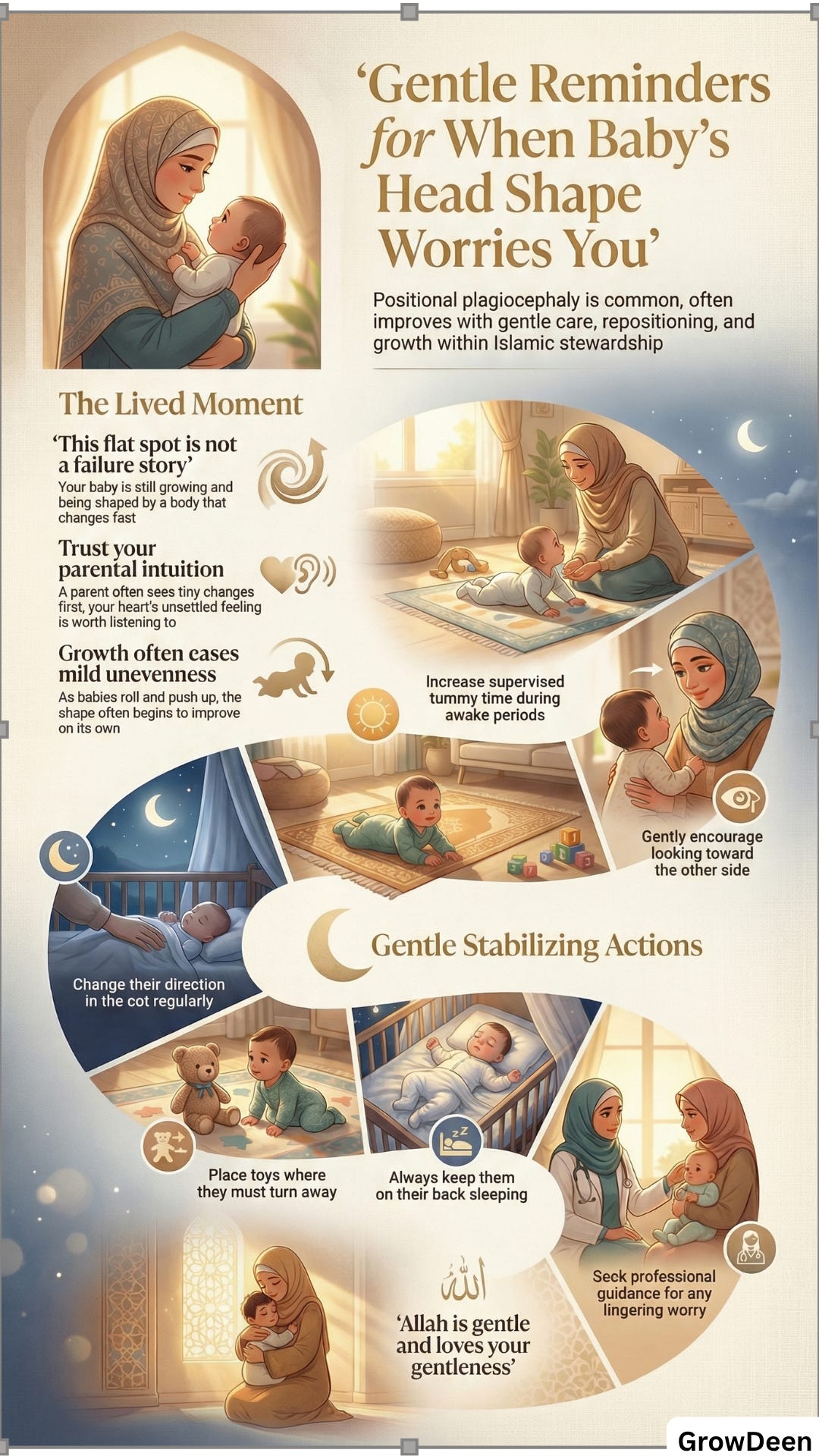
It means your baby is still soft, still growing, still being shaped by a body that changes fast.
You may have noticed it before anyone else
Often the signs are simple, visual things. One side of the back of the head may look flatter. One ear may look slightly more forward. The forehead can look a little fuller on one side too.[5][11][12]
And if your heart feels unsettled when you notice that, it is worth listening to. A parent often sees the tiny changes first.
If the asymmetry is noticeable, if the flat spot is not starting to improve by around 2 months, if your baby strongly prefers one direction, or if turning the head both ways seems difficult, it is wise to involve your doctor, child and family health nurse, or physiotherapist.[10][12] The same is true if tummy time is a struggle, pushing up is limited, or motor progress feels off.[10][12]

The Mercy of Allah is present in soft beginnings
Early babyhood is a stage of dependence. A baby does not protect himself. He is protected.
Allah says, “And Allah has extracted you from the wombs of your mothers not knowing a thing, and He made for you hearing and vision and hearts that perhaps you would be grateful.”[16] He also says, “O you who have believed, protect yourselves and your families…”[14]
That protection is not only spiritual in the narrow sense. It is also in noticing the body Allah entrusted to you. In paying attention. In acting when something needs support.
Many babies improve more than worried parents expect
A lot of mild cases get better as babies grow.[5][6][12] The head keeps growing. Babies start turning more, reaching more, rolling more, pushing up more. Life becomes less still. And when the same spot is no longer under constant pressure, the shape often begins to improve.[5][6][12]
That does not mean you ignore it.
It means you do not have to assume the worst the moment you notice it.
If articles like this help you feel calmer, clearer, and more supported as a Muslim parent, you can subscribe for free so new ones reach you gently, right when you need them.
What gentle action can look like at home
Some babies need more than time. They need intentional changes.[1][2][3][6][7][9][12][13]
That can mean more supervised tummy time during awake periods, encouraging your baby to look toward the less preferred side, changing how you place your baby during play, and following stretches or exercises if neck tightness is involved.[1][2][3][6][7][9][12][13]
Tummy time matters here. Not as a slogan. As a real, repeated practice that takes pressure off the back of the head and helps build strength through the neck, shoulders, and trunk.[1][2][6][9][12]
And parents matter deeply in this process. Guidance is important, but what happens at home every day matters just as much.[1][9][13]
The Gentleness of Allah should shape your response too
The Prophet ﷺ said, “Allah is gentle and loves gentleness in all matters.”[18]
That hadith belongs here.
Because a baby with plagiocephaly does not need anxious handling. And a worried parent does not need shame. Gentle repositioning. Gentle consistency. Gentle follow through. Sometimes that is exactly what this season asks of you.
When more help is needed, it is still just care
If the flattening is more significant, treatment may include referral to a paediatric physiotherapist, paediatrician, or plastic surgeon.[2][3][7][12] In more severe cases, a custom helmet may be recommended to reduce pressure on the flattened area and guide head growth over time.[7][8]
That is not a sign that everything has gone wrong.
It is simply one more means Allah has allowed people to discover and use.
Research has also looked at links between nonsynostotic plagiocephaly and developmental disorders, but that does not mean every baby with a flat spot will go on to have developmental problems.[10] It simply means careful follow up matters.
Safety still comes before everything else
Try to vary your baby’s head position during awake time. Change the direction you place your baby at the cot or change table. Use voice, toys, and your own face to invite turning toward the less preferred side.[1][9][12][13]
But safe sleep does not change.
Babies should still be placed on their backs to sleep, because stomach or side sleeping increases the risk of sudden unexpected death in infancy.[12] The Messenger of Allah ﷺ taught, “There should be neither harming nor reciprocating harm.”[20]
We do not chase one good while opening the door to a greater danger.
And when the days feel long, remember this too: “Allah does not burden a soul beyond what it can bear.”[17] And, “No mother should be harmed through her child, and no father through his child.”[15] The care of children was never meant to crush a family.
The Prophet ﷺ also said that each of us is a shepherd responsible for our flock.[19] Sometimes that responsibility looks very ordinary. Noticing. Asking. Adjusting. Returning for help. Trying again tomorrow.
That is not small.
That is love in action.
GIFTS FOR YOU, DEAR PARENT
If you made it this far down the page, that tells me something beautiful about you.
You did not stay here just to skim a few lines and move on. You stayed because something in this felt close to your real life.
Because you care.
Because you want to parent with more awareness.
Because even when you feel tired or unsure, you are still trying.
And that matters more than you know.
I did not want this article to remain only something you read once and then lose in the noise of the day. I wanted it to step a little closer to your real routine. That is why these Life Gifts were prepared for you.
Not as extras.
Not as decoration.
But as simple supports to help you hold onto what mattered most in what you just read.
Gentle Understanding Card
A clear and simplified reminder of the main idea from this article, so you can return to the heart of it without rereading everything.
Heartfelt Dua Card
A carefully chosen dua connected to this stage of life, because true help, steadiness, and ease come from Allah.
Gentle Actions Card
Practical examples that help turn understanding into daily action, so what touched your heart can also shape your routine.
Gentle Reminders Card
Short, steady reminders drawn from the key points, made to be saved or printed and placed somewhere you will actually see them.
These were made slowly, thoughtfully, and with sincere dua. They were created because I do not want to meet you only in one article and then disappear. I want these words to keep serving you through the many stages of this lifelong parenting journey.
If these gifts lighten something for you, even in a small way, I would love for you to keep receiving them.
Subscribe so each new Gift can arrive quietly in your inbox whenever the next stage is released. That way, you do not miss the tools prepared to support you right where you are.
May Allah place barakah in your effort, accept your intention, and make this road gentler and more rewarding than it feels today.
Please share this with a family member or friend who may need it.
Subscribe for free if you would like more gentle, research rooted, Islamically grounded support for real parenting moments.
What part of caring for your baby feels heaviest these days, and what kind of support would make it feel lighter?
References
[1] Aarnivala, H., Vuollo, V., Harila, V., Heikkinen, T., Pirittiniemi, P., & Valkama, A.M. (2015). Preventing deformational plagiocephaly through parent guidance: A randomized controlled trial. European Journal of Pediatrics, 174(9), 1197 to 1208.
[2] Baird, L.C., Klimo, P., Flannery, A.M., Bauer, D.F., Beier, A., Durham, S., Lin, A.Y., McClung-Smith, C., Mitchell, L., Nikas, D., Tamber, M., Tyagi, R., & Mazzola, C. (2016). Guidelines: Congress of neurological surgeons systematic review and evidence based guideline on the management of patients with positional plagiocephaly: The role of physical therapy. Neurosurgery, 79(5), E630 to E631.
[3] Congress of Neurological Surgeons. (2016). Systematic review and evidence based guidelines for the management of patients with positional plagiocephaly. Pediatrics, 138(5), Article e20162802.
[4] Dec, W., & Warren, S. (2011). Current concepts in deformational plagiocephaly. Journal of Craniofacial Surgery, 22(1), 6 to 8.
[5] Fahrenkopf, M.P., Adams, N.S., Mann, R.J., & Girotto, J.A. (2018). Deformational plagiocephaly. In R. Kliegman, B. Stanton, J. St Geme & N. Schor (Eds.), Nelson Textbook of Pediatrics (21st ed., pp. 3083 to 3085). Elsevier.
[6] Flannery, A., Looman, W., & Kemper, K. (2012). Evidence based care of the child with deformational plagiocephaly. Part II: Management. Journal of Pediatric Health Care, 26(5), 320 to 331.
[7] Flannery, A.M., Tamber, M.S., Mazzola, C., Klimo, P., Baird, L.C., Tyagi, R., Bauer, D.F., Beier, A., Durham, S., Lin, A.Y., McClung-Smith, C., Mitchell, L., & Nikas, D. (2016). Congress of neurological surgeons systematic review and evidence based guidelines for the management of patients with positional plagiocephaly: Executive summary. Neurosurgery, 79(5), 623 to 624.
[8] Kreutz, M., Fitze, B., Blecher, C., Marcello, A., Simon, R., Cremer, R., Zeilhofer, H., Kunz, C., & Mayr, J. (2018). Facial asymmetry correction with moulded helmet therapy in infants with deformational skull base plagiocephaly. Journal of Cranio-Maxillofacial Surgery, 46(1), 28 to 34.
[9] Leung, A., Mandrusiak, A., Watter, P., Gavranich, J., & Johnston, L. (2018). Parents as a vital part of an integrated care pathway in plagiocephaly prevention and management in infants. International Journal of Integrated Care, 18(S1), Article 161.
[10] Lynch, M.E., White, M.J., Rabatin, A.E., Brandenburg, J.E., Theuer, A.B., Viet, K.M., Hollman, J.H., & Driscoll, S.W. (2024). Incidence of nonsynostotic plagiocephaly and developmental disorders. JAMA Pediatrics, 178(9), 899 to 905.
[11] Rogers, G. (2011). Deformational plagiocephaly, brachycephaly, and scaphocephaly. Part I: Terminology, diagnosis, and etiopathogenesis. Journal of Craniofacial Surgery, 22(1), 9 to 16.
[12] The Royal Children’s Hospital (RCH). (2024). Positional plagiocephaly.
[13] Trottier, N., Hurtubise, K., Dostie, R., Camden, C., & Gaboury, I. (2025). Understanding the barriers and facilitators impacting parental adherence to positional plagiocephaly or brachycephaly prevention strategies: A qualitative exploration. Developmental Neurorehabilitation, 1 to 11.
[14] The Qur’an, Surah At-Tahrim 66:6
[15] The Qur’an, Surah Al-Baqarah 2:233
[16] The Qur’an, Surah An-Nahl 16:78
[17] The Qur’an, Surah Al-Baqarah 2:286
[18] Sahih Muslim, Hadith 2593
[19] Sahih al-Bukhari, Hadith 7138; Sahih Muslim, Hadith 1829
[20] Sunan Ibn Majah, Hadith 2340, graded Hasan