
When Protecting Your Child Comes With Tears You Did Not Expect
What Parents Are Really Protecting When They Keep Up With Vaccines

Free gift for you! A practical companion resource is waiting for you near the end of this article to help you remember, apply, and benefit from what you read.
Don’t forget to download!
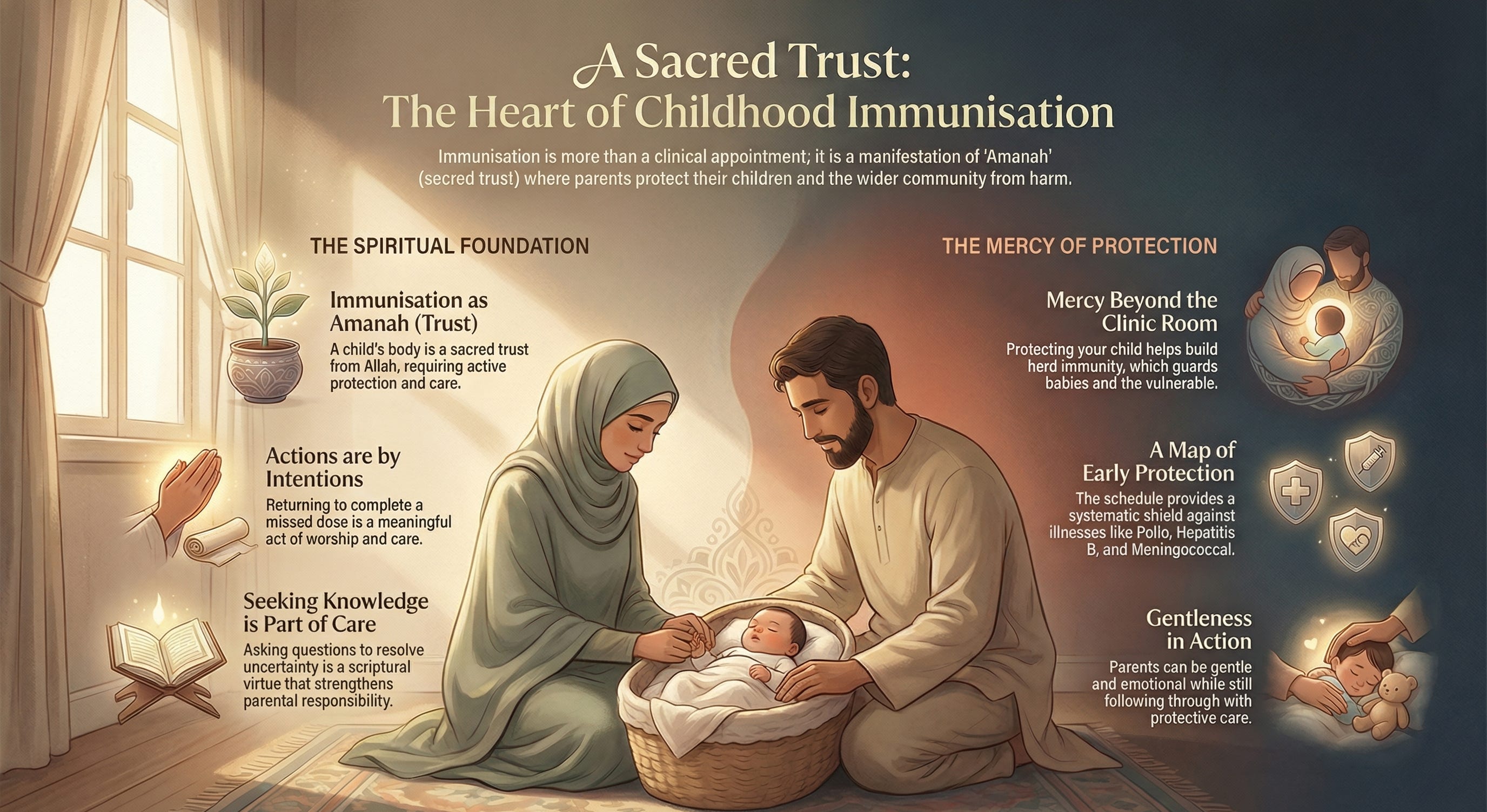
Immunisation can feel like a small, difficult moment in a parent’s week, but it is one of the quiet ways parents help protect their children and the people around them from serious infectious disease.
Sometimes it is over in a few minutes.
A waiting room. A nurse. A quick needle. A few tears that feel louder in your chest than they probably sounded in the room. Then you are back outside, fastening the car seat, holding a child who already seems almost fine again while you are still carrying the weight of it.
That is one of the strange things about immunisation.
It can look so small from the outside and still feel deeply significant to a parent who knows they are trying to protect a child they love.
The protection reaches far beyond the clinic room
Immunisation is never only about one child on one day.
It helps protect children from serious infectious diseases, including illnesses that can leave them very sick and, in some cases, take their lives. It also helps protect the people around them, because when enough people are immunised, infections have less room to move through a community. [2] [3]
That wider protection matters especially for the vulnerable ones. Some babies are still too young for certain vaccines. Some children cannot receive every immunisation because of serious illness or weakness in the immune system. This is where herd immunity matters. When enough people are protected, the spread of bacteria or viruses slows down or stops, and vulnerable people are less likely to be reached by it. [2] [3]
And if some of these diseases feel far away now, that distance is not a reason to relax. It is often one of the signs that immunisation has been quietly doing its work. If protection drops, those diseases can return. [2] [3]
Allah’s trust includes protecting the child before illness arrives
For Muslim parents, prevention is not outside the circle of care. It sits right inside it.
Allah says, “Indeed, Allah commands you to render trusts to whom they are due.” [5]
And Allah says, “And do not throw yourselves with your own hands into destruction.” [6]
A child’s body is part of that amanah. That trust includes food, sleep, treatment when they are sick, and protection when protection is available. Immunisation fits inside that care naturally.
Not as panic.
Not as pressure.
As responsibility.
The schedule can feel long until you remember what it is doing
The schedule begins early, and for tired parents, that can feel like a lot.
There is protection offered at birth for hepatitis B. Then at 6 to 8 weeks, there are three immunisations due. One helps protect against hepatitis B, diphtheria, tetanus, whooping cough, Haemophilus influenzae type b, and polio. Another protects against pneumococcal disease. A third protects against rotavirus and is given by mouth, within its proper age window. [2] [3]
At 4 months, the same three protections are given again. At 6 months, one further immunisation helps protect against hepatitis B, diphtheria, tetanus, whooping cough, Haemophilus influenzae type b, and polio. [2] [3]
At 12 months, three immunisations are due. These help protect against meningococcal disease strains A, C, W, and Y, against measles, mumps, and rubella, and against pneumococcal disease. At 18 months, another three are given. These protect against diphtheria, tetanus, and whooping cough, against measles, mumps, rubella, and chickenpox, and against Haemophilus influenzae type b. Then at 4 years, one immunisation helps protect against diphtheria, tetanus, whooping cough, and polio. [2] [3]
Influenza follows its own pattern. A yearly flu vaccine is recommended for children aged 6 months up to 5 years and for children with chronic illnesses. In the first year a child receives it, two doses are needed at least four weeks apart. After that, one dose each year is enough. COVID 19 immunisation is not part of the routine schedule described here, but it may be recommended for some children from 6 months, depending on their circumstances and current guidance. [2] [3]
Written out like this, it can sound technical.
But under all that detail is something simple.
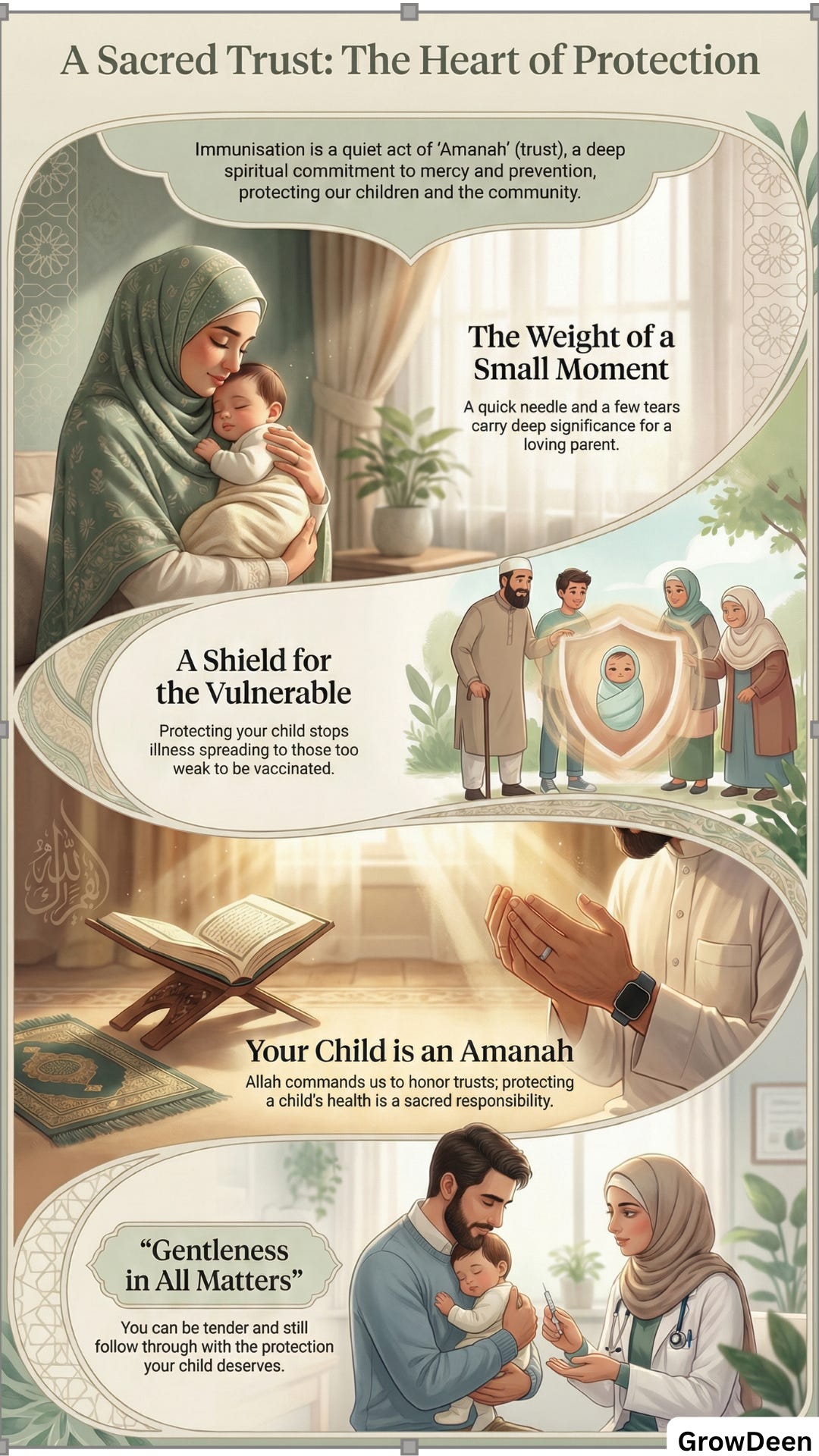
A map of protection laid across the early years.
Some children need more than the standard path
Not every child’s story fits neatly inside the standard schedule alone.
Some children need extra immunisations or more tailored protection because their risk is higher. That can include children with certain medical conditions, children whose immune systems are affected, children with chronic lung or heart conditions, children born prematurely, children travelling overseas, and in some settings certain Indigenous groups identified as needing added protection. [1] [3]
This is one of those places where good parenting is not just following a general chart. Sometimes it is noticing that your child’s situation is not quite the same as another child’s.
The Prophet ﷺ said, “Each of you is a shepherd and each of you is responsible for his flock.” [11]
That hadith lands very gently here. Responsibility is not about being harsh. It is about paying attention. It is about asking, does my child need something more specific?
Questions do not weaken care. They strengthen it
Many parents feel unsettled when immunisation appointments draw near.
Some feel emotional. Some feel confused. Some understand the purpose completely and still feel the sting of the moment because their child is small and the schedule looks long.
That is human.
And that is exactly why questions matter.
Allah says, “Do not pursue that of which you have no knowledge.” [7]
There is real mercy in that verse for parents. You do not have to bury uncertainty and pretend it does not exist. The answer is not silence. The answer is to seek sound knowledge, ask clearly, and understand what is being given and why. [3]
Children can receive immunisations through doctor clinics, community health clinics, local immunisation clinics, travel clinics, and, where needed, specialist immunisation services. Specialist services may be especially helpful for children who have had adverse reactions before, for children in high risk groups, or for families who are deeply concerned and need more tailored guidance. [3]
That kind of asking is not resistance to care.
It is part of care.
If this kind of gentle, Islamically grounded, practical support helps you feel steadier in real parenting moments, subscribe for free so each new article and life gift reaches you when you need it.
Missing a dose is not the end of the story
Sometimes life gets crowded.
An appointment is missed. A child is unwell that day. A parent forgets. The week gets away from the family.
That does not mean everything has failed.
It means the next step is to return, check the immunisation history, and arrange catch up care where needed. A clear record helps families know what has already been given, what is still due, and what still needs attention. [3] [4]
There is something hopeful in that. Parenting is full of imperfect timing. Many things can still be repaired through returning.
The Prophet ﷺ said, “Actions are according to intentions.” [8]
Even the act of coming back to complete a missed dose can carry meaning with Allah when it is done out of sincere care.
Mercy is not always the path with no tears
This is the part many parents already feel in their bones.
Mercy is not always the choice that looks soft in the most obvious way. Sometimes mercy looks like preventing a much heavier harm through a brief difficult moment.
The Prophet ﷺ said, “The merciful are shown mercy by the Most Merciful. Show mercy to those on the earth and the One above the heavens will show mercy to you.” [10]
And he ﷺ also said, “Allah is gentle and loves gentleness in all matters.” [9]
That gentleness belongs in this process too. In how you hold your child. In how you prepare them. In how you calm yourself. In how you keep the appointment while still carrying tenderness in your hands and voice.
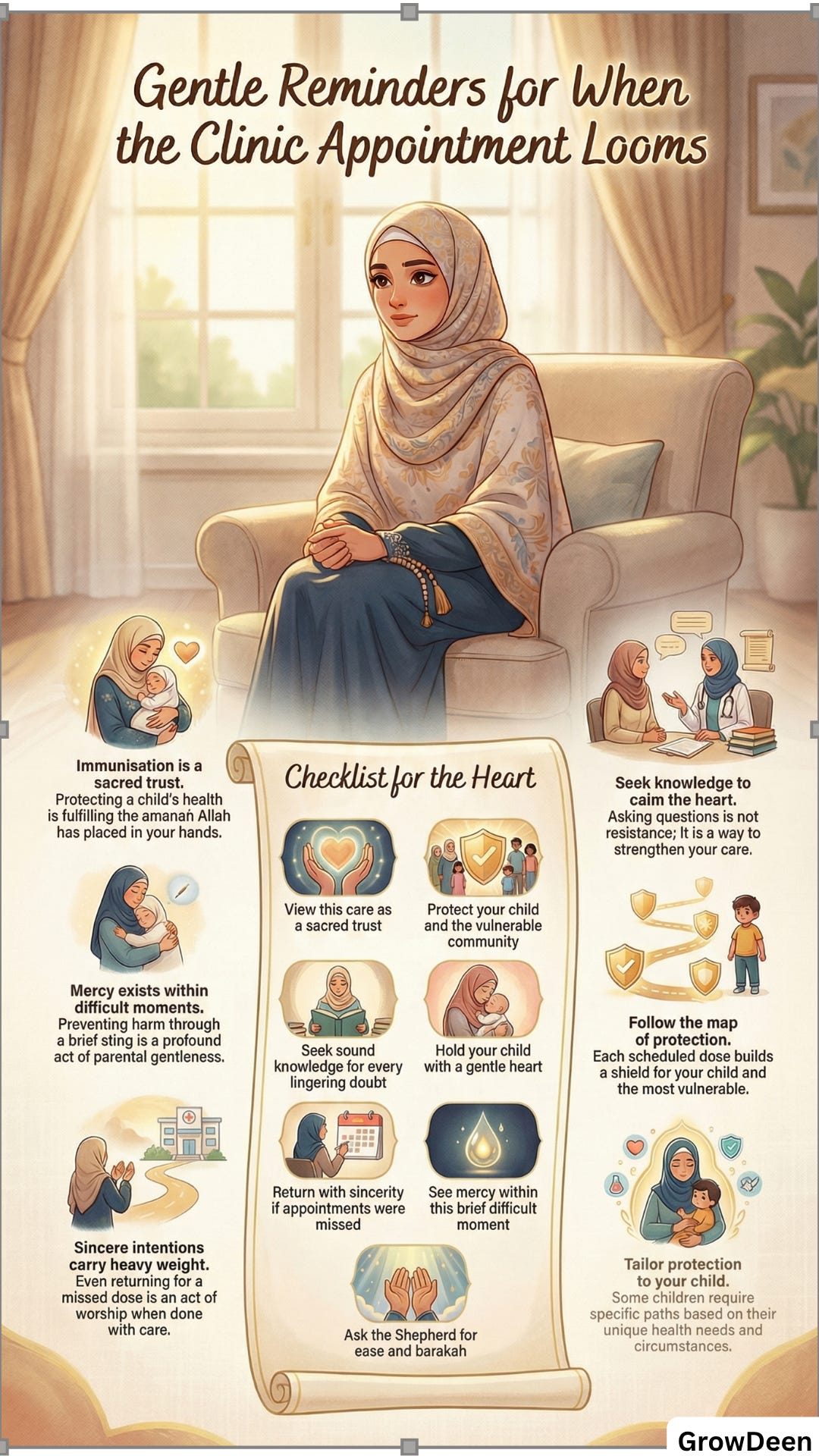
You can be gentle and still follow through.
You can feel emotional and still protect.
That is not contradiction.
That is often what faithful parenting looks like.
GIFTS FOR YOU, DEAR PARENT
If you’ve reached this part of the page, it tells me something meaningful about you.
You weren’t just skimming or passing time. You stayed because something here felt relevant to your real life.
Because you care.
Because you want to do things with more awareness.
Because you’re trying, even when it feels overwhelming.
That is not small.
So I didn’t want this article to remain just words on a page. I wanted it to gently step into your daily life in practical ways. That’s why we prepared these Life Gifts for you.
Not as extras.
Not as decorations.
But as simple tools to help you hold onto what mattered most in what you just read.
Here’s what you’ll find inside:
Gentle Understanding Card
A clear and simplified summary of the core concept from this article, so you can revisit the main idea anytime without rereading everything.
Heartfelt Dua Card
A carefully chosen dua connected to this stage of life, because we know that real strength and ease ultimately come from Allah’s help.
Gentle Actions Card
Practical examples to help you translate knowledge into action, so what you learned becomes part of your daily rhythm.
Gentle Reminders Card
Short, steady reminders drawn from the key points, designed to be printed or saved and placed somewhere you’ll see often.
These were designed slowly and thoughtfully, with time, care, and sincere dua. We created them because we genuinely want to walk alongside you, not just through one article, but through every stage of this lifelong journey.
If these gifts support you even in a small way, I would love for you to continue receiving them.
Subscribe so that each new Gift arrives directly in your inbox whenever we release the next stage. That way, you won’t miss the tools designed to support you right where you are.
May Allah place barakah in your effort, accept your intention, and make this path easier and more rewarding than it feels right now.
Please share it with a family/friend who may benefit from this knowledge.
What is one moment with your child that feels hardest lately, and what kind of support would make it feel lighter?
Subscribe for free to keep receiving gentle, research rooted, Islamically grounded support for the real moments of parenting.
References
[1] Australian Government Department of Health and Aged Care. (2025). Immunisation for Aboriginal and Torres Strait Islander people. Commonwealth of Australia.
[2] Australian Government Department of Health and Aged Care. (2024). National immunisation program schedule. Commonwealth of Australia.
[3] Australian Technical Advisory Group on Immunisation (ATAGI). (2024). Australian immunisation handbook. Australian Government Department of Health and Aged Care.
[4] Services Australia. (2024). Australian immunisation register. Australian Government.
[5] Qur’an, Surah An-Nisa 4:58
[6] Qur’an, Surah Al-Baqarah 2:195
[7] Qur’an, Surah Al-Isra 17:36
[8] Sahih al-Bukhari, Hadith 1; Sahih Muslim, Hadith 1907
[9] Sahih Muslim, Hadith 2593
[10] Jami` at-Tirmidhi, Hadith 1924
[11] Sahih al-Bukhari, Hadith 7138; Sahih Muslim, Hadith 1829