
When Feeding Feels Hard: Understanding Lactose Intolerance with Care
When Milk Doesn’t Sit Right: A Gentle Guide for Worried Parents

Free gift for you! A practical companion resource is waiting for you near the end of this article to help you remember, apply, and benefit from what you read. Don’t forget to download!
Lactose intolerance can feel confusing and worrying for parents, but with gentle understanding, balanced care, and trust in Allah, your child can still grow, heal, and thrive.
It’s that moment again.
You’ve just fed your baby. You were hoping this time would be different.
But then the restlessness begins.
The small cries. The pulling of legs. That unsettled look you can’t quite explain, but you feel it deep in your chest.
Or maybe your older child presses their hand against their stomach after meals. Or your teenager quietly pushes away foods they used to enjoy.
And you’re left wondering…
What am I missing?
When Something Feels Off, Even If You Can’t Explain It
Sometimes, it isn’t loud or obvious.
It’s just a feeling that something isn’t sitting right.
Lactose intolerance can show up like this. Quiet at first. Easy to overlook.
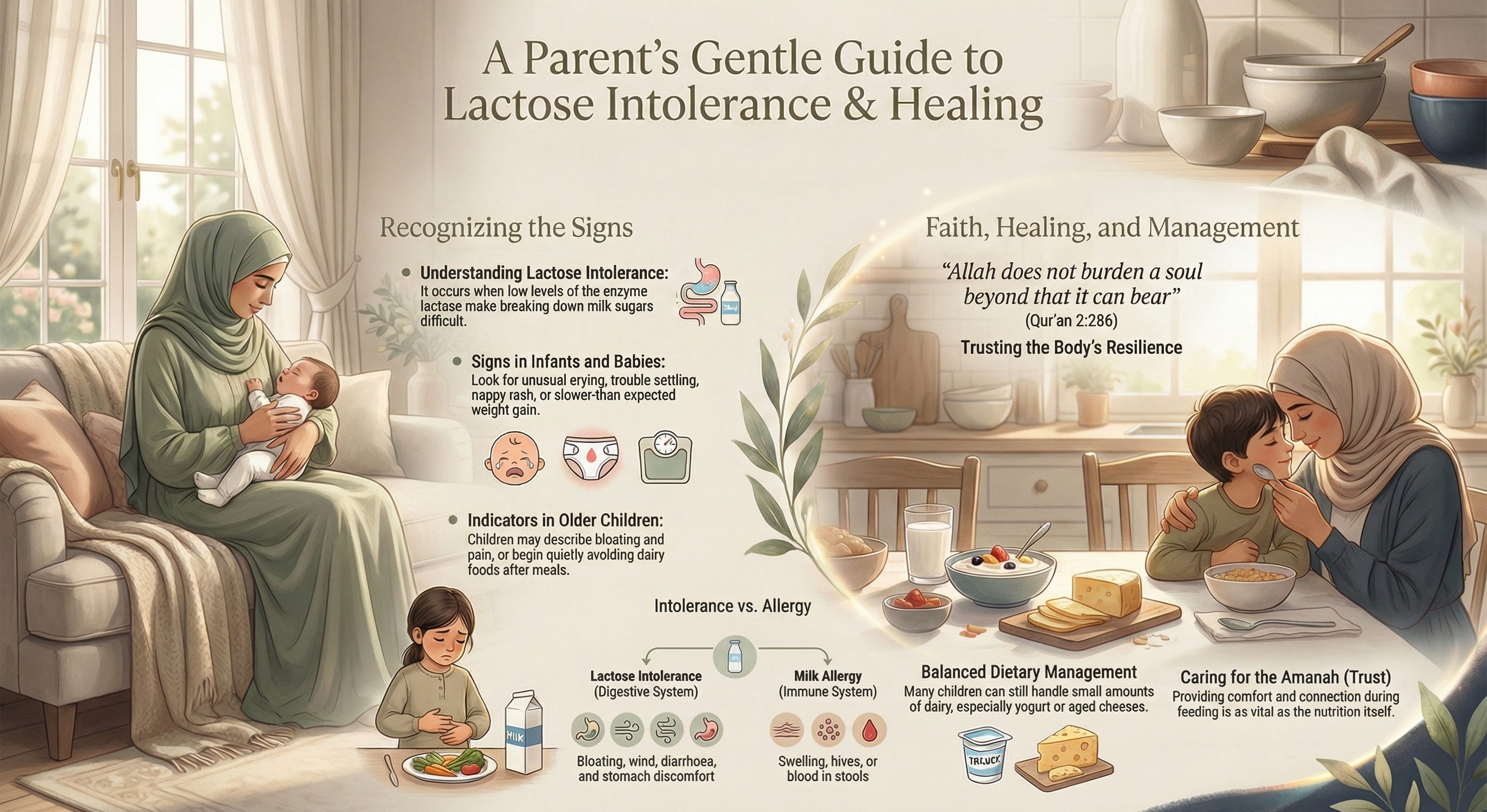
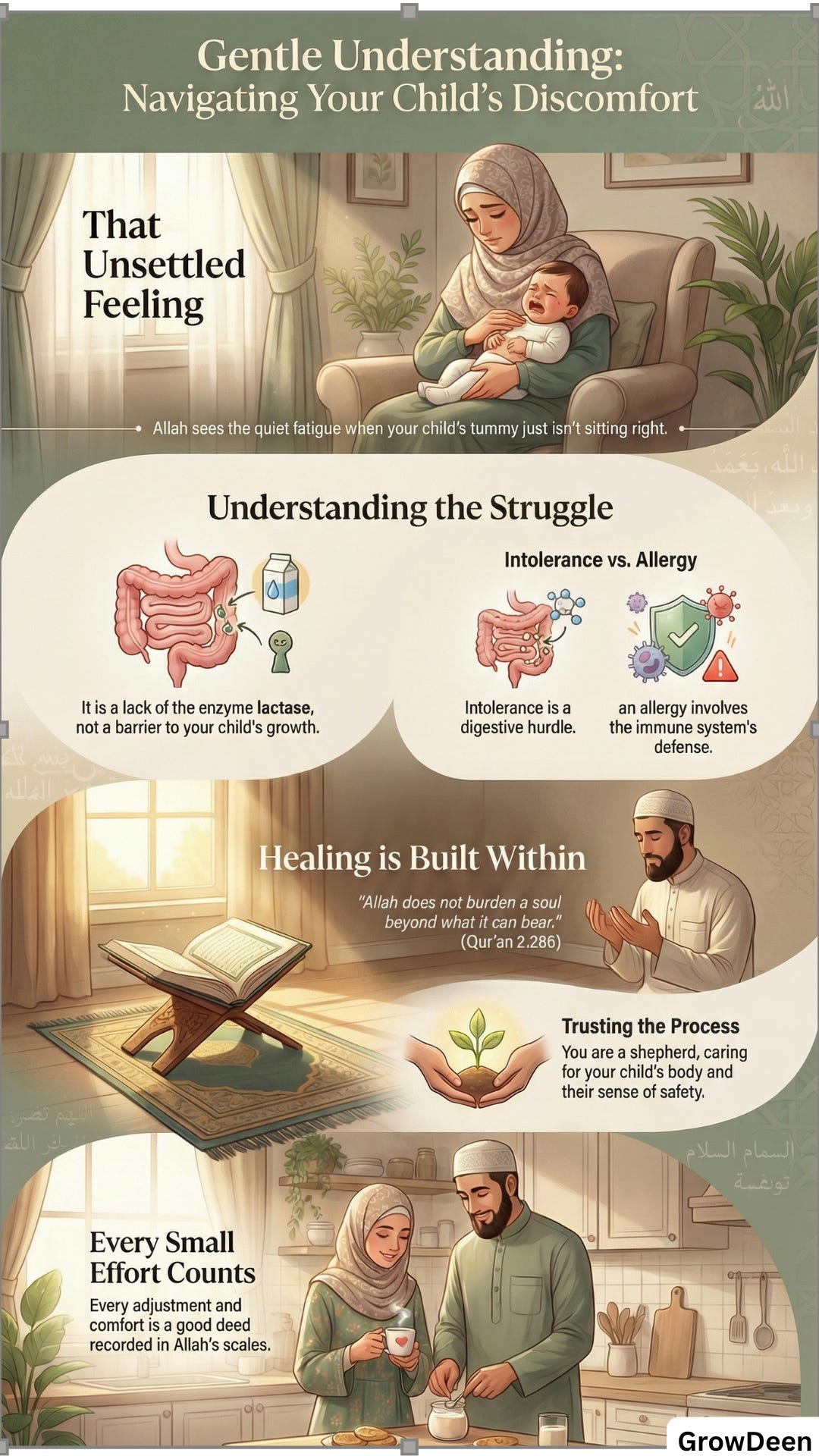
It happens when the body struggles to break down lactose, the natural sugar found in milk. This is because of low levels of an enzyme called lactase in the small intestine. When lactose isn’t properly digested, it moves through the gut and can cause bloating, discomfort, wind, and diarrhoea [3][9] .
And yet, lactose itself is not the enemy.
For babies especially, it’s a source of nourishment. It supports energy, growth, and helps the body absorb nutrients like calcium and iron [5] .
There is wisdom in how Allah nourishes us in ways we don’t fully see.
“And Allah has brought you out of the wombs of your mothers not knowing anything, and He gave you hearing, sight, and hearts so that you may give thanks” [14]
The Many Ways a Child’s Body Learns and Changes
Not all lactose intolerance looks the same.
For many children, it develops slowly over time. As they grow, their bodies naturally produce less lactase. This doesn’t always mean complete intolerance. Often, they can still handle small amounts without discomfort [5] .
Some babies, in very rare cases, are born without lactase at all. From their first days, feeding becomes difficult and requires careful medical support [5] .
And then there are temporary moments.
After illnesses like gastroenteritis, the gut can become sensitive. Lactase levels drop for a while, but as healing happens, tolerance often returns [9] .
The body bends. It recovers. It finds its way back.
Allah’s Gentleness in Your Child’s Healing
There is something deeply comforting in knowing that healing is built into the body itself.
Even when things feel uncertain.
Even when you’re adjusting, trying, learning.
“Allah does not burden a soul beyond that it can bear” [15]
This includes you.
And it includes your child.
What you are navigating right now, even the confusion, even the trial, sits within Allah’s knowledge and care.
The Signs That Can Feel So Different From One Child to Another
Babies don’t tell you what hurts.
They show you.
Crying more than usual. Trouble settling. Nappy rash. Feeding that feels tense instead of comforting. Slower weight gain.
And sometimes, even those signs can be misleading. Many healthy babies go through phases of crying or fussiness without any medical issue [6] .
Older children make it clearer.
They describe the pain. The bloating. The discomfort after eating. The awkwardness of needing the bathroom often [3] .
And quietly, they may begin avoiding foods without telling you why.
Not Everything That Looks the Same Is the Same
One thing that often causes confusion is the difference between lactose intolerance and milk allergy.
They are not the same.
Lactose intolerance is about digestion.
A milk allergy involves the immune system and can show up with symptoms like swelling, hives, or even blood in stools [4] .
This is why guessing isn’t enough.
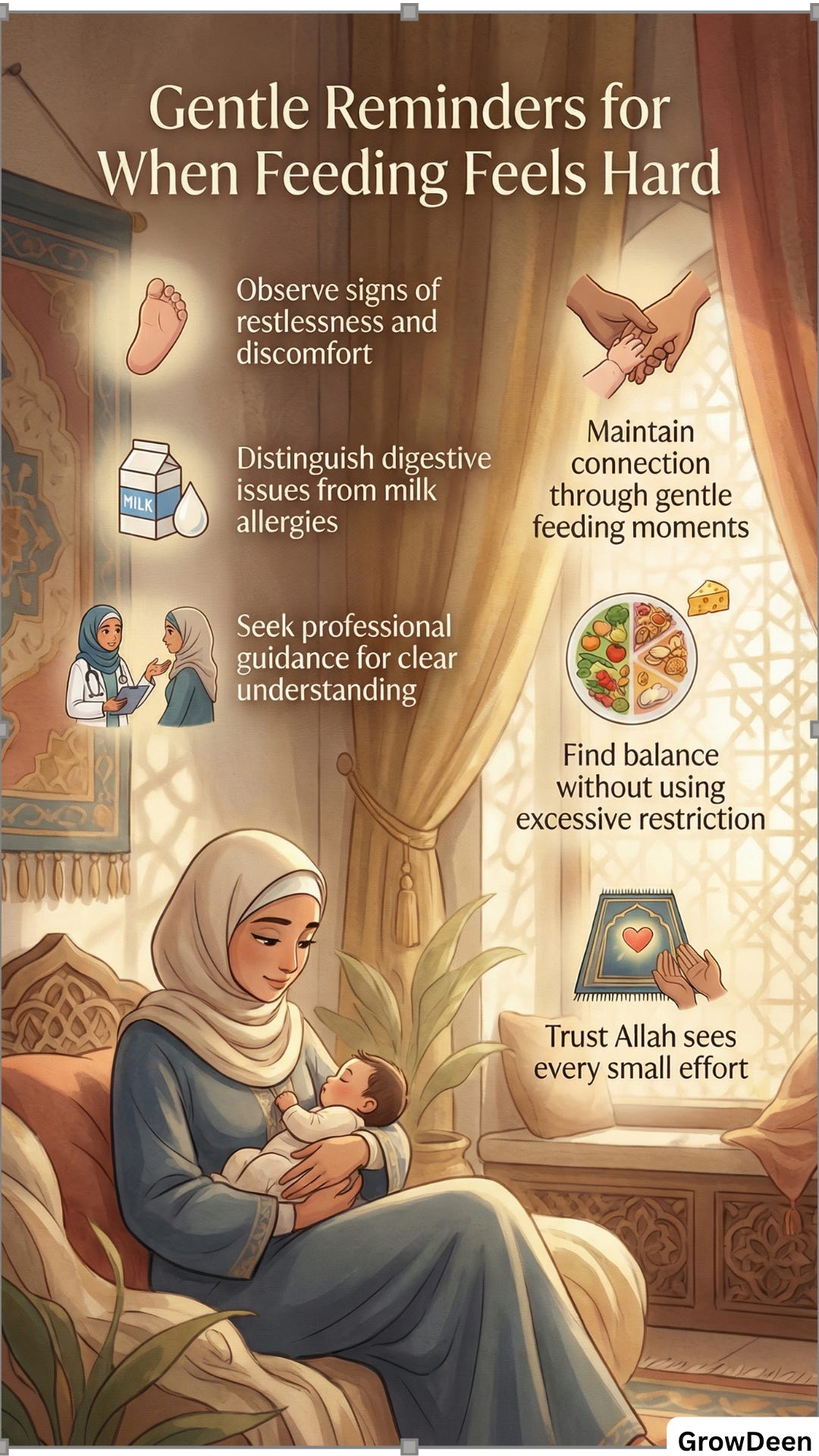
If something feels off, it’s okay to seek guidance.
Doctors may suggest a hydrogen breath test or a short elimination diet to understand what’s happening [9] .
You don’t have to figure it out alone.
You Are Not Just Feeding, You Are Trusting an Amanah
If you are breastfeeding, you might wonder if you should stop.
In many cases, you don’t need to.
Even with temporary lactose intolerance, breastfeeding is often encouraged to continue because of its deep nutritional and emotional value [10] .
There is more happening in those moments than just feeding.
There is comfort. Safety. Connection.
The Prophet ﷺ said:
“Each of you is a shepherd, and each of you is responsible for his flock” [16]
You are caring for your child’s body.
But also their sense of security.
That matters just as much.
Finding Balance Without Taking Everything Away
As children grow, this becomes less about removing foods completely and more about understanding limits.
Many children with lactose intolerance can still enjoy small amounts of dairy, especially when eaten with other foods.
Some options are gentler on the stomach, like certain cheeses and yoghurts. Lactose-free alternatives can also help maintain proper nutrition [11] .
It’s not about restriction.
It’s about learning what works for your child.
“Eat and drink, but do not be excessive…” [17]
Even in this, there is balance.
When It’s Not Intolerance, Just Too Much at Once
Sometimes, what looks like lactose intolerance is something else.
Lactose overload.
This can happen in babies who consume large amounts of lactose quickly, often due to an oversupply of breastmilk.
It’s not that their body can’t digest lactose.
It’s just overwhelmed.
Simple adjustments in feeding patterns can make a big difference [1] .
And suddenly, things begin to settle again.
Somewhere in the middle of all this, I want to gently say something to you.
If you’re finding this helpful, you don’t have to carry all of this alone. You can subscribe for free, and each new piece will come to you quietly, right when you need it, inshaAllah.
Every Small Effort You Make Is Seen
There will be days where you question yourself.
Days where you wonder if you’re doing enough. Or doing it right.
But listen.
Every time you pause to understand your child…
Every time you adjust, comfort, try again…
It counts.
“And whatever good you do, Allah knows it” [19]
Nothing is lost.
Not your effort. Not your intention.
GIFTS FOR YOU, DEAR PARENT
If you’ve reached this part of the page, it tells me something meaningful about you.
You weren’t just skimming or passing time. You stayed because something here felt relevant to your real life.
Because you care.
Because you want to do things with more awareness.
Because you’re trying, even when it feels overwhelming.
That is not small.
So I didn’t want this article to remain just words on a page. I wanted it to gently step into your daily life in practical ways. That’s why we prepared these Life Gifts for you.
Not as extras.
Not as decorations.
But as simple tools to help you hold onto what mattered most in what you just read.
Here’s what you’ll find inside:
Gentle Understanding Card
A clear and simplified summary of the core concept from this article, so you can revisit the main idea anytime without rereading everything.
Heartfelt Dua Card
A carefully chosen dua connected to this stage of life, because we know that real strength and ease ultimately come from Allah’s help.
Gentle Actions Card
Practical examples to help you translate knowledge into action, so what you learned becomes part of your daily rhythm.
Gentle Reminders Card
Short, steady reminders drawn from the key points, designed to be printed or saved and placed somewhere you’ll see often.
These were designed slowly and thoughtfully, with time, care, and sincere dua. We created them because we genuinely want to walk alongside you, not just through one article, but through every stage of this lifelong journey.
If these gifts support you even in a small way, I would love for you to continue receiving them.
Subscribe so that each new Gift arrives directly in your inbox whenever we release the next stage. That way, you won’t miss the tools designed to support you right where you are.
May Allah place barakah in your effort, accept your intention, and make this path easier and more rewarding than it feels right now.
Please share it with a family/friend who may benefit from this knowledge.
What is one moment with your child that feels hardest lately, and what kind of support would make it feel lighter?
If this felt like a gentle companion in your journey, you’re always welcome to subscribe for free so the next piece reaches you when you need it.
References
[1] Anderson, J. (2022). Lactose overload in babies. Australian Breastfeeding Association.
[2] Australasian Society of Clinical Immunology and Allergy (ASCIA). (2024). Cow’s milk (dairy) allergy.
[3] Di Costanzo, M., & Canani, B.R. (2019). Lactose intolerance: Common misunderstandings.
[4] Heine, R.G. et al. (2017). Lactose intolerance and gastrointestinal cow’s milk allergy in infants and children.
[5] Heyman, M.B. (2006). Lactose intolerance in infants, children, and adolescents.
[6] Hiscock, H., & Jordan, B. (2004). Problem crying in infancy.
[7] Kanabar, D. et al. (2001). Lactase use in infant colic.
[8] Matthews, S.B. et al. (2005). Systemic lactose intolerance.
[9] Misselwitz, B. et al. (2019). Lactose malabsorption and intolerance.
[10] NHMRC. Infant feeding guidelines.
[11] NHMRC. Australian guide to healthy eating.
[12] Porzi, M. et al. (2021). Personalized nutrition in lactose intolerance.
[13] Savaiano, D.A. et al. (2006). Lactose intolerance symptoms meta-analysis.
[14] Qur’an 16:78
[15] Qur’an 2:286
[16] Sahih al-Bukhari 7138
[17] Qur’an 7:31
[18] Sahih al-Bukhari 5199
[19] Qur’an 2:197