
When Early Play Feels Small but Allah Is Growing Something
Your Newborn’s Tiny Movements Are Doing More Than You Think

Free gift for you! A practical companion resource is waiting for you near the end of this article to help you remember, apply, and benefit from what you read. Don’t forget to download!
In the first 3 months, gentle movement play helps a newborn build early motor skills, body awareness, strength, and confidence through repeated, responsive interaction.
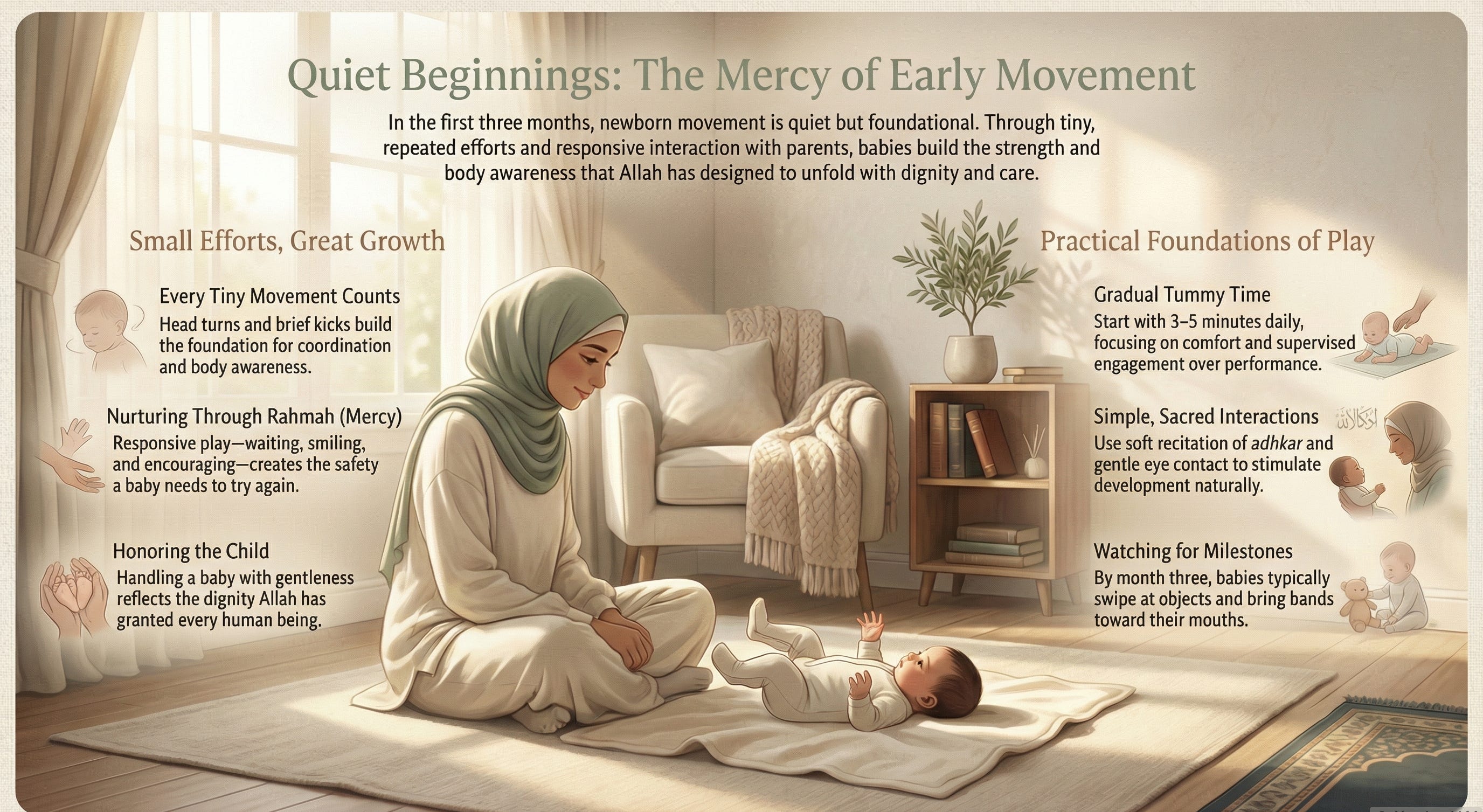
At first, it hardly looks like anything.
A little head turn. A hand opening for a second, then curling back in. A brief kick in the bath. A tiny lift of the chin before it drops again. You watch it happen and part of you wonders whether these moments even count yet.
They do.
In the newborn months, movement begins quietly. But quiet does not mean unimportant.
So much starts with very small efforts
In the first 3 months, babies are not doing big, impressive things. They are building through tiny repeated efforts. Play gives them chances to move different parts of their bodies, and through that practice they begin developing strength, coordination, body awareness, and early gross and fine motor skills.[1][2][3][4][5][6][7] The American Academy of Pediatrics and other early development guidance consistently treat play and movement as essential parts of healthy development, not as extras.
And play does something else too. It slows the adult down. A baby turns toward a voice. Watches a face. Tries again. You smile, wait, adjust, encourage. That back and forth is not only sweet. It helps a baby feel safe enough to keep trying.[4][5][6][7] WHO’s nurturing care guidance also places responsive caregiving and early learning right near the centre of healthy early development.
Allah’s care is already unfolding in the body
This stage is full of dependence, but dependence is not emptiness.
Allah says, “Say, He is the One Who brought you into being and gave you hearing, sight, and intellect. Yet you hardly give any thanks.”[9] And He says, “Indeed, We have dignified the children of Adam.”[10] Even before a baby can hold the head steady or reach with purpose, Allah has already begun the careful unfolding of their growth.
That changes how a parent sees these early days.
A baby’s body is not something to rush. It is something to handle with honour. With gentleness. With patience.
Because newborn strength is still arriving in pieces.
What is normal in these first weeks
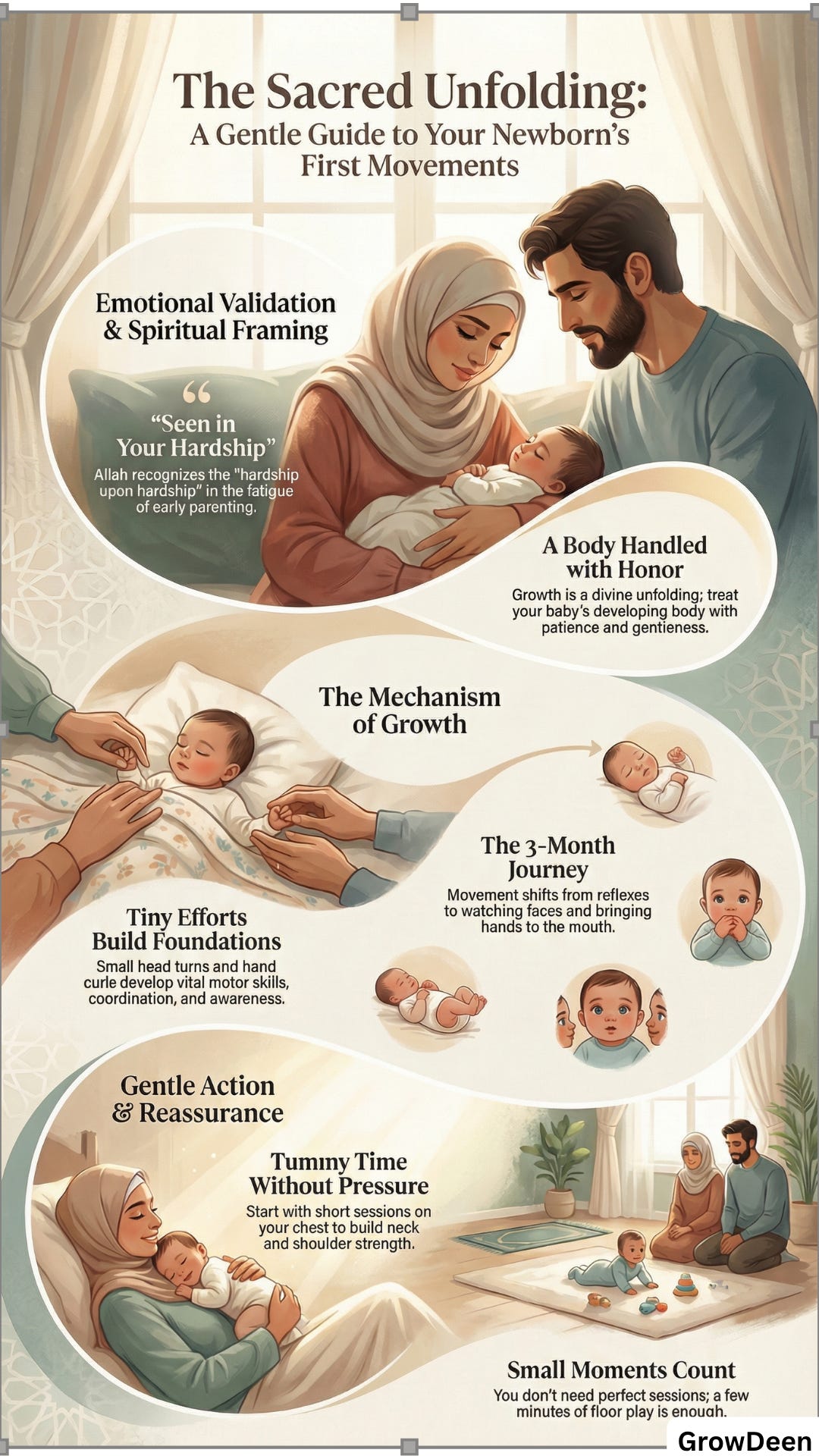
In the first month, many movements are still reflexive. A newborn may turn toward a touched cheek, suck by reflex, briefly look at a face held close, start turning the head, or lift the head for a moment during tummy time.[5][6][7] These efforts are often uneven. That is normal.
By around 2 months, many babies are looking at faces, watching movement, reacting to sound, holding their heads up more during tummy time, moving both arms and both legs, and opening their hands briefly. By around 3 months, many are bringing their hands toward their mouth, swiping at nearby objects, and lifting the head and chest more clearly when on their tummy.[5][6][7] CDC’s current milestone guidance for 2 months includes watching you as you move, looking at a toy for several seconds, holding the head up during tummy time, moving both arms and both legs, and opening hands briefly.
That does not mean every baby does everything on the same day. It means there is a broad pattern, and it unfolds over time.
The simplest movement play is often the best
You do not need complicated activities for a newborn.
A little floor time on a safe surface. A face to follow. A soft toy placed briefly in the hand. A light rattle. A gentle humming of adhkar, a calming recitation while your baby stretches and kicks. Bright, safe objects to look at and later swipe toward. These quiet moments help babies begin building neck strength, coordination, and body awareness.[4][5][6][7]
Because the neck muscles are still developing, newborns need head support when being carried or lifted.[5][7] That is not over-protection. It is simply appropriate care for a body still learning its own strength.
And if you are a tired parent, this is worth hearing clearly: small counts. A few minutes count. You do not need long perfect sessions for movement play to matter.
If this kind of gentle, research rooted, Islamically grounded support helps you breathe more easily as a parent, subscribe for free so the next article reaches you when you need it.
Tummy time matters, but it should not become pressure
Tummy time deserves special attention because it gives babies a different way to work against gravity and helps build head, neck, shoulder, and upper body strength.[1][3][8] The American Academy of Pediatrics says babies can start tummy time the day they come home from the hospital, beginning with short supervised sessions of about 3 to 5 minutes, 2 to 3 times a day, and building up as they grow stronger. NIH Safe to Sleep guidance gives similar advice and notes that by about 2 months many babies can work toward 15 to 30 minutes total per day.
At the same time, it helps to speak honestly about it. Tummy time is valuable, but it is not magic. A 2023 review noted benefits for infant development, especially prone motor skills such as head control, while also saying the evidence for plagiocephaly prevention is more limited than many people assume.
So yes, value tummy time.
But do not turn it into a burden or a measure of your worth.
Some babies fuss straight away. They press their face down and complain as if something deeply unfair has happened. That does not mean tummy time is impossible. It may just need a softer start. On your chest. Across your lap. Then, slowly, on the floor later.[8] And always, tummy time is for awake, supervised play only. For sleep, babies should still be placed on their backs.
Mercy belongs in movement too
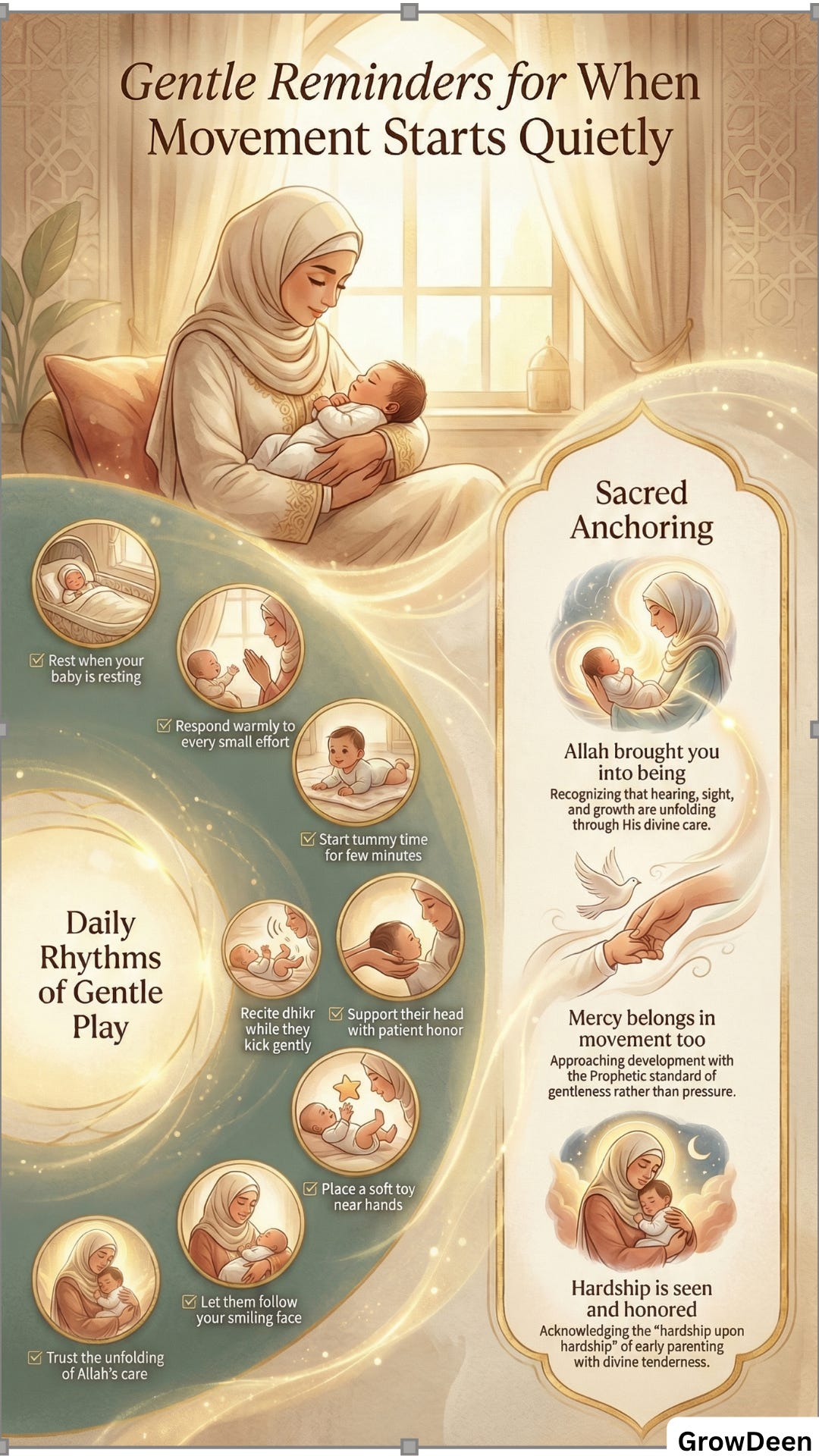
The Prophet ﷺ said, “Whoever is not merciful to others will not be treated mercifully.”[14] Newborn movement play should feel like that. Not rough. Not pressured. Not performance based. Just patient mercy repeated in small moments.
Encouragement matters too. A cheerful voice after a brief head lift. A delighted smile when your baby opens a hand. Warm amazement when they turn toward you. All of this becomes part of the learning environment.[4][5][6]
And there is something beautiful in the hadith, “The strong believer is better and more beloved to Allah than the weak believer, while there is good in both.”[13] A newborn is not being asked for adult strength, of course. But the hadith still reminds us that strength is a blessing. Helping a child grow into it with care is part of gratitude.
When concern deserves a closer look
Comparison can make parents anxious. One baby seems more active. Another quieter. One tolerates tummy time. Another cries after a minute. Development usually follows a broad order, but timing varies.
Still, concerns should not be brushed aside. It is worth speaking to a doctor, child and family health nurse, paediatric physiotherapist, or another appropriate clinician if a baby seems to lose skills they previously had, seems unusually floppy or stiff, does not respond to loud sounds, does not briefly watch faces or movement, does not bring hands toward the mouth, or seems to use one side very differently from the other. CDC milestone guidance also encourages acting early if a child is not meeting expected milestones or loses a skill they once showed.
And if you feel worn down, Allah has already spoken about the weight of early care. “His mother carried him through hardship upon hardship.”[11] These words hold tenderness for the parent too. The tiredness is real. The repetition is real. The effort is seen.
There is another mercy in the Sunnah here. The Prophet ﷺ said that he would begin the prayer intending to lengthen it, but when he heard a child crying, he would shorten it because he knew the distress it would cause the mother.[15] That is such a deep honoring of a baby’s need and a mother’s heart.
So in the first 3 months, movement play does not need to be complicated.
A little tummy time.
A little floor time.
A toy held briefly in the hand.
A face to follow.
A voice to turn toward.
A safe surface.
A patient adult.
That is enough to begin.
GIFTS FOR YOU, DEAR PARENT
If you’ve reached this part of the page, it tells me something meaningful about you.
You weren’t just skimming or passing time. You stayed because something here felt relevant to your real life.
Because you care.
Because you want to do things with more awareness.
Because you’re trying, even when it feels overwhelming.
That is not small.
So I didn’t want this article to remain just words on a page. I wanted it to gently step into your daily life in practical ways. That’s why we prepared these Life Gifts for you.
Not as extras.
Not as decorations.
But as simple tools to help you hold onto what mattered most in what you just read.
Here’s what you’ll find inside:
Gentle Understanding Card
A clear and simplified summary of the core concept from this article, so you can revisit the main idea anytime without rereading everything.
Heartfelt Dua Card
A carefully chosen dua connected to this stage of life, because we know that real strength and ease ultimately come from Allah’s help.
Gentle Actions Card
Practical examples to help you translate knowledge into action, so what you learned becomes part of your daily rhythm.
Gentle Reminders Card
Short, steady reminders drawn from the key points, designed to be printed or saved and placed somewhere you’ll see often.
These were designed slowly and thoughtfully, with time, care, and sincere dua. We created them because we genuinely want to walk alongside you, not just through one article, but through every stage of this lifelong journey.
If these gifts support you even in a small way, I would love for you to continue receiving them.
Subscribe so that each new Gift arrives directly in your inbox whenever we release the next stage. That way, you won’t miss the tools designed to support you right where you are.
May Allah place barakah in your effort, accept your intention, and make this path easier and more rewarding than it feels right now.
Please share it with a family or friend who may benefit from this knowledge.
What is one moment with your baby’s movement or play that has made you pause lately?
Subscribe for free if you would like more gentle, practical, Islamically grounded support for real parenting moments.
References
[1] Australian Government Department of Health and Aged Care. Australian 24 hour movement guidelines for the early years, birth to 5 years.
[2] Babik, I., Galloway, J. C., & Lobo, M. A. (2022). Early exploration of one’s own body, exploration of objects, and motor, language, and cognitive development relate dynamically across the first two years of life. Developmental Psychology, 58(2), 222 to 235.
[3] Carson, V., Zhang, Z., Predy, M., Pritchard, L., & Hesketh, K. D. (2022). Longitudinal associations between infant movement behaviours and development. International Journal of Behavioral Nutrition and Physical Activity, 19, Article 10.
[4] Ginsburg, K. R. (2007). The importance of play in promoting healthy child development and maintaining strong parent child bonds. Pediatrics, 119(1), 182 to 191.
[5] Howard, J. (2017). Mary D. Sheridan’s Play in Early Childhood: From Birth to Six Years (4th ed.). Routledge.
[6] Manning-Morton, J., & Thorp, M. (2003). Key Times for Play: The First Three Years. Open University Press.
[7] Sinno, D., Charafeddine, L., & Mikati, M. (2013). Enhancing Early Child Development: A Handbook for Clinicians. Springer.
[8] Williams, E., & Galea, M. (2023). Another look at tummy time for primary plagiocephaly prevention and motor development. Infant Behavior and Development, 71, Article 101839.
[9] The Qur’an, Surah Al Mulk 67:23
[10] The Qur’an, Surah Al Isra 17:70
[11] The Qur’an, Surah Luqman 31:14
[12] The Qur’an, Surah Al Baqarah 2:233
[13] Sahih Muslim, Hadith 2664
[14] Sahih al Bukhari, Hadith 5997; Sahih Muslim, Hadith 2318a
[15] Sahih al Bukhari, Hadith 709; Sahih al Bukhari, Hadith 710