
When Community Feels Too Much And Silence Feels Safer
Three Months Postpartum And Social Messages Feel Like Weights

When you stop replying to people postpartum, it is often not rudeness or ingratitude, it is overload and fear of being perceived, and you can keep one small thread of connection without drowning.
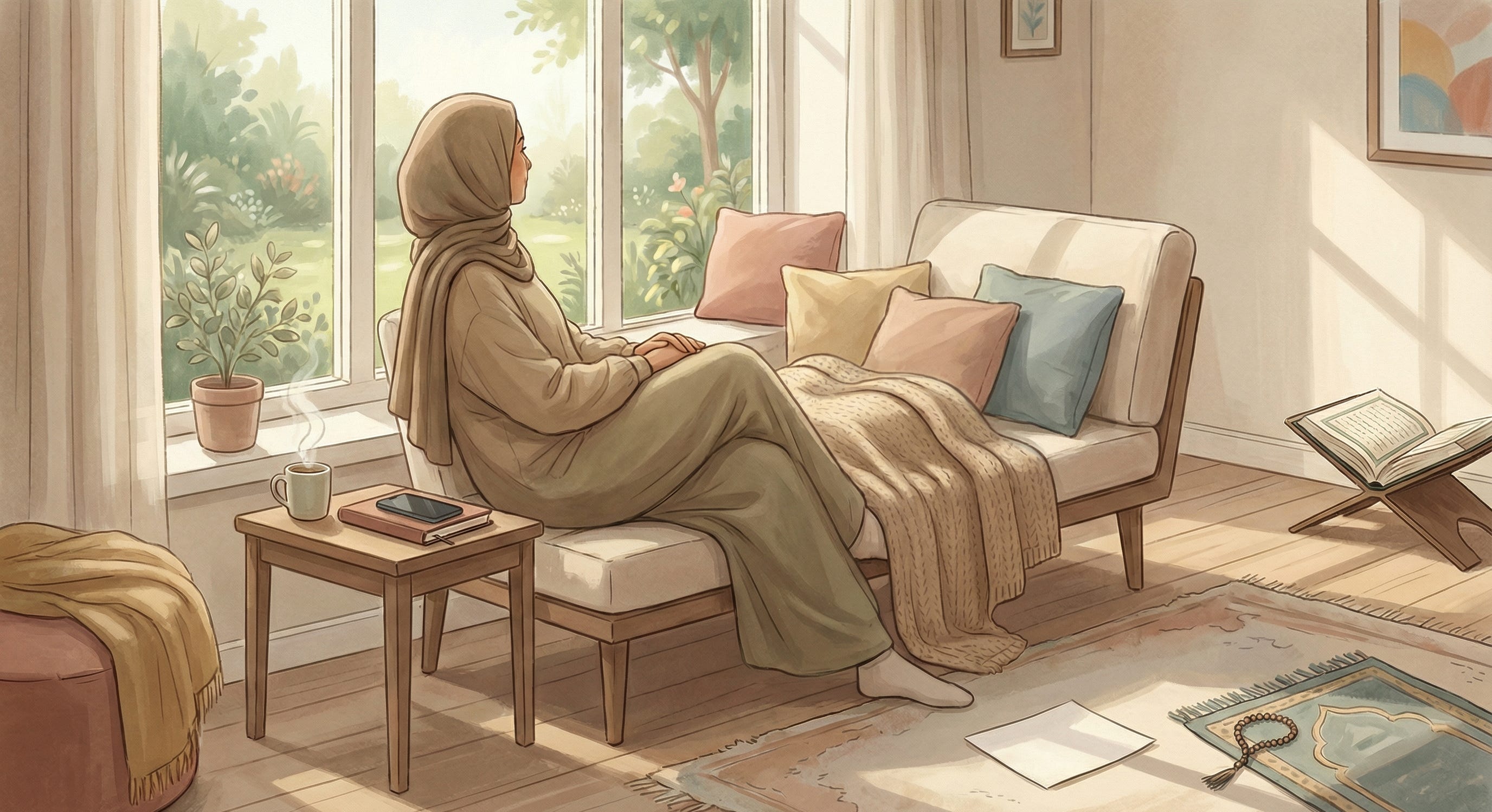
Your phone lights up again.
A friend checking in.
A cousin sending a voice note.
Someone from the masjid saying they should come by and see the baby.
It is kind. It is normal. It is the kind of thing you used to answer without thinking.
Now you stare at the screen like it is asking you to lift something heavy.
You want to answer. There is a small hunger in you for a normal conversation. Someone laughing with you. Someone seeing you as a person and not just postpartum function.
But replying means more than replying.
It means being on.
It means someone asking how you are and you either lie, or you tell the truth and then you have to manage what comes after.
So you do the simplest thing.
You do not answer.
You put the phone down and tell yourself you will reply later, when the baby naps, when you have more capacity, when you feel more human.
Later comes and goes.
The message sits there. The tiny notification starts to feel like a weight on your chest. Not because they did anything wrong. Because you are disappearing in front of your own eyes and you do not fully understand why.
Then the second feeling arrives.
Sharp and mean.
What is wrong with me. I need people. So why am I pushing them away.
When kindness feels like a demand
It is hard to explain this to anyone who is not inside it.
On the outside, it looks like you are ignoring people.
On the inside, it feels like you are trying not to collapse.
Even a sweet message can feel like a task. Not because you do not love them. Because you can already feel the energy leak that comes with being perceived.
You picture the follow up questions.
You picture the advice.
You picture the awkward silence when you do not know what to say.
So your body chooses the thing that costs less in the moment.
Silence.
The shame that turns loneliness into your fault
When people do not show up, loneliness is simple.
I am alone.
But when people reach out and you still withdraw, loneliness gets tangled with shame.
They will think I am rude.
They will think I am ungrateful.
They will see the house.
They will ask questions I do not have answers for yet.
Postpartum shame has a special voice. It does not shout. It whispers. It narrates.
And because it feels religious too, it lands deeper than normal insecurity.
You start thinking about community, ties, adab, rights. You start feeling guilty for being tired.
Then you feel guilty for feeling guilty.
Your nervous system is not being dramatic, it is overloaded
A depleted body treats normal social contact like input it cannot afford.
No more noise. No more explaining. No more holding someone else’s reaction.
Sometimes it is simply overload and broken sleep.
Sometimes withdrawal is also a sign that something heavier is sitting underneath.
Postpartum depression can include withdrawing from family and friends and feeling overwhelmed, and it is treatable. [1] [2]
NIMH’s guidance on perinatal depression explains that symptoms can affect daily life and that help is available. [3]
ACOG emphasizes screening and support for mental health conditions during pregnancy and postpartum for a reason. [4]
And even if you do not recognize yourself in any label, one thing stays true.
Support matters. Research links social support with better postpartum mental health outcomes, and decreases in support are associated with poorer outcomes. [5]
More broadly, social isolation and loneliness are linked with increased risk of depression and anxiety among other health impacts. [6]
So the goal is not “be more social.”
The goal is smaller.
How do you keep one thread of connection without feeling like you are drowning.
If you want gentle guidance for moments like this, written in a way that feels human and doable, you can subscribe for free. You will get these reflections in your inbox as you move through each life stage, without needing to search for the right words on the hard days.
A small honest doorway that does not require you to perform
Here is the embarrassing truth.
Sometimes we do not avoid people because we do not want them.
We avoid people because we do not want the version of ourselves that shows up when we are empty.
The flat voice.
The forced smile.
The “I’m fine” that tastes like cardboard.
So instead of aiming for a big comeback, pick one honest doorway.
One sentence that does not require hosting, explaining, apologizing, or becoming inspirational.
Something like:
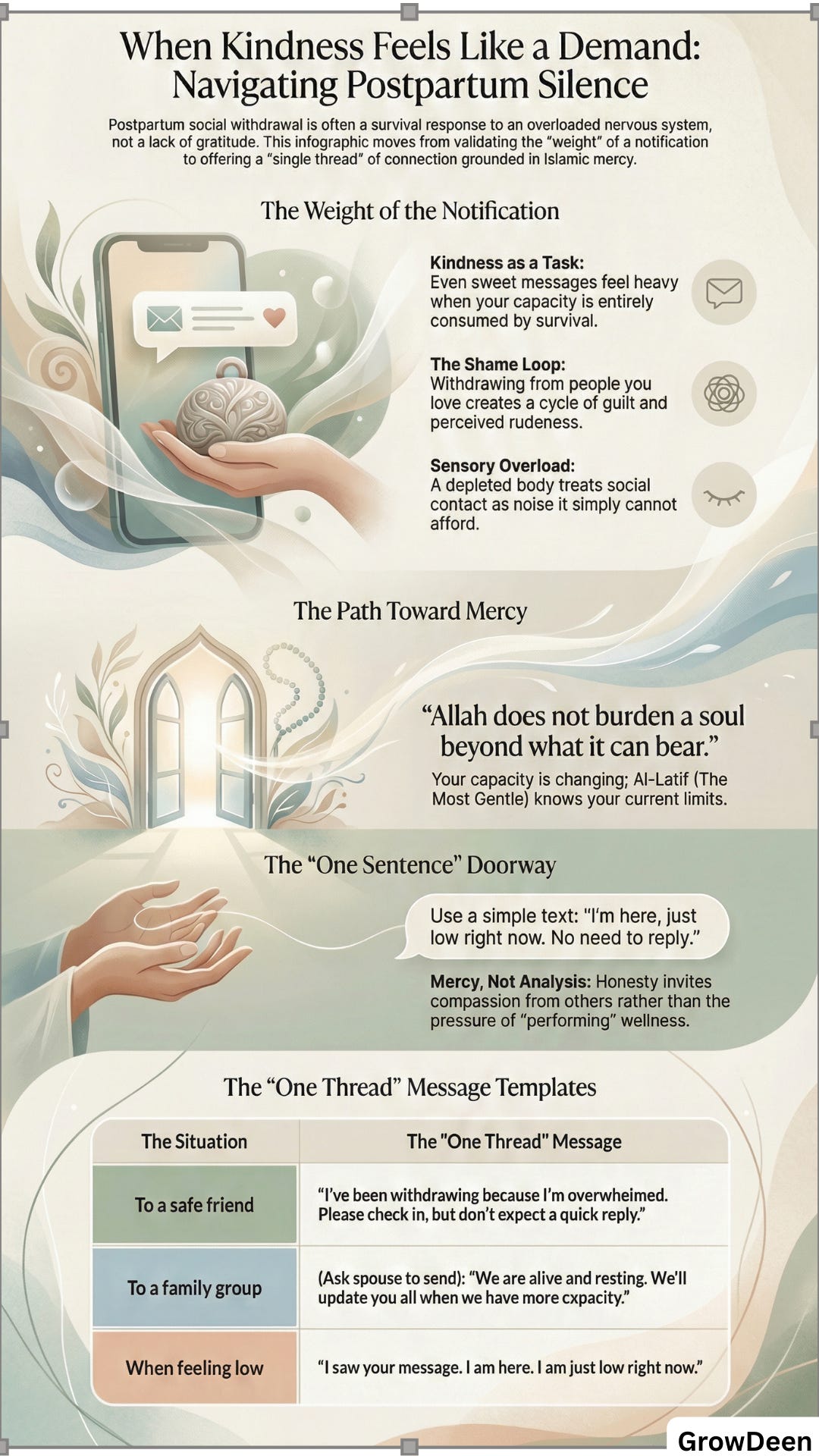
I saw your message. I am here. I am just low right now.
That kind of honesty does not invite analysis.
It invites mercy.
And if your spouse is around, it is okay to let them carry one relational task for you. A simple reply in the family chat. A short “we’re alive” update. A small boundary for visits.
Not because you are helpless.
Because you are not meant to do everything alone.
If withdrawal is deep and persistent, if you are pulling away from everyone and you also feel numb, panicky, hopeless, or unlike yourself, please consider professional support. These conditions are treatable, and you do not need to wait for a collapse to deserve care. [1] [3] [4]
Al Latif knows your capacity, and He does not shame you for it
Islam values ties and community.
And Islam also understands strain.
Allah says, “Allah does not burden a soul beyond what it can bear.” (Qur’an 2:286) [7]
Your capacity is not fixed right now. It is changing. Allah knows.
And Allah says, “Hold firmly to the rope of Allah all together and do not become divided.” (Qur’an 3:103) [8]
Sometimes “together” is a room full of people.
Sometimes it is one safe person who can sit with your quiet without taking it personally.
The Prophet ﷺ said the believers, in their mutual love, mercy, and compassion, are like one body. [9]
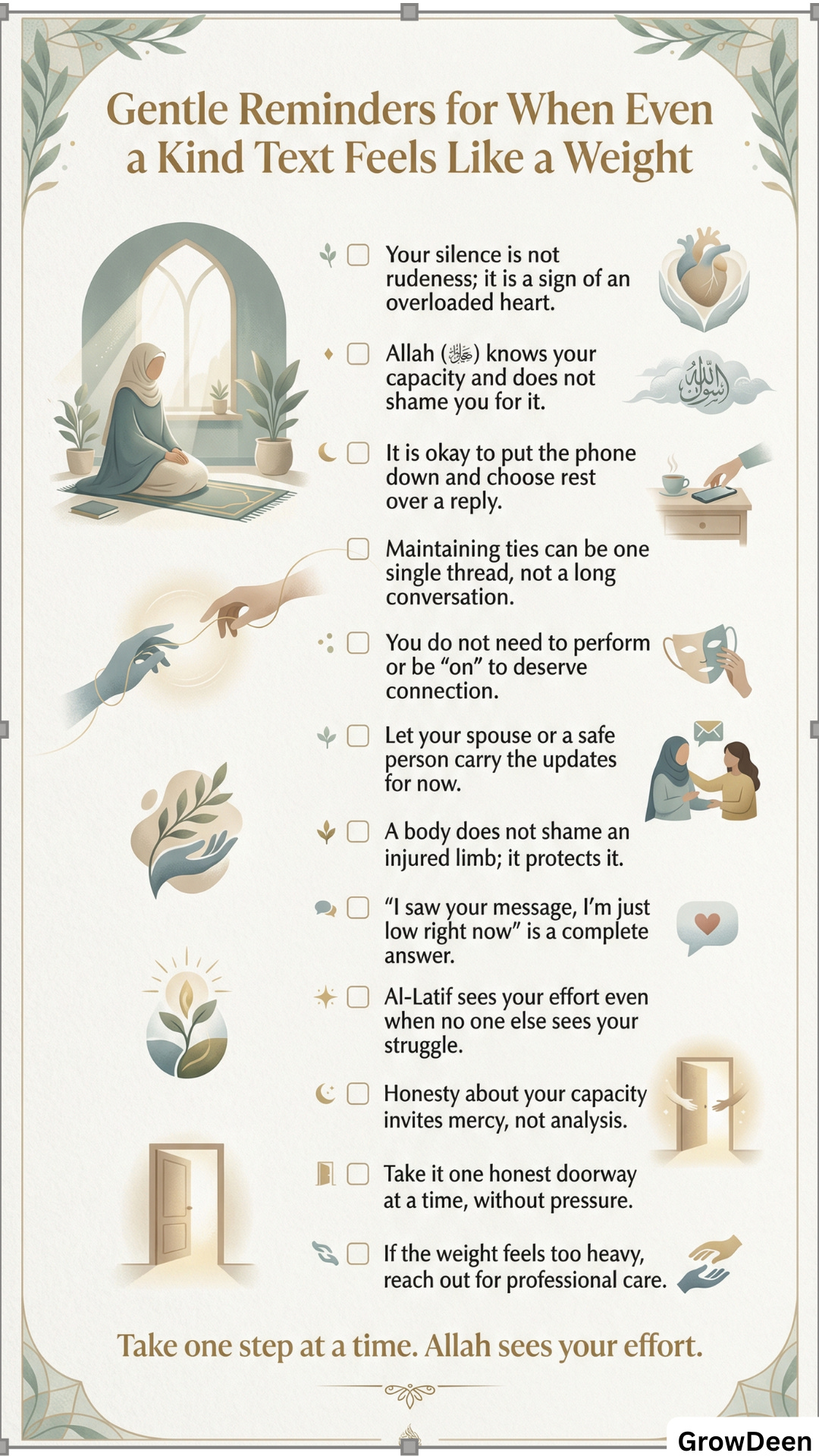
A body does not shame an injured limb for limping. It protects it.
And the Prophet ﷺ taught that maintaining ties of kinship matters. [10]
Maintaining ties does not always mean long conversations.
Sometimes, for now, it means a single thread that stays unbroken.
One message you can send today without opening the floodgates
Pick one person who feels safest.
Not the person who needs you to host them emotionally.
The person who can hold your reality without making it about them.
Send one message. Keep it plain.
I miss you. I’ve been withdrawing because I’m overwhelmed. If you’re okay with it, can you just check in sometimes without expecting quick replies.
If even that feels like too much, send less.
I saw your message. I’m here. Just low right now.
And if you notice you are withdrawing from everyone and you are feeling persistently depressed, anxious, or hopeless, consider bringing it to a clinician. Screening and support are recommended and available. [4] [1]
If you ever have thoughts of self harm or feel unable to stay safe, seek urgent help through local emergency services or crisis support and contact your healthcare provider immediately. [3] [2]
I will end with a small du‘a for you.
Allah, send this mother companionship that feels like mercy, not pressure. Protect her heart from shame. Keep one thread of connection alive until she can hold more. Ameen.
Reflection and Action Gifts
If you’ve reached this part of the page, it tells me something meaningful about you.
You weren’t just skimming words or passing time. You stayed because something here mattered to you.
Because you’re hoping, quietly, that life can feel a little lighter, a little clearer, a little more grounded than it does right now.
That’s why we prepared these Reflection and Action Gifts for you. Not as content. Not as decoration.
But as tools we intentionally created with care, time, and dua, so what you just read doesn’t stay on the page, but gently finds its way into your daily life. These resources were made slowly and thoughtfully, with parents like you in mind.
You’re welcome to save them, print them, revisit them, or place them somewhere you’ll see often.
You can use them quietly on your own, or share them with your family if that feels right.
Our only hope is that they bring you comfort, clarity, and small moments of steadiness in the middle of real life.
May Allah place barakah in your effort, accept your intention, and make what you’re trying to do easier than it feels right now.
📥 Download your Reflection and Action Gifts
This gift pack includes 👇:
Gentle Understanding Card
Gentle Reminders Card
Everyday Reflections Card
Dua Card
If these resources support you even in a small way, I’d love to continue walking alongside you.
When you subscribe, you’ll receive future reflections and practical resources like these, completely free, delivered gently to your inbox as they’re created.
And if you know another parent or mother who might need this right now, please feel free to share or restack this so the benefit can reach them too.
You’re not meant to carry this alone.
Subscribe for free if you want more gentle, practical support for postpartum moments that are hard to explain, and small tools you can actually use.
What kind of message feels hardest to reply to right now?
References