
When Caring for Your Child Means Thinking Beyond Today
Vaccines Across Life Are a Form of Care, Not Just a Schedule

Free gift for you! A practical companion resource is waiting for you near the end of this article to help you remember, apply, and benefit from what you read.
Don’t forget to download!
Vaccines help prepare the immune system before real infection arrives, so protection can begin earlier, suffering can be reduced, and vulnerable people across the lifespan can be guarded more wisely.
Sometimes the hardest parenting choices are not the dramatic ones.
They are the quiet ones. The ones that happen in a clinic room, or while reading a health form, or in that moment when you are trying to think beyond today and make a decision that is really about a future you cannot fully see.
Vaccines can feel like that.
Not because every parent doubts what they are for, but because when the body being cared for is your child’s body, even preventive decisions carry weight. You are not only thinking about medicine. You are thinking about trust. About safety. About what it means to protect someone before danger even arrives.
What a vaccine is really doing inside the body
A vaccine is meant to protect a person from an infectious disease before that disease takes hold.
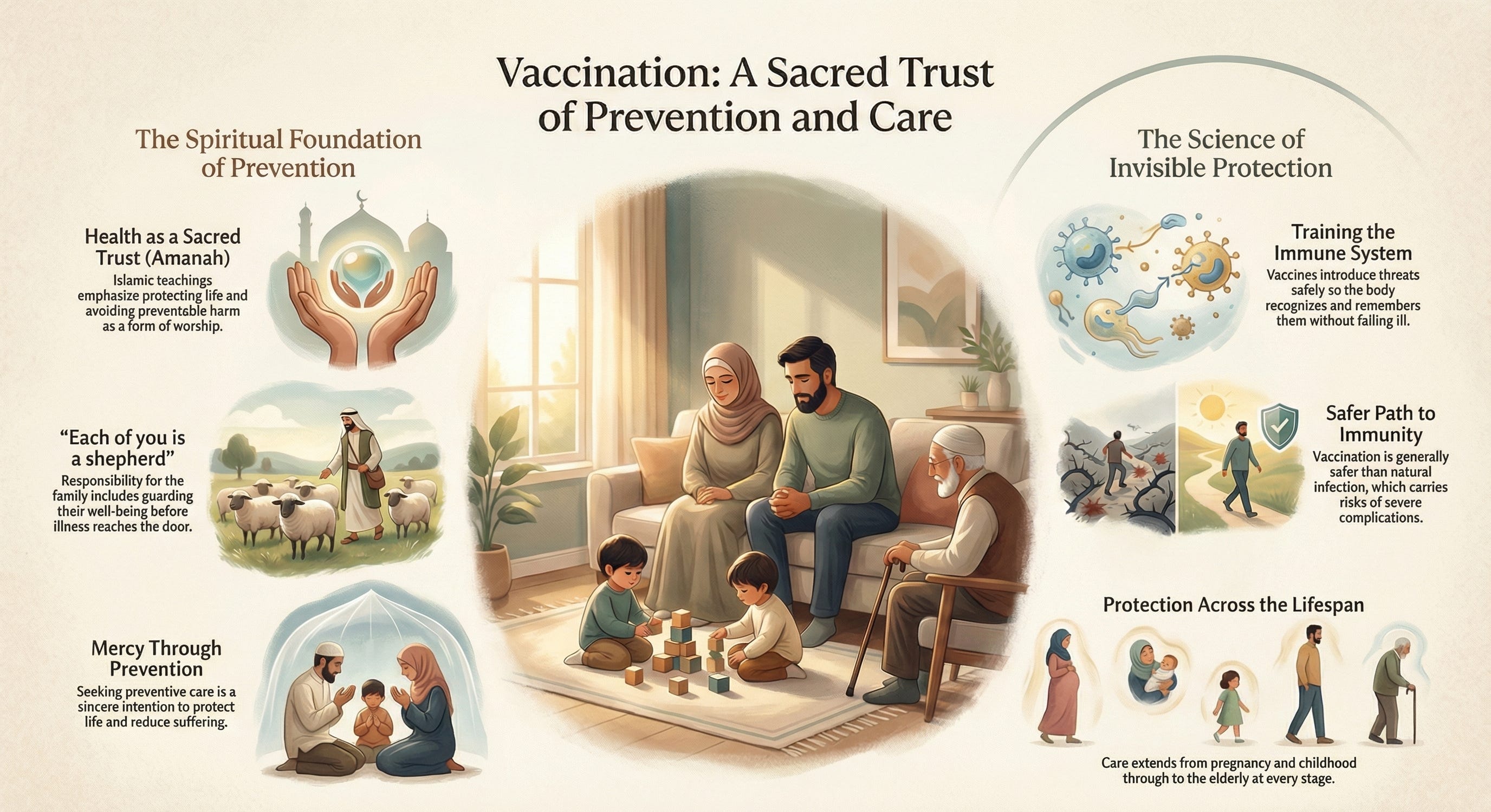
It gives the immune system a safer kind of introduction, so the body is not meeting that threat blindly for the first time. Because of that, vaccines reduce the likelihood of severe illness, complications, hospital admission, and death. They also help slow the spread of infection through the wider community. [1] [2]
Most of this work is invisible.
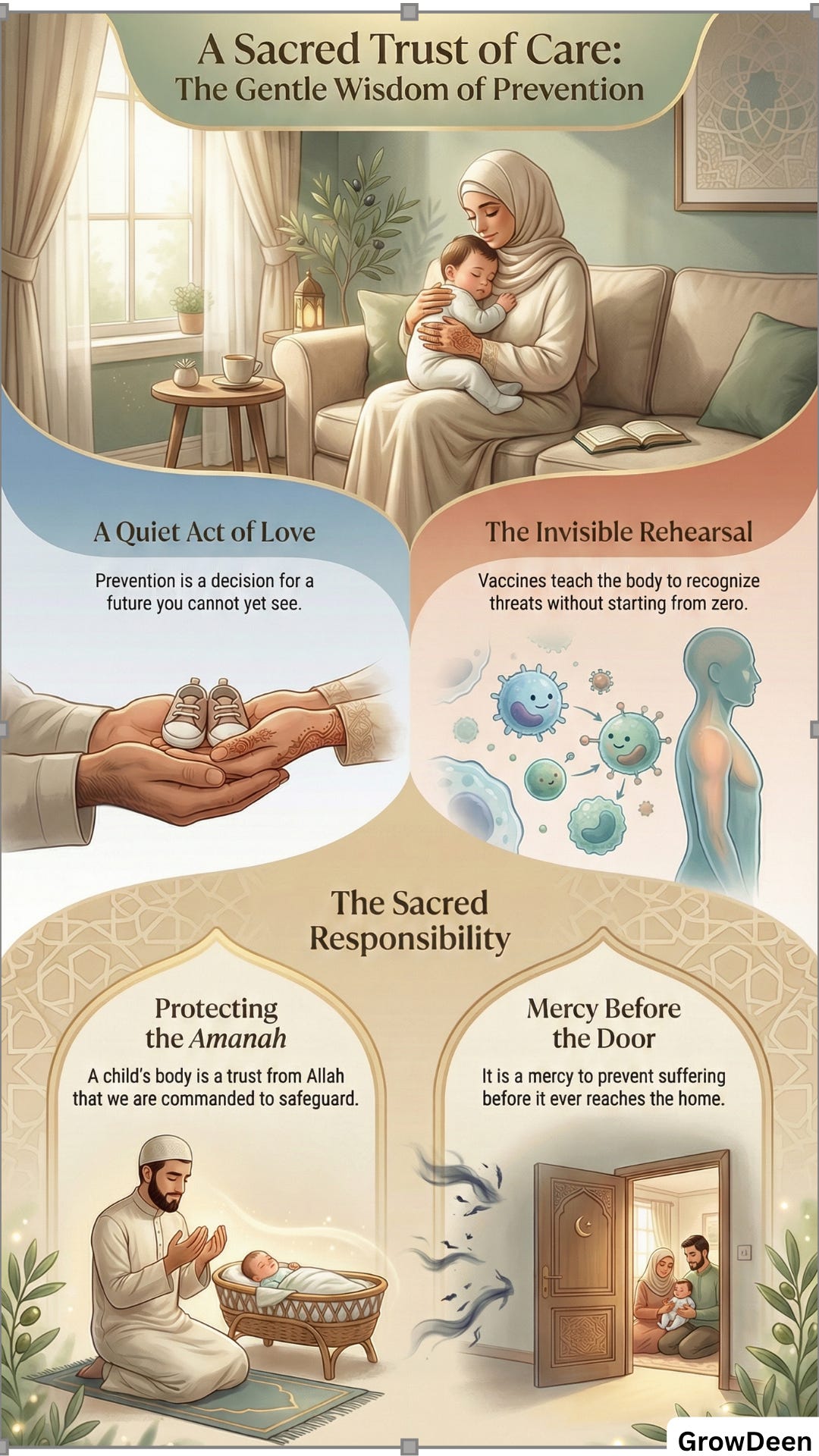
Nothing dramatic announces itself inside the body. The immune system simply learns. It recognizes. It remembers. And if the real infection comes later, the body is no longer starting from zero. [1]
There is something quietly moving about that. Protection being built where no eye can see it.
Allah’s trust includes protecting before harm arrives
For a Muslim parent, this kind of prevention is not outside the circle of worshipful care.
Allah says, “Indeed, Allah commands you to render trusts to whom they are due.” [10]
A child’s body is part of that trust. So is your own. And Allah says, “Do not throw yourselves with your own hands into destruction.” [11]
That verse lands differently when you think about preventable harm.
Prevention is not fearfulness. It is responsibility. It is one of the ordinary ways a believer tries to protect what Allah has placed in their care. Sometimes that protection happens after illness begins. Sometimes it happens before the illness ever reaches the door.
Why a vaccine is usually kinder than the illness itself
People sometimes speak as if immunity through infection and immunity through vaccination are morally or medically equal.
They are not.
Vaccination is generally safer than gaining immunity through the disease itself. Natural infection can bring serious complications, lasting damage, or death. Vaccines can have side effects too, but those are usually mild and short lived, such as soreness, tiredness, or fever. Serious adverse reactions can happen, but they are uncommon. [2] [8]
And vaccines do not need to prevent every case completely in order to matter. Even when a vaccinated person still becomes infected, the illness is often less severe than it would have been otherwise. [2] [3] [8]
That matters more than many people realize.
Less severe illness can mean less pain. Less danger. Less time in hospital. Sometimes the difference between a difficult few days and a genuine crisis.
Childhood protection is built step by step
Children receive vaccines early because the safest time to build protection is before exposure happens.
Schedules are arranged around age because some diseases are particularly dangerous in infancy and early childhood, while others are timed for later years. The exact schedule depends on the country and its official guidance, but the core principle stays the same. Protection is built gradually across infancy, childhood, and adolescence. [4]
Some vaccines are deliberately given later. HPV vaccine, for example, is routinely recommended around 11 to 12 years of age and can begin from age 9. [5]
Parents feel the weight of these decisions most deeply here.
The Prophet ﷺ said, “Each of you is a shepherd and each of you is responsible for his flock.” [13]
That responsibility is not only about reacting once a child becomes ill. Sometimes it is about protecting the child before illness arrives.
Vaccines are not only for small children
This is one of the important things people forget.
Vaccination is not only a childhood topic. It stretches across the lifespan.
During pregnancy, certain vaccines help protect both mother and baby. The source material identifies protection against whooping cough, influenza, COVID 19, and RSV as important during pregnancy. Antibodies formed during pregnancy can pass to the baby and offer protection in the first vulnerable period after birth. At the same time, not every vaccine is used during pregnancy, which is why being up to date beforehand matters. [6]
During breastfeeding, most routine vaccines remain compatible with breastfeeding. [6]
Older adults also have vaccine needs of their own. As people age, immune responses often weaken, and infections can become more dangerous. Depending on age, health conditions, and local guidance, older adults may need influenza, COVID 19, pneumococcal, shingles, and other age based or risk based vaccines. [9]
Protection belongs to every stage of life.
If this kind of gentle, Islamically grounded, practical support helps you feel steadier in real life decisions, subscribe for free so each new article and life gift reaches you right when you need it.
Some bodies need more careful planning than others
Not everyone can follow the same simple path.
People with weakened immune systems often need a more individualized vaccine plan. Inactivated vaccines are generally safe for them, though the immune response may be weaker and extra doses may sometimes be needed. Some live vaccines can be unsafe in severe immunocompromise because they may pose real risk rather than safe protection. [7]
This may apply to people with certain cancers, people receiving chemotherapy, people taking strong immunosuppressive medicines, and others whose immune systems are significantly affected. [7]
The same kind of carefulness applies with allergies. Most people with ordinary allergies, including food allergies, can still receive vaccines. True vaccine allergy is rare. The main concern is a previous severe allergic reaction to a vaccine itself or to one of its ingredients. In that case, specialist assessment matters before the same vaccine is given again. [8]
Panic is not useful here.
But tailored advice is.
Allah says, “Do not pursue that of which you have no knowledge.” [15]
That verse holds so much wisdom for modern medical decisions. There are moments for reading. And there are moments for asking a qualified person who actually knows your situation.
The words sound similar, but they do not mean exactly the same thing
People often use vaccine, vaccination, and immunisation almost interchangeably.
That is understandable. Still, the distinction is helpful.
A vaccine is the product itself. Vaccination is the act of receiving it. Immunisation is the broader result of gaining protection against the disease. [1]
That small distinction reminds us that the needle, the medicine, and the outcome are related, but not identical. It also reminds us that the point is not the moment itself. The point is the protection that follows.
And maybe that is true in more ways than one.
So much of care looks small in the moment and only later reveals what it was protecting.
Mercy sometimes prevents pain before it begins
There is mercy in treating illness after it comes.
But there is also mercy in trying to prevent some of that suffering before it begins.
The Prophet ﷺ said, “The merciful are shown mercy by the Most Merciful. Show mercy to those on the earth and the One above the heavens will show mercy to you.” [17]
And the Prophet ﷺ also said, “Actions are according to intentions.” [12]
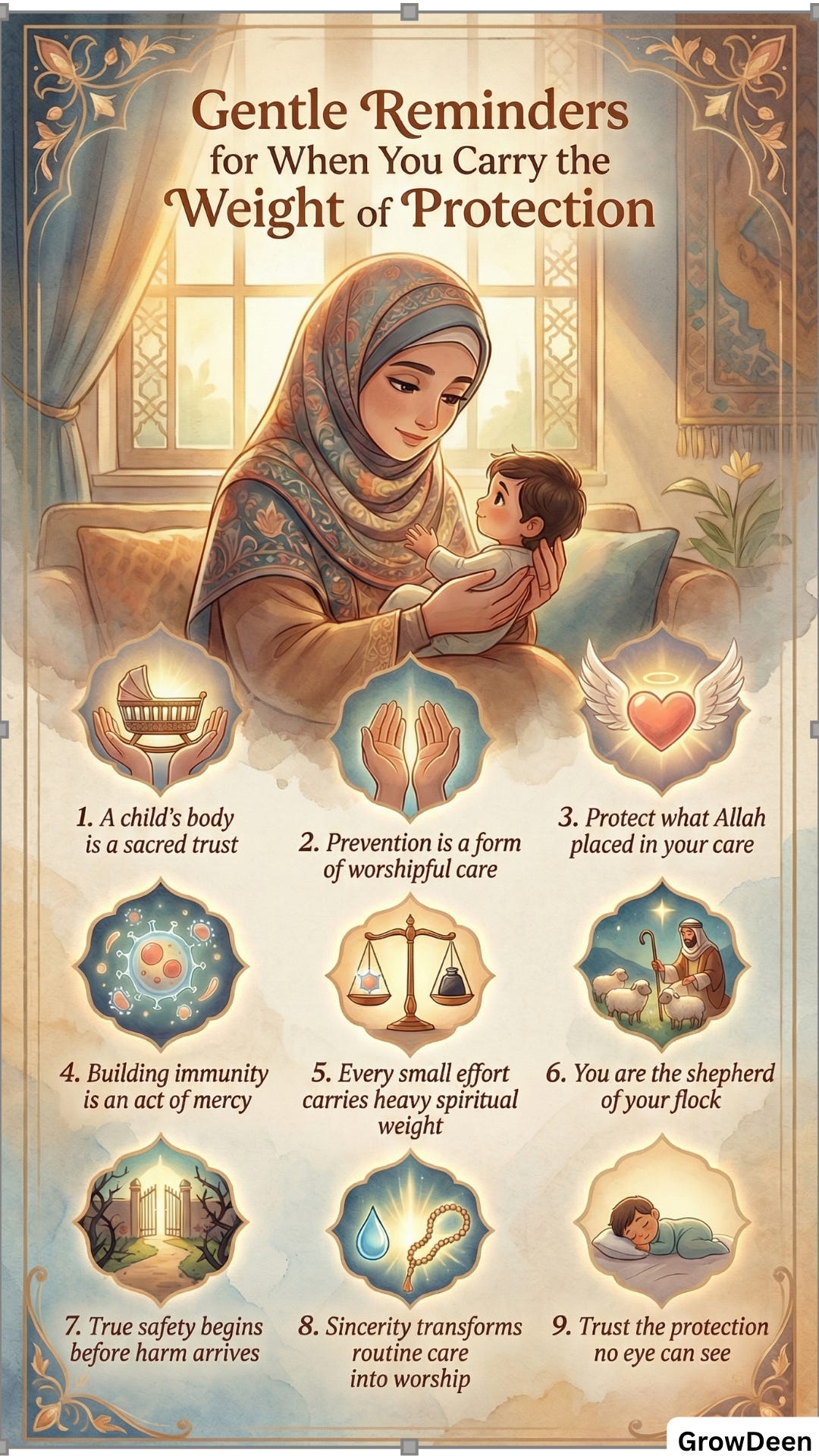
That means even preventive care can carry spiritual weight when it is sought with sincerity, responsibility, and a desire to protect life rather than treat it casually.
You may never see all the harm Allah helped avert.
That does not mean it was small.
It may be one of the quiet mercies written into your effort.
GIFTS FOR YOU, DEAR PARENT
If you’ve reached this part of the page, it tells me something meaningful about you.
You weren’t just skimming or passing time. You stayed because something here felt relevant to your real life.
Because you care.
Because you want to do things with more awareness.
Because you’re trying, even when it feels overwhelming.
That is not small.
So I didn’t want this article to remain just words on a page. I wanted it to gently step into your daily life in practical ways. That’s why we prepared these Life Gifts for you.
Not as extras.
Not as decorations.
But as simple tools to help you hold onto what mattered most in what you just read.
Here’s what you’ll find inside:
Gentle Understanding Card
A clear and simplified summary of the core concept from this article, so you can revisit the main idea anytime without rereading everything.
Heartfelt Dua Card
A carefully chosen dua connected to this stage of life, because we know that real strength and ease ultimately come from Allah’s help.
Gentle Actions Card
Practical examples to help you translate knowledge into action, so what you learned becomes part of your daily rhythm.
Gentle Reminders Card
Short, steady reminders drawn from the key points, designed to be printed or saved and placed somewhere you’ll see often.
These were designed slowly and thoughtfully, with time, care, and sincere dua. We created them because we genuinely want to walk alongside you, not just through one article, but through every stage of this lifelong journey.
If these gifts support you even in a small way, I would love for you to continue receiving them.
Subscribe so that each new Gift arrives directly in your inbox whenever we release the next stage. That way, you won’t miss the tools designed to support you right where you are.
May Allah place barakah in your effort, accept your intention, and make this path easier and more rewarding than it feels right now.
Please share it with a family/friend who may benefit from this knowledge.
What is one moment with your child that feels hardest lately, and what kind of support would make it feel lighter?
Subscribe for free to keep receiving gentle, research rooted, Islamically grounded support for the real moments of parenting.
References
[1] World Health Organization. How do vaccines work? and Vaccines and immunization: What is vaccination?
[2] World Health Organization. Vaccine efficacy, effectiveness and protection.
[3] Centers for Disease Control and Prevention. Chickenpox Vaccination.
[4] Centers for Disease Control and Prevention. Child and Adolescent Immunization Schedule by Age.
[5] Centers for Disease Control and Prevention. HPV Vaccination Recommendations.
[6] Centers for Disease Control and Prevention. Vaccines During and After Pregnancy. and Vaccinations While Breastfeeding.
[7] Centers for Disease Control and Prevention. Altered Immunocompetence.
[8] Centers for Disease Control and Prevention. Preventing and Managing Adverse Reactions. and World Health Organization. Vaccine safety basics.
[9] Centers for Disease Control and Prevention. Recommended Adult Immunization Schedule for ages 19 years or older. and Flu and People 65 Years and Older.
[10] Qur’an, Surah An-Nisa 4:58
[11] Qur’an, Surah Al-Baqarah 2:195
[12] Sahih al-Bukhari, Hadith 1; Sahih Muslim, Hadith 1907
[13] Sahih al-Bukhari, Hadith 7138; Sahih Muslim, Hadith 1829
[14] Sahih Muslim, Hadith 2593
[15] Qur’an, Surah Al-Isra 17:36
[16] Sahih al-Bukhari, Hadith 5199
[17] Jami` at-Tirmidhi, Hadith 1924