
What Your Baby Needs Most In The First Weeks Is Simpler Than You Think
What To Expect In The First Weeks With Your Baby?

In the first weeks, newborns mostly feed, sleep, cry, and adjust to life outside the womb, while caregivers support them through warmth, responsive care, bonding, and early health checks.
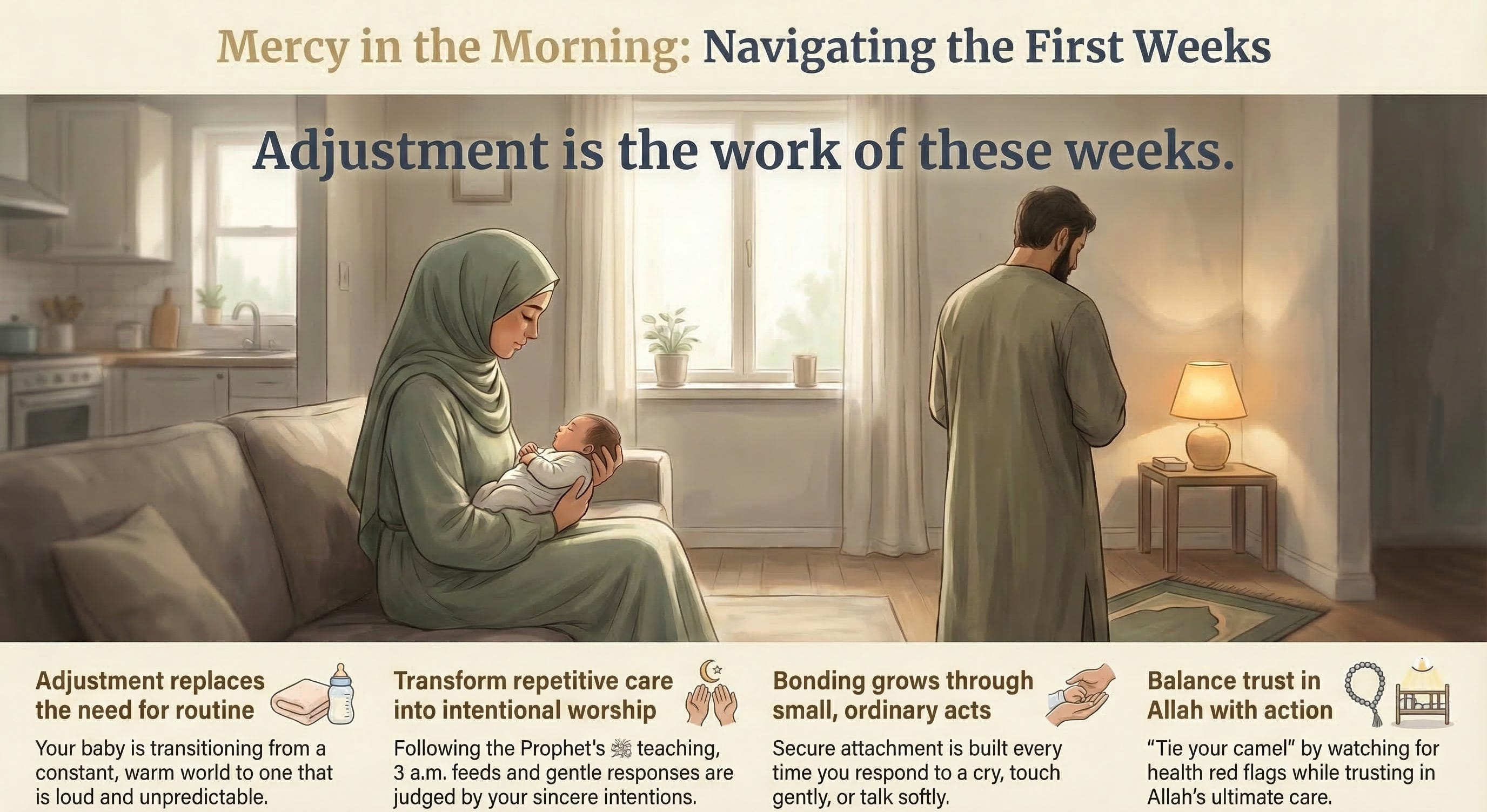
The first weeks with a newborn can feel strangely small and strangely enormous.
The day disappears into feeding, changing, crying, staring at your baby’s face, and then doing it all again before you have even had time to think.
You may find yourself asking the same question over and over.
Is this normal.
The sounds. The sleep. The feeding. The colour. The crying. The way your baby seems peaceful one minute and completely unsettled the next.
If that is where you are, you are not behind. You are in it.
The early weeks are mostly adjustment, not routine
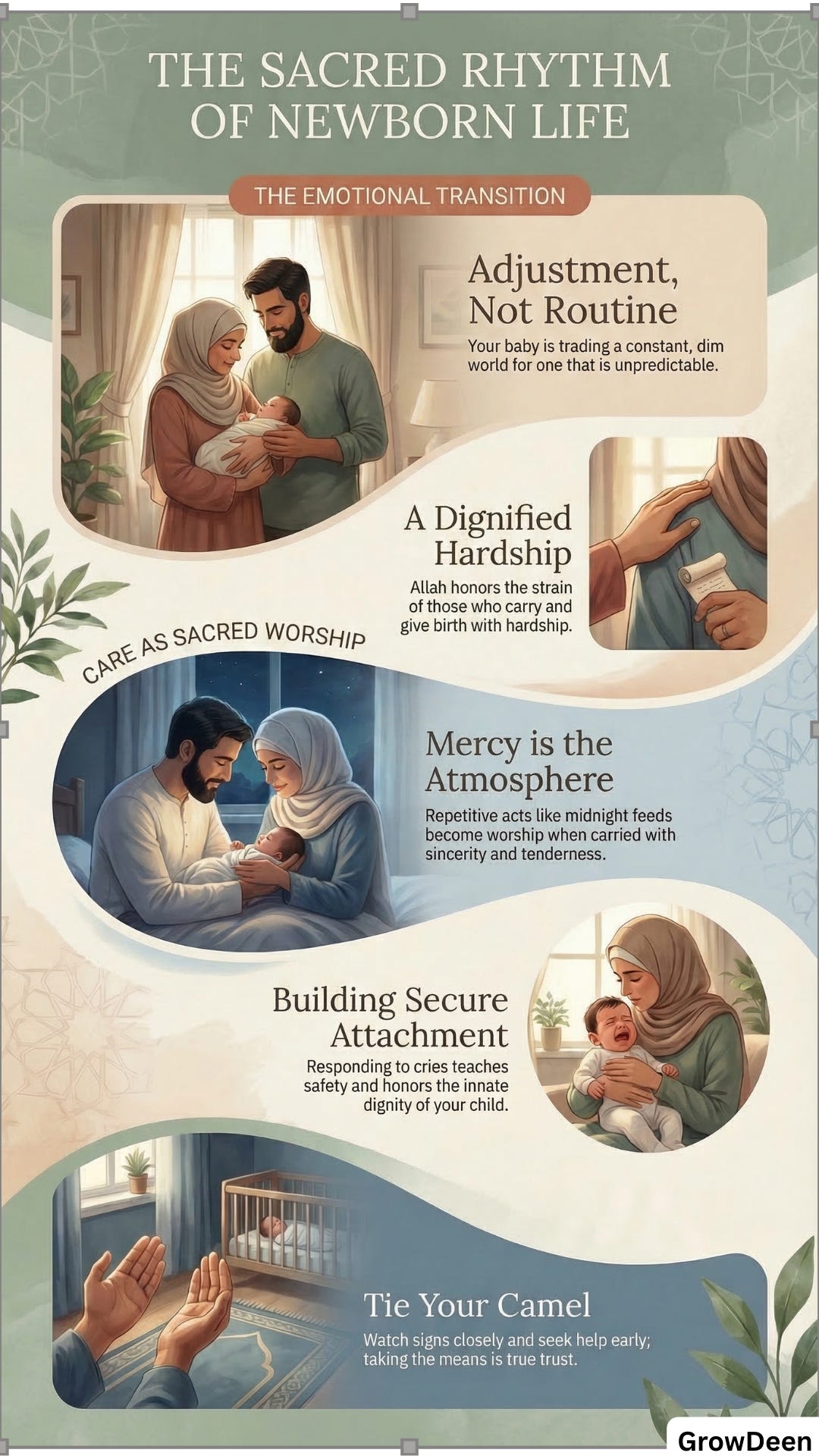
A newborn has come from a world that was warm, dim, constant, and enclosed into one that is brighter, colder, louder, and far less predictable.
That adjustment is the work of the first weeks.
Your baby is not expecting a perfect system. Your baby is looking for warmth, safety, closeness, gentle touch, and a caregiver who keeps returning. Early close contact and responsive postnatal care are part of what helps newborn adjustment unfold well. [4] [10]
And for a Muslim family, that care is never small.
Allah says, “His mother carried him with hardship and gave birth to him with hardship.” [11]
That verse gives dignity to the strain wrapped around these early days.
Allah’s mercy is present in the repetition
From the outside, newborn care can look repetitive.
Feed again. Burp again. Rock again. Change again. Try again.
But the Prophet ﷺ taught that actions are judged by intentions. [12]
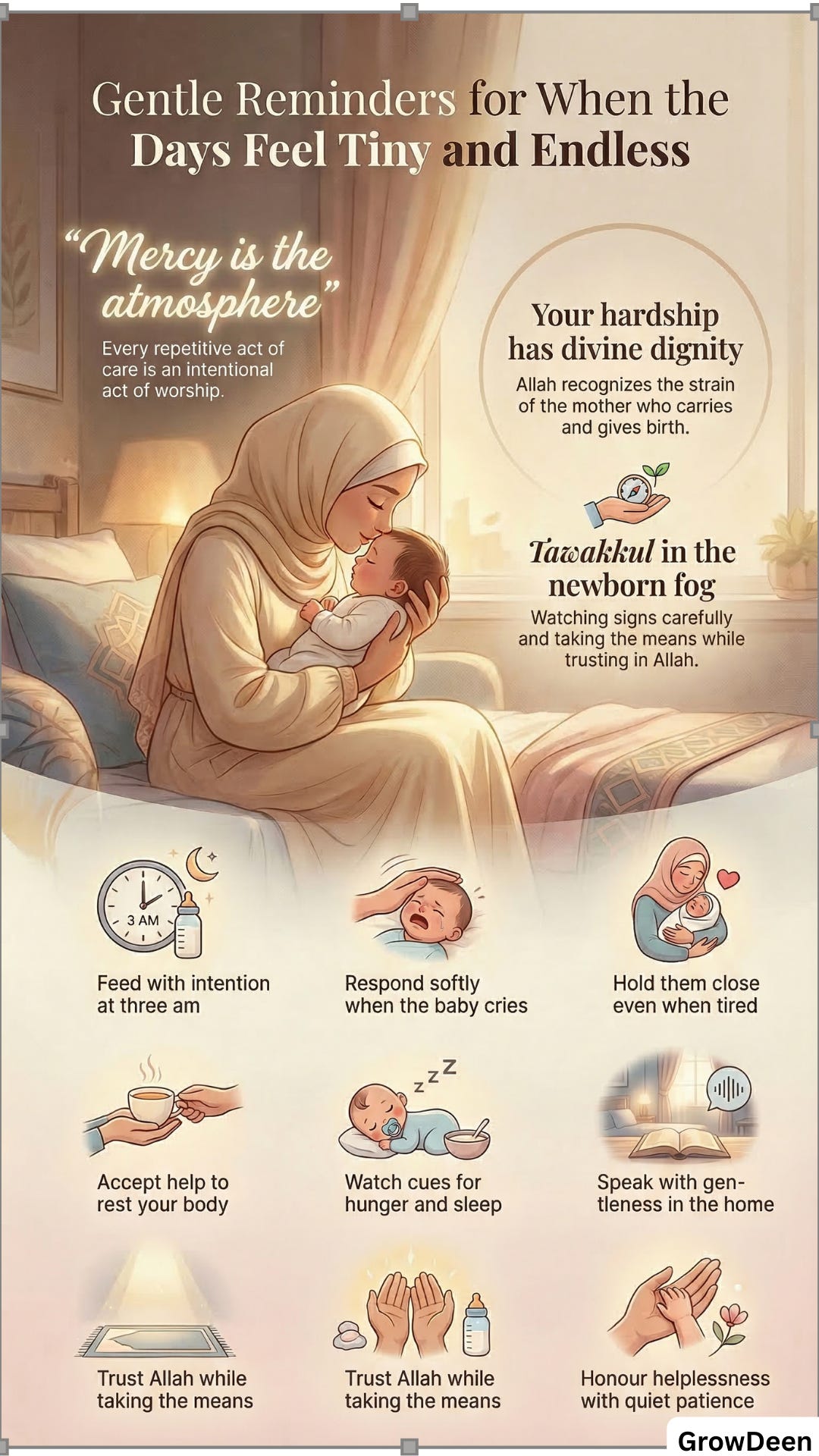
So when you feed your baby at 3 a.m., when you hold them even though your arms ache, when you respond gently while tired, all of that can become worship if it is carried with sincerity and mercy.
The Prophet ﷺ was openly tender with children, and he made clear that hearts without mercy are missing something essential. [13]
So if you needed a reminder today, let it be this.
Mercy is not extra in newborn life.
Mercy is the atmosphere.
What your newborn may look like, and why it can be unsettling
Newborns can look surprising at first.
A head may seem cone shaped after birth. A face may look puffy. Eyes may look a little swollen. Bruising may be present and then slowly fade. Most of that settles with time. [10]
Some newborns develop jaundice, and bruising can increase that risk, so yellowing of the skin or eyes is worth mentioning to your midwife, GP, or child and family health nurse. [10]
The umbilical stump dries out, darkens, and usually falls off within about the first ten days. It helps to keep it clean and dry. If the skin around it becomes red or sticky, it is worth getting advice.
Newborn skin can also do all sorts of things that make parents nervous. Dry patches. Tiny white spots. Heat rash. Cradle cap. Nappy rash. Many of these are common and mild, but if you are unsure, it is always reasonable to ask. [7]
And sometimes there are other little surprises, like swollen newborn breasts or even a little milky discharge. This can happen because of hormone exposure before birth and usually settles on its own. [5]
Feeding, sleeping, and the slow learning of your baby’s patterns
Newborns have very small stomachs, so feeding often is normal. Many feed every two to three hours, with roughly eight to twelve feeds in a day. [2]
Some feeds are quick. Some seem to take forever.
Over time, you begin to recognise hunger cues. Mouth movements. Hands coming toward the mouth. Restlessness. Sucking on fingers. Some babies wake for feeds on their own. Some need waking, especially if they are jaundiced, very sleepy, or losing more weight than expected. [1] [3]
Some weight loss in the first days is common. Babies are losing extra fluid after birth. In most cases, that loss should stay under 10 percent of birth weight, and many babies regain and pass birth weight within one to two weeks. [1] [3] [8]
If feeding feels hard, if weight loss is worrying you, or if something keeps nagging at your chest, ask early.
Sleep in the newborn weeks is also heavy but broken. Your baby may sleep a lot, but rarely in the way that feels restful for you. That can be hard in a way people do not always understand.
This is where the hadith about the body having rights lands differently. [14]
It is not abstract then.
It becomes very practical.
Eat. Rest when you can. Accept help. Let someone else hold the baby while you breathe for ten minutes.
Bonding often grows through ordinary things
Bonding with a newborn does not always arrive as a dramatic wave.
Sometimes it does.
Sometimes it grows through the smallest acts repeated over and over. Talking softly. Holding your baby close. Looking into their face. Responding to their cry. Touching them gently. Settling them after a feed. [4] [9]
This is how your baby starts learning something fundamental.
When I need, someone comes.
Attachment grows through those repeated responses. Secure caregiving is closely linked with secure infant attachment, and that attachment supports wider development. [9]
Allah says, “And We have certainly honored the children of Adam.” [15]
A newborn cannot ask in words. Honouring them at this stage means treating their helplessness with dignity, patience, care, and tenderness.
If articles like this would support you in the newborn fog, subscribe for free so the next one arrives quietly in your inbox when you need it.
Crying is one of the main languages right now
A newborn cries because they are hungry, uncomfortable, overtired, too warm, too cold, lonely, or in need of help settling.
When you respond by feeding, changing, rocking, cuddling, speaking softly, holding skin to skin, or helping them sleep, you are not spoiling your baby. You are teaching safety. [4] [10]
Some babies also cry intensely for stretches without a clear medical cause. Colic is one term used when crying and fussing become hard to explain and hard to settle. [6]
This can wear parents right down to the edge.
If crying is constant, feels different, or feels hard for you to cope with, seek support early.
And if the cry is high pitched, unusually weak, moaning, grunting, or prolonged in a way that feels wrong, that deserves urgent attention. [6] [10]
Gentleness matters here too.
Allah commanded gentle speech even in a hard confrontation. [17]
So a home with a newborn deserves gentleness all the more.
When to trust your concern and ask for help
There are moments in newborn life when waiting is not wise.
Seek medical advice promptly if your baby is not feeding well, takes only about half the usual feeds in a day, vomits more than half of three feeds in a row, has fewer than six to eight wet nappies a day, seems unusually irritable, very sleepy, hard to wake, pale, or yellow. [1] [2] [3] [10]
Sticky eyes are often caused by a blocked tear duct and may improve with time, but if the eyes are red as well as sticky, get them checked.
Rashes are often mild, but if you are uncertain, asking is part of responsible care. [7]
This fits beautifully with the Prophetic teaching, “Tie it and trust in Allah.” [16]
Tawakkul is not ignoring signs.
It is watching carefully, taking the means, and trusting Allah alongside that care.
The first weeks ask a lot, and Allah knows that
Regular health checks in the early weeks matter. They are not just for weight or measurements. They are a place to bring your 3 a.m. questions. The feeding questions. The crying questions. The rash questions. The questions you keep trying to dismiss. [10]
They are also a place to speak honestly about how you are coping.
Because the baby’s wellbeing is closely tied to the wellbeing of the people carrying them through these first weeks. [10]
And if this season feels overwhelming, that does not mean you are failing.
It means you are in the newborn weeks.
Allah intends for you ease and does not intend for you hardship. [18]
The hardship may still be real. But so is the ease Allah sends through support, sound advice, quiet routines, and people who help carry the load.
So if your days right now feel repetitive, tender, confusing, and deeply consuming, that does not mean you are doing newborn life wrong.
It means you are living it.
GIFTS FOR YOU, DEAR PARENT
If you’ve reached this part of the page, it tells me something meaningful about you.
You weren’t just skimming or passing time. You stayed because something here felt relevant to your real life.
Because you care.
Because you want to do things with more awareness.
Because you’re trying, even when it feels overwhelming.
That is not small.
So I didn’t want this article to remain just words on a page. I wanted it to gently step into your daily life in practical ways. That’s why we prepared these Life Gifts for you.
Not as extras.
Not as decorations.
But as simple tools to help you hold onto what mattered most in what you just read.
Here’s what you’ll find inside:
Gentle Understanding Card
A clear and simplified summary of the core concept from this article, so you can revisit the main idea anytime without rereading everything.
Heartfelt Dua Card
A carefully chosen dua connected to this stage of life, because we know that real strength and ease ultimately come from Allah’s help.
Gentle Actions Card
Practical examples to help you translate knowledge into action, so what you learned becomes part of your daily rhythm.
Gentle Reminders Card
Short, steady reminders drawn from the key points, designed to be printed or saved and placed somewhere you’ll see often.
These were designed slowly and thoughtfully, with time, care, and sincere dua. We created them because we genuinely want to walk alongside you, not just through one article, but through every stage of this lifelong journey.
If these gifts support you even in a small way, I would love for you to continue receiving them.
Subscribe so that each new Gift arrives directly in your inbox whenever we release the next stage. That way, you won’t miss the tools designed to support you right where you are.
May Allah place barakah in your effort, accept your intention, and make this path easier and more rewarding than it feels right now.
Please share it with a family or friend who may benefit from this knowledge.
What is one moment with your child that feels hardest lately, and what kind of support would make it feel lighter?
If you want gentle, benefit focused support for the newborn weeks, subscribe for free so the next article and the next set of Gifts arrive quietly in your inbox.
References
[1] DiTomasso, D., & Cloud, M. (2019). Systematic review of expected weight changes after birth for full-term, breastfed newborns. Journal of Obstetric, Gynecologic & Neonatal Nursing, 48(6), 593-603.
[2] Gavine, A., Shinwell, S.C., Buchanan, P., Farre, A., Wade, A., Lynn, F., Marshall, J., Cumming, S.E., Dare, S., & McFadden, A. (2022). Support for healthy breastfeeding mothers with healthy term babies. Cochrane Database of Systematic Reviews, 2022(10), CD001141.
[3] Miyoshi, Y., Suenaga, H., Aoki, M., & Tanaka, S. (2020). Determinants of excessive weight loss in breastfed full-term newborns at a baby-friendly hospital: A retrospective cohort study. International Breastfeeding Journal, 15, Article 19.
[4] Moore, E.R., Bergman, N., Anderson, G.C., & Medley, N. (2016). Early skin-to-skin contact for mothers and their healthy newborn infants. Cochrane Database of Systematic Reviews, 2016(11), CD003519.
[5] Raveenthiran, V. (2013). Neonatal mastauxe (breast enlargement of the newborn). Journal of Neonatal Surgery, 2(3), Article 31.
[6] Turner, T.L., & Palamountain, S. (2025). Infantile colic: Clinical features and diagnosis. UpToDate.
[7] UK National Health Service (NHS). (2024). Rashes in babies and children.
[8] Verd, S., de Sotto, D., Fernández, C., & Gutiérrez, A. (2018). Impact of in-hospital birth weight loss on short and medium term breastfeeding outcomes. International Breastfeeding Journal, 13, Article 25.
[9] Woodhouse, S.S., Scott, J.R., Hepworth, A.D., & Cassidy, J. (2020). Secure base provision: A new approach to examining links between maternal caregiving and infant attachment. Child Development, 91(1), e249-e265.
[10] World Health Organization (WHO). (2022). WHO recommendations on maternal and newborn care for a positive postnatal experience.
[11] Quran: Surah Al-Ahqaf 46:15.
[12] Hadith: Sahih al-Bukhari 1 and Sahih Muslim 1907.
Also: Sahih Muslim 1907
[13] Hadith: Sahih al-Bukhari 5997 and Sahih Muslim 2318.
Also: Sahih Muslim 2318
[14] Hadith: Sahih al-Bukhari 5199.
[15] Quran: Surah Al-Isra 17:70.
[16] Hadith: Jami at-Tirmidhi 2517.
[17] Quran: Surah Taha 20:44.