
What Your Baby Learns From You Between The Cries
Your Baby Is Waking Up To The World, And To You

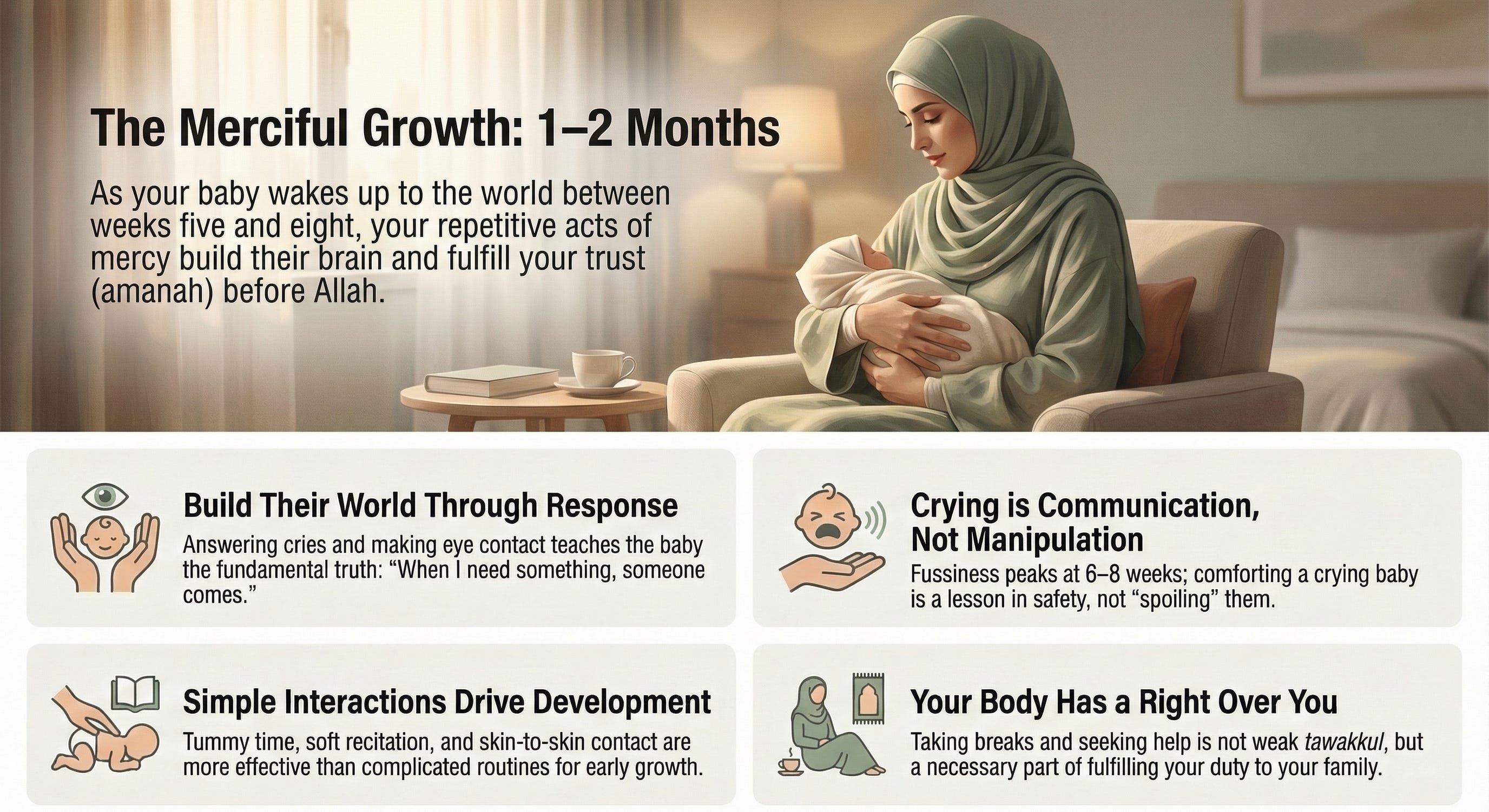
Between one and two months, your baby becomes more awake, expressive, and physically active, and grows best through warm, responsive care, simple interaction, and early support when concerns arise.
Somewhere between week five and week eight, you start noticing it.
Your baby is still tiny. Still needy. Still capable of crying in a way that rattles your whole nervous system.
But something has changed.
Their eyes stay on your face a little longer.
A strange little sound slips out that is not just crying.
Their body seems more awake, more determined, like they are quietly beginning to push against the world.
And you, sleep deprived and tender, feel two things at once.
Wonder.
And strain.
Because this stage can be sweet, yes. But it can also feel relentless.
The days are still repetitive, but your baby is changing
Around one to two months, many babies start to feel more present.
Not easy. Not predictable. Just more awake to what is around them.
They often linger on faces longer. They may respond differently to your voice. Some begin smiling around six weeks, and when it happens, it can feel like sunlight after a long tunnel. [1] [2]
At the same time, this is also the season when many babies cry more. For some families, it peaks around six to eight weeks, especially in the evenings. [3]
That rise in crying can make a parent doubt everything.
But increased fussiness at this age is widely recognised in infant care guidance. It does not automatically mean something is wrong. It means your baby is still very young, still adjusting, still communicating in the only strong way they know how.
What your baby is quietly learning from your face
A baby this age is learning through repeated human moments.
Your face.
Your voice.
Your smell.
Your hands.
Early childhood guidance keeps coming back to the same truth. Caring, responsive relationships and ordinary interaction shape early brain development and lay foundations for later learning, health, and behaviour. [4] [5]
So when you smile at your baby, or speak softly while changing a diaper, or answer their little sounds with sounds of your own, you are not “just passing time.”
You are helping build the world they live in.
That world begins with one simple message.
When I need something, someone comes.
Allah’s mercy belongs in these small moments
For a Muslim parent, this season has a hidden weight with Allah.
The outside of it looks repetitive. Feed again. Hold again. Soothe again. Walk again.
But the Prophet ﷺ taught that actions are judged by intentions. [6]
So if your intention is mercy, amanah, and seeking Allah’s pleasure, even the most ordinary newborn care becomes heavy with meaning.
And when the month feels hard, Allah’s words stay steady even when you do not feel steady.
Allah does not burden a soul beyond its capacity. [7]
That does not erase exhaustion.
But it does remind you that your struggle is seen, and your effort is not wasted.
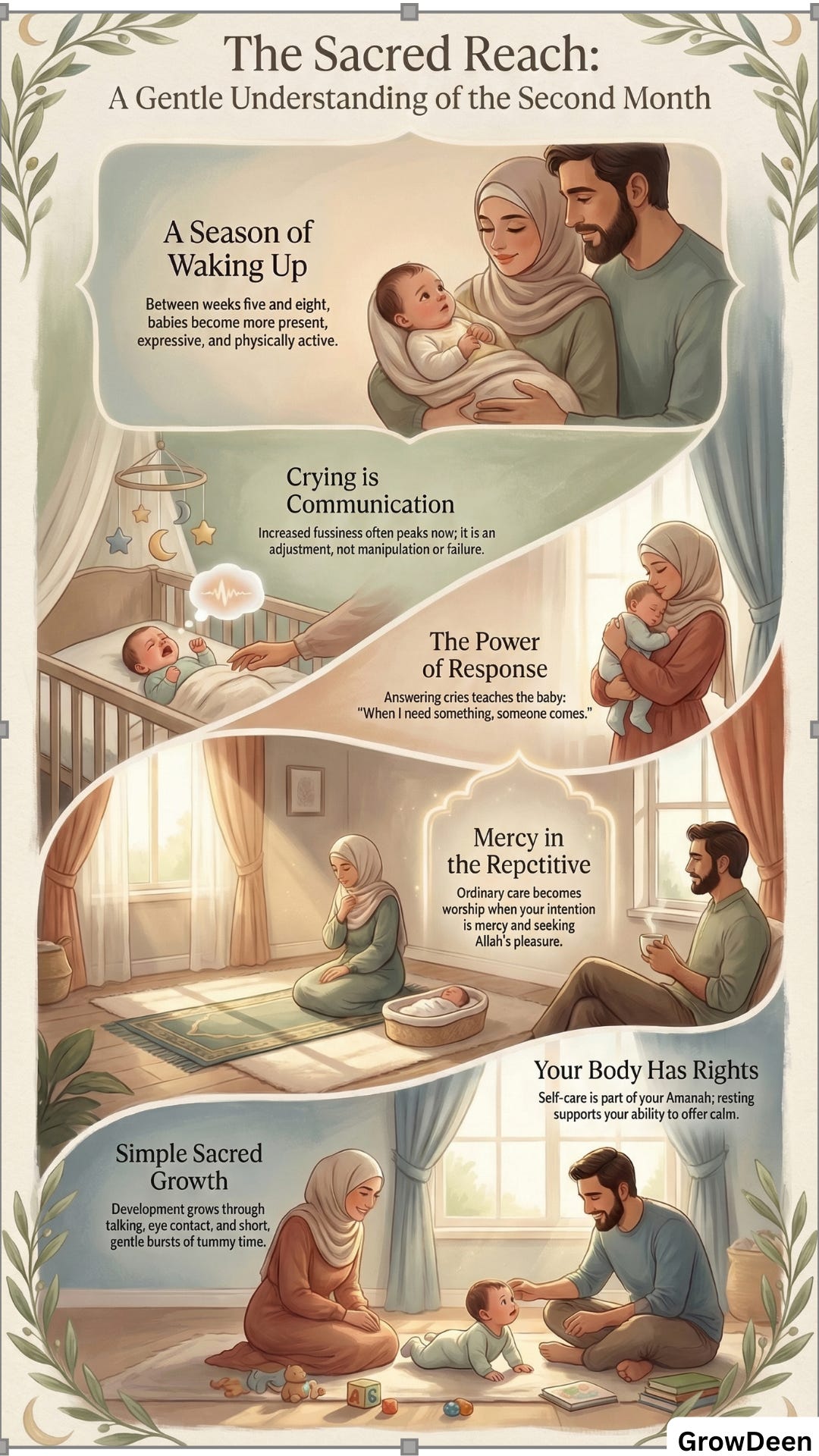
The simple things that actually help development
At one to two months, development is not pushed forward by complicated routines.
It grows through simple, repeated, human things.
Talking helps. Calm Recitation helps. Humming Adhkar helps. Reading a few lines helps. Telling your baby what you are doing helps. These repeated sounds and rhythms support the early roots of communication and language. [5]
Eye contact helps too. When your baby watches you, they are connecting emotionally, and they are also practising visual tracking and head turning. [2] [8]
Tummy time matters, even if it is short. A minute or two at a time, gently built up across the day, helps strengthen the head, neck, and upper body. [2] [8] [9]
Holding and cuddling matter. Skin to skin matters. Gentle massage may help some babies settle and feel more secure. [4]
And then there is something parents often forget.
Breaks matter too.
If your baby looks away, stiffens, arches, fusses harder, or seems shut down, that is communication. It may mean they are hungry, tired, overstimulated, or just done for now.
You do not have to push through.
You can pause.
Crying is communication, not manipulation
A baby this young is not trying to control you.
They are trying to reach you.
Sometimes the reason is obvious. Hunger. Tiredness. A wet diaper. A need to be held.
Sometimes it is not obvious at all.
That uncertainty can make parents feel helpless, especially when the crying stretches and nothing seems to work.
But comforting still matters, even when you do not know the reason. Holding, rocking, feeding, changing, swaying, speaking softly, trying again, all of that teaches safety. [4] [10]
You do not spoil a young baby by responding.
You teach them that distress meets care.
There is also a safety line that needs to be said with complete clarity.
Never shake a baby.
If you feel yourself reaching the edge, place your baby in a safe spot and step away for a moment. Breathe. Make a call. Ask for help.
The Prophet ﷺ said there should be neither harming nor reciprocating harm. [11]
Sometimes the most responsible thing a parent can do is step back before returning.
If you want support like this on the hard days, you can subscribe for free. So the next reminder meets you in your inbox when your heart is tired and your mind is foggy.
Your baby needs care, and so do you
By this stage, you may be starting to notice patterns.
A certain cry that means hunger.
A certain face that comes before sleep.
A short window when your baby is open to smiling or looking.
You are learning each other.
Not perfectly. Just gradually.
And you need care too.
When stress, anxiety, or anger start building, it becomes harder to offer calm attention. Looking after yourself is not separate from caring for your baby. It supports it. [4]
So let this count as a permission slip.
Ask for help.
Eat before you crash.
Sleep when someone trustworthy can take over.
Keep names and numbers nearby if your mind feels foggy.
The Prophet ﷺ reminded us that the body has rights. [12]
A parent collapsing from neglecting themselves is not the goal. Support is part of amanah too.
When to trust your concern and ask sooner
Parents often sense when something feels off before they can explain it clearly.
That matters.
At around two months, it is worth seeking advice if your baby does not seem to watch faces or make eye contact even briefly, does not respond to bright light or sounds, is not making little gurgling or vowel-like sounds, is not feeding well, seems unusually sleepy, is not beginning to smile, or is not moving arms or legs in the way you would expect. [1] [2] [8] [9]
It is also worth reaching out if the crying feels excessive and very hard to soothe in a way that genuinely worries you. [3]
And if you, as a parent, are showing signs of postnatal depression or anxiety, that matters deeply too. Support for you is support for your baby. [4]
Seeking help early is not weak tawakkul.
It is part of taking the means while trusting Allah. [13]
And for the heart, hold this close.
Indeed, Allah is with the patient. [14]
Not only the parents who look calm.
The real ones too.
The ones pacing the hallway, whispering du’a, trying again.
GIFTS FOR YOU, DEAR PARENT
If you’ve reached this part of the page, it tells me something meaningful about you.
You weren’t just skimming or passing time. You stayed because something here felt relevant to your real life.
Because you care.
Because you want to do things with more awareness.
Because you’re trying, even when it feels overwhelming.
That is not small.
So I didn’t want this article to remain just words on a page. I wanted it to gently step into your daily life in practical ways. That’s why we prepared these Life Gifts for you.
Not as extras.
Not as decorations.
But as simple tools to help you hold onto what mattered most in what you just read.
Here’s what you’ll find inside:
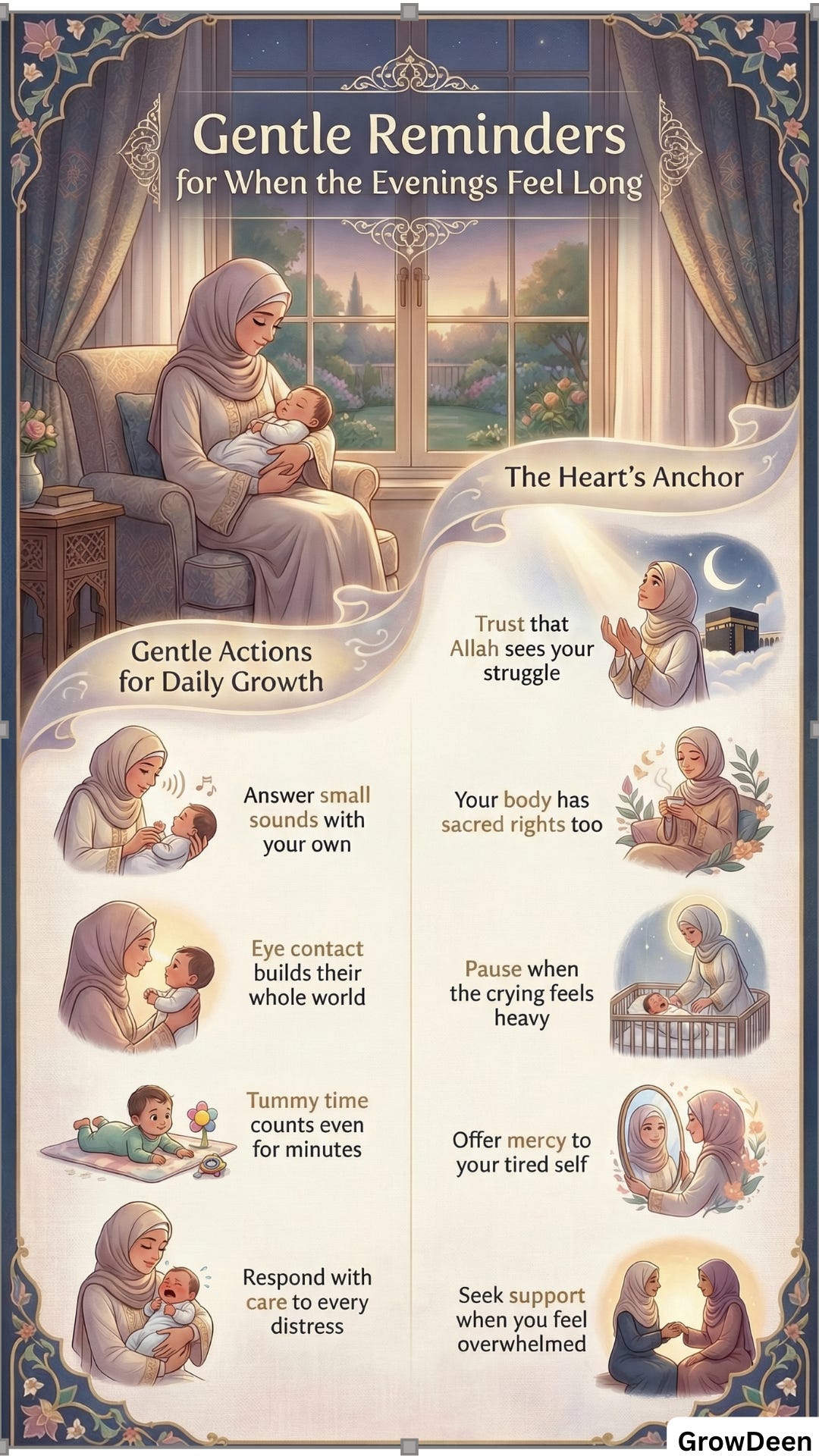
Gentle Understanding Card
A clear and simplified summary of the core concept from this article, so you can revisit the main idea anytime without rereading everything.
Heartfelt Dua Card
A carefully chosen dua connected to this stage of life, because we know that real strength and ease ultimately come from Allah’s help.
Gentle Actions Card
Practical examples to help you translate knowledge into action, so what you learned becomes part of your daily rhythm.
Gentle Reminders Card
Short, steady reminders drawn from the key points, designed to be printed or saved and placed somewhere you’ll see often.
These were designed slowly and thoughtfully, with time, care, and sincere dua. We created them because we genuinely want to walk alongside you, not just through one article, but through every stage of this lifelong journey.
If these gifts support you even in a small way, I would love for you to continue receiving them.
Subscribe so that each new Gift arrives directly in your inbox whenever we release the next stage. That way, you won’t miss the tools designed to support you right where you are.
May Allah place barakah in your effort, accept your intention, and make this path easier and more rewarding than it feels right now.
Please share it with a family/friend who may benefit from this knowledge.
What is one moment with your child that feels hardest lately, and what kind of support would make it feel lighter?
If you want gentle, benefit focused support for the newborn months, subscribe for free so the next article and the next set of Gifts arrive quietly in your inbox.
References
[1] Centers for Disease Control and Prevention (CDC). Important Milestones: Your Baby By Two Months. Link
[2] Duderstadt, K.G., & Keeton, V.F. (2024). Pediatric Physical Examination (4th ed.). Elsevier.
[3] The Royal Children’s Hospital (RCH). (2018). Crying and unsettled babies – Colic. Link
[4] World Health Organization (WHO). (2023). Improving early childhood development: WHO guideline: Summary. Link
[5] Center on the Developing Child at Harvard University. (2017, updated 2021). Three principles to improve outcomes for children and families, 2021 update. Link
[6] Hadith: Sahih al-Bukhari 1; Sahih Muslim 1907. Actions are judged by intentions. Bukhari link Muslim link
[7] Qur’an: Surah Al-Baqarah 2:286. Link
[8] Sharma, A., & Cockerill, H. (2022). From Birth to Five Years: Practical Developmental Examination (2nd ed.). Routledge.
[9] Zubler, J.M., Wiggins, L.D., Macias, M.M., Whitaker, T.M., Shaw, J.S., Squires, J.K., Pajek, J.A., Wolf, R.B., Slaughter, K.S., Broughton, A.S., Gerndt, K.L., Mlodoch, B.J., & Lipkin, P.H. (2022). Evidence-informed milestones for developmental surveillance tools. Pediatrics, 149(3), e2021052138. Link
[10] Frosch, C.A., Schoppe-Sullivan, S.J., & O’Banion, D.D. (2019). Parenting and child development: A relational health perspective. American Journal of Lifestyle Medicine, 15(1), 45-59. Link
[11] Hadith: Sunan Ibn Majah 2340. There should be neither harming nor reciprocating harm. Link
[12] Hadith: Sahih al-Bukhari 5199. Your body has a right over you. Link
[13] Hadith: Jami at-Tirmidhi 2517. Tie your camel and trust in Allah. Link
[14] Qur’an: Surah Al-Baqarah 2:153. Link
[15] Kliegman, R.M., & Marcdante, K.J. (2019). Nelson Essentials of Pediatrics (8th ed.). Elsevier.
[16] Sharma, A., Cockerill, H., & Sanctuary, L. (2022). Mary Sheridan’s From Birth to Five Years: Children’s Developmental Progress (5th ed.). Routledge.