
What Quietly Protects Your Child More Than One Bottle of Sunscreen
The Outdoor Habit Many Parents Mean to Build but Often Delay

Free gift for you! A practical companion resource is waiting for you near the end of this article to help you remember, apply, and benefit from what you read.
Don’t forget to download!
Sun safety is not about keeping children indoors in fear, but about building calm, repeatable habits that let them enjoy life outside while protecting their skin, eyes, and long term health.
It is so easy to say, “Just five more minutes.”
One more turn at the playground. One more walk without the hat because the child is already upset. One cloudy afternoon that does not feel serious enough to worry about. And because the sun does not always look harsh when it is causing harm, parents can be pulled into a false calm without realizing it.
That is part of what makes sun safety tricky.
The danger does not always announce itself loudly.
The sun does not need to feel hot to be doing harm
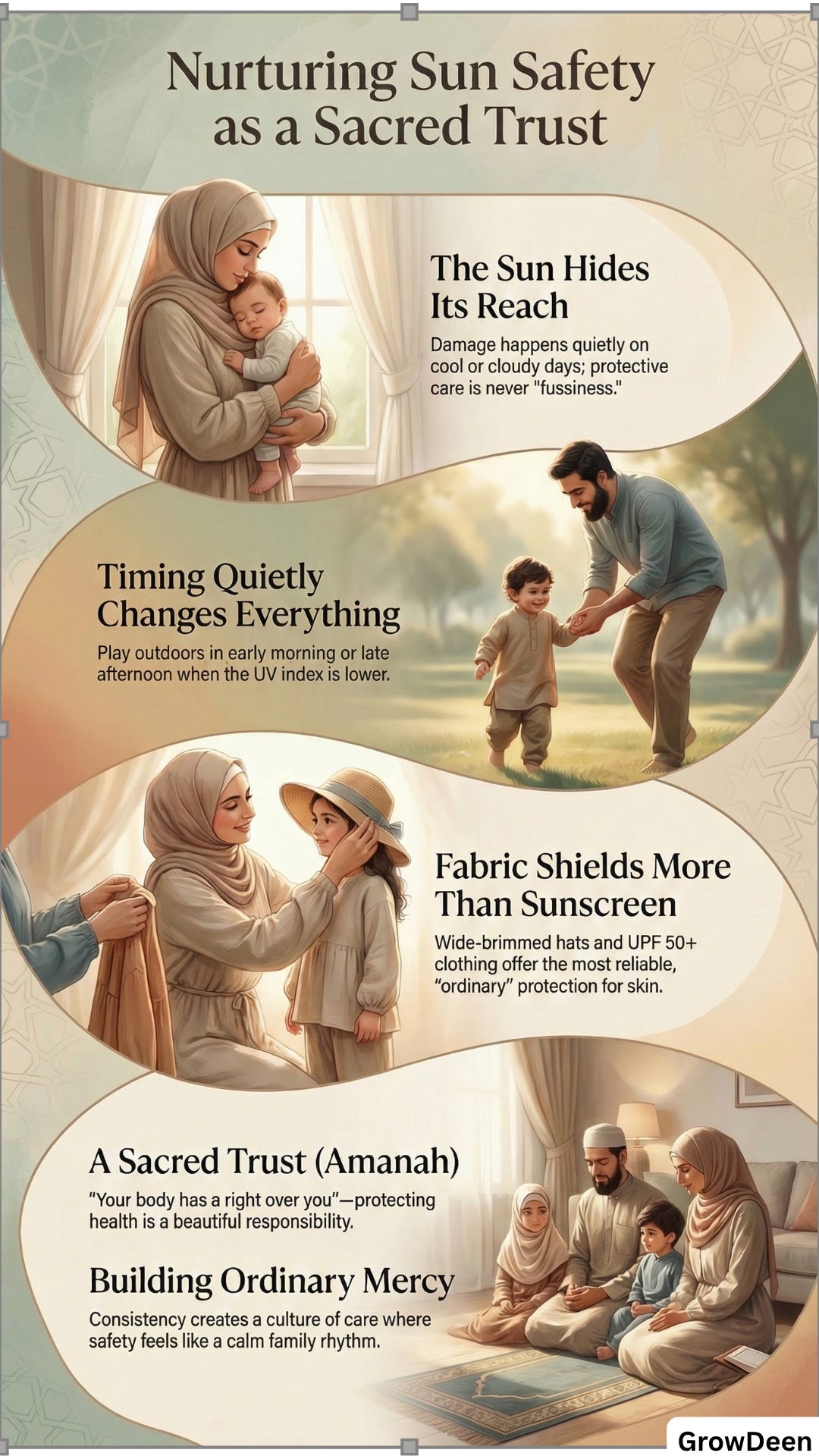
A child can be outdoors on a cool day and still be getting more ultraviolet exposure than you would guess.
That is why sun safety is not only about heat. Too much sun can damage skin, injure the eyes, weaken the immune system, and over time raise the risk of skin cancer, including melanoma. [1] [4] [8] [9] At the same time, children do need some sunlight as part of healthy life, including support for vitamin D and strong bones and muscles. [2] [5] [7] [8]
Both things are true at once.
That is the balance parents are always trying to hold. Not fear. Not carelessness. Just wise protection.
Allah’s trust includes the body your child lives in
Sometimes people treat sun safety as if it is optional fussiness.
But the body is not something Islam teaches us to neglect.
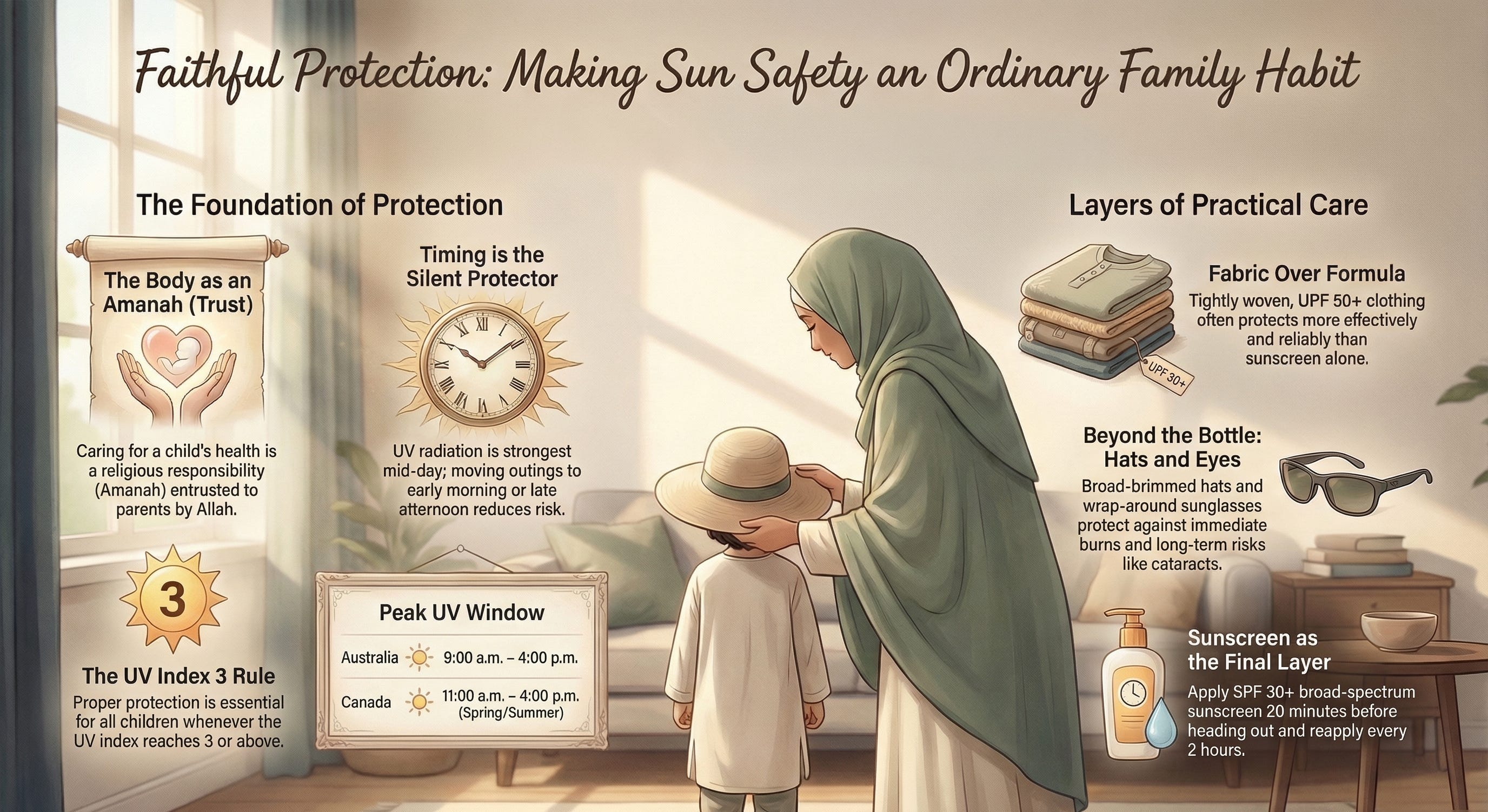
The Prophet ﷺ said, “Your body has a right over you.” [15]
And Allah says, “Do not throw yourselves with your own hands into destruction.” [16]
When I think about those words here, they feel very practical. Sun safety is not vanity. It is not overreacting. It is part of caring responsibly for a child whose body has been entrusted to you.
Amanah can look very ordinary in family life.
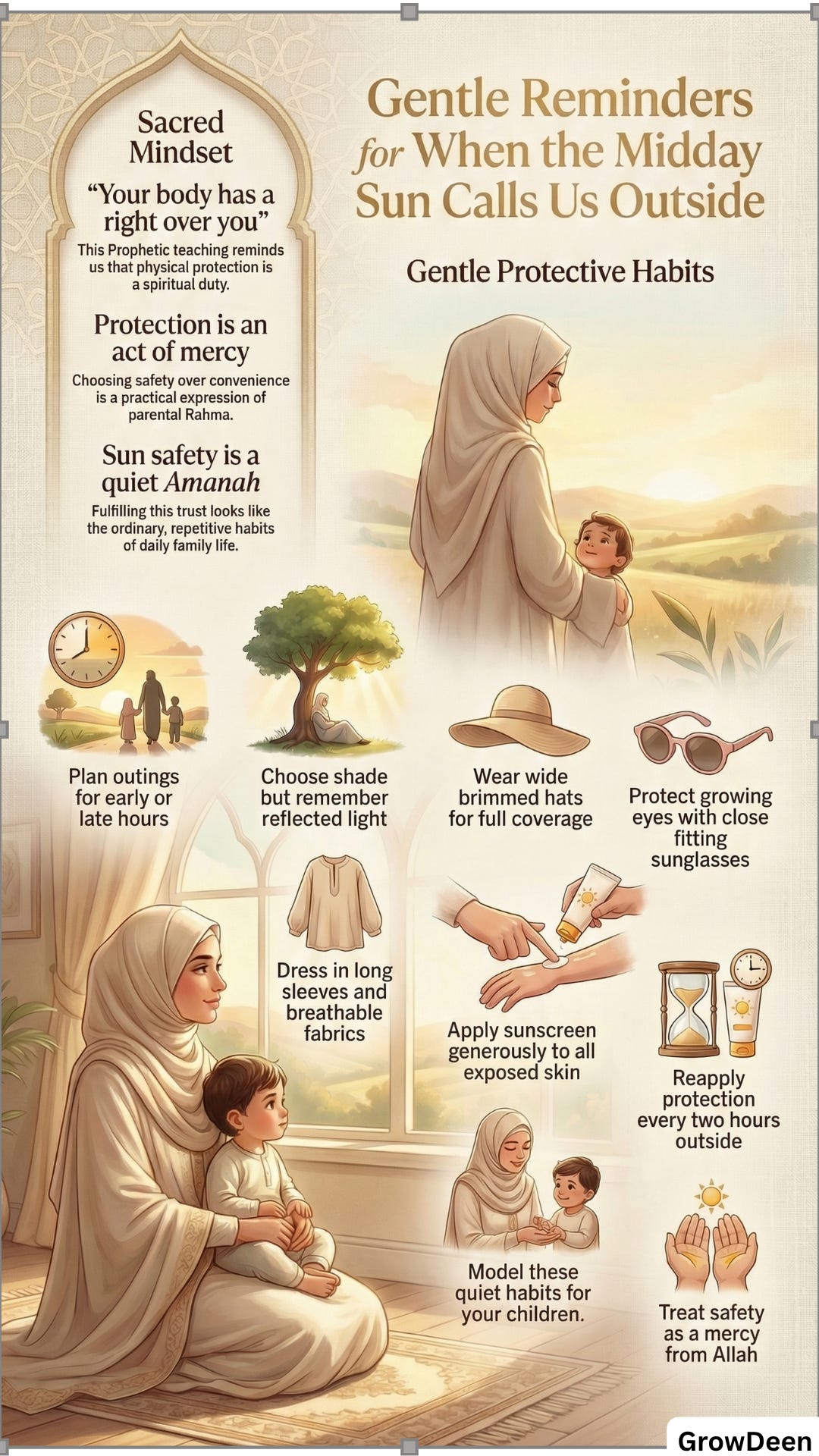
Sometimes it looks like moving the outing to later in the day.
Sometimes it looks like insisting on the hat.
Timing quietly changes everything
One of the simplest forms of protection is timing.
Ultraviolet radiation is not constant throughout the day. It varies by location and time. In places like Australia, UV is often highest from around 9 a.m. to 4 p.m., though that varies with season and location. In Canada, UV from the sun is highest in spring and summer from 11 a.m. to 4 p.m.
When the UV index is 3 or above, babies under 12 months should be kept out of direct sun, and older children need proper sun protection too. [1] [2] [3] [8]
That one shift can change so much.
A playground visit early in the morning feels different from one at midday. A walk later in the afternoon carries a different burden than one done in the harshest hours. [1] [2] [8]
Small planning choices do quiet protective work.
Shade helps, but shade is not the whole answer
Parents sometimes feel relieved the moment they find a tree, a shade sail, or the edge of a building.
And yes, shade matters. Dense shade is far better than thin shade. [1] [2] [8]
But it does not cancel the rest.
UV can still reach children indirectly, even while they are sitting under cover. It reflects from surfaces like water, sand, concrete, and snow. [1] [8] So the child in the shade still benefits from a hat, good clothing, sunglasses, and sunscreen on exposed skin.
And there is one very practical warning that matters with babies: do not cover a pram with a blanket or cloth to block the sun. That can trap heat and reduce airflow dangerously fast.
Clothing protects more quietly than people realize
Sometimes the best sun protection is not the sunscreen bottle at all.
It is the long sleeved shirt.
It is the rash vest.
It is the fabric that covers skin before the sun reaches it.
Clothing with a UPF rating of 50+ offers strong protection. [11] Tightly woven fabrics are better than loose ones. Long sleeves and longer trousers cover more skin, and even when full length feels too much in the heat, elbow length sleeves or knee length shorts are still better than leaving large areas exposed. [1] [11]
For water play, this matters even more, because reflection makes exposure harder to judge. [1] [11]
Allah says, “And Allah has made for you garments which protect you...” [12]
What a beautiful verse for such an ordinary parenting moment.
Protection is not always dramatic. Sometimes it is just the right shirt on the right day.
If gentle, practical, Islamically grounded support like this helps you think more clearly about family life, subscribe for free so each new article and life gift reaches you when you need it.
Hats, eyes, and the little battles parents know well
A good hat matters because the face, ears, and neck burn easily.
Broad brimmed hats, bucket hats, and legionnaire styles protect better than caps. [1] [11] For babies, the hat should be soft enough to wear comfortably while lying back, and if it has straps, those straps need to be safe and not left long enough to become a hazard.
Many toddlers and young children resist hats at first.
That is normal.
Usually routine works better than force. The same hat by the door. The same expectation before leaving. The same calm refusal to turn it into a huge emotional event.
Eyes need protection too. That part gets forgotten more often than it should. Close fitting, wrap around sunglasses that meet the proper standard give better coverage, and long term UV exposure is a known risk factor for cataracts. [1] [8]
Sunscreen helps, but it was never meant to carry the whole burden
Sunscreen matters, but it is not a magic shield.
Broad spectrum, water resistant SPF 30 or higher is recommended for exposed skin such as the face and hands. [1] [6] It should be applied generously about 20 minutes before going outside and reapplied every 2 hours. [6] One of the biggest reasons sunscreen fails in real life is simply that too little gets used.
For babies under 6 months, sunscreen is generally not recommended. In that age group, shade, clothing, and hats are the main protection. [3] And for children with sensitive skin, testing a small area first is wise.
Older children and teenagers bring another layer of difficulty. Often the problem is not ignorance. It is willingness. A teenager may know sunscreen matters and still avoid it because it feels greasy, looks shiny, or seems socially awkward. Giving them some say in the product, especially one they actually like using, often helps more than another lecture. [6] [10]
The Prophet ﷺ said, “Allah is gentle and loves gentleness in all matters.” [13]
That gentleness belongs here too.
Children learn sun safety by watching us repeat it
This is one of those family habits children absorb long before they fully understand it.
If you look for shade, they notice.
If you wear a hat, they notice.
If sunscreen is always in the bag, always applied before sport, always spoken about calmly, they notice that too.
The Prophet ﷺ said, “Each of you is a shepherd and each of you is responsible for his flock.” [17]
Responsibility in family life often looks repetitive. The same reminders. The same routines. The same protective habits until they stop feeling special and start feeling normal.
And that is the goal, really.
Not perfect sun safety every single time.
Just a family culture where protection is ordinary.
The Prophet ﷺ also said, “The merciful are shown mercy by the Most Merciful. Be merciful to those on the earth and the One above the heavens will show mercy to you.” [18]
Sometimes mercy looks like letting a child play outside.
Sometimes mercy looks like saying, not right now, the sun is too strong.
Both can be true.
GIFTS FOR YOU, DEAR PARENT
If you’ve reached this part of the page, it tells me something meaningful about you.
You weren’t just skimming or passing time. You stayed because something here felt relevant to your real life.
Because you care.
Because you want to do things with more awareness.
Because you’re trying, even when it feels overwhelming.
That is not small.
So I didn’t want this article to remain just words on a page. I wanted it to gently step into your daily life in practical ways. That’s why we prepared these Life Gifts for you.
Not as extras.
Not as decorations.
But as simple tools to help you hold onto what mattered most in what you just read.
Here’s what you’ll find inside:
Gentle Understanding Card
A clear and simplified summary of the core concept from this article, so you can revisit the main idea anytime without rereading everything.
Heartfelt Dua Card
A carefully chosen dua connected to this stage of life, because we know that real strength and ease ultimately come from Allah’s help.
Gentle Actions Card
Practical examples to help you translate knowledge into action, so what you learned becomes part of your daily rhythm.
Gentle Reminders Card
Short, steady reminders drawn from the key points, designed to be printed or saved and placed somewhere you’ll see often.
These were designed slowly and thoughtfully, with time, care, and sincere dua. We created them because we genuinely want to walk alongside you, not just through one article, but through every stage of this lifelong journey.
If these gifts support you even in a small way, I would love for you to continue receiving them.
Subscribe so that each new Gift arrives directly in your inbox whenever we release the next stage. That way, you won’t miss the tools designed to support you right where you are.
May Allah place barakah in your effort, accept your intention, and make this path easier and more rewarding than it feels right now.
Please share it with a family/friend who may benefit from this knowledge.
What is one moment with your child that feels hardest lately, and what kind of support would make it feel lighter?
Subscribe for free to keep receiving gentle, research rooted, Islamically grounded support for the real moments of parenting.
What part of sun safety feels hardest to keep steady in your family right now?
References
[1] American Academy of Pediatrics. (2011). Ultraviolet radiation: A hazard to children and adolescents. Pediatrics, 127(3), e791-e817.
[2] Cancer Council Australia. (2016). Position statement: Sun exposure and vitamin D - risks and benefits. Cancer Council Australia.
[3] Cancer Council Australia. (2017). Fact sheet: Sun protection and infants (0-12 months). Cancer Council Australia.
[4] Cordoro, K.M., Gupta, D., Frieden, I.J., McCalmont, T., & Kashani-Sabet, M. (2013). Pediatric melanoma: Results of a large cohort study and proposal for modified ABCD detection criteria for children. Journal of the American Academy of Dermatology, 68(6), 913-925.
[5] Erem, A.S., & Razzaque, M.S. (2021). Vitamin D-independent benefits of safe sunlight exposure. The Journal of Steroid Biochemistry and Molecular Biology, 213, 105957.
[6] Li, H., Colantonio, S., Dawson, A., Lin, X., & Beecker, J. (2019). Sunscreen application, safety, and sun protection: The evidence. Journal of Cutaneous Medicine and Surgery, 23(4), 357-369.
[7] Misra, M., Pacaud, D., Petryk, A., Collett-Solberg, P.F., & Kappy, M. (2008). Vitamin D deficiency in children and its management: Review of current knowledge and recommendations. Pediatrics, 122(2), 398-417.
[8] Neale, R.E., Lucas, R.M., Byrne, S.N., Hollestein, L., Rhodes, L.E., Yazar, S., Young, A.R., Berwick, M., Ireland, R.A., & Olsen, C.M. (2023). The effects of exposure to solar radiation on human health. Photochemical & Photobiological Sciences, 22(5), 1011-1047.
[9] Raimondi, S., Suppa, M., & Gandini, S. (2020). Melanoma epidemiology and sun exposure. Acta Dermato-Venereologica, 100(11), 250-258.
[10] Rock, V. (2016). The number 1 tip for getting teens to wear sunscreen. Cancer Council Australia.
[11] SunSmart. (2022). Sun-protective clothing. SunSmart.
[12] Qur’an, Surah An-Nahl 16:81
[13] Sahih Muslim, Hadith 2593
[14] Qur’an, Surah An-Nisa 4:58
[15] Sahih al-Bukhari, Hadith 5199
[16] Qur’an, Surah Al-Baqarah 2:195
[17] Sahih al-Bukhari, Hadith 7138; Sahih Muslim, Hadith 1829a
[18] Jami` at-Tirmidhi, Hadith 1924, Hasan Sahih
[19] Sahih al-Bukhari, Hadith 1; Sahih Muslim, Hadith 1907