
What Parents Should Know About Safe Bath Water
Before You Put Your Child in the Bath, Check This One Thing First

Free gift for you! A practical companion resource is waiting for you near the end of this article to help you remember, apply, and benefit from what you read. Don’t forget to download!
Safe bath-time for babies and children depends on warm rather than hot water, careful control of tap temperature, close supervision, and steady habits that prevent scalds before they happen.
Sometimes it is such a small moment.
You turn the tap.
Steam rises a little.
You swirl the water with your hand.
A child is waiting nearby, restless, curious, ready to climb in before you are fully finished.
And because bath time comes so often, it can start to feel harmless. Familiar. Automatic. Something your hands do while your mind is already half on the next task.
But bath water can hurt a child far faster than many adults realize.
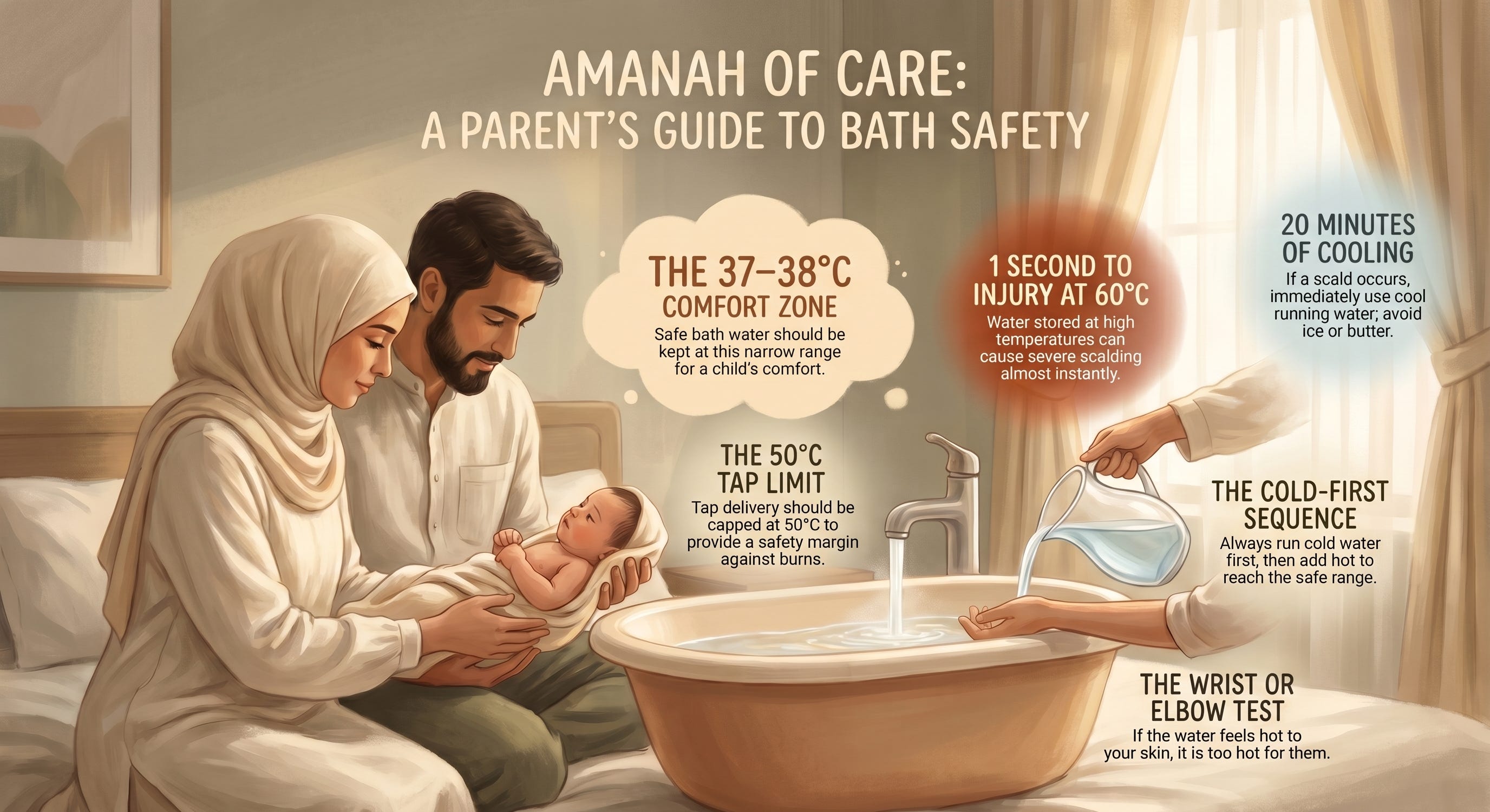
Water that feels only “a bit hot” to a grown person can burn delicate skin almost immediately. That is why safe bath temperature is not a tiny extra detail. It is part of basic child safety. Warm bath water for babies and children should be around 37–38°C, warm enough for comfort without creating unnecessary scald risk. [1][5][7]
The danger is often not the bath itself, but the seconds before it
A lot of children are not burned because someone intended to harm them.
They are burned because the water was hotter than expected.
Because the bath was not mixed properly.
Because there were hot and cold pockets still sitting there.
Because a child reached under running hot water.
Because a child turned a tap on alone.
Because the adult thought it would take only one more second to finish something else first.
Those are the ordinary patterns. And they matter because hot-water scalds remain a significant cause of burn injury in young children. [1][5][6]
One helpful distinction makes this clearer. The temperature stored inside a hot-water system is not always the same as the temperature that should come out of the tap. Water often needs to be stored above 60°C to reduce the risk of Legionella growth, but water delivered to taps used by children should be tempered lower to reduce scald risk. [1] That difference is important. It means families should not confuse water-heater storage needs with safe water delivery at the point where a child is being washed.
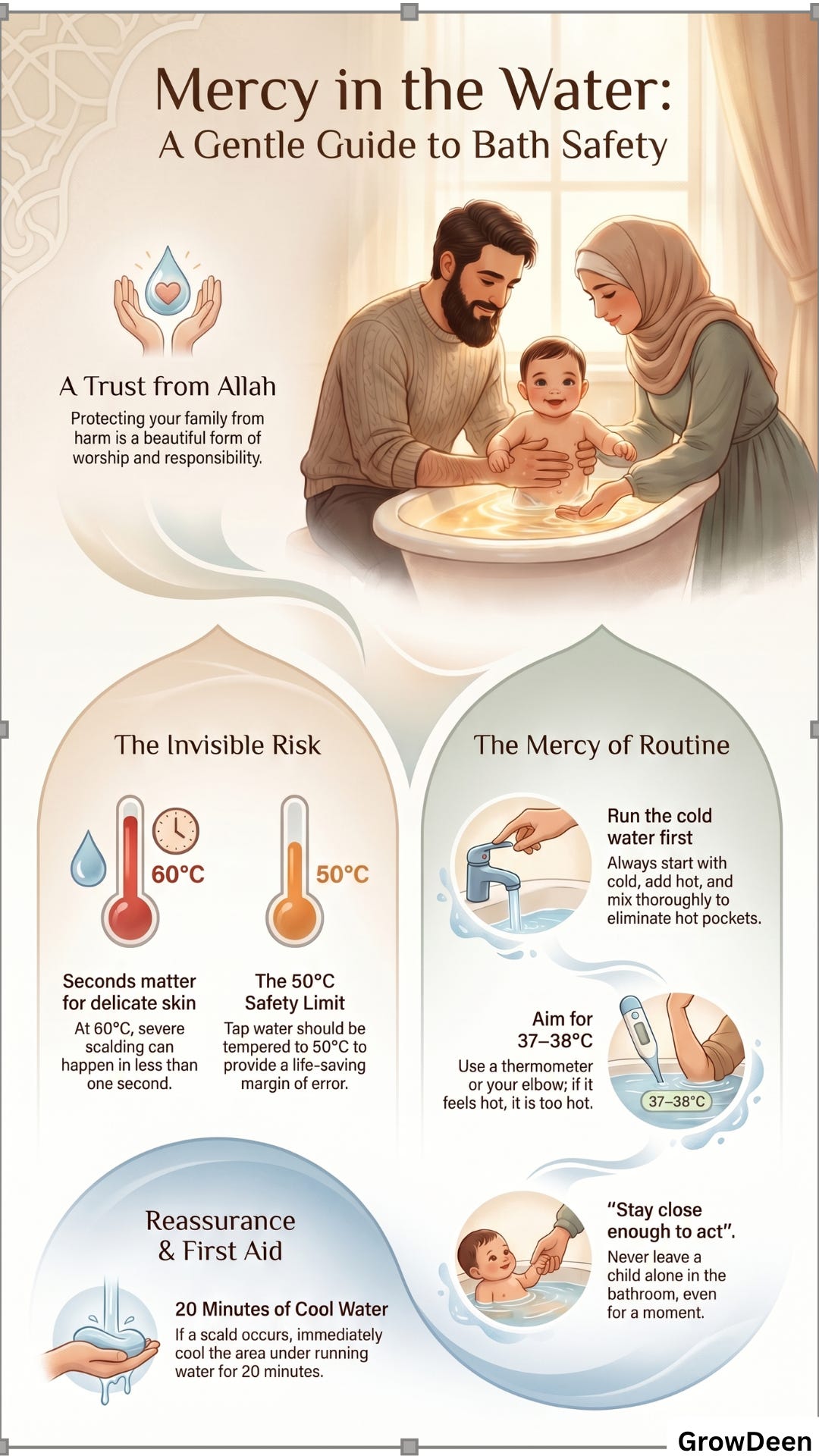
This is why the advice about a maximum delivered tap temperature of 50°C matters so much. [1][2][3][4] That is not the recommended bath temperature. It is the safety limit for the water coming out of the tap so that a child is not severely burned almost at once. At around 60°C, severe scalding can happen in under a second. At 50°C, the risk is lower and injury takes longer. [1][4] That extra margin matters.
Warm is what feels ordinary to a child’s skin
The safest bath routine is not complicated.
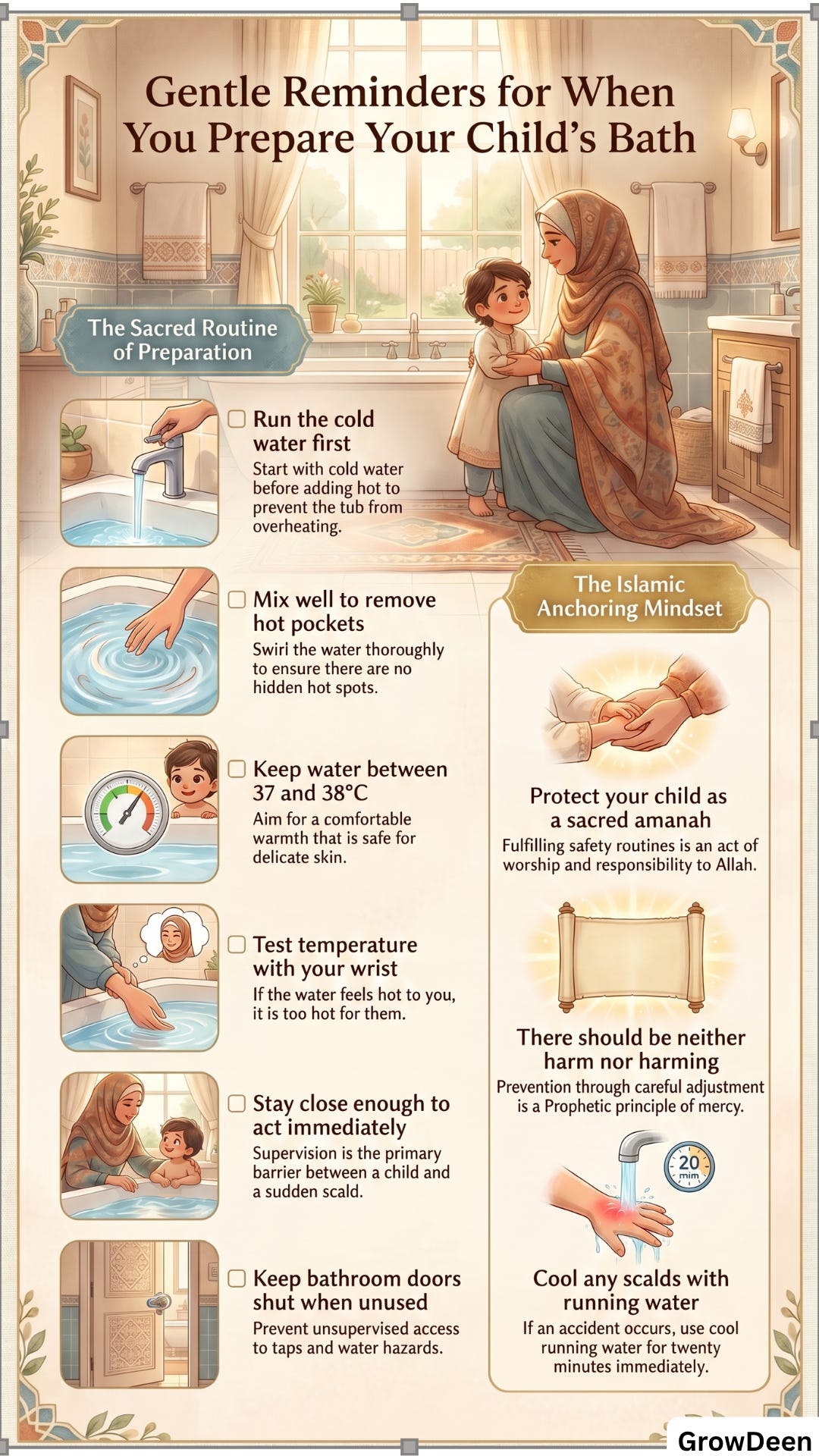
Run the cold water first.
Then add hot water.
Mix the bath thoroughly so there are no hidden hot spots.
Turn the hot tap off firmly.
If you have a mixer tap, adjust the temperature by adding more warm water rather than a burst of straight hot water.
Check the water before the child gets in. [1]
A bath thermometer is helpful. If you do not have one, use your wrist or elbow. The source guidance puts it plainly: if your skin flushes or the water feels hot, it is too hot for a child. [1] That is such a useful sentence because it cuts through the hesitation. Adults can tolerate temperatures that are not safe for children. So the standard cannot simply be, “It feels fine to me.”
And honestly, that is one of the deeper lessons in so much of child safety. The grown body is not the measure. The vulnerable body is.
A safe bathroom needs more than the right number on the thermometer
Temperature matters. But access matters too.
Children are not burned only while adults are standing there. They are also burned when they reach taps on their own. When they wander into a bathroom or laundry. When they get to the bath before the water is ready. When the room still contains hazards after everyone assumes the task is over.
So bathroom and laundry doors should stay shut when they are not in use. Children should be kept away from the bath until the water is ready and safe. Anti-scald devices, child-resistant taps or tap guards, and temperature-control devices can all be useful where appropriate. [1][2][3][4]
The research behind thermostatic mixer valves supports this practical instinct. They are not magical. But they can be a meaningful scald-prevention measure in family homes because they help control the temperature reaching the tap. [2][3]
That matters because safety is often strongest when it does not depend only on memory.
When the room itself helps you.
When the device itself helps you.
When the system quietly makes injury less likely.
Close supervision is part of hot-water safety too
It is easy to think of supervision as a drowning issue and temperature as a scald issue.
But for children, the two are tangled together.
A child left alone in a bathroom can turn on a tap, move into water that is too hot, or be unable to turn the tap off. That is why children should never be left alone in the bath or bathroom, and why a younger child should not be left in the care of an older child who may miss danger or not understand how quickly hot water can injure. [1]
Safety around hot water is not only about devices. It is about presence.
A nearby adult can stop a hand reaching toward the tap.
A nearby adult can notice the water getting hotter.
A nearby adult can intervene before seconds become damage.
This is one of those subjects where the most protective sentence might be this:
Stay close enough to act immediately.
That is what children need from us in a room where hot water is present.
If a scald happens, the first minutes matter
Even with good habits, accidents can still happen. And when they do, the first response matters.
If a scald happens, first aid should begin immediately. Cool the scalded area under cool running water for 20 minutes. [1] Guidance from burn associations, the NHS, and family-facing pediatric resources supports immediate cooling with cool running water and warns against using ice, butter, toothpaste, or other household remedies. [7][18]
That kind of quick cooling can reduce burn depth and reduce pain, especially when started promptly.
It helps to remember why this matters so much. Young children do not judge temperature well. They explore with hands and feet. They react slowly when surprised. And a burn that lasts only seconds can leave behind severe pain, dressings, hospital visits, and a long recovery. Registry data across Australia and New Zealand shows how substantial pediatric scald injury remains, especially in younger children. [5][6] WHO’s burns guidance also includes lowering hot-water tap temperatures among its prevention measures for childhood burn injuries. [15]
If writing like this helps you feel steadier in the daily work of parenting, subscribe for free so each new article arrives quietly in your inbox when it’s ready.
Allah’s mercy appears in careful preparation
In Islam, protecting a child from harm is part of the trust Allah has placed on caregivers.
Allah says, “O you who believe, protect yourselves and your families…” [8]
The verse speaks first to salvation, but the ethic of protection reaches into ordinary life too. A child’s body is not something to handle casually. It is an amanah.
Allah also says, “Do not kill yourselves. Indeed, Allah is ever Merciful to you.” [9]
The scholars explain that this includes avoiding causes of harm and not being reckless with life. That spirit fits perfectly here. Safe bath water. Safe tap temperature. Staying nearby. Learning first aid. Rearranging the room so a child cannot reach danger. None of that is outside worshipful responsibility. It is part of it.
The Prophet ﷺ said, “Each of you is a shepherd, and each of you is responsible for his flock.” [10]
Bath safety, checking water temperature, supervising closely, fixing unsafe taps, learning how to cool a scald properly: these things are not outside that responsibility. They are examples of it.
And he also said, “There should be neither harming nor reciprocating harm.” [11]
That principle sits naturally here. If harm can be prevented by a simple adjustment, then neglecting that adjustment is not a small thing.
There is mercy in this work too. The Prophet ﷺ was visibly tender with children. [12] And Allah says, “And lower to them the wing of humility out of mercy.” [13]
A parent testing bath water carefully, keeping a child away until it is safe, and staying nearby while they bathe is doing something gentle, not merely technical. It is mercy with foresight.
And intention deepens even these quiet acts. The Prophet ﷺ said, “Actions are only by intentions.” [14]
A parent who checks the bath, lowers the tap temperature, learns burn first aid, and changes the bathroom routine out of care for a child is not only being practical. They are fulfilling trust with intention.
The habits are simple, and that is part of their power
In the end, safe bath temperature is not complicated.
Warm bath water should be around 37–38°C.
Tap water should not come out dangerously hot.
Children should be kept away until the bath is ready.
The water should be mixed well.
The temperature should be checked every time.
And if something does go wrong, cooling first aid should begin straight away. [1][2][3][4][7][15][16][17][18]
These are ordinary habits.
But ordinary habits are often what stand between a child and a preventable injury.
That is what makes this subject worth taking seriously. Not because it is dramatic. But because it is so ordinary that people are tempted not to think about it at all.
And that is exactly where care begins.
GIFTS FOR YOU, DEAR PARENT
If you’ve reached this part of the page, it tells me something meaningful about you.
You weren’t just skimming or passing time. You stayed because something here felt relevant to your real life.
Because you care.
Because you want to do things with more awareness.
Because you’re trying, even when it feels overwhelming.
That is not small.
So I didn’t want this article to remain just words on a page. I wanted it to gently step into your daily life in practical ways. That’s why we prepared these Life Gifts for you.
Not as extras.
Not as decorations.
But as simple tools to help you hold onto what mattered most in what you just read.
Here’s what you’ll find inside:
Gentle Understanding Card
A clear and simplified summary of the core concept from this article, so you can revisit the main idea anytime without rereading everything.
Heartfelt Dua Card
A carefully chosen dua connected to this stage of life, because we know that real strength and ease ultimately come from Allah’s help.
Gentle Actions Card
Practical examples to help you translate knowledge into action, so what you learned becomes part of your daily rhythm.
Gentle Reminders Card
Short, steady reminders drawn from the key points, designed to be printed or saved and placed somewhere you’ll see often.
These were designed slowly and thoughtfully, with time, care, and sincere dua. We created them because we genuinely want to walk alongside you, not just through one article, but through every stage of this lifelong journey.
If these gifts support you even in a small way, I would love for you to continue receiving them.
Subscribe so that each new Gift arrives directly in your inbox whenever we release the next stage. That way, you won’t miss the tools designed to support you right where you are.
May Allah place barakah in your effort, accept your intention, and make this path easier and more rewarding than it feels right now.
Please share it with a family/friend who may benefit from this knowledge.
What is one moment with your child that feels hardest lately, and what kind of support would make it feel lighter?
You do not need to approach bath time with fear.
You do not need to become anxious around every tap and every splash.
You just need habits careful enough, and calm enough, to protect a child whose skin is still so delicate and whose safety still depends so much on you.
May Allah place barakah in your care, gentleness in your hands, and protection around the child entrusted to you. May He make your home safer, your routines steadier, and your parenting richer in mercy than in worry.
Subscribe for free if you’d like more warm, evidence-based, Islamically grounded support for the real work of raising children.
References
[1] Kendrick, D., Stewart, J., Smith, S., Coupland, C., Hopkins, N., Groom, L., Towner, E., Hayes, M., Gibson, D., Ryan, J., O’Donnell, G., Radford, D., Phillips, C., & Murphy, R. (2011). Randomised controlled trial of thermostatic mixer valves in reducing bath hot tap water temperature in families with young children in social housing
[2] Phillips, C.J., Humphreys, I., Kendrick, D., Stewart, J., Hayes, M., Nish, L., Stone, D., Coupland, C., & Towner, E. (2011). Preventing bath water scalds: A cost-effectiveness analysis of introducing bath thermostatic mixer valves in social housing
[3] Public Health Association of Australia (PHAA). (2016). Hot tap water temperature and scalds policy statement
[4] Riedlinger, D.I., Jennings, P.A., Edgar, D.W., Harvey, J.G., Cleland, H.J., Wood, F.M., & Cameron, P.A. (2015). Scald burns in children aged 14 and younger in Australia and New Zealand – An analysis based on the Burn Registry of Australia and New Zealand (BRANZ)
[5] Tracy, L.M., Rosenblum, S., & Gabbe, B.J. (2020). Burns Registry of Australia and New Zealand (BRANZ) 2018/19 annual report
[6] Australian and New Zealand Burn Association (ANZBA). (2019). First aid
[7] Qur’an, Surah At-Tahrim 66:6
[8] Qur’an, Surah An-Nisa 4:29
[9] Sahih al-Bukhari 7138
[10] Sunan Ibn Majah 2340
[11] Sahih al-Bukhari 5998
[12] Qur’an, Surah Al-Isra 17:24
[13] Sahih al-Bukhari 1, Sahih Muslim 1907
[14] World Health Organization. Burns fact sheet
[15] American Academy of Pediatrics / HealthyChildren.org. Family guidance on bathroom safety and burn prevention
[16] CDC. Control Legionella in Potable Water Systems
[17] NHS. Burns and scalds