
What Parents Often Miss Until a Tooth Starts Hurting
The Little Dental Habits That Save Children So Much Pain Later

Tooth decay rarely begins with a dramatic moment, but through steady brushing, gentler sugar habits, calm dental care, and early attention to warning signs, you can quietly protect your child’s teeth from the baby years into the teenage ones.
You notice it while your child is laughing.
Or maybe while they are brushing badly, half distracted, already trying to leave the bathroom before you have even looked properly.
A faint mark near the gum. A strange dull patch. Something brownish that was not there before. And for a second your mind does that thing parents’ minds do. You wonder if it is nothing. You hope it is nothing. But you also know these small things sometimes turn into the painful things children remember.
That is what makes tooth decay hard. It often begins so quietly that the home keeps moving as usual while the tooth is slowly changing.
It rarely starts with the kind of warning we expect
Tooth decay does not usually announce itself loudly in the beginning.
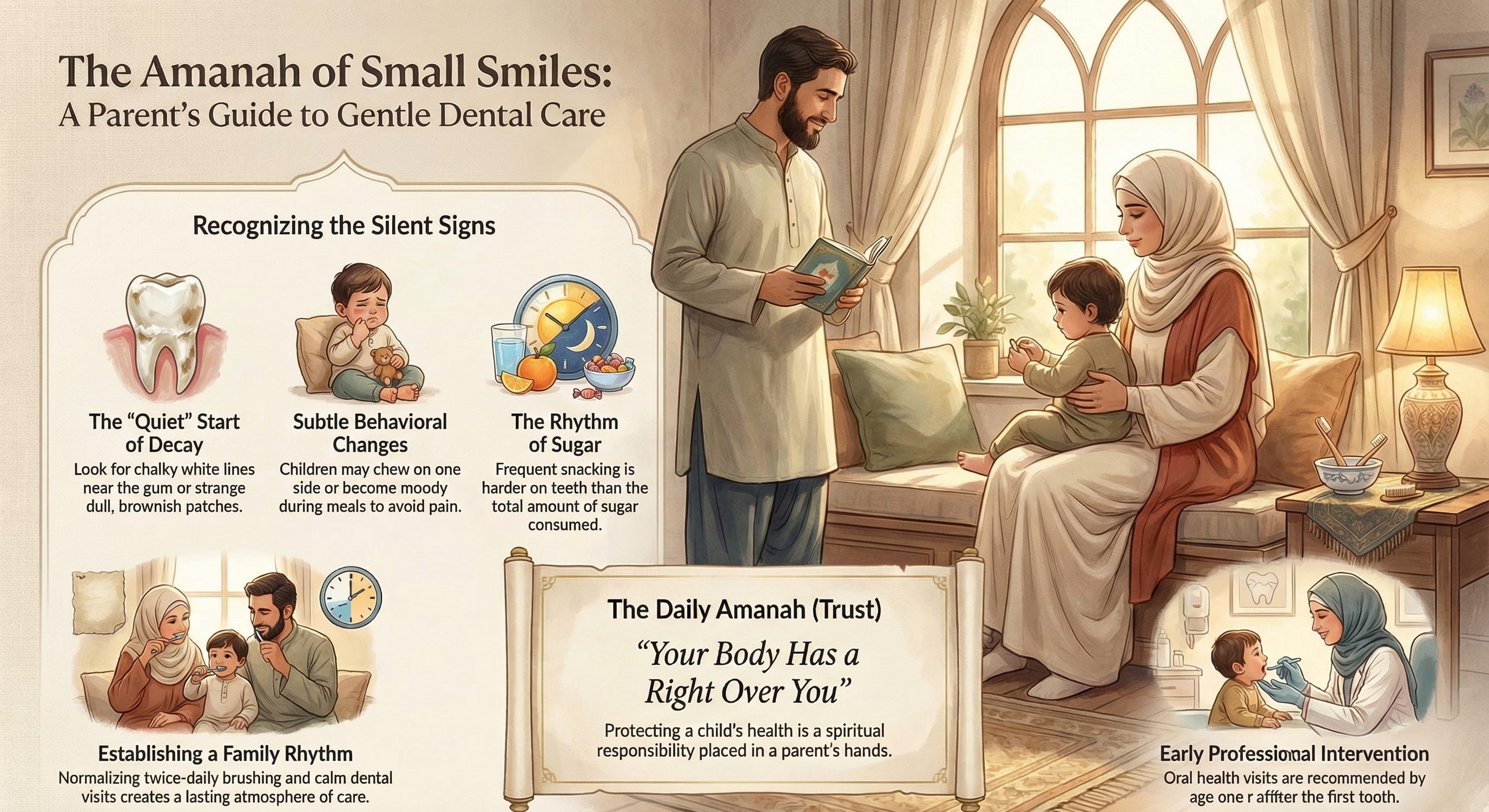
It starts with plaque bacteria feeding on sugars from food and drinks, then producing acids that slowly wear away enamel until a cavity forms. [1] [2] It is not just a cosmetic issue. It is a disease process. And it can touch babies, children, and teenagers alike. [1] [2]
A parent may first notice a chalky white line near the gum, a dark mark, or gums that seem irritated. Sometimes there is no obvious complaint at all. Then later, if things continue, there may be pain, a visible hole, a broken tooth, swelling, or signs of infection. [3] [12]
That quiet beginning is exactly why this topic matters.
When a child says nothing, the teeth may still be speaking
Some children do not tell you much.
They chew on one side. They avoid cold things. They get moody at meals. They say their mouth feels “weird” and then run off before explaining. And if the tooth is not at the front, you may not see anything right away.
When decay is left alone, it can bring more than a damaged tooth. It can affect chewing, speech, comfort, sleep, nutrition, and day to day wellbeing. [2] [12] A child does not need to be dramatic for the problem to be real.
And if there is facial swelling, pus, fever, or your child seems unwell and the teeth may be part of the story, that is not something to sit and watch for too long. [3] [12]
Allah’s trust reaches into the bathroom sink too
Dental care may look ordinary from the outside.
A toothbrush. A quick reminder. A dentist appointment you nearly forgot to book.
But for a Muslim parent, even these quiet acts sit inside amanah.
Allah says, “Indeed, Allah commands you to render trusts to whom they are due...” [13]
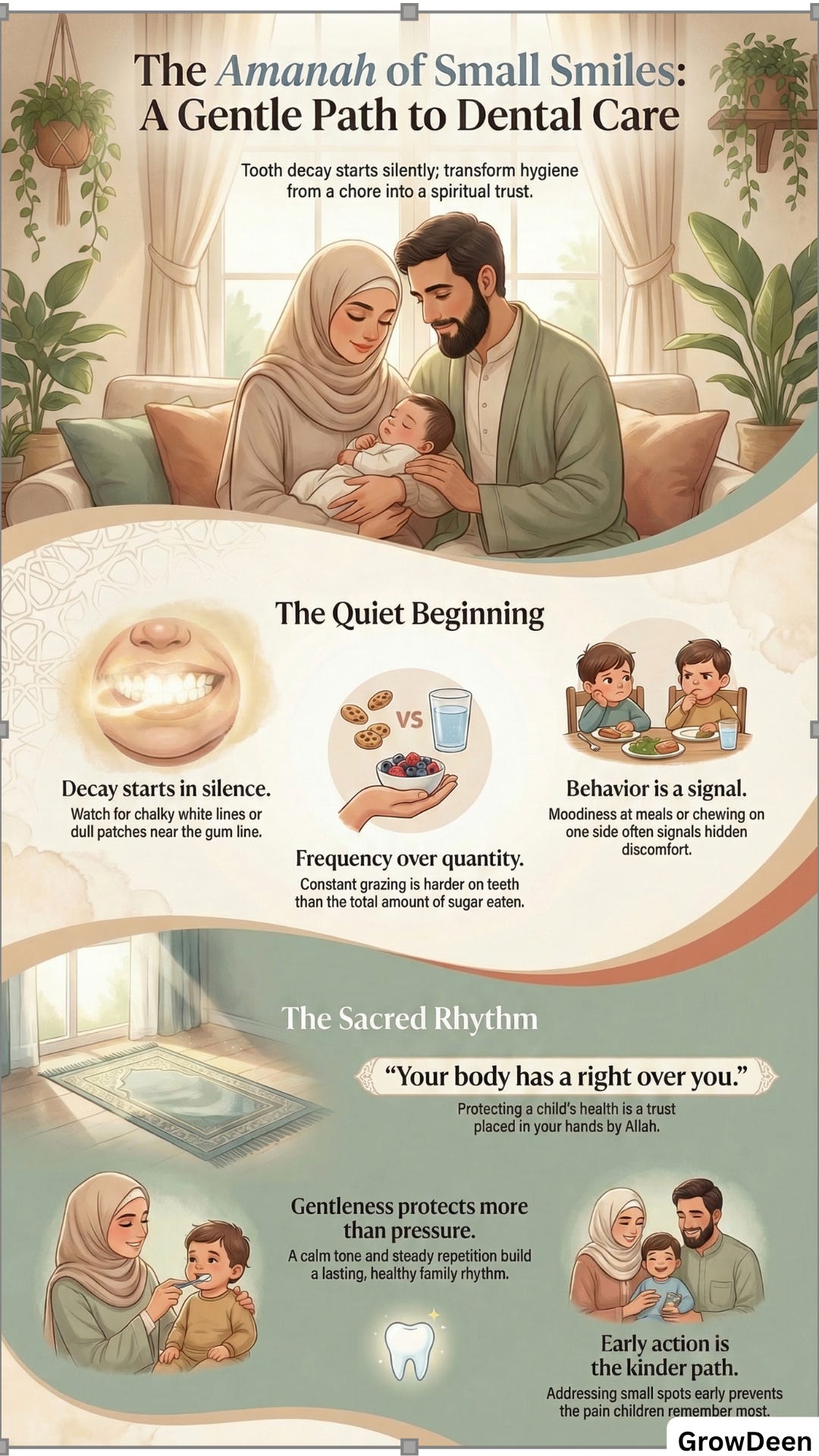
And the Prophet ﷺ said, “Your body has a right over you.” [15]
A child’s body is not casual. Their teeth are not separate from their health. Protecting them is part of the trust Allah placed in your hands. That does not mean panic over every tiny mark. It means steadiness. It means caring before there is a crisis.
Most prevention lives in ordinary repetition
There is no glamorous answer here.
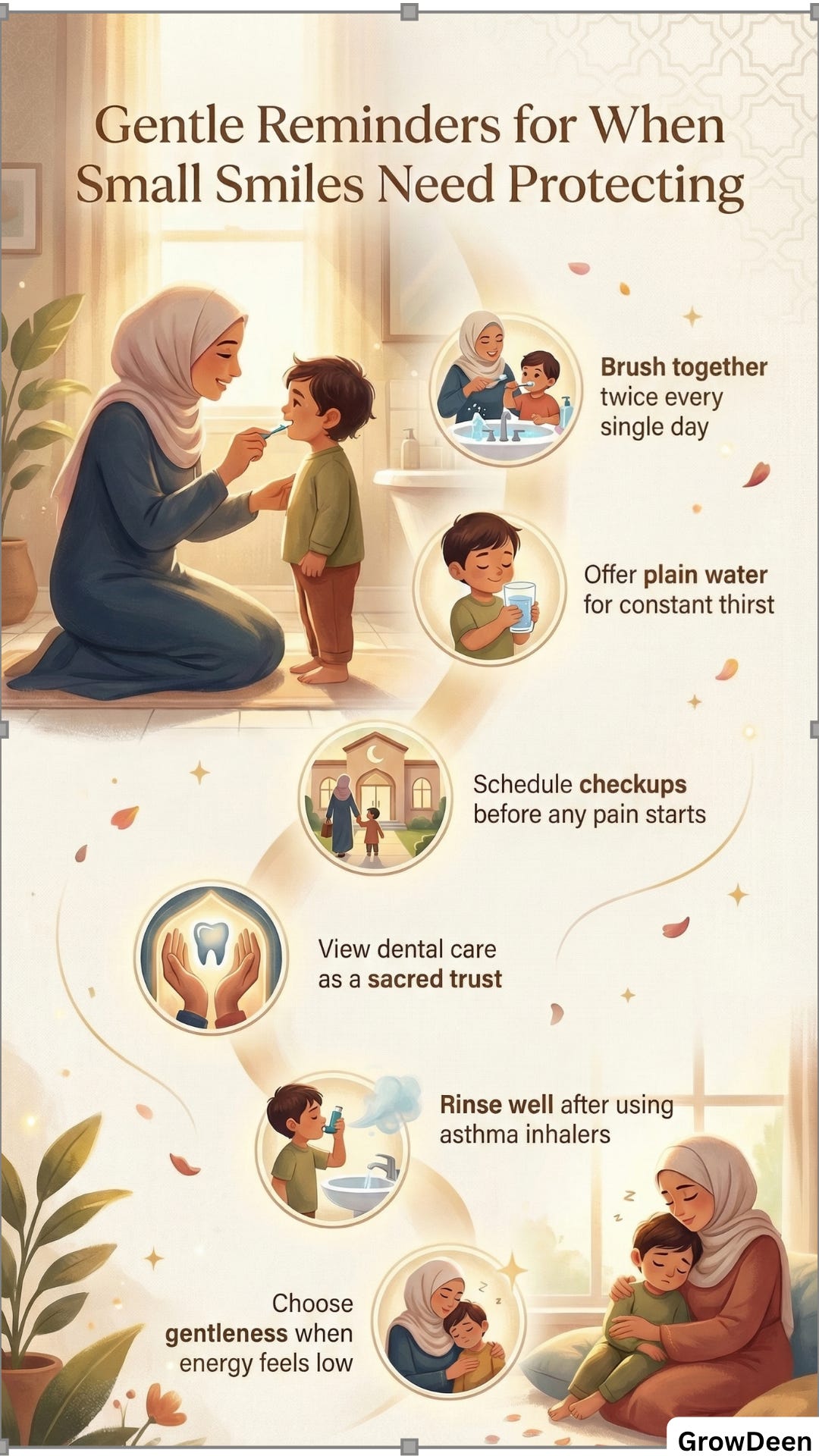
Teeth need brushing twice a day. Dental visits need to happen before pain forces them. Fluoride toothpaste matters. [4] [5] [11] For the youngest children, an oral health visit is advised by age one or within six months of the first tooth coming in. [4] [11]
That sounds simple on paper. In real homes, it is less neat.
A sleepy child refuses. A teenager rushes. Someone says they already brushed when they did not. A baby bites the brush. A parent is tired. This is why prevention is less about knowing what matters and more about building a family rhythm that keeps returning to it.
The Prophet ﷺ said, “Allah is gentle and He loves gentleness.” [14]
That hadith belongs here too. Not every child responds to pressure. Sometimes a calmer tone protects more than a harsher one.
If gentle, practical, Islamically grounded support like this helps you think more clearly about family life, subscribe for free so each new article and life gift comes straight to you when you need it.
Sugar is not only about how much, but how often
This part catches many families.
It is not only the amount of sugar that matters. It is the rhythm of exposure.
When a child grazes all day, keeps sipping sweet drinks, or snacks constantly without the teeth getting a break, the mouth stays in a pattern where acid attacks restart again and again. [7] That is hard on teeth in a quiet, cumulative way.
So protection often looks like structure. Clear snack times. Meals in one place. Plain water when thirsty. Fewer sweet drinks drifting through the day. [7]
For babies, this starts even earlier than many realize. Before solids, they do not need anything beyond breastmilk or infant formula, and after six months they can also begin small amounts of water. [6] Dummies should not be dipped in honey, sugar, or other sweet substances. [6]
And bedtime bottles deserve real attention. A bottle may feel like the easiest path to sleep, especially when you are exhausted. But repeated sleeping with breastmilk or formula around the teeth raises the risk of decay because saliva drops during sleep and the mouth loses some of its natural protection. [6] [9]
The things that quietly make teeth struggle
Some children are doing many things right and still need extra attention.
Asthma inhalers can leave material in the mouth that is rough on teeth if the mouth is not rinsed afterward. [6] Acidic drinks can wear enamel down. Vomiting and reflux can do the same. [8] After these exposures, rinsing with water helps, but brushing should wait about 30 to 60 minutes so softened enamel is not scrubbed while it is vulnerable. [8]
Some medicines also add to dental risk. Liquid or chewable medicines with sugar can increase caries risk, especially if used long term. Some medicines reduce saliva, and a drier mouth makes decay more likely. [9] [10] [12]
This is one reason parents need mercy toward themselves too. Not every dental struggle comes from neglect. Sometimes there are extra burdens in the picture.
A family culture protects more than one lecture ever will
Children notice what adults repeat.
A home where brushing is normal morning and night, where water is ordinary, where sugar is not background noise all day, and where dental checkups are spoken about calmly gives a child something steady to copy.
That matters more than one serious speech.
The Prophet ﷺ said, “Each of you is a shepherd and each of you is responsible for his flock.” [16]
Responsibility here does not mean becoming tense and watchful every second. It means creating an atmosphere. A home pattern. A tone that says, this is how we care for our bodies.
Early action is usually the kinder action
If something looks wrong, do not guess for too long.
A worsening spot does not usually explain itself in a helpful way. Pain tends to make children braver at hiding than we expect, especially older ones. They minimize. They delay. They say it is fine until it is very much not fine.
Allah says, “Do not follow what you have no knowledge of.” [18]
There is such wisdom in that for parenting. Not every uncertainty should become panic. But not every uncertainty should become delay either.
And Allah says, “Eat and drink, but do not waste.” [17]
There is moderation in this whole topic. Not excess sugar. Not neglect. Not harshness. Just thoughtful care, repeated quietly over years.
Protection usually looks like that.
GIFTS FOR YOU, DEAR PARENT
If you’ve reached this part of the page, it tells me something meaningful about you.
You weren’t just skimming or passing time. You stayed because something here felt relevant to your real life.
Because you care.
Because you want to do things with more awareness.
Because you’re trying, even when it feels overwhelming.
That is not small.
So I didn’t want this article to remain just words on a page. I wanted it to gently step into your daily life in practical ways. That’s why we prepared these Life Gifts for you.
Not as extras.
Not as decorations.
But as simple tools to help you hold onto what mattered most in what you just read.
Here’s what you’ll find inside:
Gentle Understanding Card
A clear and simplified summary of the core concept from this article, so you can revisit the main idea anytime without rereading everything.
Heartfelt Dua Card
A carefully chosen dua connected to this stage of life, because we know that real strength and ease ultimately come from Allah’s help.
Gentle Actions Card
Practical examples to help you translate knowledge into action, so what you learned becomes part of your daily rhythm.
Gentle Reminders Card
Short, steady reminders drawn from the key points, designed to be printed or saved and placed somewhere you’ll see often.
These were designed slowly and thoughtfully, with time, care, and sincere dua. We created them because we genuinely want to walk alongside you, not just through one article, but through every stage of this lifelong journey.
If these gifts support you even in a small way, I would love for you to continue receiving them.
Subscribe so that each new Gift arrives directly in your inbox whenever we release the next stage. That way, you won’t miss the tools designed to support you right where you are.
May Allah place barakah in your effort, accept your intention, and make this path easier and more rewarding than it feels right now.
Please share it with a family/friend who may benefit from this knowledge.
What is one moment with your child that feels hardest lately, and what kind of support would make it feel lighter?
Subscribe for free to keep receiving gentle, research rooted, Islamically grounded support for the real moments that shape family life.
What tooth care habit feels hardest to keep steady in your home right now?
References
[1] Government of Canada. Cavities. Public Health Agency of Canada. March 18, 2025.
[2] healthdirect Australia. Tooth decay.
[3] NHS. Tooth decay.
[4] American Academy of Pediatric Dentistry. Periodicity of Examination, Preventive Dental Services, Anticipatory Guidance/Counseling, and Oral Treatment for Infants, Children, and Adolescents. The Reference Manual of Pediatric Dentistry, 2025 to 2026.
[5] American Academy of Pediatric Dentistry. Policy on Early Childhood Caries (ECC): Consequences and Preventive Strategies. The Reference Manual of Pediatric Dentistry, 2025 to 2026.
[6] healthdirect Australia. Looking after your baby or child’s teeth.
[7] NHS England. Delivering Better Oral Health: An Evidence-Based Toolkit for Prevention. Chapter 10: Healthier Eating.
[8] healthdirect Australia. Dental erosion: symptoms, treatments and causes.
[9] National Institute of Dental and Craniofacial Research. Dry Mouth.
[10] American Dental Association. Chewing Gum.
[11] Health Canada. Fluoride and oral health. June 16, 2025.
[12] Centers for Disease Control and Prevention. Cavity Facts | Oral Health. May 15, 2024.
[13] Qur’an, Surah An-Nisa 4:58
[14] Sahih Muslim 2593
[15] Sahih al-Bukhari 5199
[16] Sahih Muslim 1829a