
What Parents Need to Notice When a Newborn Looks Yellow
Newborn Jaundice Is Common, but Some Signs Should Never Be Ignored

Free gift for you! A practical companion resource is waiting for you near the end of this article to help you remember, apply, and benefit from what you read. Don’t forget to download!
Newborn jaundice is common and often settles with time or simple treatment, but every jaundiced baby needs proper checking so serious causes are not missed and dangerous bilirubin levels are treated early.

A yellow tinge on a newborn’s skin can make a room go quiet very quickly.
Sometimes it is only the face at first. Sometimes the eyes catch it before the skin does. You look once, then again in better light, and suddenly your heart becomes very alert.
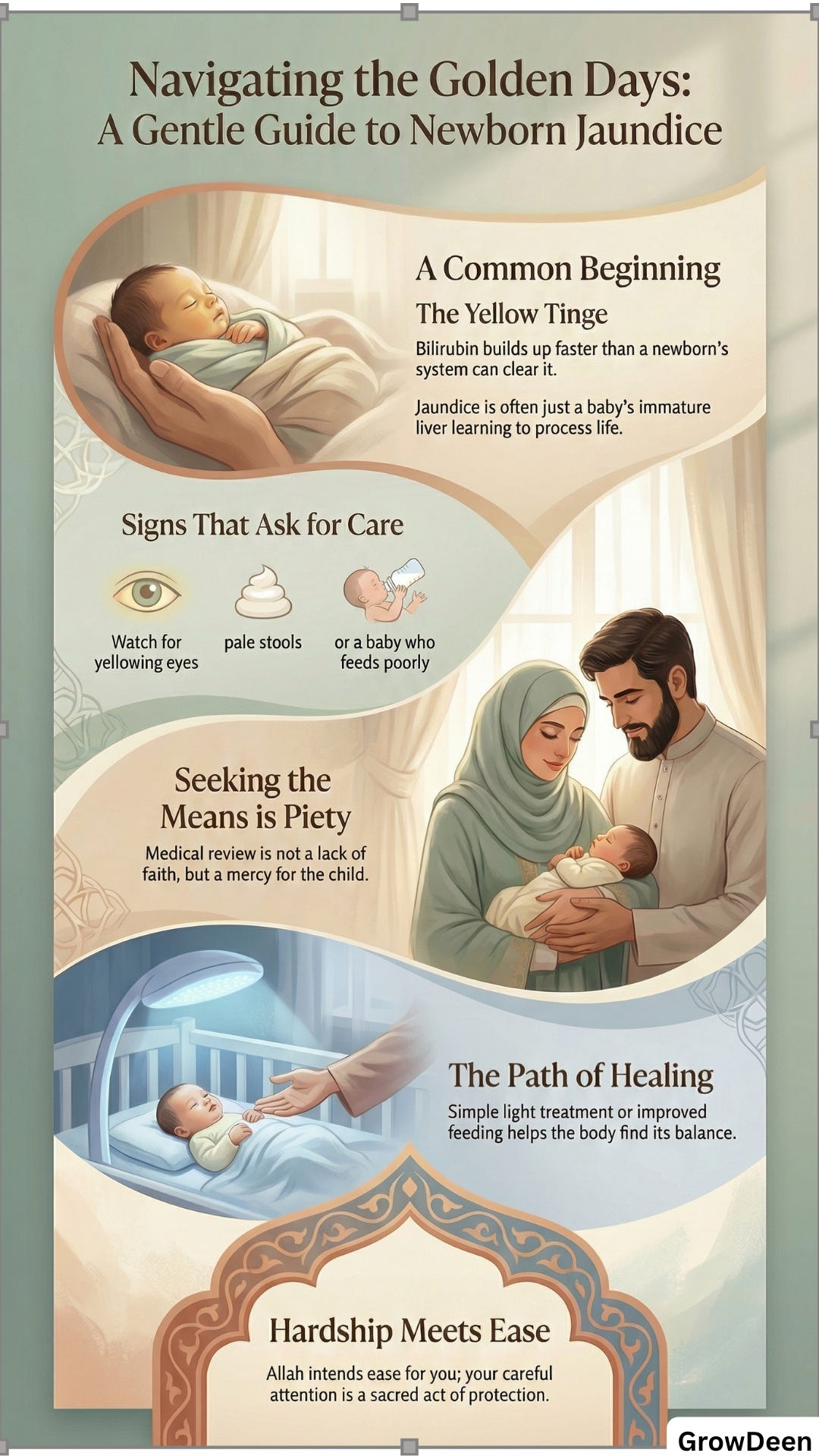
Jaundice in a newborn happens when bilirubin builds up in the blood faster than the baby can clear it. Bilirubin is produced when old red blood cells break down. Usually the liver processes it, mixes it into bile, and the body gets rid of it through the gut. But in the first days and weeks of life, that whole system is still immature, and several things can interrupt the process, so bilirubin rises and the skin and eyes begin to look yellow. [2] [3] [5] [8] [9]
When yellow is common, but still needs respect
Most newborn jaundice is not dangerous.
That matters to say plainly, because parents often see yellow and imagine the worst.
The commonest form is physiological jaundice. In that case, the baby’s liver is simply still catching up with the work it needs to do. This is very common in term babies and even more common in premature babies, and it usually improves as the liver matures. [3] [5] [6] [8] [9]
But common does not mean ignored. Every newborn with jaundice should still be checked and monitored properly. [3] [6] [7] [8]
Not all jaundice tells the same story
There are several patterns of newborn jaundice, and they do not all mean the same thing.
Breast milk jaundice tends to appear in breastfed babies after the first few days, usually in a baby who otherwise seems well. It is generally not harmful and often settles gradually over the following weeks. [3] [5] [8] [9]
Breastfeeding jaundice is different. That one is tied more to poor intake and dehydration, where the baby is not getting enough milk and bilirubin is not being cleared well. It improves when feeds improve and the baby starts getting enough fluid. [3] [5] [6] [8]
Some jaundice follows the circumstances of birth itself. Delayed cord clamping can increase the number of red blood cells entering the baby’s circulation, which means more red blood cells later need to be broken down, and bilirubin can rise as a result. Bruising after birth interventions can do something similar, because pooled blood from bruised areas breaks down and adds to the bilirubin load. [3] [6] [7] [8]
In many of these babies, close monitoring is enough and the jaundice settles over a week or two.
The causes that should never be brushed aside
More serious causes exist, and they are the ones that should not be missed.
Blood group incompatibility between mother and baby can lead to rapid destruction of the baby’s red blood cells, and bilirubin can rise early, sometimes in the first 24 hours after birth. These babies usually need treatment rather than simple watching. [3] [5] [6] [8]
Biliary atresia is rare, but it matters deeply because delay costs time the baby does not have. In biliary atresia, the small tubes that should carry bile out from the liver are absent, damaged, or blocked. The baby may seem well at first, but if the condition is not recognized early, serious liver disease follows. [3] [5] [8] [9]
The visible signs are not complicated, but they matter. The baby’s skin and the whites of the eyes begin to look yellow. The colour often starts around the face and head, then spreads downward if bilirubin rises further. A baby may also become drowsier than expected or feed poorly. [3] [6] [8]
If the cause is biliary atresia, there can also be pale stools and dark urine. That combination should never be brushed off. [3] [5] [6] [8] [9]
Allah’s mercy is present in careful noticing
This is one of those newborn matters that asks a lot from parents in a very short span of time.
Allah says, “And We have certainly honored the children of Adam.” [10] That honor includes the smallest of them, the ones who cannot tell you where they hurt or why they are not feeding well.
And Allah says, “And We have enjoined upon man goodness to his parents. His mother carried him with hardship and gave birth to him with hardship...” [11]
In those early postpartum days, both mother and baby are in a tender state. That is part of why careful medical attention matters so much.
Islam does not ask people to confuse trust in Allah with neglecting the means. The Prophet ﷺ said, “Allah has not sent down a disease except that He has also sent down its cure.” [12] And he ﷺ said, “There should be neither harming nor reciprocating harm.” [13]
So if a baby needs bilirubin checked, check it. If the baby needs light treatment, accept the treatment. If urgent surgery is needed for biliary atresia, delay is not piety. Preventing harm is part of mercy.
If this kind of gentle, Islamically grounded, practical support helps you feel steadier in real parenting moments, subscribe for free so each new article and life gift reaches you when you need it.
When the baby needs checking, not guessing
A nurse, midwife, or doctor should assess any newborn who looks jaundiced.
Medical review is especially important if the baby is feeding poorly, not gaining enough weight, seems unwell, has pale stools, has dark urine, or simply looks more yellow than before. [3] [6] [7] [8]
Jaundice that appears very early, especially in the first 24 hours after birth, deserves extra concern because that pattern is more likely to point toward a pathological cause. [3] [5] [6] [8]
If the bilirubin level is only mildly raised, the baby may just need observation and repeat checking. But if the level is higher, or the story suggests something more serious, further testing is needed. [3] [5] [6] [8] [9]
Those tests usually begin with measuring bilirubin. Sometimes this is done first with a bilirubinometer placed briefly on the skin. Sometimes a heel prick blood test is needed to get a more accurate reading. If jaundice is pronounced, appears early, lasts too long, or seems unusual, clinicians may do other tests to work out the cause. [3] [5] [6] [8] [9]
The point is not testing for the sake of testing.
It is to know whether this is the ordinary newborn pattern or something that needs quicker action.
Treatment may be simple, or it may need speed
Treatment depends on how high the bilirubin is and why it is rising.
Many babies with physiological jaundice, or jaundice linked to delayed cord clamping or bruising, only need close watching and follow up. [3] [6] [7] [8]
If bilirubin climbs higher, phototherapy is the standard treatment. The baby is placed under a special blue light, which helps break bilirubin down into forms the body can remove more easily. [1] [4] [5] [6] [8] Some babies receive phototherapy in hospital for a couple of days. In selected situations, home phototherapy with a biliblanket may also be used, provided the baby is suitable and follow up is reliable. [1] [4] [6] [7]
Phototherapy is usually well tolerated. A baby may have a mild rash or looser stools for a short time, and some babies need extra feeds because of small fluid losses during treatment. [1] [4] [6] [7]
Breast milk jaundice is usually managed by continuing breastfeeding, not stopping it. [3] [5] [6] [8] Breastfeeding jaundice improves when feeding improves, and sometimes that means practical help from a lactation consultant or another clinician skilled in newborn feeding. [3] [6] [8]
In severe cases, especially with blood type incompatibility driving a dangerous rise in bilirubin, exchange transfusion may be needed. That is when the baby’s blood is gradually replaced with compatible fresh blood. [3] [4] [5] [6] [8]
If severe jaundice is left untreated, bilirubin can injure the brain. This is one of the reasons newborn jaundice, though often benign, is never something to guess your way through. [3] [5] [6] [8] [9]

Even here, Allah writes ease beside hardship
Only one major form of newborn jaundice is clearly preventable in a direct way: jaundice linked to certain blood group incompatibilities in future pregnancies. If clinicians identify that risk, an anti D injection after delivery can reduce complications later on. [3] [5] [6] [8] [9]
Not every type of jaundice can be prevented.
But early recognition still changes outcomes.
A yellow baby does not always mean danger. But it always means pay attention.
And for the parent walking through the hard nights of uncertainty, Allah says, “Allah intends for you ease and does not intend for you hardship.” [10]
And He says, “Indeed, with hardship comes ease. Indeed, with hardship comes ease.” [11]
Those verses do not erase the fear.
But they do steady the heart inside it.
GIFTS FOR YOU, DEAR PARENT
If you’ve reached this part of the page, it tells me something meaningful about you.
You weren’t just skimming or passing time. You stayed because something here felt relevant to your real life.
Because you care.
Because you want to do things with more awareness.
Because you’re trying, even when it feels overwhelming.
That is not small.
So I didn’t want this article to remain just words on a page. I wanted it to gently step into your daily life in practical ways. That’s why we prepared these Life Gifts for you.
Not as extras.
Not as decorations.
But as simple tools to help you hold onto what mattered most in what you just read.
Here’s what you’ll find inside:
Gentle Understanding Card
A clear and simplified summary of the core concept from this article, so you can revisit the main idea anytime without rereading everything.
Heartfelt Dua Card
A carefully chosen dua connected to this stage of life, because we know that real strength and ease ultimately come from Allah’s help.
Gentle Actions Card
Practical examples to help you translate knowledge into action, so what you learned becomes part of your daily rhythm.
Gentle Reminders Card
Short, steady reminders drawn from the key points, designed to be printed or saved and placed somewhere you’ll see often.
These were designed slowly and thoughtfully, with time, care, and sincere dua. We created them because we genuinely want to walk alongside you, not just through one article, but through every stage of this lifelong journey.
If these gifts support you even in a small way, I would love for you to continue receiving them.
Subscribe so that each new Gift arrives directly in your inbox whenever we release the next stage. That way, you won’t miss the tools designed to support you right where you are.
May Allah place barakah in your effort, accept your intention, and make this path easier and more rewarding than it feels right now.
Please share it with a family/friend who may benefit from this knowledge.
What is one moment with your child that feels hardest lately, and what kind of support would make it feel lighter?
Subscribe for free to keep receiving gentle, research rooted, Islamically grounded support for the real moments of parenting.
What part of newborn jaundice feels most worrying or unclear to you right now?
References
[1] Anderson, C.M., Kandasamy, Y., & Kilcullen, M. (2022). The efficacy of home phototherapy for physiological and non-physiological neonatal jaundice: A systematic review. Journal of Neonatal Nursing, 28(5), 312-326.
[2] Cohen, R.S., Wong, R.J., & Stevenson, D.K. (2010). Understanding neonatal jaundice: A perspective on causation. Pediatric Neonatology, 51(3), 143-148.
[3] Harding, K., Mason, D.S., & Efron, D. (Eds). (2020). Paediatric handbook (10th edn). Wiley-Blackwell.
[4] Maisels, M.J., & McDonagh, A.F. (2008). Phototherapy for neonatal jaundice. New England Journal of Medicine, 358(9), 920-928.
[5] Moerschel, S.K., Cianciaruso, L.B., & Tracy, L.R. (2008). A practical approach to neonatal jaundice. American Family Physician, 77(9), 1255-1262.
[6] The Royal Children’s Hospital (RCH). (2020). Clinical practice guidelines: Jaundice in early infancy.
[7] Safer Care Victoria (SCV). (2014). Jaundice in neonates.
[8] Shaughnessy, E.E., & Goyal, N.K. (2024). Jaundice and hyperbilirubinemia in the newborn. In R. Kliegman & J. St Geme (Eds), Nelson textbook of pediatrics (22nd edn, Chapter 137). Elsevier.
[9] Smith, D. (2022). The newborn infant. In M. Bunk, W. Hay, M. Levin, R. Deterding & M. Abzug (Eds), Current diagnosis & treatment: Pediatrics (26th edn, Chapter 2). McGraw-Hill Education.
[10] Qur’an, Surah Al-Isra 17:70
[11] Qur’an, Surah Al-Ahqaf 46:15
[12] Sahih al-Bukhari, Hadith 5678
[13] Sunan Ibn Majah, Hadith 2340, Hasan