
What Parents Need to Know Before Trusting a Temperature Reading
How to Take a Child’s Temperature Without Letting Panic Lead

Free gift for you! A practical companion resource is waiting for you near the end of this article to help you remember, apply, and benefit from what you read.
Don’t forget to download!
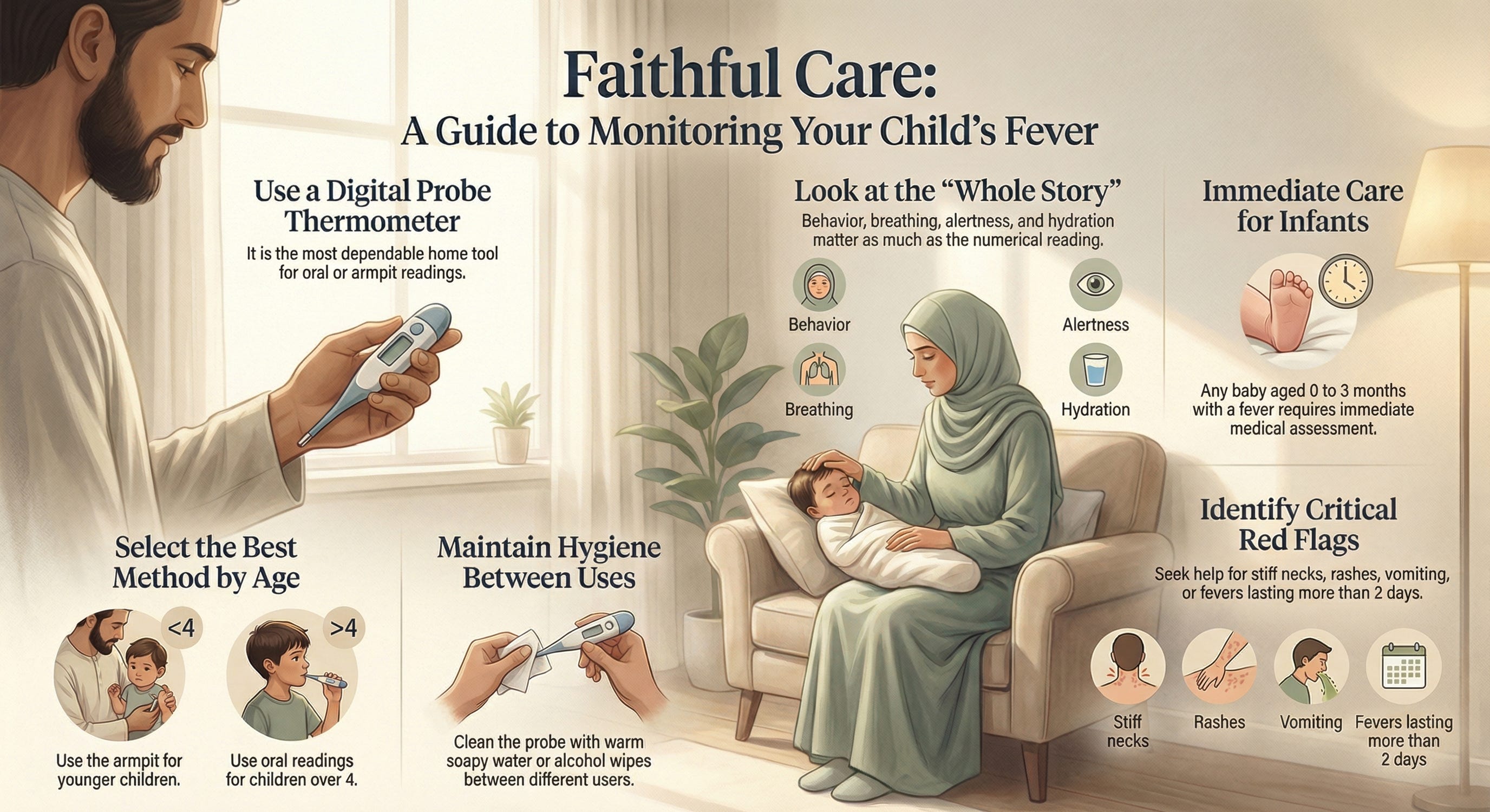
The most dependable way to check a child’s temperature at home is with a digital oral or armpit thermometer, but the child’s overall condition matters more than the number alone when deciding whether urgent help is needed.
When a child seems unwell, most parents do the same thing first.
They reach for the forehead.
It is instinctive. A warm face. Heavy eyelids. More crying than usual. A child who does not want to drink, or keeps vomiting, or just looks unlike themselves. In those moments, the question of fever arrives quickly.
But a hand on the skin cannot tell you enough.
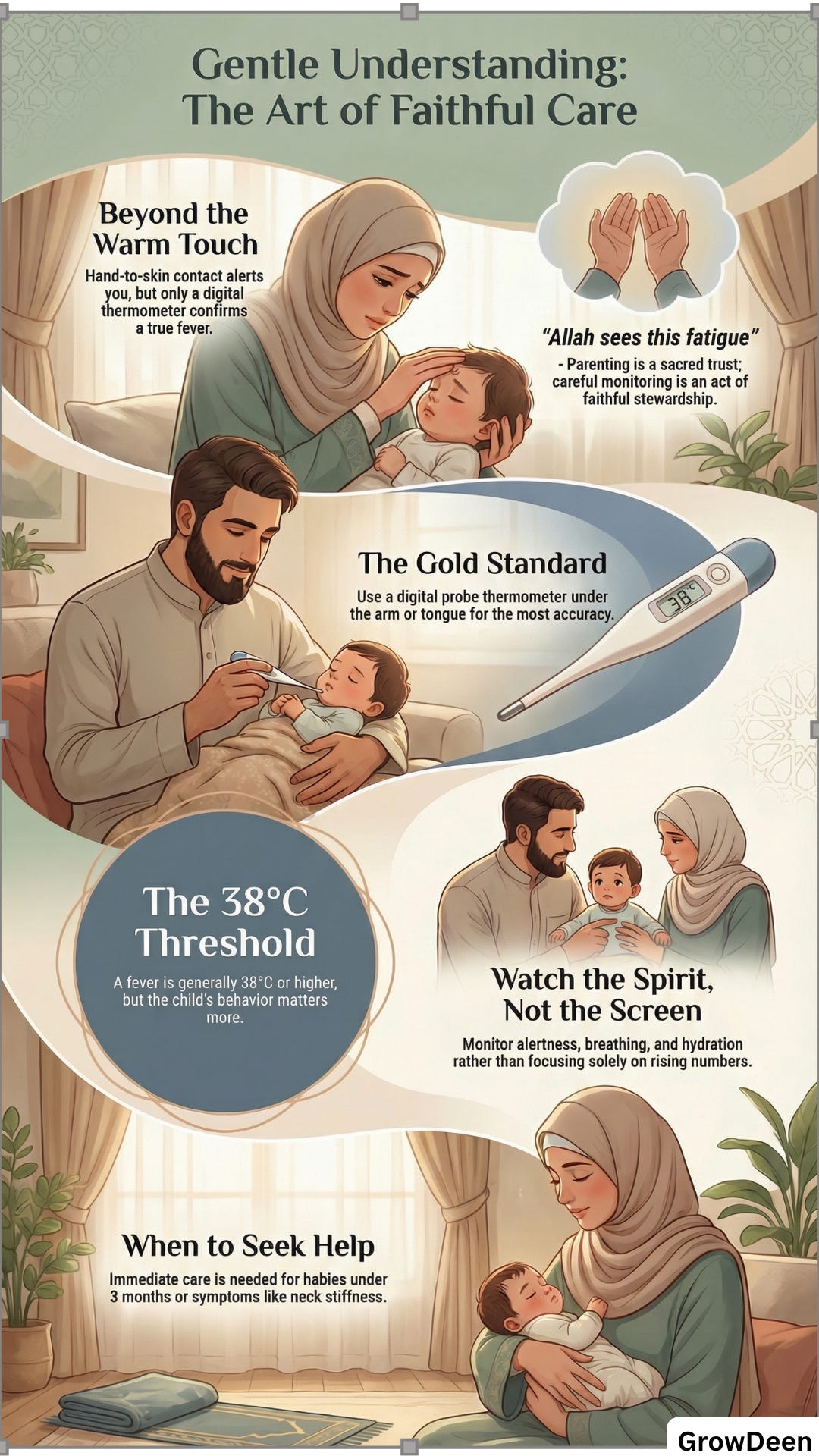
It can alert you. It cannot confirm it. Touching the skin is not a reliable way to tell whether there is truly a fever, which is why using a thermometer is the better path when you want a more accurate answer. [2] [4] [5] [7] [8]
When touching their forehead is not enough
In children, the average body temperature is around 37°C, and a fever generally means the temperature is above 38°C. [2] [4] [7] [8] You can check a child’s temperature at any time, but it makes the most sense when they seem unwell, unusually warm, more sleepy, more irritable, in pain, refusing fluids, or vomiting. [4] [7] [8]
That small shift matters.
Less guessing. More clarity.
And even then, the thermometer is not meant to replace your judgment about the child in front of you. It is there to help you see more clearly, not to carry the whole decision by itself. [1] [4] [7] [8]
The thermometer that is usually worth trusting
The best home tool here is usually a digital probe thermometer. It is simple, widely available, and more dependable than many of the easier looking alternatives. [2] [4] [5] [7] [8] It can be used in the mouth or under the armpit. Of the common home methods, an oral reading with a digital probe is generally the most accurate. [2] [4] [7] [8] An armpit reading is often the easiest, especially in younger children, though it tends to read a little lower because it is measuring from outside the body rather than inside. [4] [7] [8]
If you use the same thermometer for both mouth and armpit, it needs to be cleaned properly between uses. Warm soapy water or an alcohol wipe is suitable. [4] [8]
It sounds small.
But sick child moments are often made of small things that suddenly matter a great deal.
Allah’s care is present in careful little things
In those worried moments, Islam does not ask a parent to become careless just because the task seems ordinary.
Allah says, “Indeed, Allah commands you to render trusts to whom they are due.” [9] One of the quiet trusts in parenting is careful handling of a child’s body, even in very practical things like checking temperature properly and cleaning a thermometer before using it again.
And the Prophet ﷺ said, “Each of you is a shepherd and each of you is responsible for his flock.” [10] That hadith lands gently here. A parent does not need to know everything instantly. But they do need to care enough not to guess lazily when better care is possible.
Not every quick option deserves your trust
This is where many parents get pulled in.
Ear thermometers are quick, and that is exactly why they are tempting. Forehead thermometers feel easy, especially with a child who resists being handled. Fever strips, digital pacifier thermometers, and even phone apps can look convenient too.
But convenient is not the same as dependable.
Digital ear thermometers are not considered reliable enough here and are not recommended. [5] [6] Forehead or temporal artery thermometers can be inaccurate and are not recommended as the main method either. [3] [5] [6] Pacifier thermometers, fever strips, smartphone apps, and similar shortcuts are not dependable enough for assessing a child’s temperature. [4] [5] [8] Mercury thermometers bring another problem altogether. If they break, they can poison a child, so replacing them with a safer digital option is the better path. [2] [4] [8]
A digital probe may not look impressive.
Still, it is usually the wiser choice.
How to do it without turning the moment into a struggle
If you are taking an oral temperature, place the thermometer well under one side of the child’s tongue. The child should hold it in place with their lips, not bite it, and breathe through the nose while waiting for the beep. If they have just had a hot or cold drink, wait 5 minutes first, otherwise the reading may mislead you. [4] [7] [8] Oral temperatures are generally more suitable for children older than 4 years, because younger children often cannot cooperate well enough for a dependable result. [4] [7] And if the child has a blocked nose and cannot comfortably keep the mouth closed, the armpit is the more sensible option. [4] [8]
For an armpit temperature, place the thermometer directly against the skin, not over clothing. Then close the child’s arm over it and hold the elbow gently against the body until the thermometer beeps. [4] [7] [8] This is usually the easiest method in younger children, and sometimes ease matters because a struggling child can make any reading harder to trust.
A digital probe thermometer can also be used rectally, but that is not recommended here. It is uncomfortable and can injure the lining of the rectum. [2] [4] [8]
If this kind of gentle, practical, Islamically grounded support helps you think more clearly in stressful parenting moments, subscribe for free so each new article and life gift reaches you right when you need it.
The number is never the whole story
This is one of the hardest things for parents to hold onto when worry rises.
The number matters, yes. But not in isolation.
A child’s temperature can rise and fall during illness. It can also be affected by when they last had medicine. The more important question is often how the child is looking and behaving overall. [1] [4] [7] [8] Breathing, alertness, drinking, pain, rash, stiffness, and the child’s overall change matter just as much as the reading itself.
Some children need urgent medical attention much sooner than others. If a baby aged 0 to 3 months has a fever, they need immediate medical assessment. The same is true for a child of any age with a weak immune system who develops fever. [1] [4] [7] [8] For children older than 3 months, medical review is needed if the fever lasts 2 days or more, or if the child has trouble breathing, seems drowsy, refuses to drink, passes urine less often, shows dehydration, has a stiff neck, headache, light sensitivity, vomiting, rash, a febrile seizure, or pain that is not improving with suitable medicine. [1] [4] [7] [8] And there is another category parents often feel before they can explain it well: the child just does not seem right, or seems to be getting worse. That matters too. [1] [4] [7] [8]
If those symptoms are severe, or the child worsens quickly, emergency care is needed straight away. [1] [4] [7] [8]
Wisdom is not knowing everything yourself
Sometimes the thermometer is the easy part.
The harder part is knowing what to do with the reading once you have it.
Allah says, “Do not pursue that of which you have no knowledge.” [12] If you are unsure how to use the thermometer, not confident the reading is right, or unsure whether the child’s symptoms are serious, it is better to ask a doctor, nurse, or pharmacist than to carry on with shaky guesses.
And Allah says, “Allah does not burden a soul beyond that it can bear.” [13] In a long night with a sick child, that reminder softens the heart. You do the careful thing in front of you. You measure. You observe. You seek help when it is needed. That is faithful care.
The Prophet ﷺ also said, “Allah is gentle and loves gentleness in all matters.” [11] Responsibility and gentleness belong together here. One keeps you from brushing aside warning signs. The other keeps panic from taking over the room.
GIFTS FOR YOU, DEAR PARENT
If you’ve reached this part of the page, it tells me something meaningful about you.
You weren’t just skimming or passing time. You stayed because something here felt relevant to your real life.
Because you care.
Because you want to do things with more awareness.
Because you’re trying, even when it feels overwhelming.
That is not small.
So I didn’t want this article to remain just words on a page. I wanted it to gently step into your daily life in practical ways. That’s why we prepared these Life Gifts for you.
Not as extras.
Not as decorations.
But as simple tools to help you hold onto what mattered most in what you just read.
Here’s what you’ll find inside:
Gentle Understanding Card
A clear and simplified summary of the core concept from this article, so you can revisit the main idea anytime without rereading everything.
Heartfelt Dua Card
A carefully chosen dua connected to this stage of life, because we know that real strength and ease ultimately come from Allah’s help.
Gentle Actions Card
Practical examples to help you translate knowledge into action, so what you learned becomes part of your daily rhythm.
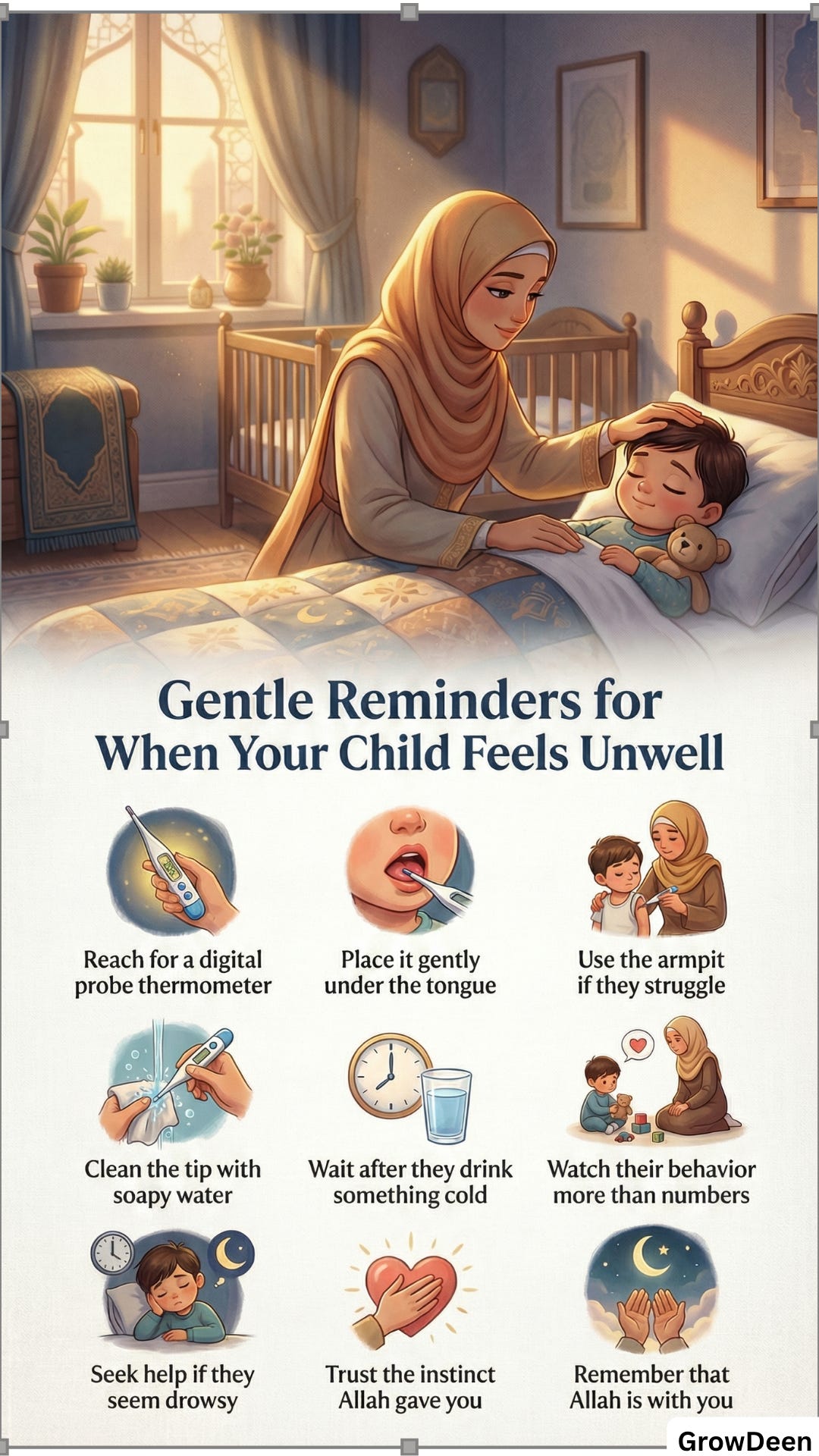
Gentle Reminders Card
Short, steady reminders drawn from the key points, designed to be printed or saved and placed somewhere you’ll see often.
These were designed slowly and thoughtfully, with time, care, and sincere dua. We created them because we genuinely want to walk alongside you, not just through one article, but through every stage of this lifelong journey.
If these gifts support you even in a small way, I would love for you to continue receiving them.
Subscribe so that each new Gift arrives directly in your inbox whenever we release the next stage. That way, you won’t miss the tools designed to support you right where you are.
May Allah place barakah in your effort, accept your intention, and make this path easier and more rewarding than it feels right now.
Please share it with a family/friend who may benefit from this knowledge.
What is one moment with your child that feels hardest lately, and what kind of support would make it feel lighter?
Subscribe for free to keep receiving gentle, research rooted, Islamically grounded support for the real moments of parenting.
References
[1] Allen, C.H. (2024). Fever without a source in children 3 to 36 months of age: Evaluation and management. UpToDate.
[2] El-Radhi, A.S.M. (2012). Fever management: Evidence vs current practice. World Journal of Clinical Pediatrics, 1(4), 29-33.
[3] Geijer, H., Udumyan, R., Lohse, G., & Nilsagård, Y. (2016). Temperature measurements with a temporal scanner: Systematic review and meta-analysis. BMJ Open, 6, Article e009509.
[4] National Institute for Health and Care Excellence (NICE). (2019, updated 2021). Fever in under 5s: Assessment and initial management [NG143].
[5] Niven, D.J., Gaudet, J.E., Laupland, K.B., Mrklas, K.J., Roberts, D.J., & Stelfox, H.T. (2015). Accuracy of peripheral thermometers for estimating temperature: A systematic review and meta-analysis. Annals of Internal Medicine, 163(10), 768-777.
[6] Paes, B.F., Vermeulen, K., Brohet, R.M., Van der Ploeg, T., & De Winter, J.P. (2010). Accuracy of tympanic and infrared skin thermometers in children. Archives of Disease in Childhood, 95, 974-978.
[7] Sullivan, J.E., & Farrar, H.C. (2011). Fever and antipyretic use in children. Pediatrics, 127(3), 580-587.
[8] Ward, M.A. (2024). Fever in infants and children: Pathophysiology and management. UpToDate.
[9] Qur’an, Surah An-Nisa 4:58
[10] Sahih al-Bukhari, Hadith 7138; Sahih Muslim, Hadith 1829
[11] Sahih Muslim, Hadith 2593