
What Parents Need to Know About Choking Prevention
The Small Habits That Protect a Child’s Breath

Free gift for you! A practical companion resource is waiting for you near the end of this article to help you remember, apply, and benefit from what you read. Don’t forget to download!
Preventing choking in babies and young children depends on close supervision, safer food preparation, keeping small objects out of reach, and remembering that many choking emergencies happen quietly and fast.
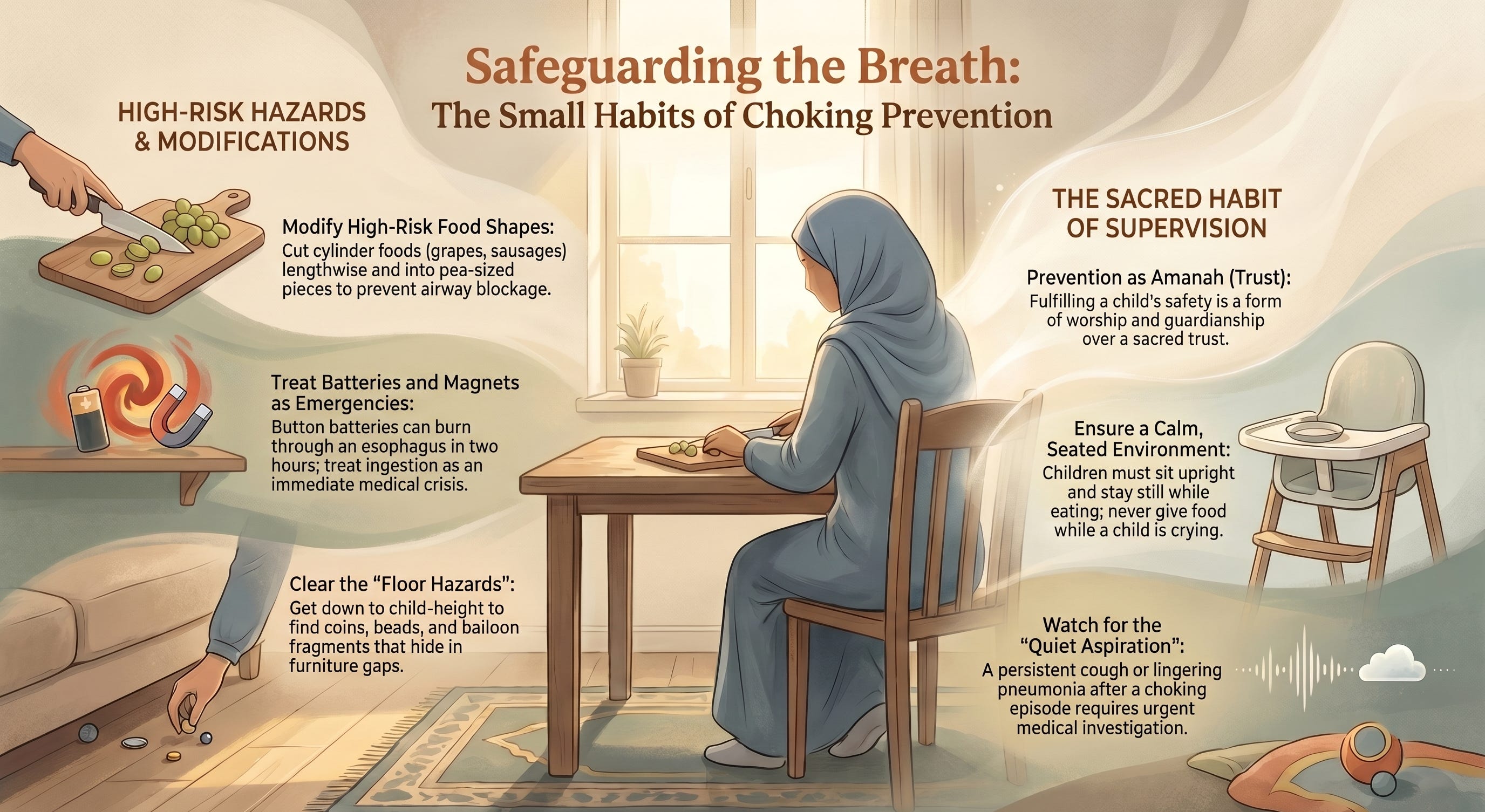
Choking is one of those dangers that hides inside ordinary life.
A grape on a plate.
A coin under the sofa.
A bead from an older child’s craft kit.
A balloon fragment after a birthday.
A shirt button, a battery, a pen cap, a peanut dropped and not noticed.
Children do not separate the world into “food” and “not food” the way adults do. They explore with their mouths, especially in the early years. That is part of childhood. It is also exactly why choking prevention has to be built into daily life, not saved for emergencies. [1][2][5][6][7][8][9][10][17][18]
Their curiosity is normal, and that is why the risk is real
Young children, especially those under four, are at the highest risk.
Their chewing is immature.
Their airways are narrow.
They are still learning how to handle different textures.
And when they are excited, laughing, crying, distracted, running, or trying to eat too quickly, the risk rises further. [1][2][17][18]
The American Academy of Pediatrics notes that children younger than five are especially vulnerable to choking on food and small objects, and the CDC keeps emphasizing the same practical truth: shape, size, and texture matter a great deal in the infant and toddler years. [17][18]
That matters because a lot of parents only think in terms of “safe food” and “unsafe food.” But choking risk is rarely that simple. The same food can be manageable one year and dangerous the year before. The same snack can be safe when modified and unsafe when served carelessly.
A child’s stage matters.
Their setting matters.
Their mood matters.
Your attention matters.
It is not only about what they eat, but how it reaches them
The list of food choking hazards stays wide for a reason.
Hard foods.
Sticky foods.
Round foods.
Stringy foods.
Foods with pits or bones.
Foods with skins or peels.
Hot dogs, grapes, nuts, seeds, popcorn, chunks of meat, raw carrots, cherry tomatoes, berries, fruit stones, chewing gum, and hard lollies all deserve caution. [1][2][5][17][18]
The reason is not that these foods are “bad.”
It is that their shape or texture makes them more likely to block a child’s airway if swallowed the wrong way.
How food is served matters as much as what is served. Until a child can chew well, foods should be mashed, grated, peeled, or cut into pea-sized pieces or smaller. Cylinder-shaped foods like grapes and sausages should be cut lengthwise, then into smaller pieces. Whole nuts and seeds should not be given until at least four years of age. Bones and pits should be removed. Hard fruits and vegetables should be softened, grated, mashed, or peeled. [1][2][5][17][18]
That may feel repetitive when you read it.
Good.
Repetition is part of how safety becomes instinct.
Meals need steadiness more than speed
The setting around eating matters too.
A child should sit down while eating.
Not walk.
Not run.
Not crawl around with food in hand.
Not lie back.
Not wander through the room still chewing.
The source material emphasizes supervised sitting during meals and snacks, and the CDC guidance says children should sit upright in a high chair or other safe place while eating. [1][17][18]
This is one of those things adults get tired of repeating. Sit down. Stay there. Chew first. Slow down. But most choking prevention is not dramatic. It is a collection of very ordinary, very repetitive rules that quietly protect a child.
Crying and eating also do not mix well. Food should not be given while a child is crying because chewing and swallowing safely become harder in that state. [1] So does rushing. So does laughter with a full mouth. So does turning meals into chaos because everyone is tired and trying to get through the evening quickly.
Sometimes the safest meal is simply the calmest one.
The floor is often carrying more danger than the plate
One of the strengths of this topic is that it does not stop at food.
It has to go wider.
Coins, screws, pins, beads, buttons, marbles, magnets, pen caps, toy parts, balloon fragments, batteries, jewelry, stickers, pebbles, and seasonal decorations all belong in the choking conversation. [2][4][6][7][8][9][10]
In younger children, a foreign body is often not exotic at all. It is something from the floor. A sibling’s toy box. A desk drawer. A handbag. A holiday decoration box. A broken pen left on a table edge.
A systematic review of non-food foreign body aspiration found that beads, toy parts, pins, and other small household items remain persistent causes of airway emergencies in children. [6] Another review across different continents found that while the specific patterns vary by setting, the broader problem stays the same: small, accessible objects remain a universal risk. [7]
This is why one of the best habits a parent can develop is simply this: get down to child height and look around.
Check the floor.
Check the gaps under furniture.
Separate older siblings’ small toys from younger children’s spaces.
Choose sturdy toys without loose parts.
Follow age recommendations.
These things sound almost too basic to matter, but basic is exactly where most prevention lives. [1][8][9]
Some objects are not just choking hazards, but emergencies of their own
Button batteries deserve their own warning.
They are not only choking hazards.
They are burn hazards too.
If a child swallows a button battery, the danger is far more severe than a simple blockage. The Royal Children’s Hospital warns that a button battery can burn through a child’s oesophagus in as little as two hours, causing life-threatening injury or death. [8] The U.S. Consumer Product Safety Commission says suspected button battery ingestion requires immediate emergency action, and for some children 12 months or older who swallowed the battery within the past 12 hours, honey may be advised while on the way to urgent care, but emergency assessment must never be delayed. [19]
That means button batteries should be treated with a seriousness that goes beyond ordinary small-object caution. Keep them out of reach. Make sure battery compartments are screwed shut. Do not assume a child could never get into them.
Small magnets belong in the same heavy-warning category. If swallowed, especially more than one, they can attract each other through the bowel and cause severe internal injury. [1] The first moment may look like simple mouthing behavior. The deeper harm can be much worse.
And balloons deserve more seriousness too. Uninflated balloons and broken balloon pieces can mold tightly to the airway and be much harder to remove than many solid objects. [1][9] That is part of why pediatric safety guidance treats them as a real risk, not a party leftover to ignore.
Not every dangerous aspiration ends in obvious panic
This part matters because many people imagine choking only as a loud, unmistakable crisis.
Sometimes it is.
Sometimes it is quieter.
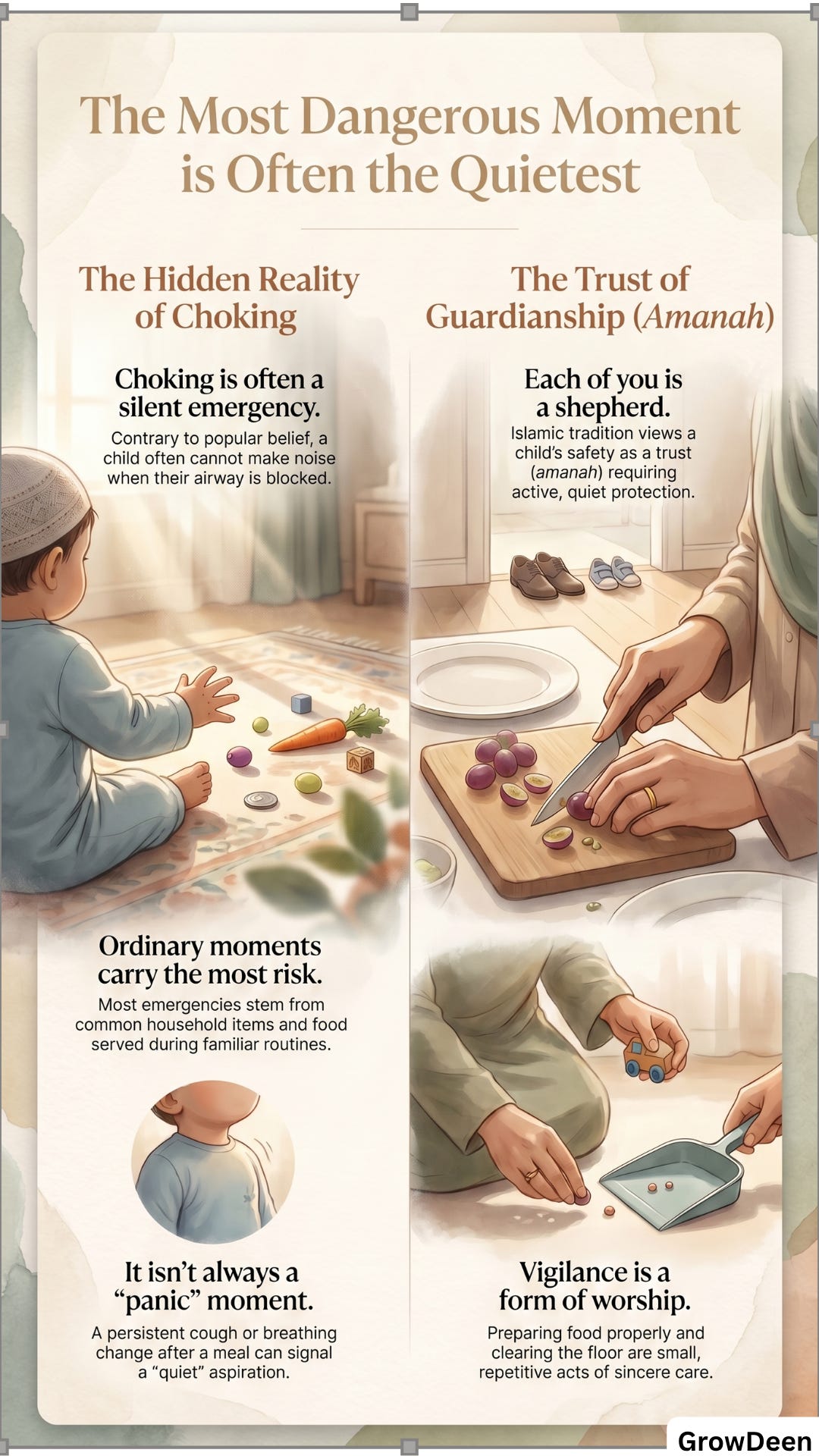
If a child swallows or inhales food, liquid, or an object and it enters the lungs, they may later develop a cough or pneumonia that does not go away. [3][6][7] Not all aspiration events end with an obvious emergency in the moment. Some leave behind quieter symptoms that keep lingering.
That means persistent cough after a choking episode should be taken seriously.
Ongoing breathing changes should be taken seriously.
A pneumonia that does not seem to resolve properly after a suspected choking event should be taken seriously.
Current pediatric airway literature notes that foreign body aspiration can present variably and may require a high index of suspicion, especially when persistent respiratory symptoms follow a choking episode. [3][7]
Sometimes what protects a child is not only responding quickly to the dramatic event.
Sometimes it is refusing to dismiss the quiet aftermath.
If this kind of careful, grounded writing helps you feel steadier in the real work of caring for children, subscribe for free so the next article and companion resources arrive quietly in your inbox.
Allah’s mercy is in the watchfulness too
From an Islamic perspective, choking prevention fits very naturally into the idea of amanah.
A child’s body, breath, and safety are trusts given to adults. Allah says, “Indeed, Allah commands you to render trusts to whom they are due.” [11]
A parent who cuts grapes, checks the floor for small objects, secures a battery compartment, and sits with a child during meals is doing more than “being careful.” They are fulfilling a trust.
Allah also says, “And do not throw yourselves with your own hands into destruction.” [12]
That verse has broad meaning, but it speaks clearly to preventable harm. If something is known to cause danger, ignoring it is not a small matter. And in choking prevention, many risks are already well known. The work is to act on what is known before regret arrives.
The Prophet ﷺ said, “Each of you is a shepherd, and each of you is responsible for his flock.” [13]
That hadith reaches directly into parenting. Choking prevention is full of small acts of guardianship: choosing safer foods, slowing down meals, keeping tiny objects out of reach, refusing to let a child wander and snack, learning first aid instead of hoping you will never need it.
There is mercy in how this is done too. The Prophet ﷺ showed tenderness to children openly. [14] Real mercy is not only what happens after a child chokes and cries. It is the quiet work that prevents the choking in the first place.
And the Prophet ﷺ also said, “Allah is gentle and loves gentleness in all matters.” [15]
Gentleness here includes the atmosphere around eating. Not shoving food into a crying child. Not rushing meals. Not treating young children as if they can manage adult foods before they are ready. Gentleness is not carelessness. It is carefulness without harshness.
And intention matters too. “Actions are only by intentions.” [16]
In Islam, even repetitive, ordinary care can become worship when done sincerely for Allah. A parent who learns choking first aid, prepares food properly, and keeps the home safer for a small child is not just checking a box. They are serving with intention.
In the end, choking prevention is quiet work, and that is exactly why it saves lives
It is not glamorous.
It is not impressive.
It is often repetitive, watchful, and almost invisible.
But that is exactly why it works.
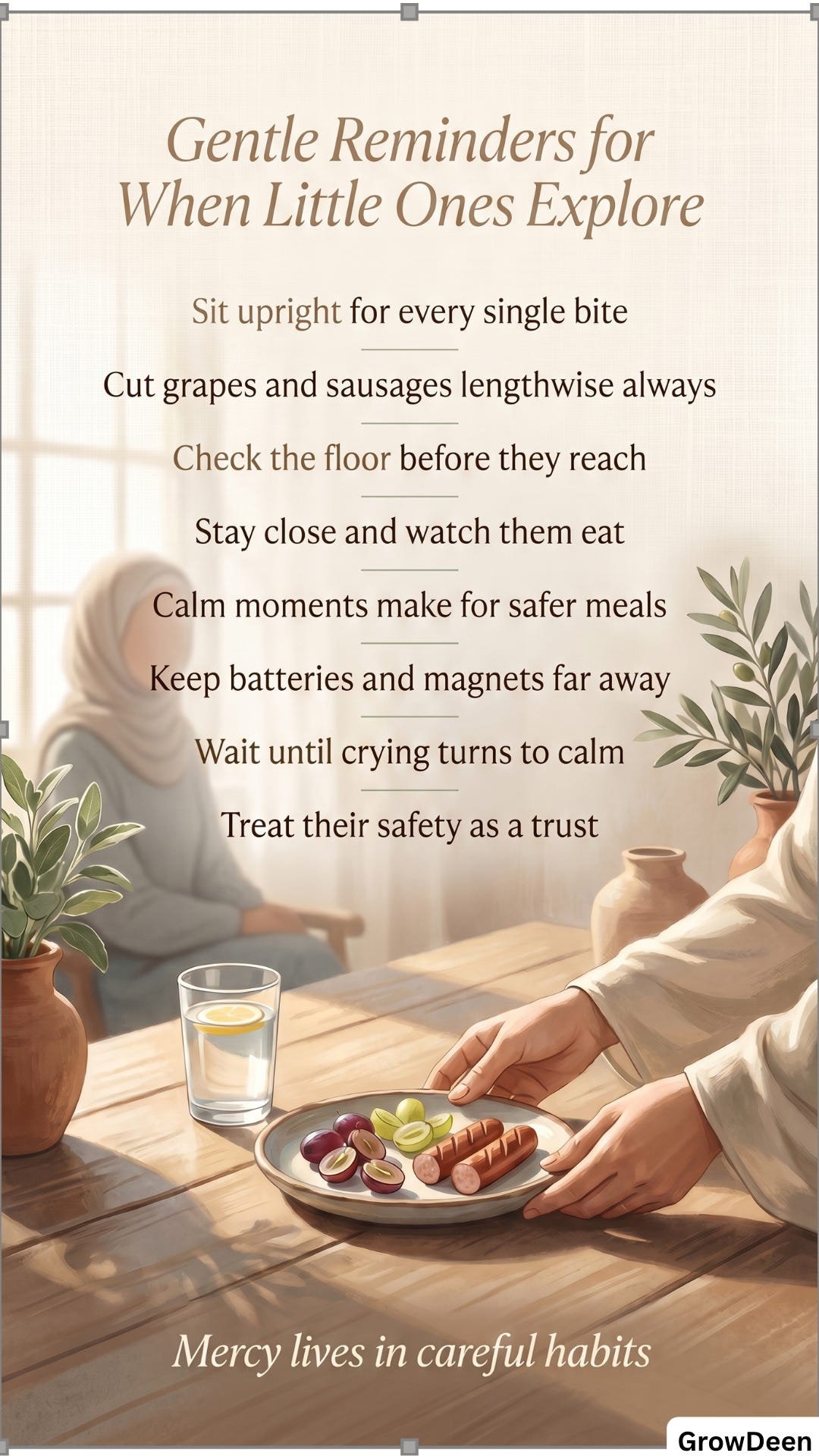
Sit the child down.
Stay with them.
Prepare food for their stage, not for your convenience.
Keep small objects away.
Respect batteries and magnets as major hazards.
Take persistent cough after a choking episode seriously.
These are small habits.
But they protect something enormous.
A child’s breath.
GIFTS FOR YOU, DEAR READER
If you’ve reached this part of the page, that tells me something meaningful about you.
You stayed with this.
You did not just skim it and move on.
And that usually means something here felt close to real life. Maybe it named a fear you have never said out loud. Maybe it sharpened your attention to things that usually disappear into the background. Maybe it simply reminded you how much of caregiving is made up of small decisions that nobody sees, but that matter deeply.
That effort matters.
Your willingness to read carefully, reflect honestly, and let practical guidance sit with you is not small. It says something beautiful about the kind of care you are trying to give.
I did not want this article to remain only words on a page.
I wanted it to stay with you a little longer than that.
To move with you into the kitchen.
Into snack time.
Into toy cleanup.
Into the ordinary places where a child’s safety can be protected by small, steady choices.
So we prepared a small companion pack for you.
Not as decoration.
Not as pressure.
But as a few thoughtful resources designed to help this stay close to daily life. Something you can save, revisit, print, reflect on, or keep nearby when you want the heart of this guidance in a form that is easier to carry into the day.
The hope is simple.
Not just that you read.
But that what you read becomes easier to remember, easier to apply, and easier to return to when you need it.
These companion resources were made slowly, thoughtfully, with care and sincere du’a. They were prepared because some kinds of guidance are too important to leave as a passing impression. They deserve something steadier. Something that helps bridge the gap between knowing and doing.
So please do download the companion pack.
And if it supports you, subscribe for free so future articles and companion resources arrive directly in your inbox. That way, the next time something is published for a real stage of care and responsibility, it reaches you without extra effort from you.
And if someone comes to mind while you are reading, a parent, grandparent, teacher, caregiver, or anyone responsible for small children, share it with them too.
May Allah place barakah in your effort, accept your intention, and make the care you give more protective, more merciful, and more rewarded than it feels in the moment.
What is one everyday choking risk you think adults around children still underestimate most?
Subscribe for free if you’d like future articles and companion resources that help Islamic wisdom and practical care stay close to real life.
References
[1] Denny, S.A., Hodges, N.L., & Smith, G.A. (2015). Choking in the pediatric population
[2] Keil, O., & Schwerk, N. (2023). Foreign body aspiration in children: Being safe and flexible
[3] Kimia, A., Lois, L., Shannon, M., Capraro, A., Mays, D., Johnston, P., Hummel, D., & Shuman, M. (2009). Holiday ornament-related injuries in children
[4] Lorenzoni, G., Hochdorn, A., Beltrame Vriz, G., Francavilla, A., Valentini, R., Baldas, S., Cuestas, G., Rodriguez, H., Gulati, A., Sebastian van As, A.B., & Gregori, D. (2022). Regulatory and educational initiatives to prevent food choking injuries in children: An overview of the current approaches
[5] Lorenzoni, G., Vertuani, M., Basso, V., Rescigno, P., Ocagli, H., & Gregori, D. (2023). Characterization of non-food foreign bodies aspirated by children: A systematic review of the literature
[6] Parvar, S.Y., Sarasyabi, M.S., Moslehi, M.A., Priftis, N.K., Cutrera, R., Chen, M., Lili, Z., Gonuguntla, K.H., Joseph, T., Alajmi, M., Alshammari, S., Singh, V., Parakh, A., Indawati, W., Triasih, R., & Fasseeh, N. (2023). The characteristics of foreign bodies aspirated by children across different continents: A comparative review
[7] The Royal Children’s Hospital (RCH). Safety: Button batteries
[8] The Royal Children’s Hospital (RCH). Safety: Choking, suffocation and strangulation prevention
[9] Wineski, R.E., Panico, E.C., Bailey, L.N., Cardenas, A.M., Grayson, J.W., & Wiatrak, B.J. (2020). Flat sticker as a mobile airway foreign body: A case report and review of the literature
[10] Qur’an, Surah An-Nisa 4:58
[11] Qur’an, Surah Al-Baqarah 2:195
[12] Sahih al-Bukhari 7138
[13] Sahih al-Bukhari 5998
[14] Sahih Muslim 2593
[15] Sahih al-Bukhari 1, Sahih Muslim 1907
[16] American Academy of Pediatrics / HealthyChildren.org. Choking Prevention for Babies & Children, AAP patient education on choking prevention and first aid for infants and children
[17] Centers for Disease Control and Prevention. Choking Hazards | Infant and Toddler Nutrition
[18] U.S. Consumer Product Safety Commission. Button Cell and Coin Battery Information Center