
What Most Parents Don’t Realize About Baby Carriers at First
What Parents Should Know Before Using a Baby Carrier or Sling

Free gift for you! A practical companion resource is waiting for you near the end of this article to help you remember, apply, and benefit from what you read. Don’t forget to download!
Baby carriers, slings, and backpacks can be deeply practical and comforting for families, but they are only truly helpful when they protect a baby’s breathing, support healthy hip positioning, fit securely, and match the child’s stage of development.
There is a certain kind of relief that comes when a baby finally settles against your chest.
The crying softens.
Your hands are free again.
You can move through the kitchen, answer the door, pick something up from the floor, or simply breathe without feeling like the whole day has stopped.
For many parents, a carrier or sling becomes part of ordinary life almost immediately. It feels practical. Tender. Close. A way of keeping a baby near while still moving through the work of the day.
And that closeness can be beautiful.
But closeness on its own is not what makes babywearing safe.
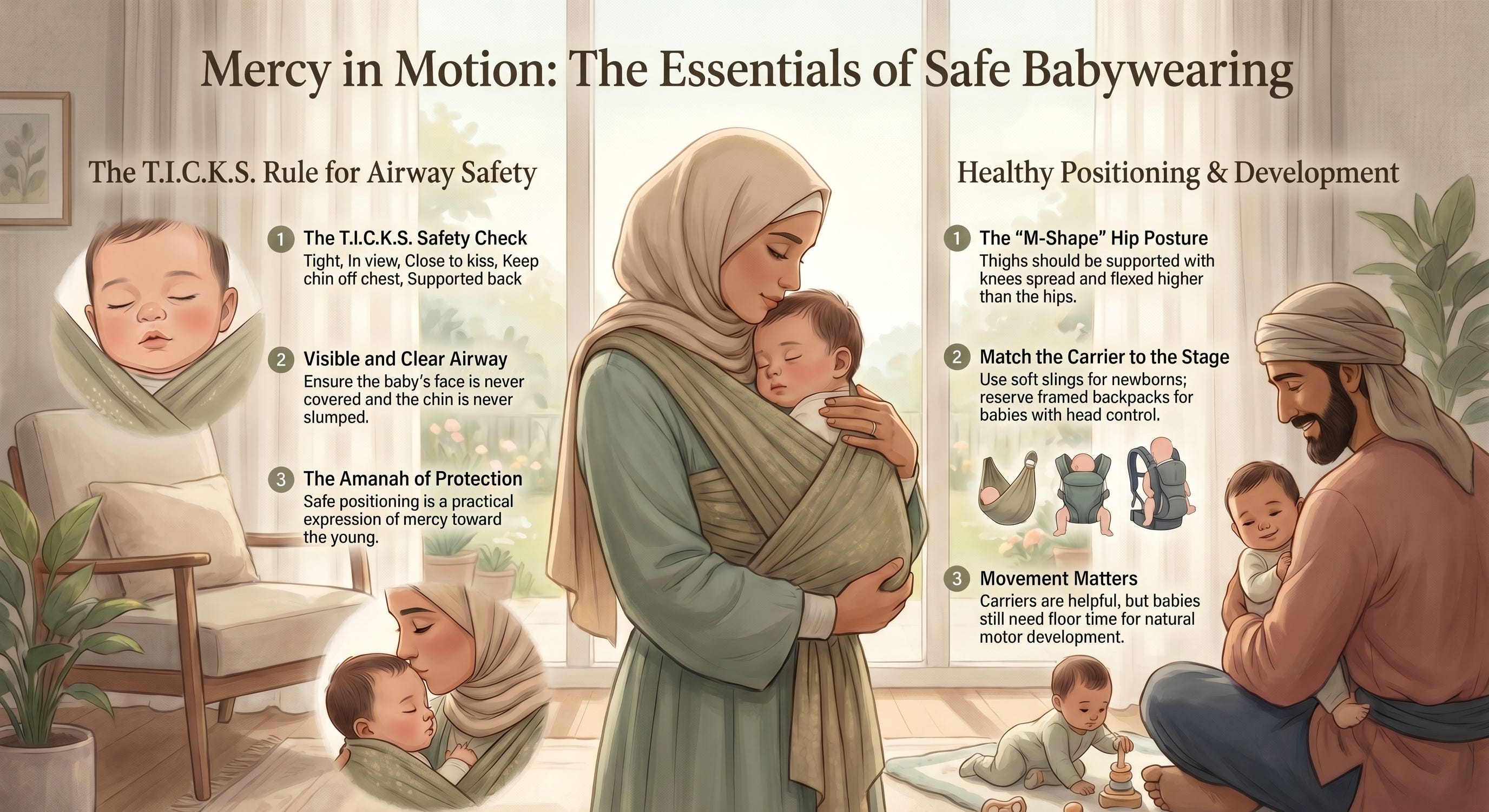
A sling, carrier, or backpack only helps when it supports the baby’s breathing, body position, and stage of development, and when the adult using it understands how to fit it well and use it with care. That is what turns it from a convenience into something genuinely protective. [1][2][3][4][5]
Not every kind of carrier is meant for every stage
This matters more than many people realize at first.
Soft front carriers and slings are usually used with younger babies, especially babies who still need dependable head and neck support. Framed backpacks are different. They are meant for older babies and toddlers who can hold the head steady and sit well on their own. That difference is not small. It is one of the basic safety questions behind the whole category. [1][3][5][13][15]
Babies under four months need particular care here. Framed carriers are not appropriate for that stage because airway and neck risks are still too high. Very young babies are simply more vulnerable in these products. Their control is limited. Their airways are smaller. Their bodies cannot correct poor positioning the way an older child’s body can. [1][3][5][13][15]
That can make parents nervous, and I understand why.
But the answer is not fear.
It is fit. It is timing. It is knowing what belongs to this stage and what does not.
The hips should look supported, not left hanging
This is one of the most important details, and many parents only hear about it vaguely.
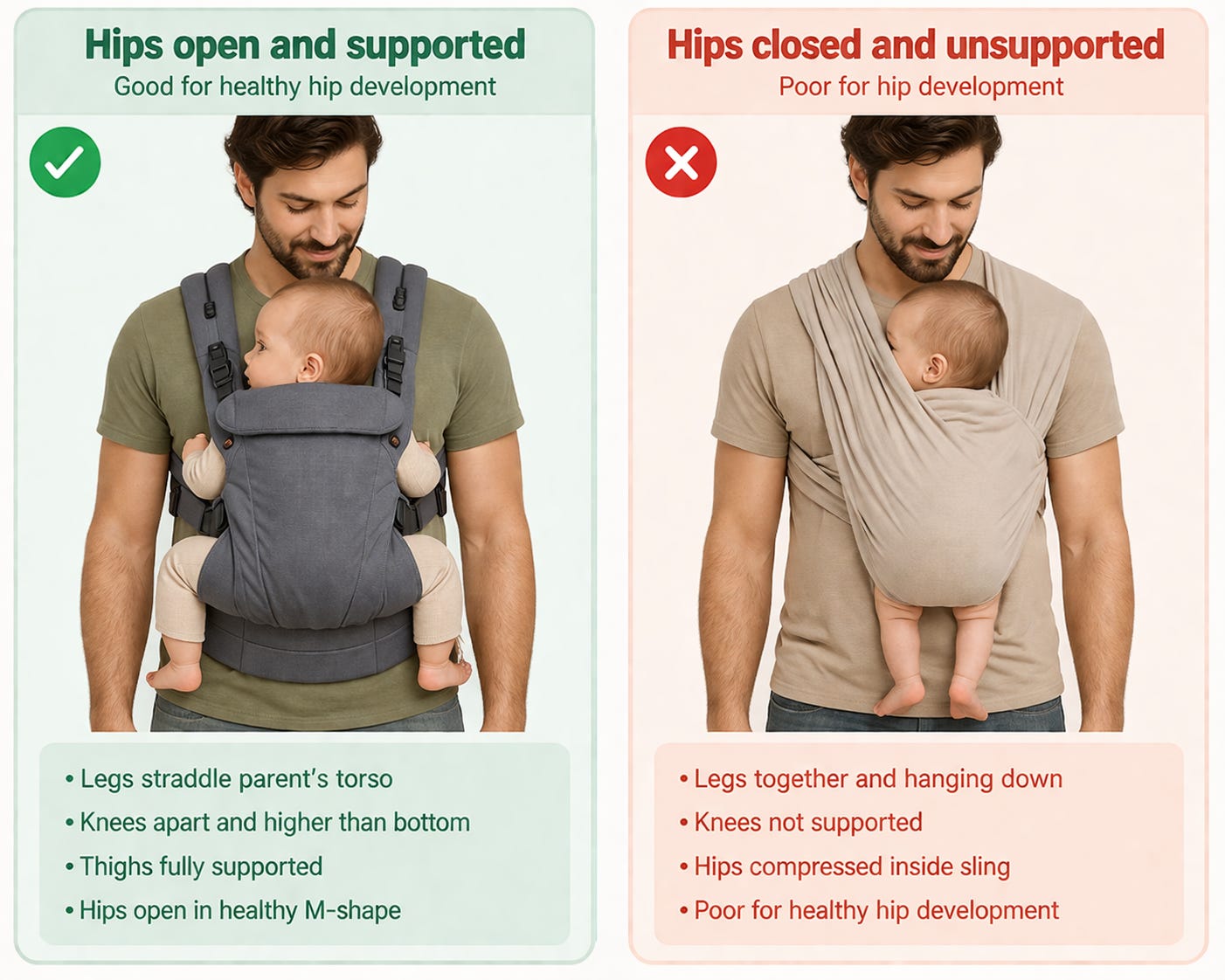
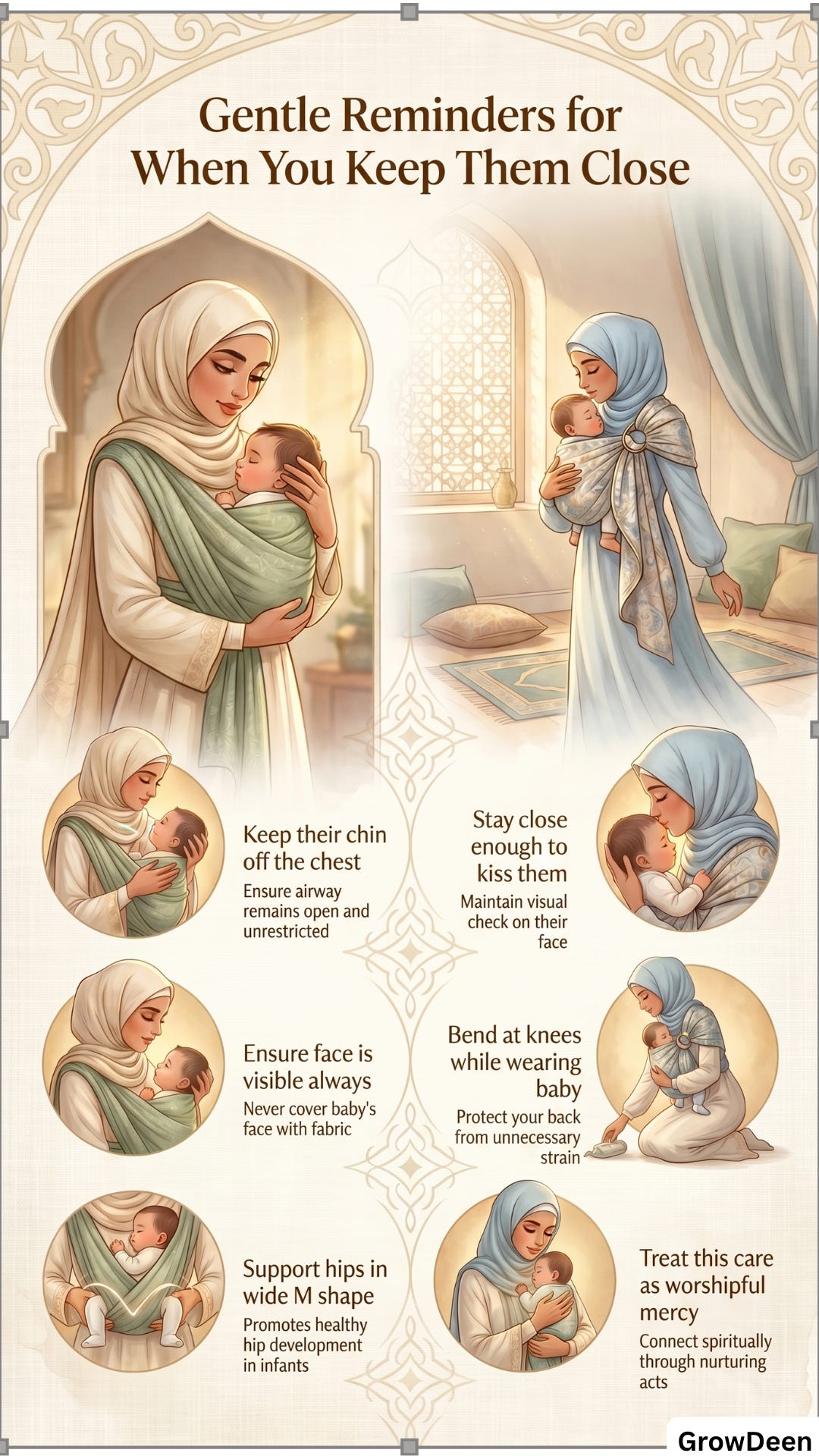
Healthy hip positioning means the baby’s thighs are supported, the knees are spread apart, and the hips rest in a flexed, “M-shaped” posture instead of hanging straight down with the legs pressed together. That is the position that gives more support to developing hips, and it is the position associated with healthier babywearing design. [5][12]
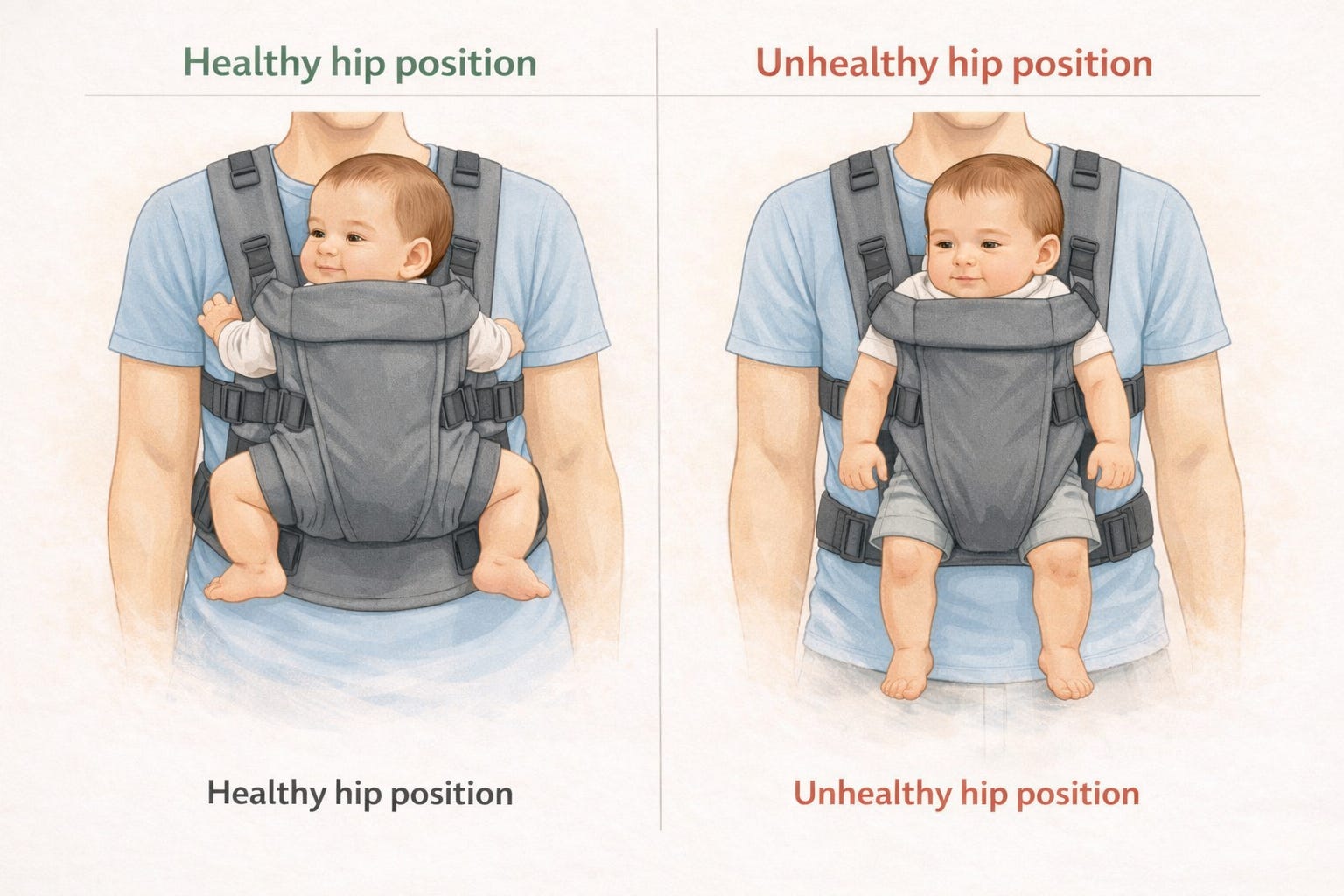
The concern here is developmental dysplasia of the hip. That phrase can sound clinical and far away until you realize the underlying point is simple: the developing hips should be supported well, not left to dangle in a narrow position for long stretches. The International Hip Dysplasia Institute supports babywearing positions that keep the hips flexed and spread rather than extended and held together. [5][12]
That does not mean a brief less-than-perfect moment in a carrier automatically causes damage. Parents do not need to spiral over every small adjustment or imperfect second. The steadier takeaway is this: prefer carriers that support the thighs well, allow the legs to straddle the adult’s body, and avoid extended periods where the baby’s hips are forced into a narrow dangling posture. That is especially protective in younger babies whose hips are still developing. [12]
Breathing comes before everything else
Hip support matters.
Airway safety matters more urgently.
A poor position can become dangerous quickly and quietly, especially in young babies. A baby can suffocate if the face is covered, if loose fabric allows slumping, or if the chin drops onto the chest and narrows the airway. Babies in distress do not always cry loudly or clearly. Sometimes they grow quieter. Sometimes the warning signs are subtle. [1][2][3][4][5][14][15]
That is why the T.I.C.K.S. rule remains so useful. The baby should be:
Tight
In view at all times
Close enough to kiss
Keep chin off the chest
Supported back
This is not just a nice reminder to glance at once and forget. It is a real safety check. Consumer-safety guidance and infant-safety guidance continue to emphasize these same core checks because they protect against the risks that matter most. [1][2][3][4][5][14][15]
The “chin off the chest” point deserves more attention than it usually gets. A baby whose chin folds down can have the airway narrowed without it being obvious to a distracted adult. That is why face visibility matters. That is why upright positioning matters. That is why loose, curled, hidden positioning in slings is not something to be casual about.
The babies who need extra caution are often the smallest ones
Some babies are at higher risk in slings and carriers.
Babies under four months.
Babies born prematurely.
Babies with low birth weight.
Babies who are unwell or medically vulnerable.
These babies require extra care because their airways are more delicate and their ability to lift, reposition, or protect themselves is more limited. Red Nose guidance specifically advises added caution with younger or medically vulnerable infants and recommends professional advice when needed. [3][5][15]
And there are signs parents should take seriously. Distress may show up as grunting, wheezing, rapid breathing, laboured breathing, color change, or unusual fussiness. Those things should not be brushed off as “just one of those baby noises” when a child is in a carrier. A parent does not need to panic at every sound, but they do need permission to stop, check, adjust, and take concerns seriously. [3][5][15]
Sometimes the most protective sentence a parent can tell themselves is this:
I am allowed to pause and recheck.
I am allowed to take the baby out.
I am allowed to stop even if everyone else says it looks fine.
That kind of steadiness protects.
Small mistakes during ordinary moments are where many accidents happen
A lot of parents imagine the main danger is dramatic misuse.
Very often, it isn’t.
Falls and preventable injuries are more likely during the little in-between moments. While putting the baby in. While taking the baby out. While bending too quickly. While walking over uneven ground. While hurrying. While multitasking. [1][4][13][14]
That is why the practical cautions matter so much.
Wear shoes that are easy to walk in.
Bend at the knees rather than folding from the waist.
Hold onto something stable if you need to bend down.
Do not carry hot drinks while wearing a baby in a front carrier or sling.
Do not cook with a baby in a front-worn carrier or sling.
Those things can sound basic on paper. In real life, they are exactly the kinds of details that prevent ordinary household accidents. [1][4][13][14]
Shopping choices matter too. Clear written, visual, or video instructions matter. Durable materials matter. Secure straps and buckles matter. The baby should be able to move the head, arms, and legs freely while the face stays visible and uncovered. The adult’s comfort matters as well. Broad padded shoulder straps and a supportive waist belt help spread the child’s weight more evenly, especially once the baby gets heavier. HealthyChildren.org gives similar guidance on fit, face visibility, and choosing a carrier that actually matches the baby’s age and size. [1][4][13][14]
If this kind of gentle, evidence-based, Islamically grounded support helps you, subscribe for free so new articles arrive in your inbox when they are ready.
Carriers are helpful, but babies still need the floor
This is another point worth keeping in plain sight.
Carriers can be wonderful. They can soothe a child, free a parent’s hands, and make ordinary life much more manageable. But they are not meant to replace tummy time, floor time, stretching, rolling, and the natural movement babies need as they grow. [13]
Babies need closeness.
They also need space.
They need to be held and they need room to move.
Those two things are not in competition with each other. A balanced day can include both. A carrier helps in one part of life. The floor helps in another. Both serve development differently. [13]
There is also one modern caution parents should keep in mind: recalls still happen in this category. The U.S. Consumer Product Safety Commission has continued to issue recall notices for sling carriers sold without compliant restraints or with fall and suffocation hazards. That is a useful reminder to buy from reputable sources, read instructions carefully, and pay attention to recalls or products that seem poorly made. [16]
Allah’s gentleness is present in careful carrying
Babywearing can be seen through the lens of mercy.
Not only convenience.
Not only efficiency.
Mercy.
Keeping a child close while moving through the day can be a tender thing. Feeding, carrying, soothing, settling, adjusting. These are not small acts in Islam. They sit inside the honored labor of caring for the young.
Allah says, “Mothers may breastfeed their children two complete years for whoever wishes to complete the nursing.” [6]
That verse continues with language about fairness and avoiding harm, and it fits this subject beautifully. Infant care is honored, and that means it should not be handled carelessly. Allah also says, “His mother carried him with hardship and gave birth to him with hardship.” [7]
Carrying a child is effort.
But it is honored effort.
The Prophet ﷺ said, “He is not one of us who does not show mercy to our young.” [8]
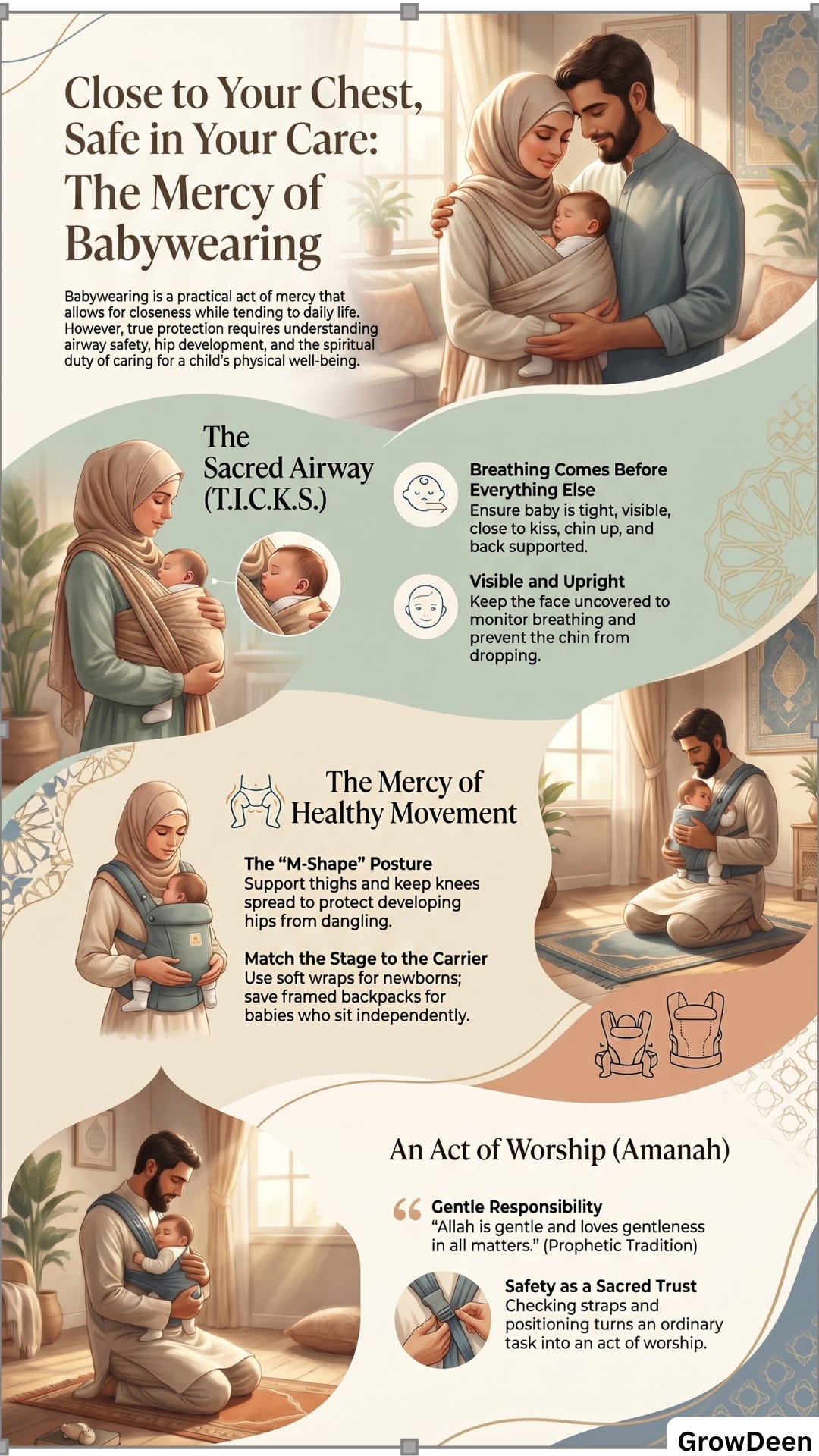
Mercy here is not vague softness. It includes learning how to keep a baby’s airway clear. It includes choosing a supportive fit instead of a fashionable one. It includes slowing down to adjust straps properly. It includes refusing unsafe shortcuts even on busy days.
And the Prophet ﷺ said, “Allah is gentle and loves gentleness in all matters.” [9]
That gentleness appears in the little checks.
The baby’s face is visible.
The chin is lifted.
The back is supported.
The straps are secure.
The adult slows down instead of rushing.
That is gentleness made practical.
And then there is intention. “Actions are only by intentions,” the Prophet ﷺ taught. [10]
A parent fastening a carrier carefully, checking that the baby is upright and visible, and using the means Allah has made available to protect a child can turn an ordinary task into an act of worship. The child’s body is an amanah. Safety belongs to that trust. Allah says, “And do not throw yourselves with your own hands into destruction.” [11]
It is a broad warning, but it speaks clearly here too. Avoid preventable harm. Especially where the vulnerable are concerned.
What matters most is not the product, but the knowledge behind it
So the real question is not whether carriers are good or bad by themselves.
They can be very practical. Very comforting. Very helpful.
The real question is whether they are used with knowledge.
A good carrier supports the baby’s body, keeps the airway clear, fits the child’s stage, and stays comfortable enough for the adult to use without strain. A poor fit, loose fabric, unsafe positioning, overheating, or careless multitasking can turn the same tool into a risk. That is the line parents need to see clearly. [1][2][3][4][5][12][13][14][15]
If you are ever unsure, slow down.
Check the face.
Check the chin.
Check the hips.
Check the straps.
Check whether this really matches your baby’s age and stage.
That kind of carefulness is not overthinking. It is love with knowledge inside it.
GIFTS FOR YOU, DEAR PARENT
If you’ve reached this part of the page, it tells me something meaningful about you.
You weren’t just skimming or passing time. You stayed because something here felt relevant to your real life.
Because you care.
Because you want to do things with more awareness.
Because you’re trying, even when it feels overwhelming.
That is not small.
So I didn’t want this article to remain just words on a page. I wanted it to gently step into your daily life in practical ways. That’s why we prepared these Life Gifts for you.
Not as extras.
Not as decorations.
But as simple tools to help you hold onto what mattered most in what you just read.
Here’s what you’ll find inside:
Gentle Understanding Card
A clear and simplified summary of the core concept from this article, so you can revisit the main idea anytime without rereading everything.
Heartfelt Dua Card
A carefully chosen dua connected to this stage of life, because we know that real strength and ease ultimately come from Allah’s help.
Gentle Actions Card
Practical examples to help you translate knowledge into action, so what you learned becomes part of your daily rhythm.
Gentle Reminders Card
Short, steady reminders drawn from the key points, designed to be printed or saved and placed somewhere you’ll see often.
These were designed slowly and thoughtfully, with time, care, and sincere dua. We created them because we genuinely want to walk alongside you, not just through one article, but through every stage of this lifelong journey.
If these gifts support you even in a small way, I would love for you to continue receiving them.
Subscribe so that each new Gift arrives directly in your inbox whenever we release the next stage. That way, you won’t miss the tools designed to support you right where you are.
May Allah place barakah in your effort, accept your intention, and make this path easier and more rewarding than it feels right now.
Please share it with a family/friend who may benefit from this knowledge.
What is one moment with your child that feels hardest lately, and what kind of support would make it feel lighter?
You do not need to be frightened of babywearing to be careful with it.
You do not need to reject carriers to respect their risks.
You only need enough knowledge to use them with steadiness, gentleness, and attention.
May Allah place barakah in the work of your hands, protect the child you carry, and make your care a source of mercy for both of you. May He give you calm in the small decisions, wisdom in the practical ones, and safety in the ordinary moments that make up family life.
Subscribe for free if you’d like more warm, evidence-based, Islamically grounded support for the real work of raising children.
References
[1] ACCC Product Safety. Baby carriers, wraps and slings guide
[2] Australian Competition & Consumer Commission (ACCC). (2014). What you need to know about: Baby slings
[3] Hubbs-Tait, L., & Peek, G. (2017). Protecting infants and toddlers from positional asphyxia: Car seats and sling carriers
[4] Kidsafe South Australia. Baby slings
[5] Red Nose National Scientific Advisory Group. (2021). Information statement: Slings, baby carriers and backpacks
[6] Qur’an, Surah Al-Baqarah 2:233
[7] Qur’an, Surah Al-Ahqaf 46:15
[8] Jami‘ at-Tirmidhi 1920
[9] Sahih Muslim 2593
[10] Sahih al-Bukhari 1, Sahih Muslim 1907
[11] Qur’an, Surah Al-Baqarah 2:195
[12] International Hip Dysplasia Institute. Baby Wearing, International Hip Dysplasia Institute. Baby Carriers & Related Products
[13] HealthyChildren.org / American Academy of Pediatrics. Baby Carriers: Backpacks, Front Packs & Slings, HealthyChildren.org / American Academy of Pediatrics. Baby-Wearing
[14] ACCC Product Safety. Baby carriers, wraps and slings guide, ACCC Product Safety. Move baby safely
[15] Red Nose Australia. Slings and baby carriers
[16] U.S. Consumer Product Safety Commission. Recent recall notice for sling carriers with infant suffocation and fall hazards