
What If Your Baby’s Earliest Learning Is Happening in Your Arms
Newborn Cognitive Play Begins Long Before Toys Matter

Free gift for you! A practical companion resource is waiting for you near the end of this article to help you remember, apply, and benefit from what you read. Don’t forget to download!
In the first 3 months, newborn cognitive play grows through quiet, loving interaction, helping a baby build early attention, memory, communication, and brain development through simple everyday moments.
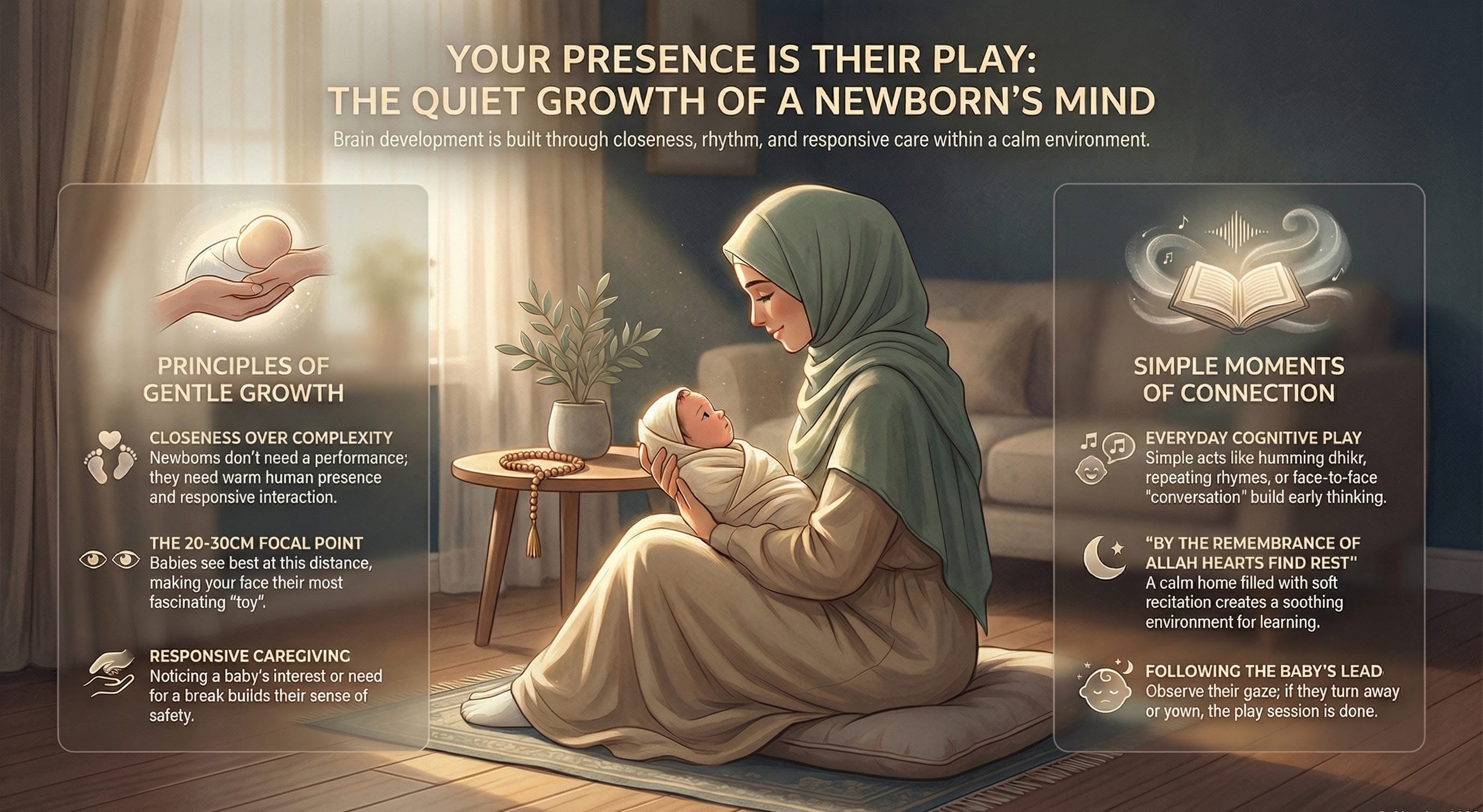
You are holding your baby after a feed, not doing anything especially clever.
Maybe you are just looking at them. Maybe you say their name softly. Maybe you repeat the same little rhyme you have said ten times already. Their eyes rest on your face. Then drift. Then come back. A tiny pause. A small sound. A little movement in the mouth, as if something is beginning.
From the outside, it looks like almost nothing.
But so much is happening.
So much begins in very quiet moments
In the first weeks of life, cognitive play is not loud. It is not complicated. It is not about toys doing impressive things. It is about closeness, rhythm, repetition, and response. When you talk, hold, watch, and answer your baby’s cues, those moments support early thinking, attention, memory, communication, and the first patterns of learning about the world.[1][2][3][4][5][6][8][9][10]
This is one of the loveliest things about the newborn stage.
A baby does not need a performance to begin learning. They need warm human presence.
Your face is already one of your baby’s favourite things to study
A newborn starts learning from the beginning. Your baby begins recognising your voice and becomes deeply interested in your face, especially when you stay close and speak with warmth.[3][4][5][6][7][8][9][13]
And through these repeated interactions, your baby is learning more than sound and sight. They are learning whether the world feels safe. Whether care comes when they need it. Whether they are surrounded by steadiness and love.
Allah says, “And Allah has extracted you from the wombs of your mothers not knowing a thing, and He made for you hearing and vision and hearts that perhaps you would give thanks.”[14]
What a beautiful description of this stage.
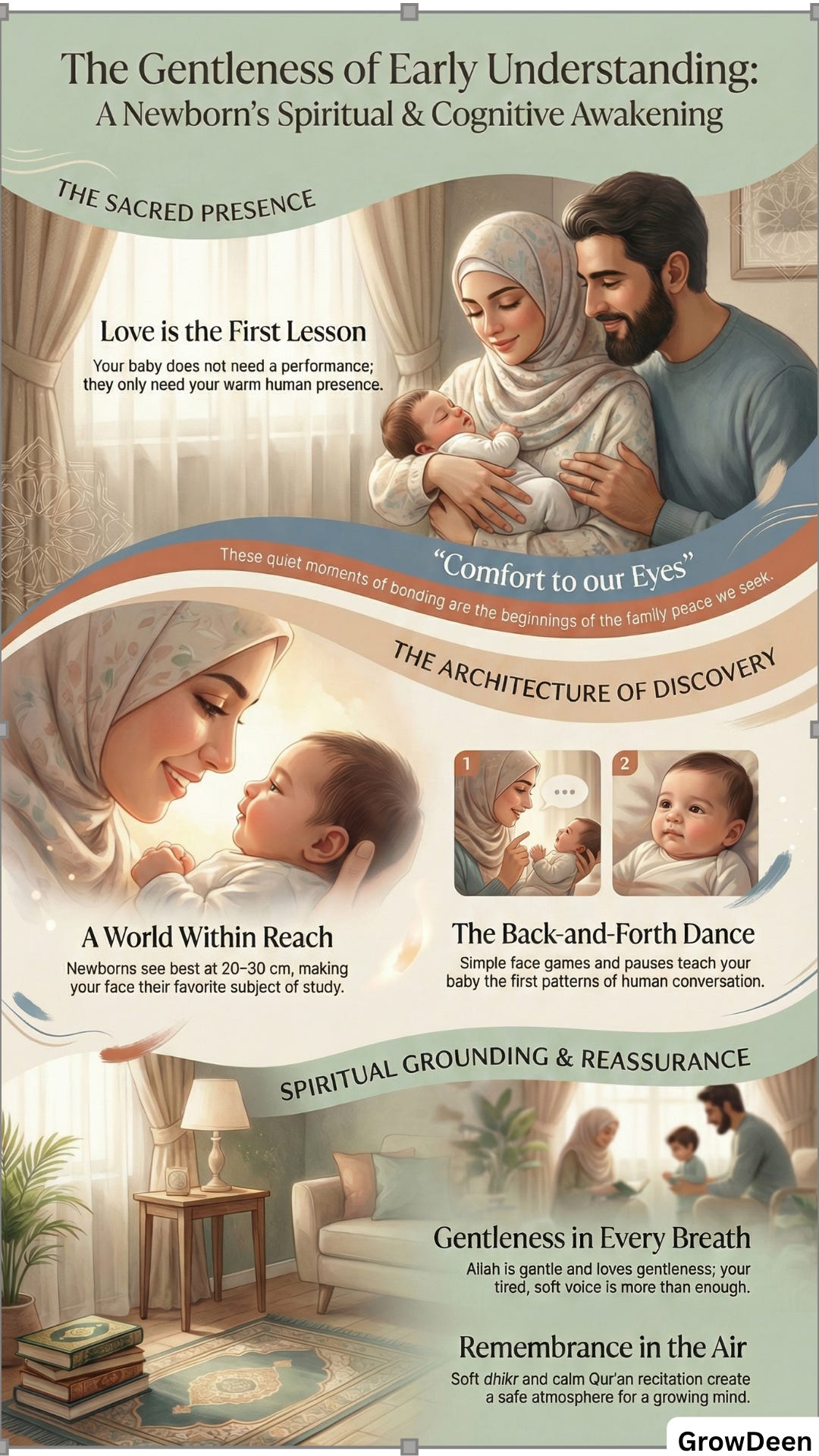
A baby arrives knowing nothing, yet already equipped by Allah with the beginnings of hearing, seeing, receiving, and learning. And Allah teaches believers to ask, “Our Lord, grant us from our spouses and our offspring comfort to our eyes.”[15] These early moments are part of that comfort.
The Mercy of Allah is present in small beginnings
At this age, very simple experiences are full of meaning.
A baby may stare at a shape moving slowly above them, or look at a brightly coloured object, or quietly study the line of your eyebrows while you talk.[5][6][7][12] Newborn vision is still developing, and babies generally see best at around 20 to 30 cm from their face, which is one reason your face during feeding or holding becomes so fascinating to them.[12]
But babies also do not want the whole world at once. Too many people, too many sounds, too much activity can overwhelm them quickly.[5][6][8]
There is mercy in remembering that. A newborn’s mind is growing, but it is growing gently. Not under pressure. Not in a rush.
The gentlest things are often the most powerful
This is why the best cognitive play ideas are often the gentlest ones.
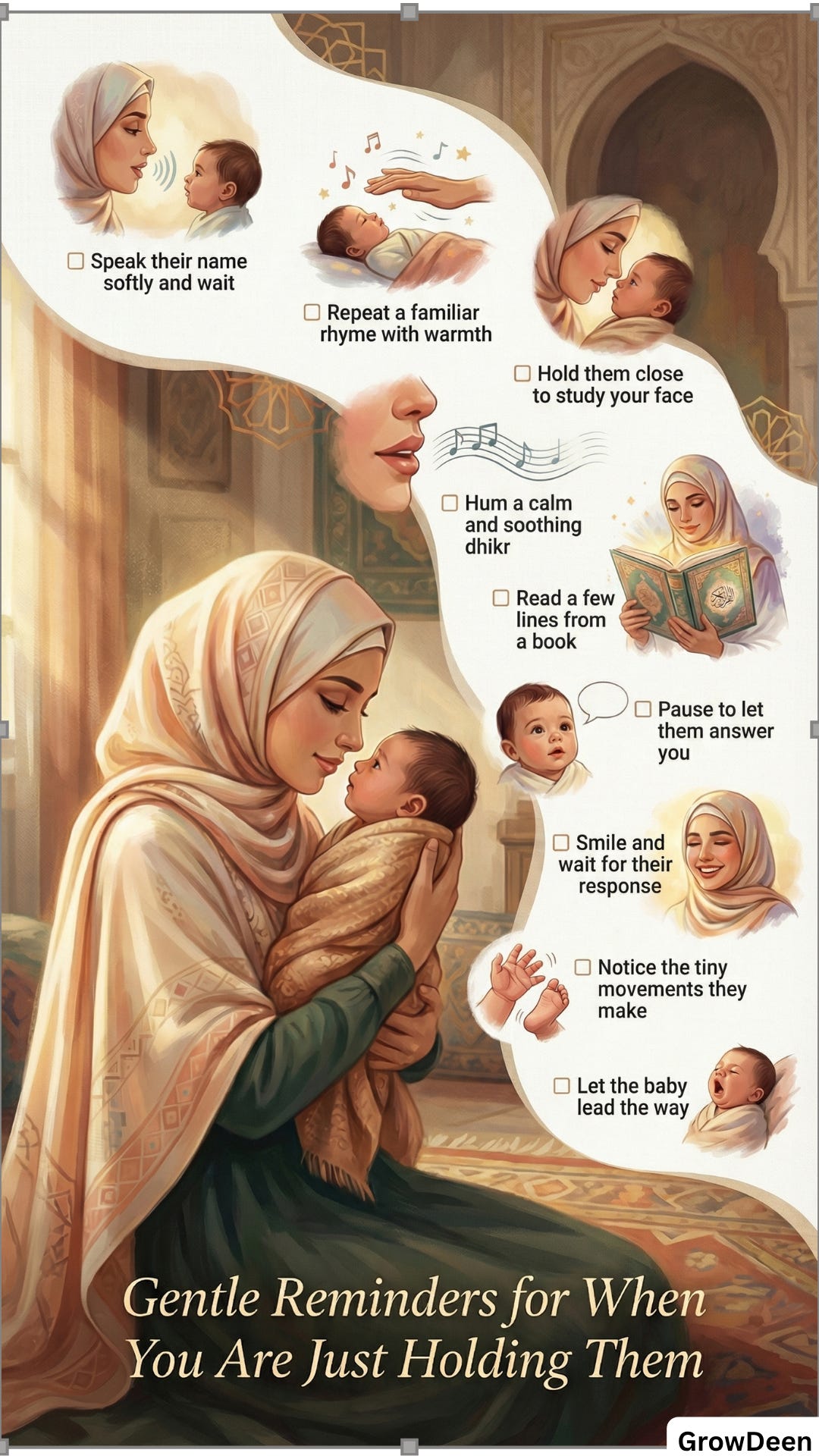
Talk to your baby often. Make eye contact. Read a few lines from a simple book. Repeat the same short rhyme. Tell them what you are doing while dressing them. Pause after you speak, as if they are already part of a conversation.[2][5][6][8][10][11]
In a Muslim home, these moments can also include a calm passage from the Qur’an or soft adhkar hummed in a soothing way. The point is not to turn the moment into a lesson. The point is familiarity. Repetition. A loving voice that feels safe.
Allah says, “Unquestionably, by the remembrance of Allah hearts find rest.”[20]
A newborn does not understand the words yet, but they can still be soothed by the calmness of a home where remembrance lives in the air.
You can also play little face games. Smile and wait. Stick out your tongue. Round your lips. Pause and see what your baby does. Some babies begin trying to copy what they see. That kind of back and forth is one of the earliest forms of shared attention.[1][5][6][7][10][12][13]
If this kind of gentle, Islamically grounded support helps you feel more settled as a parent, subscribe for free so the next article reaches you quietly when you need it most.
Following your baby is part of wisdom too
It is wise to let your baby lead as much as possible.
If they seem fascinated by the feel of a soft toy, stay there. If they are studying your face, keep talking. If they turn away, fuss, yawn, or seem tired, it may be time to stop and try again later.[5][8][9][10][11]
Responsive caregiving is not only about calming distress. It is also about noticing interest and building from there.
The Prophet ﷺ showed this tender kind of attention with children. When he spoke playfully to Abu ‘Umayr about his little bird, it showed a beautiful way of entering a child’s world with warmth and presence.[17] And he said, “He is not one of us who does not show mercy to our young.”[18]
Mercy in newborn play includes slowing down enough to notice what the baby is actually ready for.
You do not need to force anything open
There is a lot for a newborn to learn, but that learning does not need to be pushed.
Some babies are more alert. Some need things introduced slowly. Some stay with a face for longer. Some look away quickly and need quieter transitions. Both are still learning.
Allah says, “His mother carried him in weakness upon weakness.”[16]
That verse honours the fragility of this stage. It also honours the parent carrying it with them.
So if your baby needs shorter moments, gentler play, or a quieter pace, that is not a problem to fix. It is part of learning your baby. And if you are tired yourself, that does not mean you are failing. A warm voice still counts when you are tired. A short story still counts. A little window view still counts. A few seconds of eye contact still count.
The Prophet ﷺ also said, “Allah is gentle and loves gentleness in all matters.”[19]
That hadith belongs here too.
A newborn’s mind opens best in calm, patient, loving interaction. Not hurry. Not pressure.
So newborn cognitive play can stay wonderfully simple.
A warm voice.
A repeated rhyme.
A short story.
A calm recitation.
A hummed dhikr.
A soft toy.
A window view.
A face game.
A quiet walk.
A pause to let the baby answer in their own way.
These moments are not small to a newborn. They are part of how the mind begins to open.
GIFTS FOR YOU, DEAR PARENT
If you’ve reached this part of the page, it tells me something meaningful about you.
You weren’t just skimming or passing time. You stayed because something here felt relevant to your real life.
Because you care.
Because you want to do things with more awareness.
Because you’re trying, even when it feels overwhelming.
That is not small.
So I didn’t want this article to remain just words on a page. I wanted it to gently step into your daily life in practical ways. That’s why we prepared these Life Gifts for you.
Not as extras.
Not as decorations.
But as simple tools to help you hold onto what mattered most in what you just read.
Here’s what you’ll find inside:
Gentle Understanding Card
A clear and simplified summary of the core concept from this article, so you can revisit the main idea anytime without rereading everything.
Heartfelt Dua Card
A carefully chosen dua connected to this stage of life, because we know that real strength and ease ultimately come from Allah’s help.
Gentle Actions Card
Practical examples to help you translate knowledge into action, so what you learned becomes part of your daily rhythm.
Gentle Reminders Card
Short, steady reminders drawn from the key points, designed to be printed or saved and placed somewhere you’ll see often.
These were designed slowly and thoughtfully, with time, care, and sincere dua. We created them because we genuinely want to walk alongside you, not just through one article, but through every stage of this lifelong journey.
If these gifts support you even in a small way, I would love for you to continue receiving them.
Subscribe so that each new Gift arrives directly in your inbox whenever we release the next stage. That way, you won’t miss the tools designed to support you right where you are.
May Allah place barakah in your effort, accept your intention, and make this path easier and more rewarding than it feels right now.
Please share it with a family/friend who may benefit from this knowledge.
What is one moment with your child that feels hardest lately, and what kind of support would make it feel lighter?
Subscribe for free if you would like more gentle, research rooted, Islamically grounded support for the real moments of raising a child.
References
[1] Babik, I., Galloway, J.C., & Lobo, M.A. (2022). Early exploration of one’s own body, exploration of objects, and motor, language, and cognitive development relate dynamically across the first two years of life. Developmental Psychology, 58(2), 222 to 235.
[2] Bruce, T. (2011). Learning Through Play: For Babies, Toddlers and Young Children (2nd ed.).
[3] Fett, R. (2019). Brain Health from Birth: Nurturing Brain Development During Pregnancy and the First Year.
[4] Gross, G. (2019). How to Build Your Baby’s Brain: A Parent’s Guide to Using New Gene Science to Raise a Smart, Secure, and Successful Child.
[5] Howard, J. (2017). Mary D. Sheridan’s Play in Early Childhood: From Birth to Six Years (4th ed.).
[6] Siegler, R.S., Saffran, J., Eisenberg, N., & Gershoff, E. (2020). How Children Develop (6th ed.).
[7] Silvestri, V., Arioli, M., Colombo, L., Porro, M., & Macchi Cassia, V. (2025). The role of visual spatial frequencies in newborns’ processing of dynamic facial expressions of emotion. Developmental Psychology, 61(5), 977 to 988.
[8] Wittmer, D.S., & Petersen, S.H. (2018). Infant and Toddler Development and Responsive Program Planning: A Relationship Based Approach (4th ed.).
[9] World Health Organization. Nurturing care for early childhood development.
[10] American Academy of Pediatrics. 3 Brain Building Ways to Play With Your Baby.
[11] American Academy of Pediatrics. How to Share Books With Your Baby.
[12] American Academy of Pediatrics. Infant Vision Development: What Can Babies See?
[13] Centers for Disease Control and Prevention. Milestones by 2 Months.
[14] The Qur’an, Surah An Nahl 16:78
[15] The Qur’an, Surah Al Furqan 25:74
[16] The Qur’an, Surah Luqman 31:14
[17] Sahih al Bukhari 6203; Sahih Muslim 2150a
[18] Jami` at Tirmidhi 1919, graded Hasan Sahih
[19] Sahih Muslim 2593