
What Gentle Care Really Looks Like With Cradle Cap
When Cradle Cap Is Ordinary and When It Needs Another Look

Free gift for you! A practical companion resource is waiting for you near the end of this article to help you remember, apply, and benefit from what you read. Don’t forget to download!
Cradle cap is a common, harmless scalp condition in babies that usually settles on its own, though some babies need medical review if the skin becomes inflamed, weepy, or unusually widespread.
You part the hair just a little and your heart stirs.
There it is again. That thick yellow scale sitting on your baby’s scalp, stubborn and strange looking, the kind of thing that makes a parent wonder if they missed something or let something go too far. It can look so much worse than it actually is.
That is one of the difficult things about cradle cap.
It often looks serious before you know what it is.
When it looks unpleasant but usually isn’t harmful
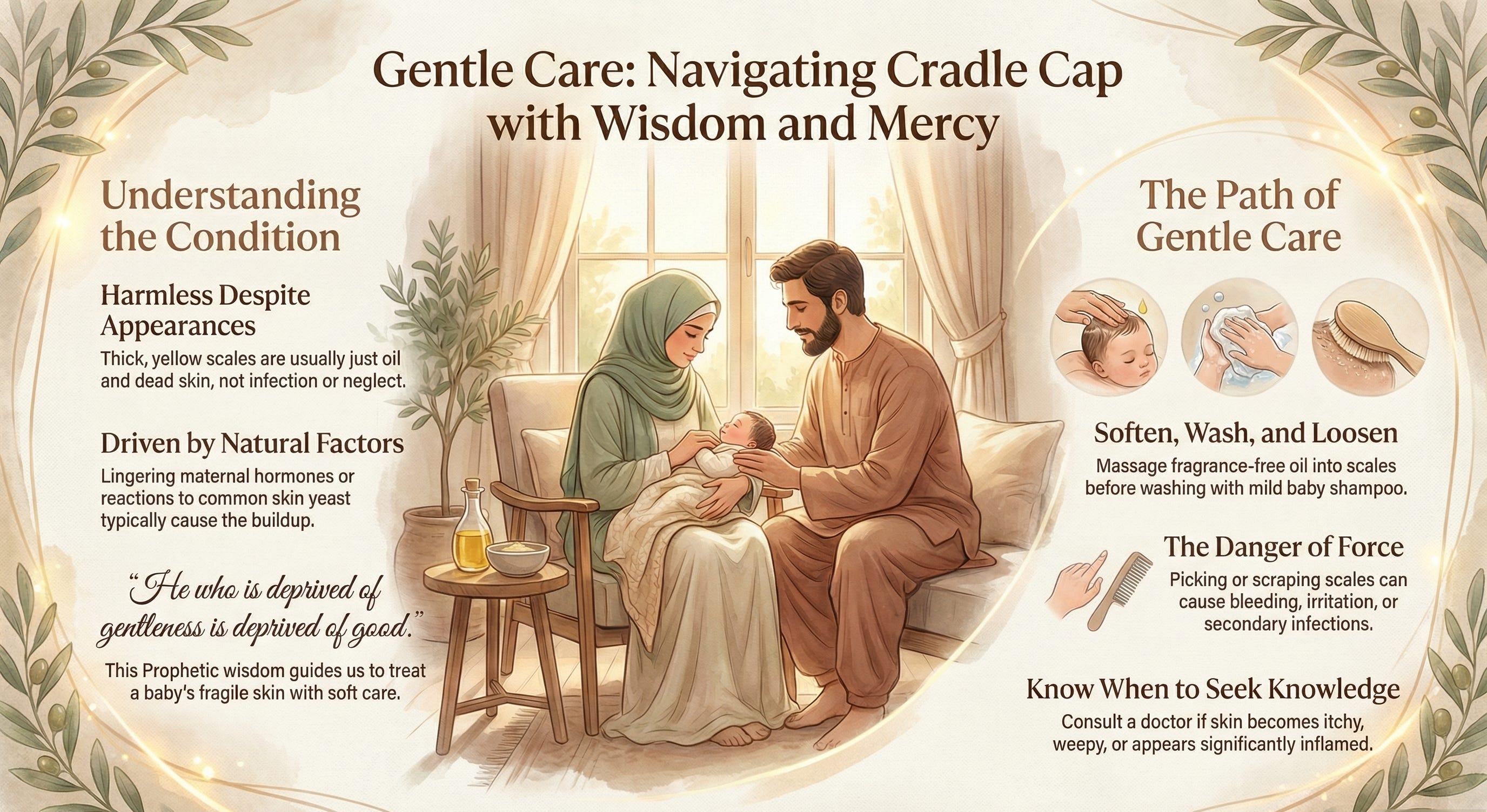
Cradle cap is usually harmless. It is not contagious. It is not dangerous. It does not usually hurt, and most babies are not bothered by it at all. It also does not cause baldness or lasting hair loss, even if the hair looks a little matted while the scale is there. [1] [2] [3] [5] [6]
That matters to say clearly, because many parents see those greasy, thick scales and immediately fear infection or neglect or some deeper skin problem.
Usually, it is none of those.
Most of the time, what is happening is that oil on the scalp and dead skin cells are clinging together instead of shedding away smoothly. One explanation is that maternal hormones still lingering after birth encourage the baby’s oil glands to work a little more than usual. Another is that the baby’s immune system reacts to yeast that normally lives on the skin, which adds a little inflammation to the picture. [1] [2] [3] [5] [6]
Why it shows up in these odd little places
Cradle cap most often appears as pale yellow, greasy, waxy scale on the top of the scalp or toward the back of the head. Sometimes it spreads to the eyebrows or behind the ears. Some babies also get a similar pattern in body folds like the neck, groin, behind the knees, or inside the elbow creases. [1] [3] [5] [6]
Underneath the crust, the skin can look a bit inflamed. On lighter skin that may look red. On darker skin it may look brown, purple, grey, or simply lighter than the surrounding skin. [3] [5] [6]
And still, despite how it looks, cradle cap usually does not bother the baby very much.
That is one of the clues that helps separate it from eczema.
Allah’s gentleness belongs in moments like this too
This is one of those baby conditions that quietly teaches restraint.
Not every problem needs to be attacked.
Some need to be handled softly.
Allah says, “And let those fear who, if they left behind weak offspring, would be concerned for them. So let them fear Allah and speak words of appropriate justice.” [7] A baby is fragile in obvious ways and subtle ways too. So the goal here is not aggressive treatment. It is careful care.
And if the picture feels unclear, Allah says, “Ask the people of knowledge if you do not know.” [8]
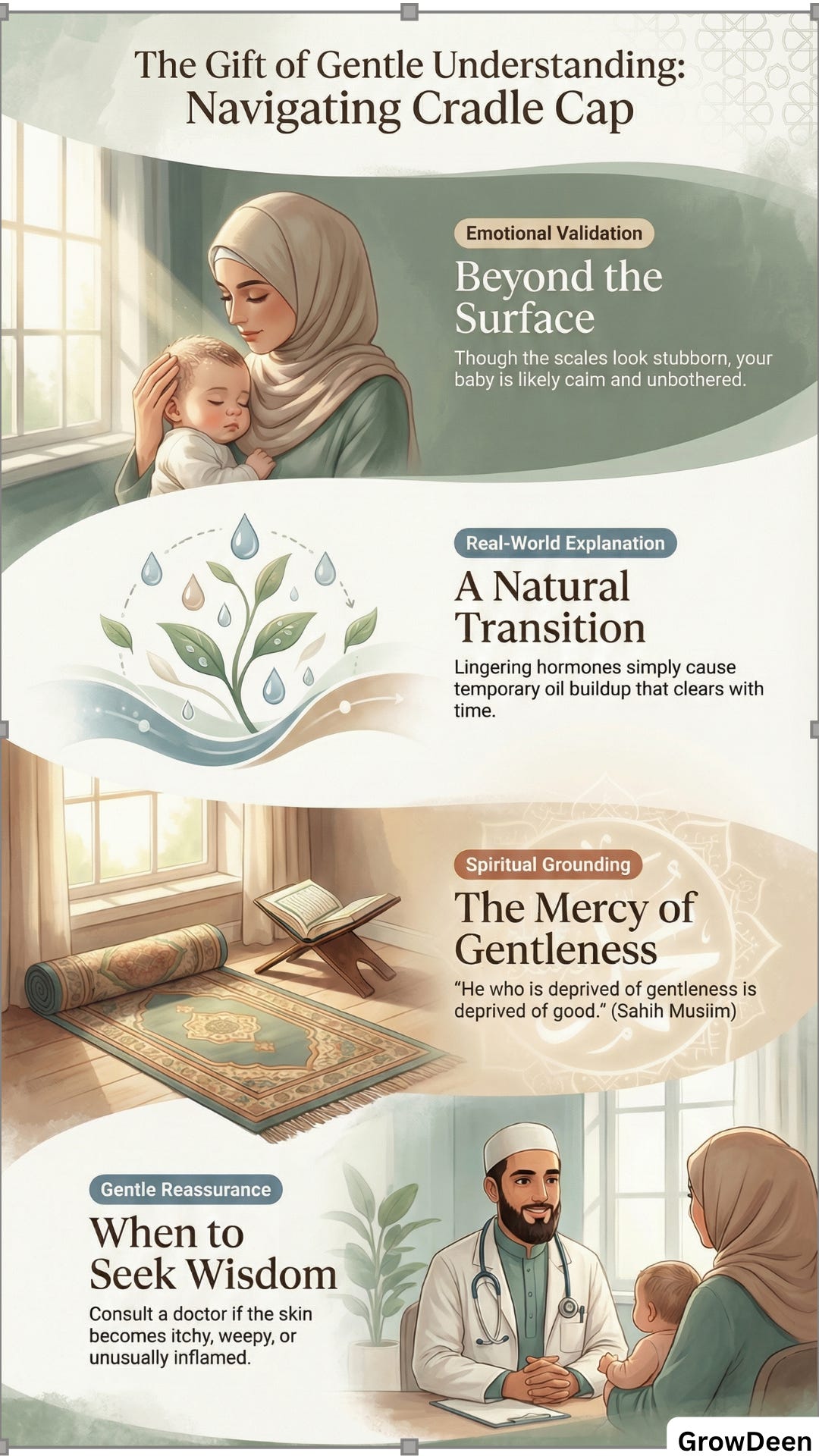
That verse fits baby skin issues more than people first realize. If you are not sure whether it is cradle cap, or the skin looks infected, spreading, or more inflamed than it should, asking is not overreacting. It is part of mercy.
The babies who need another look
Cradle cap usually does not itch. It usually does not make a baby upset.
So if the rash seems itchy, if the baby looks bothered by it, or if the skin underneath stays inflamed and unsettled instead of calm beneath the scale, eczema becomes more likely and the baby should be reviewed. [2] [3] [5]
Medical review is also a good idea if the skin becomes weepy, very inflamed, more widespread than expected, or if the baby seems unwell in other ways. [3] [5] [6]
That is because cradle cap itself is usually calm.
When the baby or the skin no longer seems calm, the story may be shifting.
What gentle care actually looks like
In many cases, no treatment is needed at all. Cradle cap often clears by itself over the months after birth. [1] [3] [5] [6]
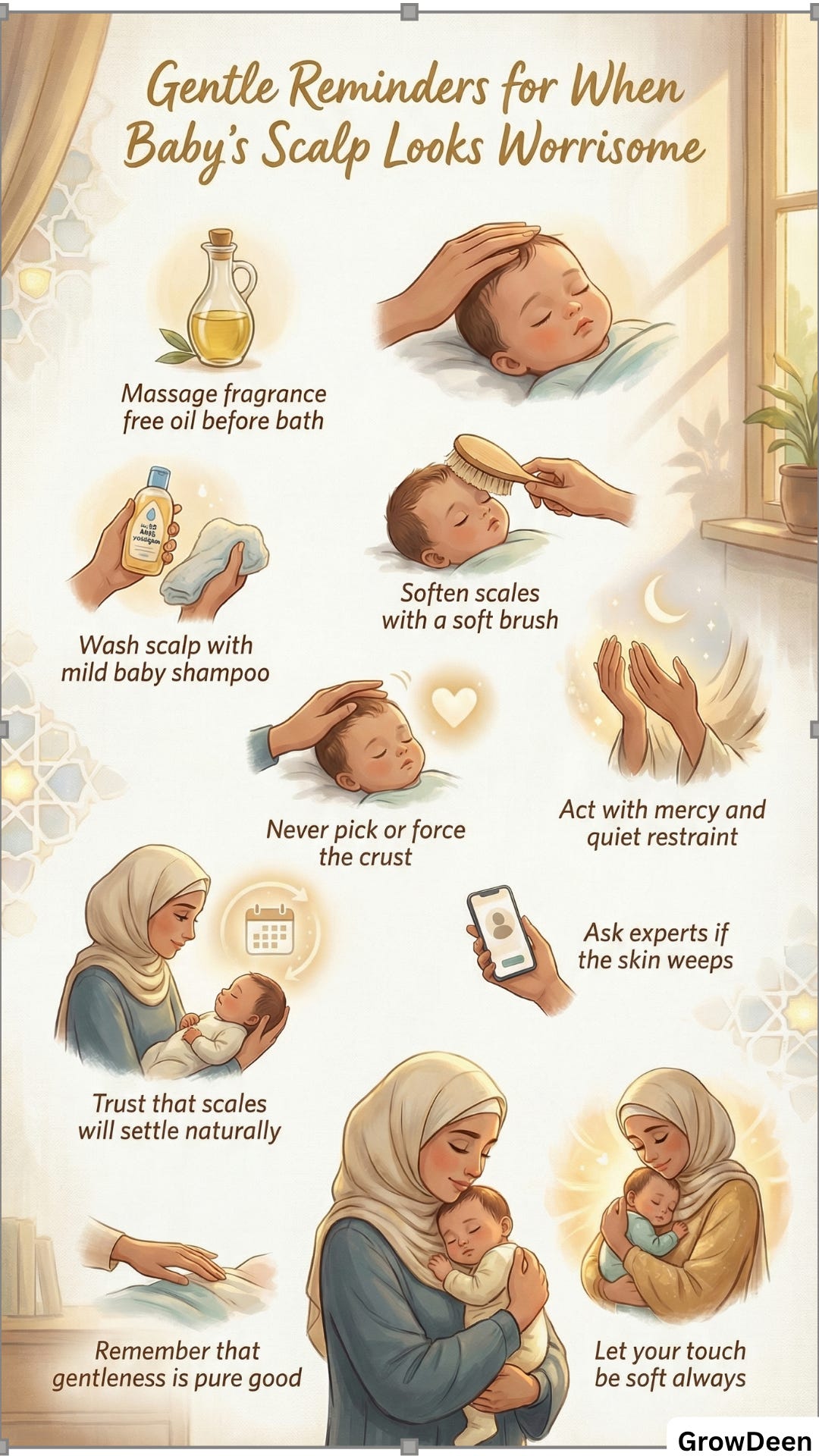
But many parents understandably want to soften the crusts and lift them more gently. The usual approach is simple. Before bathing, massage a fragrance free moisturiser, bath oil, or petroleum jelly into the crusted areas. Then wash the scalp with a mild baby shampoo. Over time, the scale softens and can be loosened gently with a cotton bud or a soft baby toothbrush. [3] [4] [5] [6]
Gently is the word that matters most.
The Prophet ﷺ said, “He who is deprived of gentleness is deprived of good.” [9]
That hadith sits so naturally here. Baby skin rarely responds well to force.
If gentle, Islamically grounded, practical support like this helps you in the newborn season, subscribe for free so each new article and life gift reaches you right when you need it.
The things that usually make it worse
The crusts should not be picked or forced off. That can make the skin bleed and open the door to irritation or infection. [3] [4] [6]
A baby does not need the scalp scraped clean in one determined sitting.
Slow softening works better than force.
The Prophet ﷺ also said, “Whoever does not show mercy will not be shown mercy.” [10]
Mercy here can look very simple. Not picking. Not rushing. Not turning a temporary condition into a sore scalp because the scales looked unpleasant to you.
When treatment moves beyond home care
If the skin under or around the crust becomes inflamed or weepy, if the rash spreads, or if the baby seems bothered by it, a doctor may need to step in. [3] [5] [6]
A doctor may prescribe a mild corticosteroid combined with an anti yeast cream if there is more inflammation than simple cradle cap should have. [3] [4] Sometimes an over the counter anti dandruff shampoo is suggested, but if it is used, it should be used cautiously because it can irritate a baby’s skin and eyes. It is generally diluted and used only briefly, not dragged on week after week. [4] [6]
And if cradle cap improves and then returns, that does not necessarily mean anything has gone wrong. Often it simply means the baby’s oil glands are still more active than they will be later. In most babies, it settles by 6 to 12 months. [1] [3] [5] [6]
The Prophet ﷺ said, “Purity is half of faith.” [11]
That does not mean over washing or scrubbing a baby raw. It means gentle cleanliness has value, and caring for the body with steadiness and softness is part of a believer’s way of living.
GIFTS FOR YOU, DEAR PARENT
If you’ve reached this part of the page, it tells me something meaningful about you.
You weren’t just skimming or passing time. You stayed because something here felt relevant to your real life.
Because you care.
Because you want to do things with more awareness.
Because you’re trying, even when it feels overwhelming.
That is not small.
So I didn’t want this article to remain just words on a page. I wanted it to gently step into your daily life in practical ways. That’s why we prepared these Life Gifts for you.
Not as extras.
Not as decorations.
But as simple tools to help you hold onto what mattered most in what you just read.
Here’s what you’ll find inside:
Gentle Understanding Card
A clear and simplified summary of the core concept from this article, so you can revisit the main idea anytime without rereading everything.
Heartfelt Dua Card
A carefully chosen dua connected to this stage of life, because we know that real strength and ease ultimately come from Allah’s help.
Gentle Actions Card
Practical examples to help you translate knowledge into action, so what you learned becomes part of your daily rhythm.
Gentle Reminders Card
Short, steady reminders drawn from the key points, designed to be printed or saved and placed somewhere you’ll see often.
These were designed slowly and thoughtfully, with time, care, and sincere dua. We created them because we genuinely want to walk alongside you, not just through one article, but through every stage of this lifelong journey.
If these gifts support you even in a small way, I would love for you to continue receiving them.
Subscribe so that each new Gift arrives directly in your inbox whenever we release the next stage. That way, you won’t miss the tools designed to support you right where you are.
May Allah place barakah in your effort, accept your intention, and make this path easier and more rewarding than it feels right now.
Please share it with a family/friend who may benefit from this knowledge.
What is one moment with your child that feels hardest lately, and what kind of support would make it feel lighter?
Subscribe for free to keep receiving gentle, research rooted, Islamically grounded support for the real moments of parenting.
References
[1] Australasian College of Dermatologists (ACD). (2017). Seborrhoeic dermatitis and cradle cap.
[2] Bender, N.R., & Chiu, Y.E. (2020). Eczematous disorders. In Nelson textbook of pediatrics (21st edn, pp. 3491-3495). Elsevier.
[3] Phillips, R., & Orchard, D. (2020). Dermatologic conditions. In Paediatric handbook (10th edn, pp. 250-264). Wiley Blackwell.
[4] Poindexter, G., Burkhart, C., & Morrell, D. (2009). Therapies for pediatric seborrheic dermatitis. Pediatric Annals, 38(6), 333-338.
[5] Prok, L.D., & Torres-Zegarra, C.X. (2022). Skin. In Current diagnosis and treatment: Pediatrics (26th edn, Chapter 15). McGraw-Hill Education.
[6] Stewart, T. (2017). Cradle cap. DermNet NZ.
[8] Qur’an, Surah Al-Anbiya 21:7
[9] Sahih Muslim, Hadith 2592
[10] Sahih al-Bukhari, Hadith 5997; Sahih Muslim, Hadith 2318
[11] Sahih Muslim, Hadith 223