
What Every Parents Should Know About Stroller Safety Before the Next Walk
Before You Put Baby in the Stroller, Read This First

Free gift for you! A practical companion resource is waiting for you near the end of this article to help you remember, apply, and benefit from what you read. Don’t forget to download!
A pram or stroller can make life with a baby much easier, but real safety depends on a stable design, proper restraints, careful use, alert supervision, and an adult who does not let convenience replace attention.
There is a certain kind of relief in putting a baby into a pram and stepping out the door.
Your arms get a break.
The bag has somewhere to go.
You can move, breathe, walk, think.
For many parents, a pram or stroller starts to feel like freedom very quickly. It helps you leave the house. It helps you carry what you need. It helps you move through a day that already asks a lot from your body and mind.
And that helpfulness is real.
But a stroller is not passive equipment.
It can tip.
It can roll away.
It can trap little fingers.
It can collapse if it has not been locked properly.
And it can become dangerous if a baby is left sleeping in it unattended. [1][2]
That is why stroller safety is not mostly about choosing something that looks nice or feels convenient in the shop. It is about understanding what keeps a child safe once the real, tired, ordinary parts of life begin.
The first thing to notice is not style, but structure
A safer pram or stroller begins with its build.
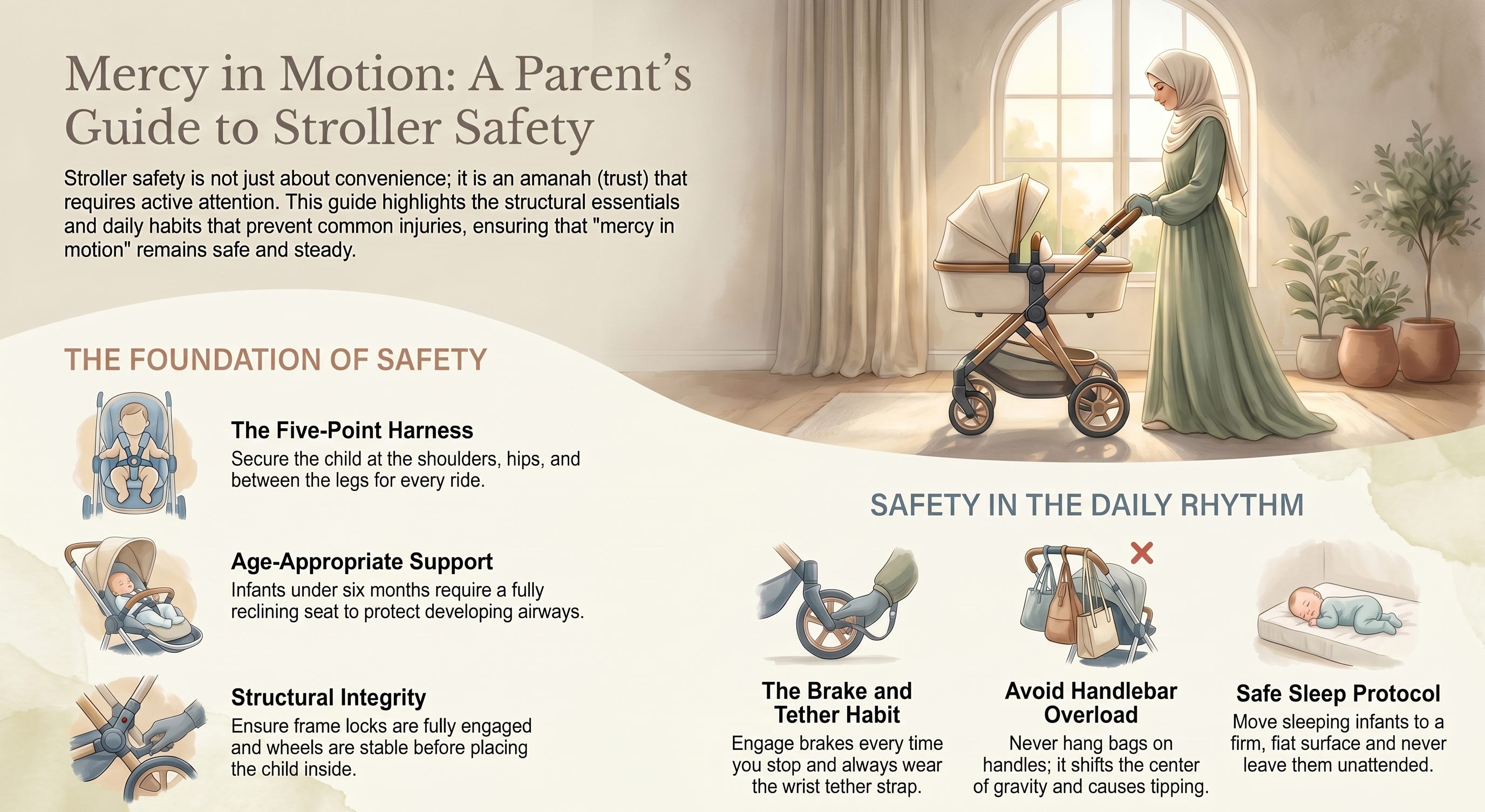
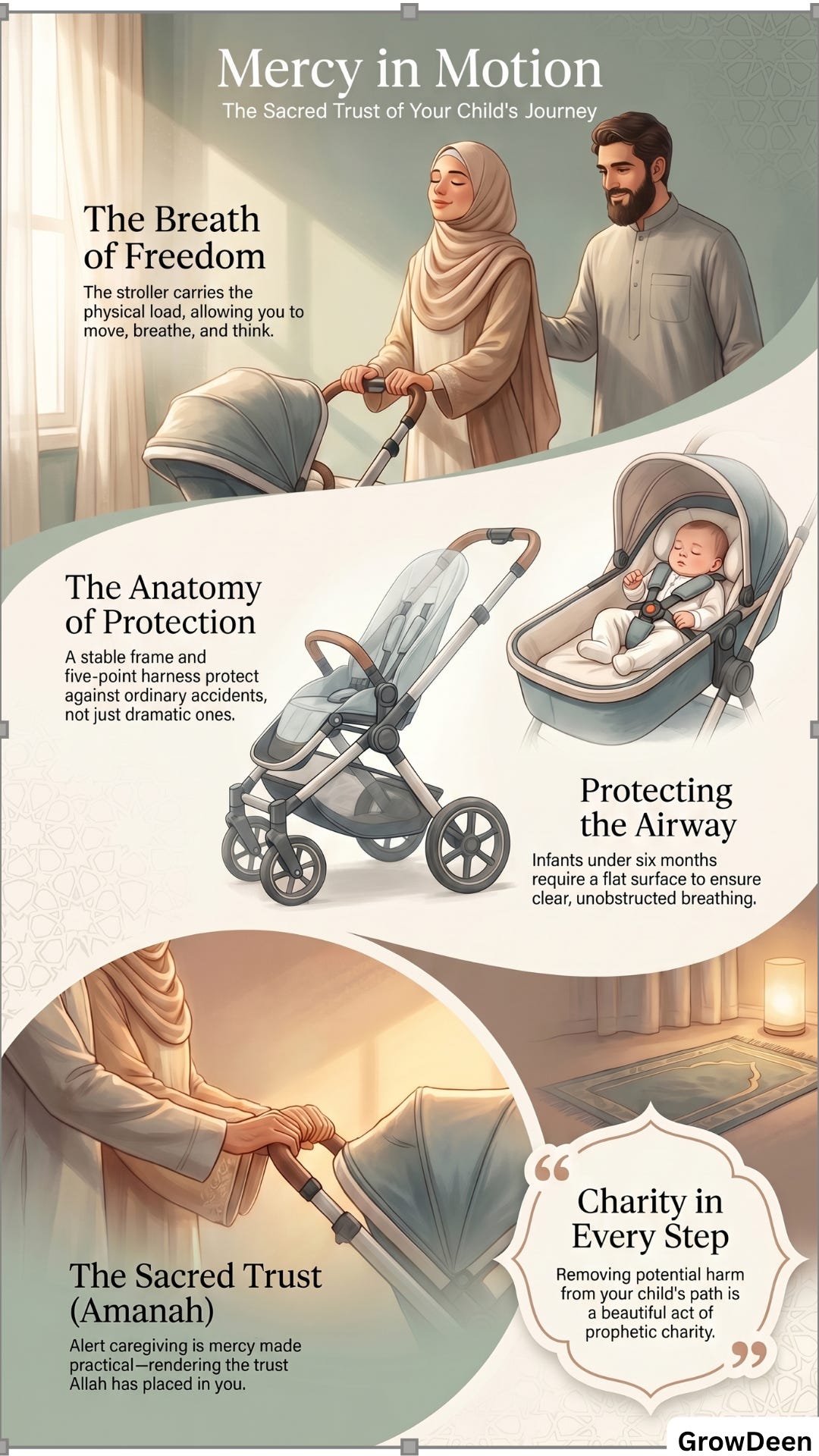
The base should feel stable. The frame should feel strong. The locking mechanism should be secure. The brakes should work properly. The harness should hold the child at the shoulders, hips, and between the legs. These are not bonus features. They are the parts that matter most. [1][2][3]
A five-point harness deserves special attention. So do secure folding locks, reliable brakes, and a wrist tether strap. These are some of the most important features because they protect against the kinds of accidents that happen in ordinary moments, not only dramatic ones. [1][2][3]
It also helps to choose a pram or stroller that complies with recognized safety standards where you live, and to buy from a reputable manufacturer that provides clear instructions, age guidance, warnings, and recall support. That kind of clarity matters later, when the product is no longer new and you are using it in a hurry, on little sleep, trying to get through a real day. [1][2]
A stroller has to match the stage your child is actually in
This is one of those details parents can miss without realizing they are missing it.
Not every stroller suits every baby.
An upright, non-reclining stroller is not safe for a baby under six months. Young babies need more support because their head control is still developing. If the stroller does not recline adequately, a baby can slump into a position that affects the airway. HealthyChildren.org gives similar guidance, reminding parents that very young infants need the right support and that restraints should be used every single time. [3][4]
That point matters because it is easy to assume that if a stroller is marketed broadly for babies and children, it must suit every stage automatically.
It doesn’t.
A baby’s age, muscle control, airway vulnerability, and body position all matter. Convenience should not get to decide those things.
The small mistakes are often the ones that lead to big accidents
A lot of stroller injuries do not happen because someone was wildly reckless.
They happen because a parent was tired.
Because they were in a rush.
Because the ground looked flat enough.
Because the bag only weighed a little.
Because the brake was not set for “just a second.”
Because the harness felt unnecessary for a short trip.
That is how ordinary danger often arrives.
The folding mechanism is a good example. If a stroller is opened in a rush or only partly locked, the risk is not theoretical. Children’s fingers can get trapped in hinges. A stroller that is not locked open properly can collapse. The American Academy of Pediatrics advises keeping children clear while opening and closing the stroller and checking that it is securely locked before placing a child inside. [3]
Then there is tipping. This is one of the most common stroller-related injury patterns, and it often happens because the center of gravity changes. A bag hanging over the handles may look harmless, but it can pull the stroller backward. That is why parents are warned not to hang bags from stroller handles and not to exceed weight limits. HealthyChildren.org says the same thing directly: hanging bags or other items from stroller handles can make the stroller tip backward. [3][5]
The harness belongs in this same conversation. Children can wriggle, lean, push up, twist, and stand faster than many adults expect. A five-point harness should be used every ride, not only on busy roads or rough ground. It is not there for exceptional situations. It is there for normal ones. [3][5]
Some habits feel small until the day they save your child
Brakes are one of those habits.
A stroller can roll on what looks like a flat surface, especially if the ground is less level than it seems or the child shifts their weight. The safest habit is to put the brakes on every time you stop, even if you think you will only pause briefly. Parking parallel to roads or train tracks also matters so the stroller cannot roll into danger. That kind of habit feels tiny right up until it prevents something terrible. [5][6]
The wrist tether strap belongs in the same category.
Many adults ignore it, especially during normal walks. But runaway strollers have caused serious injuries and deaths. The tether is not decoration. It is protection for the moment your hand slips, you stumble, or the stroller moves unexpectedly on a slope. [5]
This is the kind of safety that depends less on what you own and more on what you do every time.
Use the brakes.
Use the tether.
Use the harness.
Do not trust a slope just because it looks gentle.
Do not trust a moment just because it feels brief.
Sleep in a stroller needs more caution than many people realize
This part matters deeply.
If a baby under six months falls asleep, the stroller should allow the baby to lie flat on a level surface. And a baby should not be left unattended asleep in a pram or stroller because suffocation and strangulation risks are real. [4][7][8]
That aligns with current American Academy of Pediatrics guidance, which says that if a baby falls asleep in a stroller, car seat, swing, infant carrier, or sling, the baby should be moved to a firm, flat, non-inclined sleep surface as soon as possible. [4][7][8]
It helps to say this plainly because many exhausted parents need plain language.
A stroller is a travel tool.
It is not the safest place for unattended sleep.
The same caution applies to loose blankets, pillows, and draped covers. Pillows and blankets in the stroller can create hazards. Covering the stroller in a way that restricts airflow can trap heat and reduce ventilation. Safe Kids and AAP sleep-safety materials both keep returning to the same basic concerns: clear airways and avoiding soft sleep hazards around young infants. [7][8][9]
Sometimes parents do these things out of love, wanting the baby to feel cozy, shaded, tucked in.
I understand that instinct.
But in baby safety, cozy-looking and safe are not always the same thing.
The road outside the house has its own risks too
Once you leave home, stroller safety takes on another layer.
Rough terrain, curbs, stairs, crowded places, uneven ground, transport platforms, and busy roads all bring their own risks. Avoiding rough terrain, curbs, and stairs where possible is not overcautious. Lifting or bouncing a stroller up steps, dragging it over curbs, or forcing it through difficult ground increases the chance of losing control or damaging the stroller itself. If public transport is involved, asking for help when lifting is sensible, especially when the stroller is loaded and the child is inside. [5]
Jogging and all-terrain strollers need caution too. They are not simply “better strollers.” They are a different category. They may be useful for some families, but they still require attention to age guidance, restraint use, and terrain. A sturdier-looking stroller does not remove the need for care. In some situations, it can make adults feel overconfident and take risks they would not otherwise take. [3][10]
There is also another modern reality parents should stay aware of: recalls happen. Sometimes injuries come from misuse. Sometimes they come from product defects. In late 2024, CPSC announced a recall of certain YOYO³ strollers because the parking brake could disengage, creating an injury hazard. In another recall, UPPAbaby RIDGE jogging strollers were recalled because openings in the rear disc brakes could cause fingertip amputation or laceration to a nearby child. These examples are reminders to register products where possible, check recall notices, and stop using a stroller if a serious safety problem is announced. [6][10]
If gentle, carefully researched writing like this supports you, subscribe for free so the next article arrives in your inbox when it’s ready.
Allah’s mercy shows up in alert, careful caregiving
A child in a pram is completely dependent on the adult pushing it.
That dependence should soften a person.
It should humble them.
It should remind them that safety is not cold or mechanical. It is mercy made practical.
Allah says, “Indeed, Allah commands you to render trusts to whom they are due.” [11]
A child’s safety is one of the clearest trusts a parent or carer carries. And Allah says, “And do not throw yourselves with your own hands into destruction.” [12]
That warning speaks here too. Avoidable carelessness belongs here. Not using the harness. Ignoring the brakes. Hanging heavy bags from the handle. Walking away from a sleeping child in a stroller. These are not small things when a child is helpless inside the equipment we control.
The Prophet ﷺ said, “Each of you is a shepherd, and each of you is responsible for his flock.” [13]
That hadith fits parenting with painful precision. And there is another hadith that carries a surprising beauty in this subject: “Removing something harmful from the road is charity.” [14]
A safer stroller path. Careful handling near roads. Preventing the stroller from becoming a danger to your child or to others. All of this sits comfortably within that prophetic ethic of removing harm.
And the Prophet ﷺ also taught, “There should be neither harming nor reciprocating harm.” [15]
That principle is broad, but it belongs here fully.
Even gentleness matters here. A stroller should not become a place where a child is left too long, strapped in carelessly, or handled roughly in the name of efficiency. Allah says, “And lower to them the wing of humility out of mercy.” [16]
That verse is often remembered in other family relationships, but its spirit belongs in caregiving more broadly too. A safe stroller is not merely a practical object. In the right hands, it becomes part of mercy.
The best stroller advice is simple enough to remember on a tired day
In the end, the best stroller advice is not complicated.
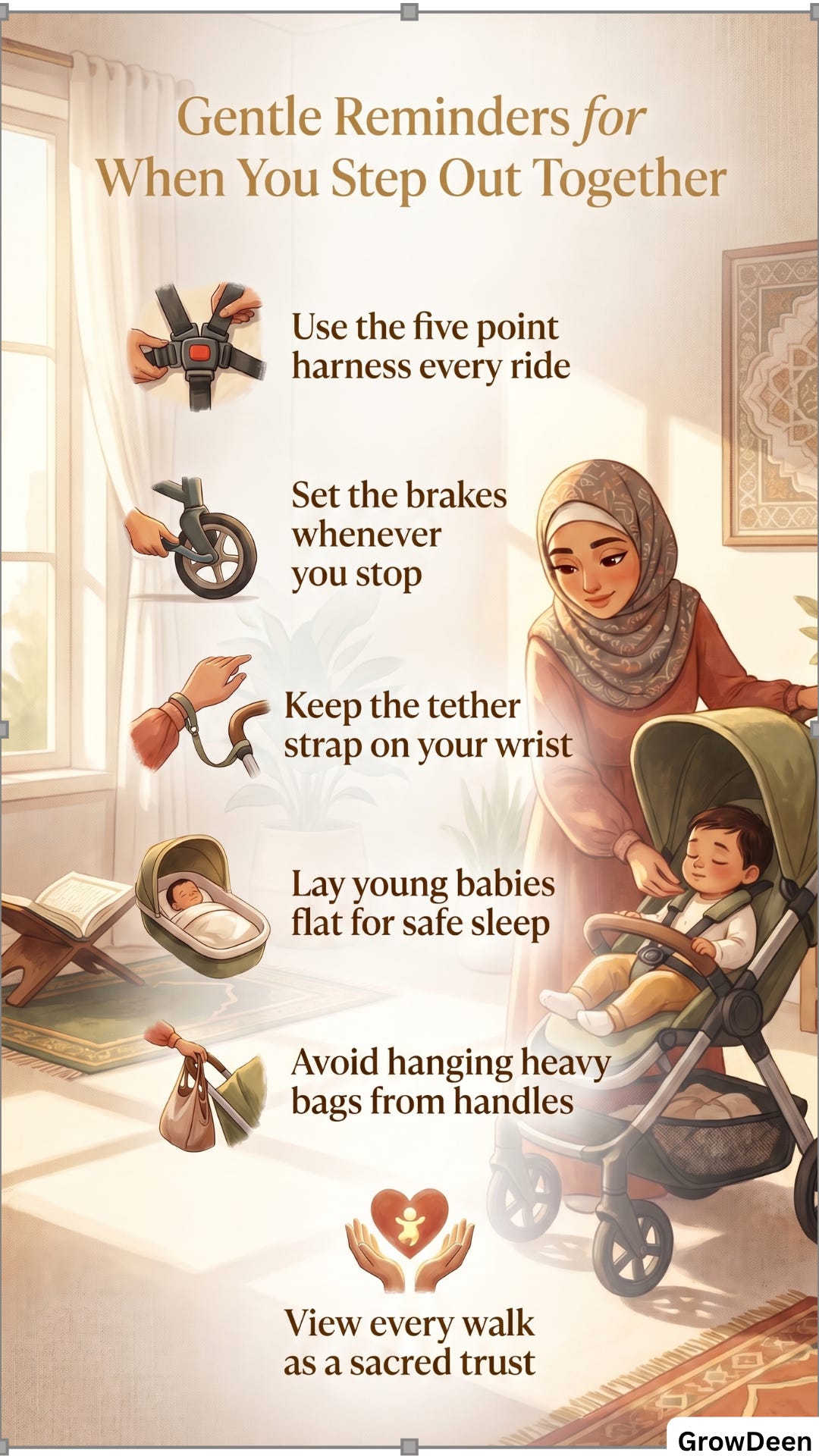
Choose a stable stroller that meets recognized safety requirements where you live.
Use the harness every time.
Use the brakes every time you stop.
Put the tether strap on your wrist.
Do not overload the handles.
Do not leave a child unattended.
Be careful with sleep.
Check for recalls.
And remember that the stroller is there to help you care for your child, not to let your attention drift away from them. [1][2][3][4][5][6][7][8][9][10]
Babies need movement too. Toddlers need movement too. A stroller is a travel tool, not a substitute for tummy time, walking, climbing, play, and physical activity. That balance matters. Convenience is helpful. But development still needs room. [3][10]
On a tired day, maybe that is enough to remember:
Safety first.
Attention still matters.
The wheels do not remove the amanah.
GIFTS FOR YOU, DEAR PARENT
If you’ve reached this part of the page, it tells me something meaningful about you.
You weren’t just skimming or passing time. You stayed because something here felt relevant to your real life.
Because you care.
Because you want to do things with more awareness.
Because you’re trying, even when it feels overwhelming.
That is not small.
So I didn’t want this article to remain just words on a page. I wanted it to gently step into your daily life in practical ways. That’s why we prepared these Life Gifts for you.
Not as extras.
Not as decorations.
But as simple tools to help you hold onto what mattered most in what you just read.
Here’s what you’ll find inside:
Gentle Understanding Card
A clear and simplified summary of the core concept from this article, so you can revisit the main idea anytime without rereading everything.
Heartfelt Dua Card
A carefully chosen dua connected to this stage of life, because we know that real strength and ease ultimately come from Allah’s help.
Gentle Actions Card
Practical examples to help you translate knowledge into action, so what you learned becomes part of your daily rhythm.
Gentle Reminders Card
Short, steady reminders drawn from the key points, designed to be printed or saved and placed somewhere you’ll see often.
These were designed slowly and thoughtfully, with time, care, and sincere dua. We created them because we genuinely want to walk alongside you, not just through one article, but through every stage of this lifelong journey.
If these gifts support you even in a small way, I would love for you to continue receiving them.
Subscribe so that each new Gift arrives directly in your inbox whenever we release the next stage. That way, you won’t miss the tools designed to support you right where you are.
May Allah place barakah in your effort, accept your intention, and make this path easier and more rewarding than it feels right now.
Please share it with a family/friend who may benefit from this knowledge.
What is one moment with your child that feels hardest lately, and what kind of support would make it feel lighter?
You do not need to fear the stroller to use it wisely.
You do not need to become anxious about every outing.
You just need good habits strong enough to stay with you when the day gets busy.
May Allah place mercy in your care, steadiness in your hands, and protection around the child entrusted to you. May He make your ordinary outings safer, calmer, and more blessed than they feel in the rush of daily life.
Subscribe for free if you’d like more warm, evidence-based, Islamically grounded support for the real work of raising children.
What is one stroller habit you want to become more consistent with this week?
References
[1] ACCC Product Safety. Keep baby safe
[2] U.S. Consumer Product Safety Commission. Carriages and Strollers, U.S. Consumer Product Safety Commission. New Stroller Standard
[3] HealthyChildren.org / American Academy of Pediatrics. How to Choose a Safe Baby Stroller
[4] American Academy of Pediatrics. Safe Sleep
[5] Safe Kids Worldwide. Stroller Safety Tips
[6] U.S. Consumer Product Safety Commission. Stokke Recalls YOYO3 Strollers Due to Injury Hazard
[7] American Academy of Pediatrics. Safe Sleep and Your Baby: How Parents Can Reduce the Risk of SIDS and Suffocation
[8] HealthyChildren.org. Safe Sleep: Back is Best, Avoid Soft Bedding, Inclined Surfaces and Bedsharing
[9] Safe Kids Worldwide. Sleep Safety and Suffocation Prevention Tips
[10] U.S. Consumer Product Safety Commission. UPPAbaby Recalls RIDGE Jogging Strollers Due to Fingertip Amputation Hazard, HealthyChildren.org / American Academy of Pediatrics. Tummy Time
[11] Qur’an, Surah An-Nisa 4:58
[12] Qur’an, Surah Al-Baqarah 2:195
[13] Sahih al-Bukhari 7138
[14] Sahih Muslim 1009
[15] Sunan Ibn Majah 2340
[16] Qur’an, Surah Al-Isra 17:24