
What Development Really Grows From In The First 12 Months
The First Year Is Fast, But Ensure Your Baby Is Not Behind

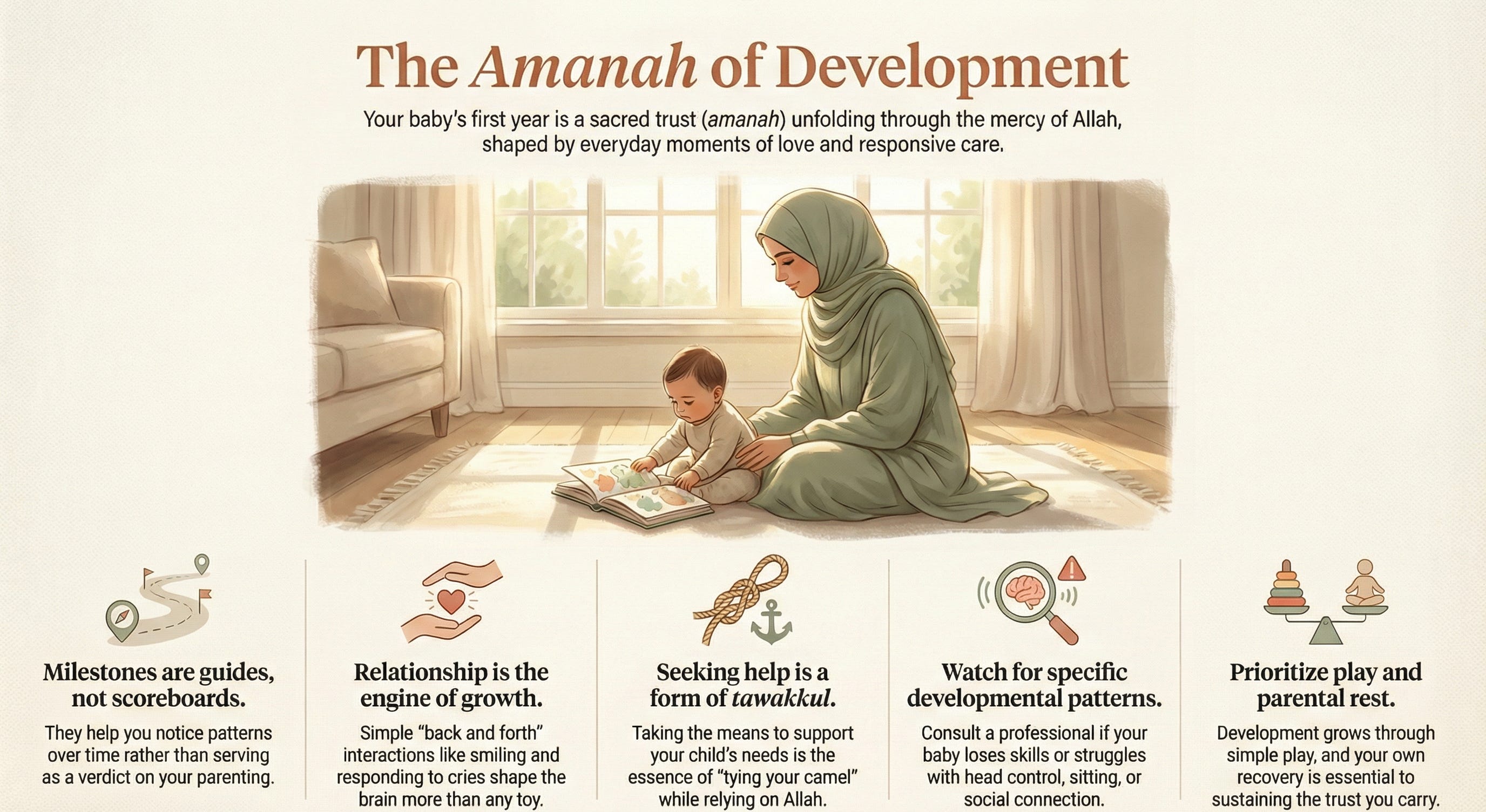
A baby’s first year unfolds through love, play, and responsive care, and when something feels off especially across multiple areas or if skills are lost seeking support early is a form of amanah, not a failure.
You’re standing at the sink, rinsing a bottle, trying to keep your eyes open.
Your phone is open on the counter. You promised yourself you would stop searching.
But your thumb scrolls anyway.
“Six months should be…”
“Nine months should be…”
And then you look over at your baby. Sweet. Small. Busy being themselves.
You feel love. You feel gratitude.
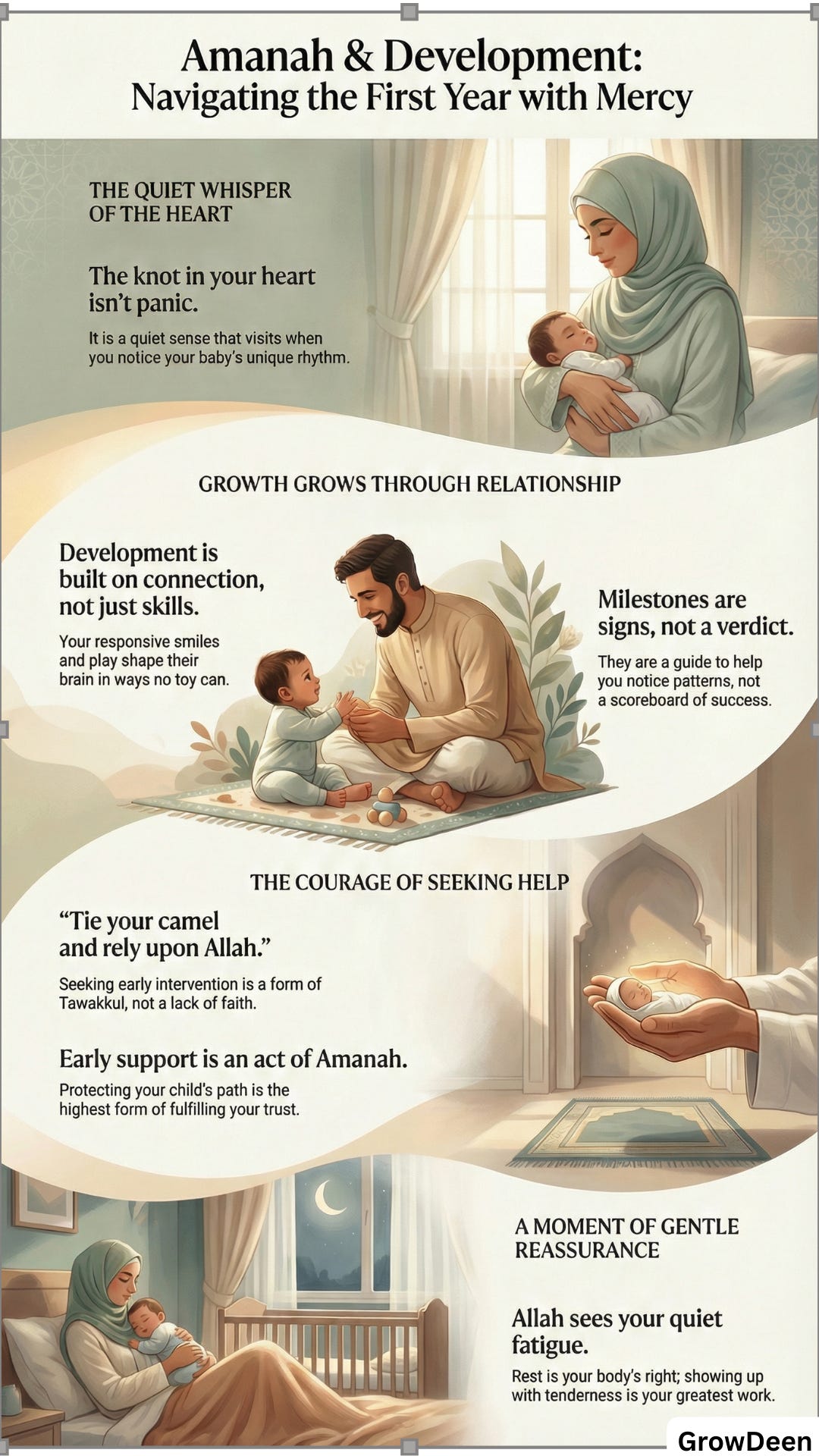
And you feel that tight little knot that comes when your heart whispers, Something is off.
Not panic. Not drama.
Just that quiet mother sense that visits at the worst times.
The first year is not a race, but it can feel like one
The first twelve months are a blur of feeding, waking, soothing, cleaning, repeating.
And inside that blur, your baby is doing something astonishing. The brain, the body, the nervous system, the whole little person is growing through everyday moments, not through lessons. Through being held. Answered. Played with. Comforted.
If you are exhausted, it makes sense that you would look for a clear sign that you are doing this right.
Milestones can feel like that sign.
But they were never meant to be a scoreboard. They are more like a guide that helps you notice patterns over time.
What your baby learns from you that no toy can teach
A baby’s development is not built only from skills. It is built from relationship.
When you respond to a cry, smile back, copy their little sounds, pause as if you’re listening to their “story,” you are shaping their growth in ways that are real and measurable. This kind of back and forth has deep links to how children develop across social, emotional, and communication areas.
This is why a baby can be surrounded by things and still feel unsettled.
And why a baby held with warmth can settle even when life is hard.
That is not softness. That is biology and mercy meeting in the same place.
The mercy of Allah in a slow unfolding
Allah did not create babies to unfold like machines.
Some babies sit early and walk late. Others skip crawling. Some talk in bursts. Some take their time.
Variation is part of the human design, and many guides emphasize watching progress over time instead of fixating on one exact day.
And when you find yourself spiraling into comparison, hold this close:
Allah does not burden a soul beyond what it can bear.
Your job is not to control every timeline.
Your job is care.
Your job is showing up again and again with tenderness.
Milestones are signs, not a verdict
Milestones are simply things many children can do by certain ages. They help families and clinicians notice when something might need a closer look.
Most milestone guidance looks at a few broad areas, like movement, hand skills, communication, hearing and vision, and social connection.
If you have ever felt confused reading them, you are not alone.
A tired parent reads one line and thinks, My baby is behind.
A calmer parent reads the same line and thinks, I will watch, I will support, and I will speak up if my gut keeps tapping me.
Both parents love their baby.
One parent just needs more reassurance.
Play is not extra, it is how the work happens
Sometimes parents think development needs a “program.”
But much of it grows inside play, especially play with a caring adult.
Peekaboo. Humming adhkar. Reciting calming Surahs. Floor time. A spoon on a tray. A soft book you read for the tenth time.
It looks small.
But it is doing something big.
If your baby is getting love and a safe space to explore, that is not a weak foundation. That is a strong one.
And if you are stretched thin, remember this too:
Your body has a right over you.
Rest and recovery are not selfish in Islam. They are part of staying steady for the amanah you carry.
Here is something gentle I want to offer you, right here in the middle.
If you want more support like this, you can subscribe for free. Not for me. For you.
So you have a calm, trustworthy place to return to when parenting feels loud, and you need someone to help you breathe again.
When your worry is actually your amanah speaking
Some babies develop more slowly for many reasons. Sometimes it is temporary, connected to illness or a difficult season. Sometimes it is linked to early medical history, prematurity, or other factors that shape the pace of growth in the first year.
What matters most is this.
Early support helps when delays are present.
Healthy relationships and early intervention can strengthen outcomes, and some children who receive help earlier may need less support later.
This is not about labeling your baby.
It is about giving your baby what they need, as early as possible, if they need it.
And in our deen, taking the means is not a lack of tawakkul.
It is part of it.
Tie your camel, and rely upon Allah.
Signs that deserve a closer look, without fear
Most parents sense something before they can explain it.
If your concern keeps returning, bring it to a professional who works with babies. Often that starts with your family doctor, a public health nurse, or a pediatrician.
There are a few patterns that many sources treat as reasons to check sooner rather than later.
If a baby seems not to see or hear well.
If a baby cannot use both arms or both legs in a typical way.
If head control is not coming along by around three to four months.
If sitting without support is not happening by around nine months.
If there is no crawling by twelve months, or no bearing weight on legs by twelve months.
If babbling is not emerging by around six months.
If social connection feels absent, like limited eye contact or little interest in faces and interaction.
If your baby loses skills they once had.
And one more thing, because parents quietly blame themselves for this.
Crying can be intense in the early months, and many babies cry a few hours a day, with crying often peaking around six to eight weeks.
So if your baby cries a lot, it does not automatically mean you caused harm.
It means you have a baby.
If any of these points land close to home, please do not carry it alone.
Seeking help is not you giving up.
It is you protecting your baby.
It is you doing amanah with courage.
And when your heart feels heavy, remember that du’a is not a last resort. It is worship.
Allah(swt) says: Call upon Me, I will respond to you.
Allah, place calm in this parent’s heart, and guide them to what is best for their child.
GIFTS FOR YOU, DEAR PARENT
If you have reached this part of the page, it tells me something precious about you.
You were not only skimming. You stayed because something here touched your real life.
Because you care.
Because you want to move through motherhood with more awareness, not just survival.
Because you keep trying, even when you feel tired to the bone.
That is not small at all.
I also did not want this to remain only words on a screen. I wanted it to slip gently into your day and become something you can actually hold onto. That is why we prepared these Life Gifts for you.
Not as decoration.
Not as extras.
As simple tools to help you remember what mattered most in what you just read.
Here is what you will find inside.
Gentle Understanding Card
A clear, simple return point to the heart of this article, so you can revisit the main idea without needing to reread the whole thing.
Heartfelt Dua Card
A carefully chosen du’a connected to this stage of life, because real strength and real ease come from Allah’s help.
Gentle Actions Card
Practical examples that help you turn what you learned into small steps, so the knowledge becomes part of your daily rhythm.
Gentle Reminders Card
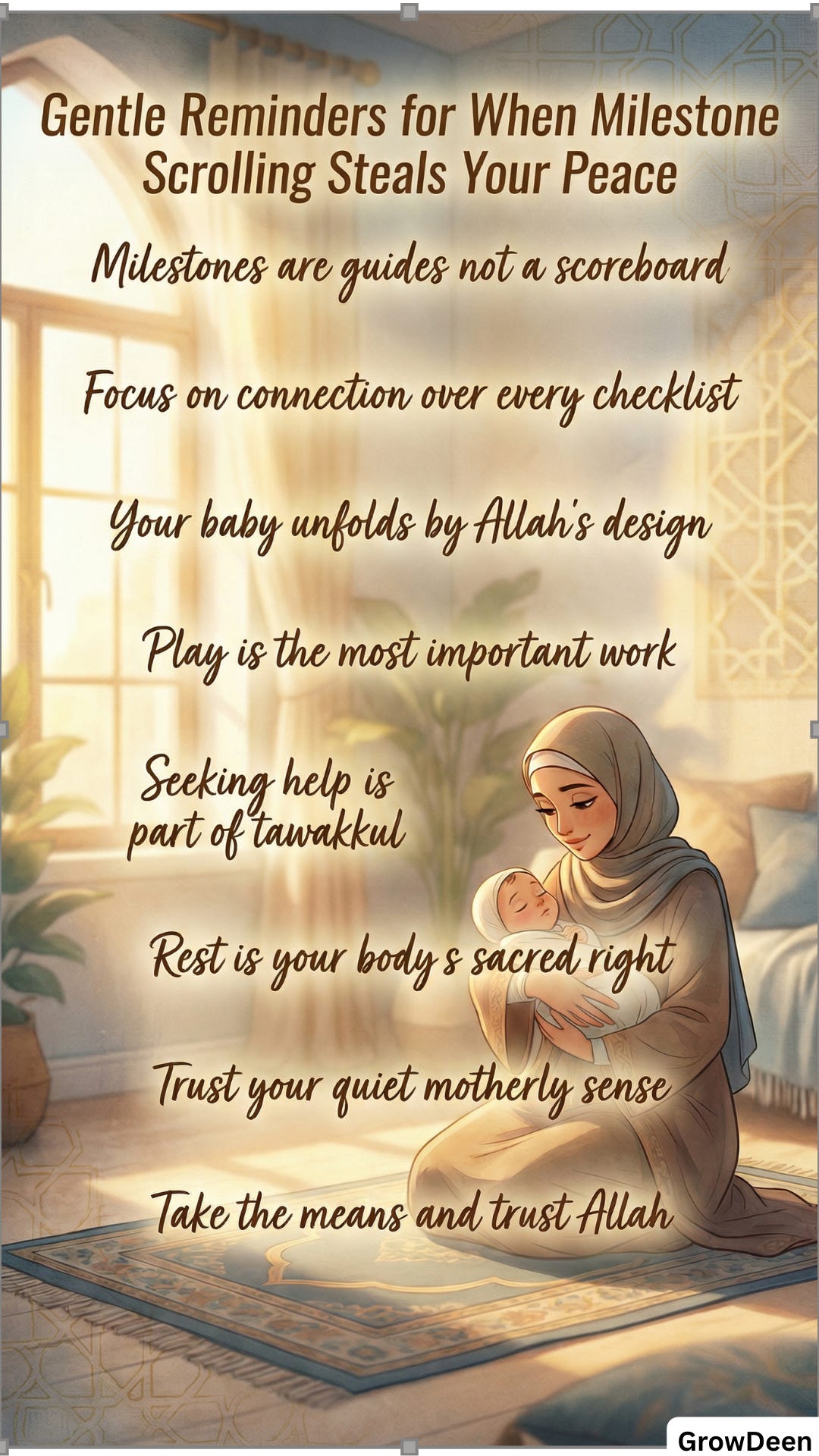
Short, steady reminders taken from the key ideas, designed to be printed or saved and placed where your eyes fall often.
These were made slowly, with care, and with sincere du’a. We made them because we truly want to walk beside you, not only through one article, but through every stage of this lifelong journey.
If these gifts support you even a little, I would love for you to keep receiving them.
Subscribe so that each new Gift arrives in your inbox whenever we release the next stage, so you do not miss the tools designed to support you exactly where you are.
May Allah place barakah in your effort, accept your intention, and make this path easier and more rewarding than it feels right now.
Please share this with a family member or friend who may benefit from it.
In the comments, what is one small sign of growth you noticed recently that you do not want to overlook?
References
[1] Centers for Disease Control and Prevention. CDC’s Developmental Milestones.
[2] Ford, A. L. B., Elmquist, M., Merbler, A. M., Kriese, A., Will, K. K., & McConnell, S. R. (2020). Toward an ecobehavioral model of early language development. Early Childhood Research Quarterly, 50(Part 1), 246–258. https://doi.org/10.1016/j.ecresq.2018.11.004
[3] Frosch, C. A., Schoppe Sullivan, S. J., & O’Banion, D. D. (2019). Parenting and child development: A relational health perspective. American Journal of Lifestyle Medicine. https://doi.org/10.1177/1559827619849028
[4] Julian, M. M., Lawler, J. M., & Rosenblum, K. L. (2017). Caregiver child relationships in early childhood: Interventions to promote well being and reduce risk for psychopathology. Current Behavioral Neuroscience Reports, 4, 87–98. https://doi.org/10.1007/s40473-017-0110-0
[5] Kliegman, R. M., & Marcdante, K. J. (2019). Nelson Essentials of Pediatrics (8th ed.). Elsevier. https://evolve.elsevier.com/cs/product/9780323528078
[6] McCall, R. B., Groark, C. J., Hawk, B. N., Julian, M. M., Merz, E. C., Rosas, J. M., Muhamedrahimov, R. J., Palmov, O. I., & Nikiforova, N. V. (2019). Early caregiver child interaction and children’s development: Lessons from the St. Petersburg USA Orphanage Intervention Research Project. Clinical Child and Family Psychology Review, 22, 208–224. https://pubmed.ncbi.nlm.nih.gov/30196471/
[7] National Scientific Council on the Developing Child. (2020). Connecting the brain to the rest of the body: Early childhood development and lifelong health are deeply intertwined. Working Paper No. 15. Center on the Developing Child at Harvard University. https://developingchild.harvard.edu/resources/working-paper/connecting-the-brain-to-the-rest-of-the-body-early-childhood-development-and-lifelong-health-are-deeply-intertwined/
[8] National Scientific Council on the Developing Child. (2004, updated 2009). Young children develop in an environment of relationships. Working Paper No. 1. Center on the Developing Child at Harvard University. https://developingchild.harvard.edu/resources/working-paper/wp1/
[9] Onigbanjo, M. T., & Feigelman, S. (2024). The first year. In R. Kliegman & J. W. St Geme III (Eds.), Nelson Textbook of Pediatrics (22nd ed.). Elsevier. https://shop.elsevier.com/books/nelson-textbook-of-pediatrics-2-volume-set/kliegman/978-0-323-88305-4
[10] Shamel, S., & Zarkesh, M. R. (2025). Recent challenges in children’s developmental milestones. Pediatric Research, 98(2), 393–396. https://doi.org/10.1038/s41390-024-03781-5
[11] Yogman, M., Garner, A., Hutchinson, J., Hirsh Pasek, K., & Michnick Golinkoff, R. (2018). The power of play: A pediatric role in enhancing development in young children. Pediatrics, 142(3), e20182058. https://publications.aap.org/pediatrics/article/142/3/e20182058/38649
[12] Zubler, J. M., Wiggins, L. D., Macias, M. M., et al. (2022). Evidence informed milestones for developmental surveillance tools. Pediatrics, 149(3), e2021052138. https://doi.org/10.1542/peds.2021-052138
[13] Qur’an 2:286. https://quran.com/en/al-baqarah/286
[14] Sahih Muslim 2319a. Mercy is only removed from the wretched. https://sunnah.com/muslim:2319a
[15] Sahih al Bukhari 5199. Your body has a right over you. https://sunnah.com/bukhari:5199
[16] Jami` at Tirmidhi 2517. Tie it and rely upon Allah. https://sunnah.com/tirmidhi:2517
[17] Qur’an 40:60. https://quran.com/40/60