
What Actually Matters When Your Child Has a Fever
When a Child’s Fever Needs Calm Care and When It Needs Urgent Help

Free gift for you! A practical companion resource is waiting for you near the end of this article to help you remember, apply, and benefit from what you read.
Don’t forget to download!
Fever in a child often looks frightening, but most of the time it is the body responding to infection, and what children need most is calm observation, fluids, comfort, and prompt medical help when warning signs appear.
It is often the heat of their forehead that unsettles you first.
Or the way they lie across you, heavier than usual. Less chatty. Less bright. Maybe their cheeks look flushed. Maybe their little body feels strangely hot and your mind begins running ahead before you have even reached for the thermometer.
That is one of the hardest parts of fever in children.
It can make a parent feel afraid very quickly.
If you have ever looked at your child and felt your chest tighten before you even knew the number, you are not overreacting. You are caring.
The fever is not always the enemy you think it is
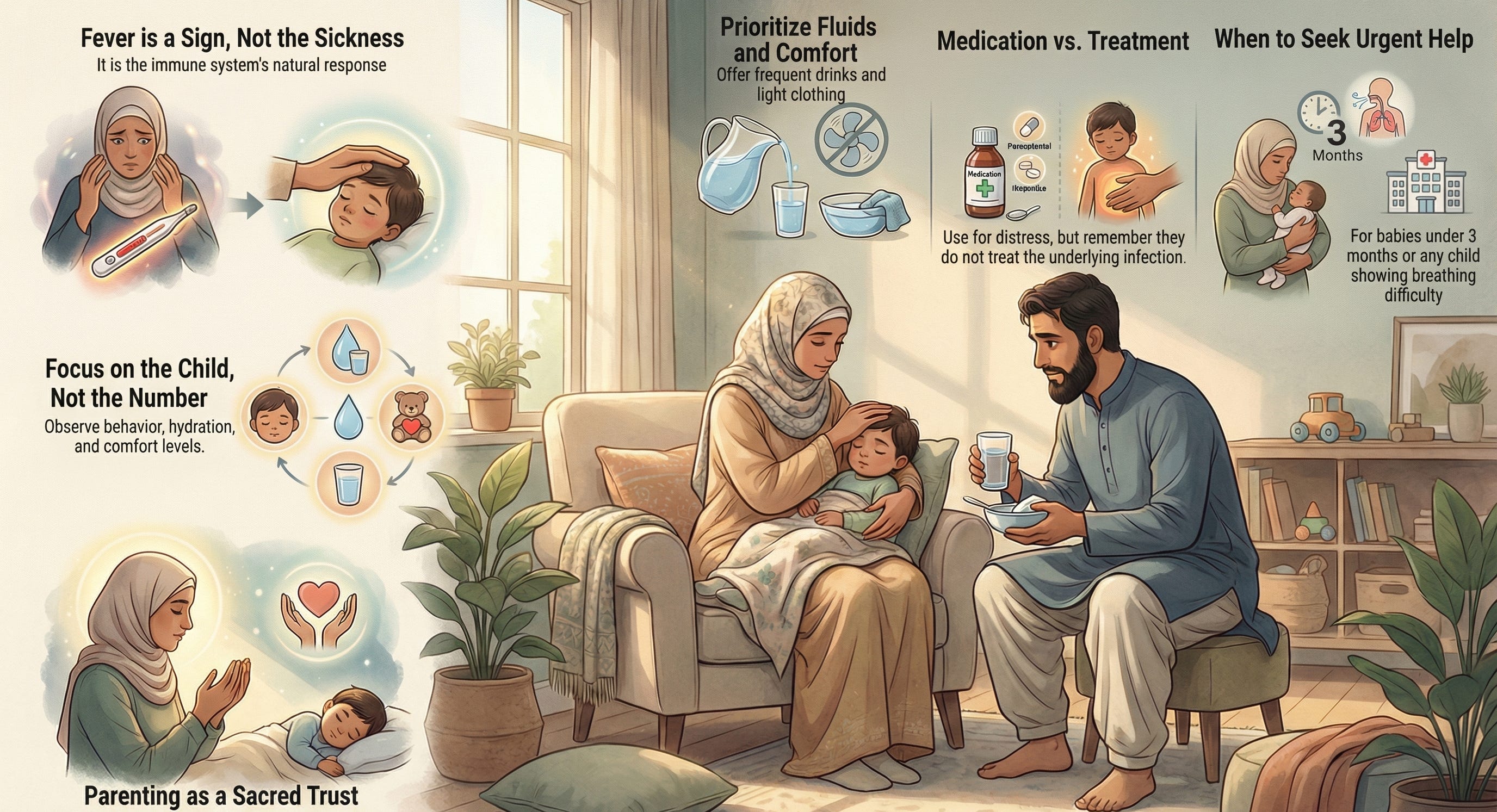
A fever means the body temperature has gone above 38°C. The usual range sits around 36.5°C to 38°C. But fever itself is not an illness. Most of the time, it is the body responding to infection, inflammation, or another trigger. [1] [2] [3] [7] [9] [12] [13]
That matters, because many parents see the number and feel as if the fever itself is the main danger.
Usually, it is not.
Often the fever is simply evidence that the immune system has noticed something and is reacting. Viral infections are the most common cause. Colds, flu, sore throats, ear infections, gastroenteritis, urinary infections, pneumonia, and other childhood illnesses can all bring fever with them. Less commonly, fever can also happen after medicines, vaccines, or inflammatory conditions. [1] [2] [7] [9]
Sometimes the temperature rises slowly. Sometimes it seems to leap up. A child may shiver while it is climbing, then sweat when it begins to fall. The pattern is not always neat.
The number matters less than the child in front of you
This is one of the gentlest but most important shifts a parent can make.
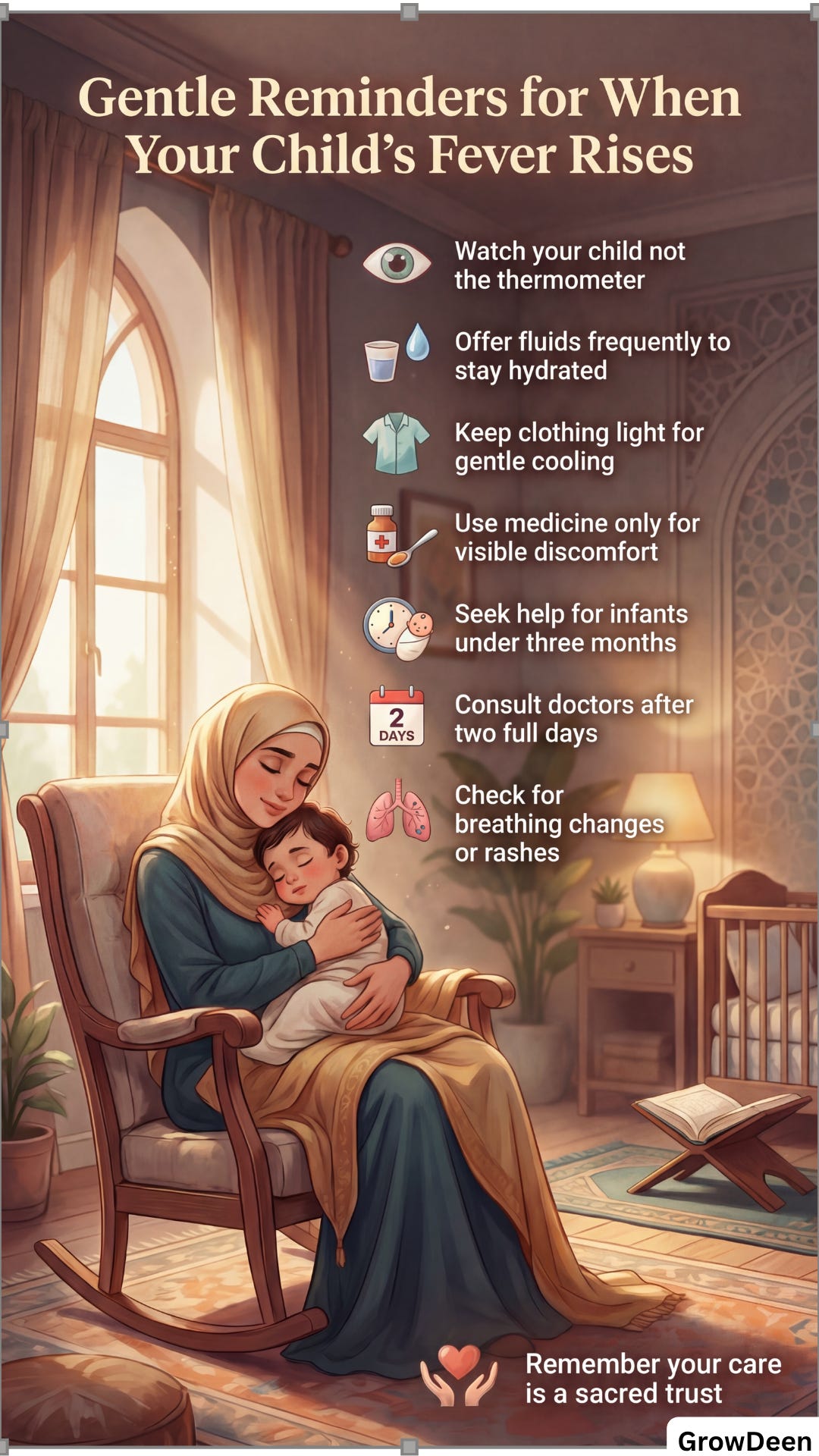
Do not look only at the thermometer. Look at your child.
Some children cope surprisingly well with fever. Others feel miserable. Some want to sleep. Some cling. Some stop drinking well. Some become floppy, irritable, or unusually quiet. What matters most is not only how high the number is, but how the child is coping and whether they are showing signs that something more serious may be happening. [7] [9] [13]
That is why fever medicine is not needed just because the number is high. It is better used when the child feels hot, distressed, or clearly uncomfortable. [6] [7] [9] [10] [13]
Paracetamol and ibuprofen can help with comfort. They do not treat the infection itself. They do not remove the cause. They simply help the child feel better while the body keeps doing its work. [4] [6] [10] [11] [13]
And there is another gentler truth here too. Fever can be exhausting and upsetting, but it is not meaningless in the sight of Allah. When Ibn Masʿud رضي الله عنه found the Prophet ﷺ suffering from severe fever, the Prophet ﷺ explained that the believer is rewarded through affliction, and that even a thorn prick can become a means of sins falling away. [22] That does not mean we stop seeking treatment or comfort. It means a difficult night with a feverish child is not empty in Allah’s sight.
Allah’s trust appears sharply in moments like this
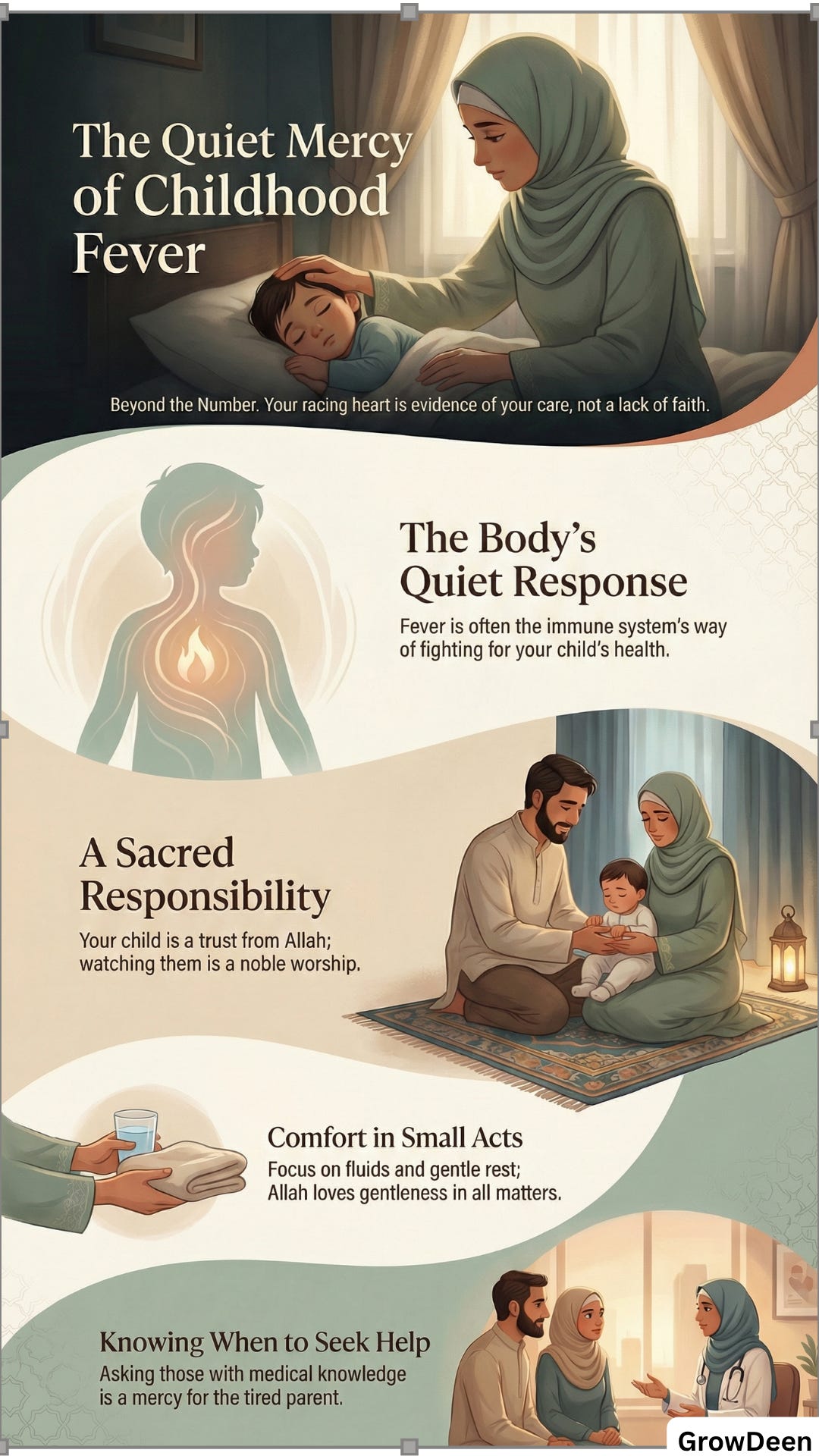
When a child is unwell, the ordinary weight of parenting becomes very real.
Allah says, “Indeed, Allah commands you to render trusts to whom they are due.” [14]
A child’s body is part of that trust.
And the Prophet ﷺ said, “Each of you is a shepherd and each of you is responsible for his flock.” [15]
That responsibility is not only in the big life decisions. It is here too. In watching carefully. In noticing changes. In deciding whether the child needs fluids, rest, medicine, or medical help. This is not small in the sight of Allah.
And if you feel unsure, that does not mean you are weak. Allah says, “Ask the people of knowledge if you do not know.” [16]
There is mercy in that verse for tired parents. You do not have to carry uncertainty alone.
Some children need urgent help much sooner
This part matters deeply.
If a baby aged 0 to 3 months has a fever, they need immediate medical assessment. The same urgency applies to a child of any age who has a weak immune system and develops fever. [7] [8] [9] [12]
For children older than 3 months, a broader picture matters. Medical review is needed if the fever lasts more than 2 days, or if the child seems to be getting worse instead of slowly improving. The same is true if there is breathing difficulty, drowsiness, refusal to drink, passing urine less often, signs of dehydration, stiff neck, severe headache, sensitivity to light, vomiting, rash, febrile seizure, or pain that is not easing with suitable medicine. [7] [9]
If any of these are severe, or your child worsens quickly, do not sit with it too long.
This is not a moment for brave guessing.
Comfort often looks simpler than frightened parents expect
At home, the first priorities are usually fluids and comfort.
A child with fever needs enough to drink so they do not slide toward dehydration. They may not want much food, and that is often fine for a while. Drinking matters more in the short term. [7] [9]
Clothing should stay light. Usually one layer less than the child would normally wear is enough. Cool baths, sponging, and fans are best avoided because they often make children more uncomfortable instead of helping. [5] [7] [9]
Ibuprofen can be used if the child is older than 3 months. Paracetamol can also be used when fever is making the child uncomfortable. [6] [9] [10] [11] [13] But if medicine is needed for more than 48 hours, the child should be reviewed by a doctor. [7] [9] [10] [13]
There is something deeply calming in remembering that fever care is not usually about doing many things.
It is about doing the right simple things carefully.
And along with those simple means, there is room for duʿa. One of the beautiful authentic supplications that fits a feverish child so naturally is the ruqyah taught by Jibril عليه السلام to the Prophet ﷺ:
بِاسْمِ اللَّهِ أَرْقِيكَ، مِنْ كُلِّ شَيْءٍ يُؤْذِيكَ، مِنْ شَرِّ كُلِّ نَفْسٍ أَوْ عَيْنِ حَاسِدٍ، اللَّهُ يَشْفِيكَ، بِاسْمِ اللَّهِ أَرْقِيكَ
In the name of Allah I perform ruqyah for you, from everything that is harming you, from the evil of every soul or envious eye. May Allah heal you. In the name of Allah I perform ruqyah for you. [23]
That duʿa brings such tenderness into the room. Not panic. Not helplessness. Just a parent taking the means and turning their heart toward Ash Shaafi, the One who truly heals.
If writing like this helps you feel more steady in the real moments of parenting, subscribe for free so each new article and life gift reaches you right when you need it.
Some “helpful” things are not actually safe
When a child is hot and miserable, it is easy to reach for whatever seems strong or familiar.
But aspirin should not be given to children unless a doctor has specifically prescribed it. In children, it can increase the risk of Reye’s syndrome, a rare but potentially fatal illness. It can also cause serious harm in a child who has chickenpox or flu symptoms. [7] [9] [13]
And antibiotics are not fever medicine. If the fever is caused by a bacterial infection, antibiotics may be needed to treat that infection. But antibiotics do not treat fever by itself, and they are not the answer to every febrile child. [2] [7] [9]
Sometimes the wisest care is not adding more.
It is refusing the wrong thing.
Mercy is often quiet in a feverish room
Illness changes the whole mood of a home.
Children become clingy, frightened, limp, restless, or miserable. Parents become tired. Night feels longer. Small decisions suddenly feel weighty.
Allah says, “Allah does not burden a soul beyond that it can bear.” [18]
And Allah says, “Do not throw yourselves with your own hands into destruction.” [19]
So fever care is not about ignoring danger signs out of hope that things will just settle. Nor is it about panicking over every rise in temperature. It is careful mercy. Thoughtful mercy.
The Prophet ﷺ said, “Allah is gentle and loves gentleness in all matters.” [17]
And he ﷺ said, “The merciful are shown mercy by the Most Merciful. Show mercy to those on the earth and the One above the heavens will show mercy to you.” [21]
Sometimes mercy in fever looks like a cool drink offered again. A medicine given only because the child truly needs comfort. A hand resting on their back. A decision not to wait too long when something no longer feels right.
These are small acts.
But they are not small to Allah.
GIFTS FOR YOU, DEAR PARENT
If you’ve reached this part of the page, it tells me something meaningful about you.
You weren’t just skimming or passing time. You stayed because something here felt relevant to your real life.
Because you care.
Because you want to do things with more awareness.
Because you’re trying, even when it feels overwhelming.
That is not small.
So I didn’t want this article to remain just words on a page. I wanted it to gently step into your daily life in practical ways. That’s why we prepared these Life Gifts for you.
Not as extras.
Not as decorations.
But as simple tools to help you hold onto what mattered most in what you just read.
Here’s what you’ll find inside:
Gentle Understanding Card
A clear and simplified summary of the core concept from this article, so you can revisit the main idea anytime without rereading everything.
Heartfelt Dua Card
A carefully chosen dua connected to this stage of life, because we know that real strength and ease ultimately come from Allah’s help.
Gentle Actions Card
Practical examples to help you translate knowledge into action, so what you learned becomes part of your daily rhythm.
Gentle Reminders Card
Short, steady reminders drawn from the key points, designed to be printed or saved and placed somewhere you’ll see often.
These were designed slowly and thoughtfully, with time, care, and sincere dua. We created them because we genuinely want to walk alongside you, not just through one article, but through every stage of this lifelong journey.
If these gifts support you even in a small way, I would love for you to continue receiving them.
Subscribe so that each new Gift arrives directly in your inbox whenever we release the next stage. That way, you won’t miss the tools designed to support you right where you are.
May Allah place barakah in your effort, accept your intention, and make this path easier and more rewarding than it feels right now.
Please share it with a family/friend who may benefit from this knowledge.
What is one moment with your child that feels hardest lately, and what kind of support would make it feel lighter?
Subscribe for free to keep receiving gentle, research rooted, Islamically grounded support for the real moments of parenting.
References
[1] Barbi, E., Marzuillo, P., Neri, E., Naviglio, S., & Krauss, B.S. (2017). Fever in children: Pearls and pitfalls. Children, 4(9), Article 81.
[2] Curtis, N., Starr, M., & Osowicki, J. (2020). Infectious diseases. In K. Harding, D.S. Mason & D. Efron (Eds), Paediatric handbook (10th edn, pp. 301-335). Wiley-Blackwell.
[3] Harden, L.M., Kent, S., Pittman, Q.J., & Roth, J. (2015). Fever and sickness behavior: Friend or foe? Brain, Behavior, and Immunity, 50, 322-333.
[4] Hay, A.D., Costelloe, C., Redmond, N.M., Montgomery, A.A., Fletcher, M., Hollinghurst, S., & Peters, T.J. (2009). Paracetamol plus ibuprofen for the treatment of fever in children (PITCH): Randomised controlled trial. British Medical Journal, 337, Article a1302.
[5] Meremikwu, M.M., & Oyo-Ita, A. (2002). Paracetamol versus placebo or physical methods for treating fever in children. Cochrane Database of Systematic Reviews, 2002(2), CD003676.
[6] Narayan, K., Cooper, S., Morphet, J., & Innes, K. (2017). Effectiveness of paracetamol versus ibuprofen administration in febrile children: A systematic literature review. Journal of Paediatrics and Child Health, 53(8), 800-807.
[7] National Institute for Health and Care Excellence (NICE). (2019, updated 2021). Fever in under 5s: Assessment and initial management [NG143]. NICE.
[8] Palazzi, D.L. (2023). Fever of unknown origin in children: Evaluation. UpToDate.
[9] The Royal Children’s Hospital (RCH). (2022). Febrile child.
[10] The Royal Children’s Hospital (RCH). (2020). Pain relief for children – paracetamol and ibuprofen.
[11] Southey, E.R., Soares-Weiser, K., & Kleijnen, J. (2009). Systematic review and meta-analysis of the clinical safety and tolerability of ibuprofen compared with paracetamol in paediatric pain and fever. Current Medical Research and Opinion, 25(9), 2207-2222.
[12] Starr, M. (2016). Febrile infants and children in the emergency department: Reducing fever to its simplest form. Journal of Paediatrics and Child Health, 52(2), 109-111.
[13] Sullivan, J.E., & Farrar, H.C. (2011). Fever and antipyretic use in children. Pediatrics, 127(3), 580-587.
[14] Qur’an, Surah An-Nisa 4:58
[15] Sahih al-Bukhari, Hadith 7138; Sahih Muslim, Hadith 1829
[16] Qur’an, Surah An-Nahl 16:43
[17] Sahih Muslim, Hadith 2593
[18] Qur’an, Surah Al-Baqarah 2:286
[19] Qur’an, Surah Al-Baqarah 2:195
[20] Sahih al-Bukhari, Hadith 5199
[21] Jami` at-Tirmidhi, Hadith 1924
[22] Sahih al-Bukhari, Hadith 5648; Sahih al-Bukhari, Hadith 5667
[23] Sahih Muslim, Hadith 2186