
What 15 Years of Sleep Research Reveals About Newborns, Toddlers, and Teens
What the Research Says About Children's Sleep That Most Parents Never Hear

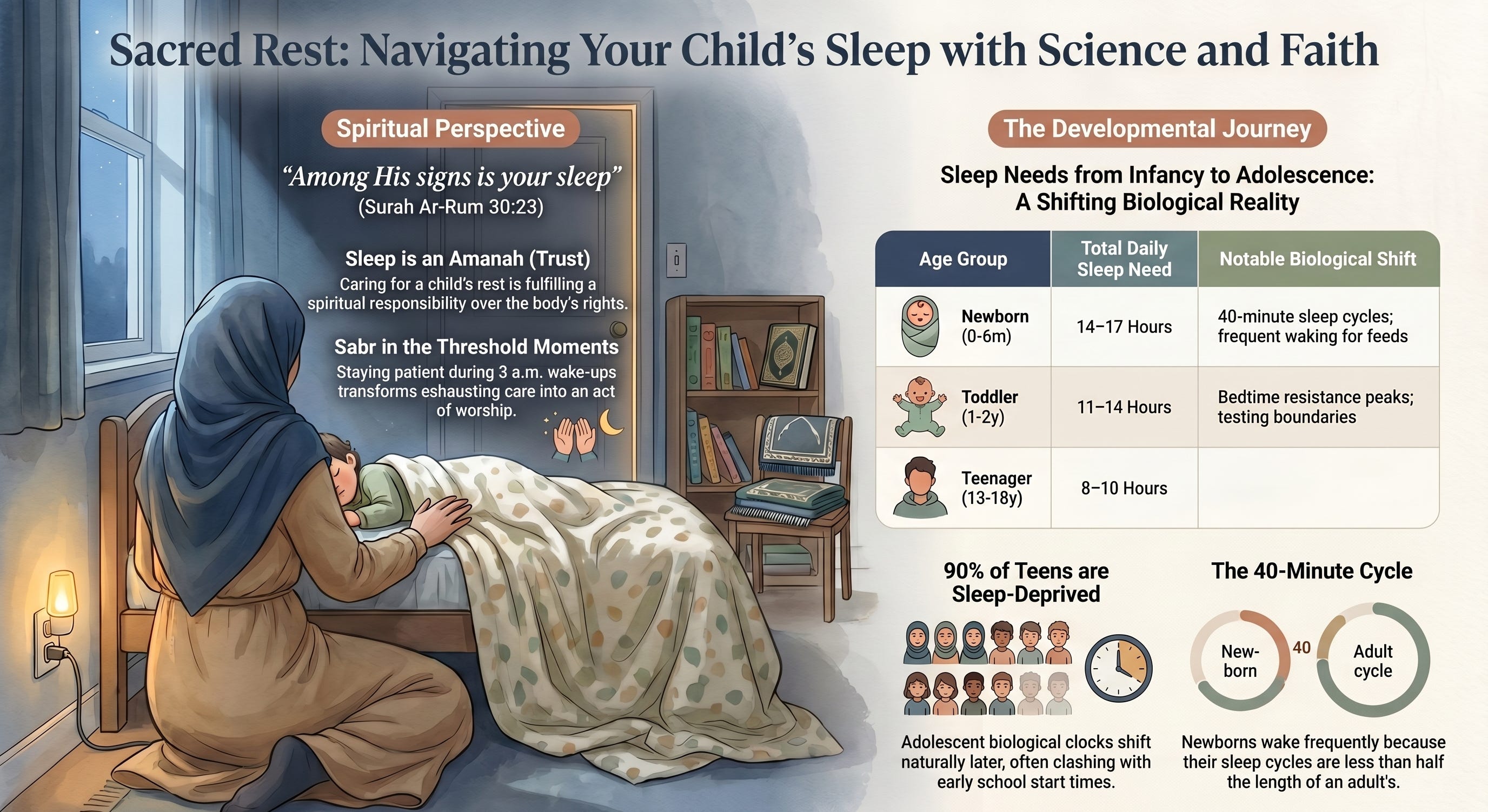
Research shows over 90% of adolescents don’t get enough sleep on school nights, and one-third of parents report infant sleep struggles. [1] This guide walks you through what’s actually normal at every age — from newborn night wakings to teenage circadian shifts — so you can stop second-guessing and start supporting your child’s rest with confidence.
Your newborn wakes for the fourth time tonight. You’re running on three hours of sleep, wondering if you’re doing something wrong.
You’re not.
When I studied the research on infant sleep patterns, one truth kept surfacing: what looks like a problem is often just biology. Newborns wake frequently because their sleep cycles last only 40 minutes. [2] Toddlers fight bedtime because they’re testing boundaries at exactly the age they’re supposed to. Teenagers want to stay up late because their circadian rhythm has actually shifted — it’s not defiance.
Here’s what the National Sleep Foundation found: sleep needs change dramatically from birth through adolescence, and most parents are navigating these stages without knowing what’s actually normal. [3] Over one-third of parents report that their baby has sleep difficulties between six and twelve months. [4] But many of those “difficulties” are just developmental patterns, not failures.
Why This Guide Is Different
Research-backed and current. Every recommendation comes from peer-reviewed studies published between 2003 and 2019, including guidelines from the National Sleep Foundation and longitudinal research tracking children from birth to age nine.
Islamic wisdom woven in. Sleep isn’t just a medical topic — the Qur’an describes it as one of Allah’s signs. This guide connects the science of rest to the spiritual responsibility of caring for what’s been entrusted to you.
Actionable companion resource. You’ll get a free Sleep by Age Reference Guide (3-page PDF) to print and keep on your nightstand — quick-reference charts showing exactly how much sleep your child needs at every stage, plus red flags that signal when to seek help.
What Actually Happens During Sleep (And Why It Matters)
Sleep isn’t just “time off.” During sleep, children’s bodies release growth hormone. Their brains consolidate what they learned that day. Their immune systems strengthen. [5]
The Qur’an says, “And among His signs is your sleep by night and by day, and your seeking of His bounty.” [6] Sleep is mercy made biological. It’s when growth happens, when memories form, when young bodies repair themselves.
But here’s the thing: sleep looks completely different at six months than it does at six years. And parents who don’t know this spend months worrying about patterns that are actually normal.
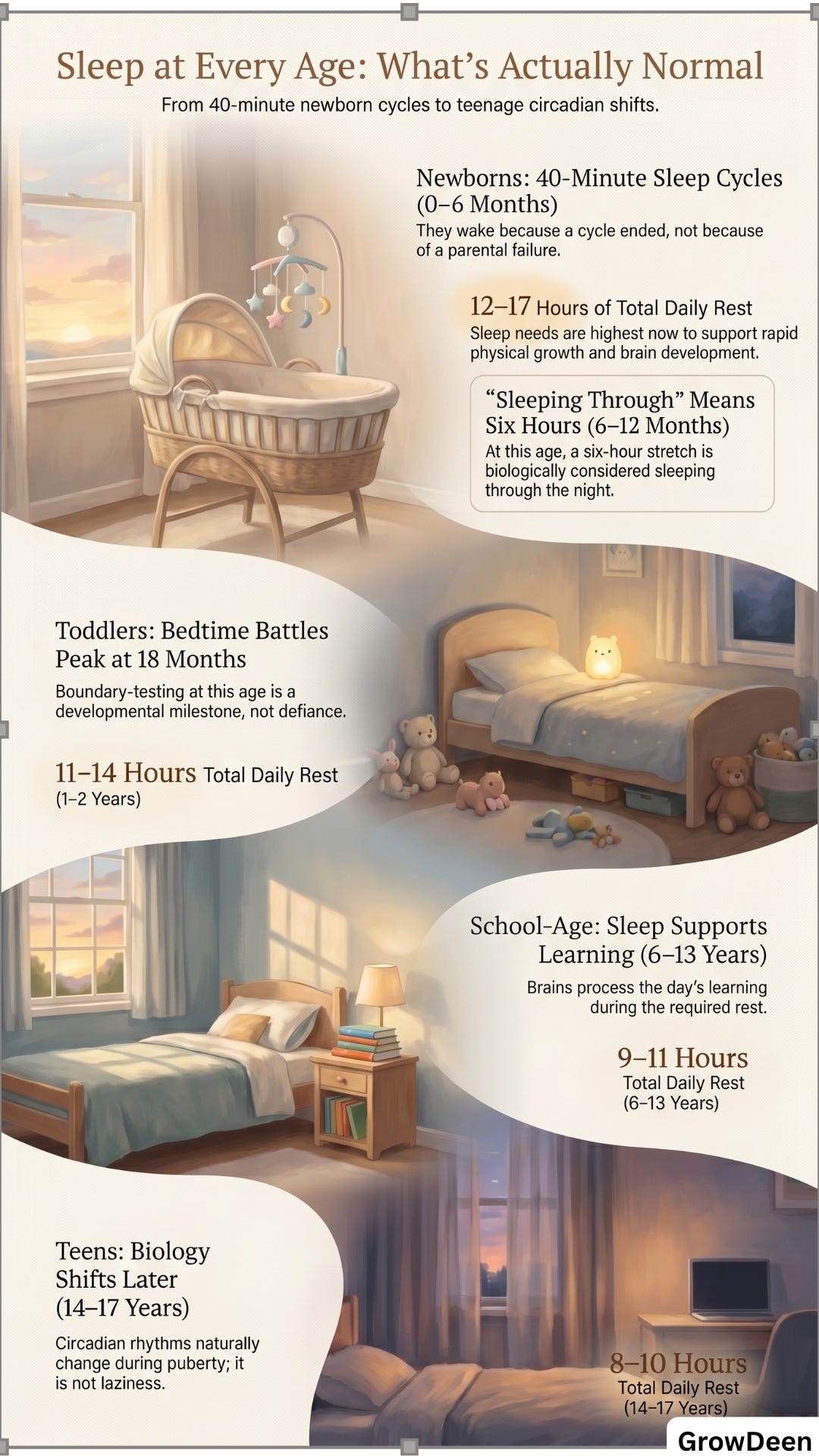
Newborns: The First Six Months (14-17 Hours Total)
Newborns don’t know the difference between 2 a.m. and 2 p.m. They sleep in short bursts — 14 to 17 hours total across the whole day. [7] They wake frequently because their stomachs are tiny and they need to eat often.
Here’s what surprised me when I dug into the research: newborns cycle between active sleep (where you see jerking or sucking motions) and quiet sleep (where they’re still and breathing evenly). These cycles last about 40 minutes. [8] That’s why your baby wakes up just when you thought they were finally settled. They’ve completed a cycle and don’t yet know how to transition to the next one without help.
By three months, something shifts. Babies start developing circadian rhythms — internal clocks that help them recognize day from night. [9] They begin sleeping longer stretches at night, though “sleeping through the night” might mean five or six hours, not the full eight you’re hoping for.
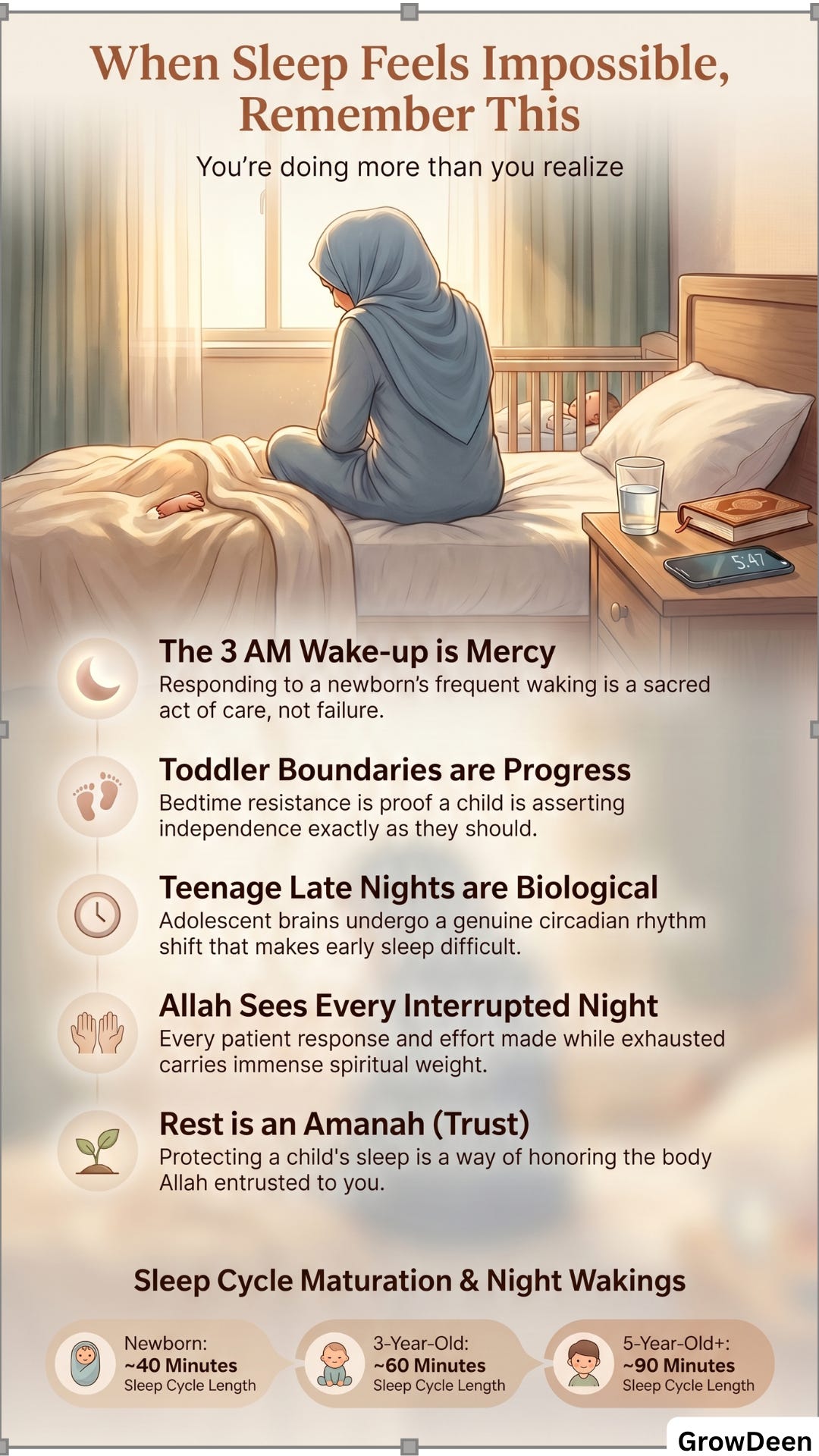
The Prophet Muhammad ﷺ showed tenderness toward children’s needs, even shortening his prayer when he heard a baby crying. [10] That 3 a.m. wake-up you’re responding to? That’s not weakness. That’s mercy.
Babies 6-12 Months: When Patterns Emerge (12-15 Hours Total)
Between six and twelve months, most babies sleep 12 to 15 hours in a 24-hour period, with more of it happening at night. [11] By six months, many babies can sleep a six-hour stretch. [12]
Almost two-thirds of babies this age still wake at least once during the night and need help settling. [13] That’s normal. About one in ten babies calls out three to four times per night. Also normal.
Here’s why: babies this age are learning new skills. When your baby is mastering how to sit up or crawl, their brain stays active even during sleep. They wake more as these neural pathways develop. It’s temporary, but when you’re the one soothing them back to sleep at 2 a.m., “temporary” feels eternal.
One-third of parents say their baby has sleep problems during this stage. [14] But often, what feels like a problem is just development doing what it’s supposed to do.
I know this is a lot to track, especially when you’re managing nighttime wake-ups and trying to remember which stage means what. That’s why I’ve created a free Sleep by Age Reference Guide — a printable 3-page PDF with quick-reference charts showing how much sleep your child needs at every age, what’s normal, and what’s not. Keep reading to download it at the end of this article — it’s designed to stay on your nightstand where you’ll actually use it.
Toddlers: The Bedtime Battles (11-14 Hours Total)
Toddlers need 11 to 14 hours of sleep every 24 hours — usually 10 to 12 hours at night plus a one- to two-hour nap. [15]
But toddlers have opinions now. They’re testing boundaries, asserting independence, and bedtime becomes a negotiation. This is the most common sleep complaint parents report, and it peaks around 18 months. [16] Your toddler wants one more story, one more drink of water, one more hug. They want to stay up with the family.
Fewer than 5% of two-year-olds wake three or more times overnight. [17] If your toddler is waking that frequently, it’s worth examining their daytime routine and sleep environment.
Allah says in the Qur’an, “O you who have believed, seek help through patience and prayer.” [18] Those bedtime struggles test your patience. They’re also opportunities to practice sabr — staying calm and consistent even when you’re exhausted.
Preschoolers: Naps Start Fading (10-13 Hours)
Children aged three to five need 10 to 13 hours of sleep at night. [19] Many still take a short nap during the day, usually about an hour. But as they get enough nighttime sleep, those naps naturally fade.
Preschoolers can handle more independence now. They can brush their teeth, put on pajamas, choose a bedtime story. Giving them small choices within the routine helps them feel control while you maintain structure.
This is also when fears surface. Fear of the dark. Fear of monsters. Fear of being alone. These aren’t manipulations — they’re real anxieties that need gentle reassurance.
School-Age Children: Rest Supports Learning (9-11 Hours)
Once children start school, they need 9 to 11 hours of sleep each night. [20] School-age children rarely nap unless they’re sick or didn’t sleep well the night before. If your child frequently asks to nap after school, check whether they’re getting enough sleep at night. [21]
Primary school children are often tired by 7:30 p.m. Their bodies are growing, their brains are processing a full day of learning, and they genuinely need that rest.
Sleep supports cognitive function at this stage. Children who get enough sleep perform better academically, regulate emotions better, and have fewer behavioral issues. [22]
The Prophet ﷺ encouraged sleeping after Isha and waking early, aligning rest with natural rhythms. [23] This practice can help children develop lifelong healthy sleep habits.
Teenagers: The Biological Night Owl (8-10 Hours)
Adolescents need 8 to 10 hours of sleep per night. [24] But here’s what changes during puberty: their circadian rhythm shifts. It becomes biologically natural for teenagers to want to stay up later and sleep later in the morning. [25]
This isn’t laziness. It’s biology.
But when school starts early, teenagers end up chronically sleep-deprived. Over 90% of adolescents don’t get the recommended amount of sleep on school nights. [26]
The consequences are serious. Lack of sleep during these years has been linked to depression, anxiety, poor academic performance, and increased risk of accidents. [27]
Parents can help by encouraging good sleep hygiene: limiting screens before bed, keeping bedrooms dark and cool, maintaining consistent schedules. Allah has entrusted you with your child’s care — that amanah includes protecting their rest.
How Sleep Cycles Work (And Why Kids Wake at Night)
We all cycle through deep sleep, light sleep, and brief wakings during the night. From about six months onward, a sleep cycle includes REM (rapid eye movement) sleep and non-REM sleep. [28]
Children have a lot of deep non-REM sleep in the first few hours after falling asleep. [29] That’s why they sleep so soundly early in the night. Later, they spend more time in REM and light sleep, so they wake more easily toward morning.
Sleep cycles get longer as children grow. A three-year-old’s cycle lasts about 60 minutes. By age five, it’s matured to 90 minutes. [30] Children often wake briefly at the end of each cycle. Most don’t remember it. But some call out and need help settling.
Understanding this helps you respond with more patience. That 3 a.m. wake-up isn’t defiance. It’s biology.
The Islamic Perspective: Rest as Responsibility
Sleep is a trust. Your child’s body is an amanah given to you by Allah. Ensuring they get adequate rest is part of fulfilling that responsibility.
The Qur’an reminds us: “And do not kill yourselves, for indeed Allah is to you ever Merciful.” [31] Scholars extend this to include neglecting the body’s needs — including sleep.
The Prophet Muhammad ﷺ said, “Your body has a right over you.” [32] This applies to children too. Their growing bodies and developing brains need rest. When you prioritize sleep, you honor that right.
Some parents feel guilty enforcing bedtime when their child resists. But structure is mercy. It teaches children that rest matters, that their bodies deserve care, that there are rhythms to life that support wellbeing.
Patience is required at every stage. The mother soothing a newborn at 2 a.m. The father redirecting a toddler back to bed. The parent setting boundaries around a teenager’s late-night phone use. These acts, done with the intention of caring for what Allah entrusted to you, carry spiritual weight.
What You Can Do Right Now
Sleep needs change as children grow. What looks like a problem at one stage is often just normal development.
The goal isn’t perfection. It’s progress. Small, consistent efforts pay off. A bedtime routine. A dark, quiet room. Age-appropriate schedules. These simple practices make a difference.
And when you’re exhausted, when you’ve been woken for the fourth time tonight, remember: Allah sees your effort. He knows the weariness, the sacrifice, the patience required to meet your child’s needs hour after hour.
The Qur’an says, “Indeed, with hardship comes ease.” [33] That ease will come. Children do eventually sleep through the night. Toddlers do stop fighting bedtime. Teenagers do learn the value of rest.
Until then, you do what you can. You respond with mercy. You stay consistent. You protect their sleep. And you trust that this investment in their rest is an investment in their growth, their health, their future.
Your Free Sleep by Age Reference Guide
If you’ve read this far, you’re the kind of parent who takes your child’s wellbeing seriously — not as paranoia, but as protective love.
Inside the Sleep by Age Reference Guide (one comprehensive PDF, 3 pages):
Page 1: Quick-Reference Sleep Chart — How much sleep your child needs from newborn to age 18, organized by age range with typical wake windows and nap schedules — designed like a laminated card you can keep on your nightstand.
Page 2: Red Flags & When to Seek Help — Clear signs that distinguish normal developmental sleep patterns from genuine sleep disorders — so you know when to trust the process and when to call your pediatrician.
Page 3: Islamic Du’as for Bedtime — Authentic Prophetic supplications you can say with your child before sleep — organized by age so you can teach them gradually as they grow.
This isn’t just a PDF to download and forget. It’s a tool designed to stay in your home — where you’ll actually use it when you need it most.
This Sleep by Age Reference Guide is what every GrowDeen subscriber receives with each article. We cover the full journey of raising Muslim children, all backed by scientific research and rooted in Islamic wisdom.
If you’re a Muslim parent who wants both evidence-based guidance AND Islamic perspective, subscribe for free so future resources arrive in your inbox before you need them.
You’ll receive guidance when it’s ready — no clutter, just guidance when there’s something valuable to share.
Before You Go: Check Your Child’s Bedtime Tonight
Don’t just think about this. Do it tonight: look at what time your child actually went to sleep, then count backward to when they need to wake up. Are they getting the hours they need for their age?
If not, shift bedtime earlier by 15 minutes this week. Just 15 minutes. You don’t have to fix everything at once.
May Allah place barakah in your effort, ease your nights, and grant your children rest that restores them.
Share This With One Exhausted Parent You Know
Think of one person right now: the new mother in your family who’s been up every two hours with her newborn, the friend whose toddler has turned bedtime into a two-hour ordeal, the sister whose teenager is sleeping through Fajr because they stayed up until 2 a.m.
This article could give them permission to stop blaming themselves. Share it with them today — not as advice-giving, but as support. Sometimes the most loving thing we can do is share what finally helped us understand.
Frequently Asked Questions
Q: My 8-month-old was sleeping through the night but suddenly started waking again. What happened?
A: This is often called a sleep regression, and it’s tied to developmental leaps. When babies are learning new skills like crawling or pulling up, their brains stay active during sleep. [34] This usually resolves within 2-4 weeks once the skill is mastered. Stay consistent with your bedtime routine and respond calmly to night wakings. For more detail on managing this stage, see the section “Babies 6-12 Months: When Patterns Emerge” above.
Q: How do I know if my child has a real sleep disorder or if this is just a phase?
A: Normal developmental sleep challenges improve with consistency and time. Red flags that suggest a disorder include: loud snoring, pauses in breathing during sleep, extreme difficulty waking in the morning despite adequate sleep hours, or daytime sleepiness that interferes with activities. [35] If you’re concerned, talk to your pediatrician.
Q: Is it normal for my toddler to fight bedtime every single night?
A: Yes. Bedtime resistance peaks around 18 months and gradually improves with age. [36] About one-third of parents report this as their biggest sleep challenge during toddlerhood. The key is staying consistent: same routine, same time, calm but firm boundaries. Your toddler is testing limits, which is exactly what they’re supposed to do at this stage.
Q: Should I wake my teenager for Fajr if they didn’t go to sleep until midnight?
A: This is a balance between religious obligation and biological need. Teenagers’ circadian rhythms genuinely shift during puberty, making early sleep difficult. [37] Work with your teen to establish an earlier bedtime that allows both adequate sleep and time for Fajr. If they’re chronically sleep-deprived, consult with a knowledgeable scholar about accommodations while addressing the root issue of late bedtimes.
Q: My 5-year-old still naps during the day. Is that okay?
A: Some five-year-olds still need a short nap, but many don’t. [38] The question is whether they’re getting enough nighttime sleep. If your child is sleeping 10-13 hours at night and still seems tired during the day, the nap is fine. But if the nap is making bedtime difficult, it might be time to phase it out. Watch for their cues.
Q: How much sleep do newborns actually need in the first month?
A: Newborns typically sleep 14-17 hours total in every 24-hour period, but it’s broken into short stretches of 2-4 hours because they need to feed frequently. [39] They don’t distinguish between night and day yet, which is why those first weeks feel so exhausting. This pattern starts to shift around 6-12 weeks when circadian rhythms develop.
References
[1] Owens, J., Adolescent Sleep Working Group, Committee on Adolescence, et al. (2014). Insufficient sleep in adolescents and young adults: An update on causes and consequences. Pediatrics, 134(3), Article e921. https://doi.org/10.1542/peds.2014-1696
[2] Davis, K.F., Parker, K.P., & Montgomery, G.L. (2004). Sleep in infants and young children: Part One: Normal sleep. Journal of Pediatric Health Care, 18(2), 65-71. https://doi.org/10.1016/S08915245(03)00149-4
[3] Hirshkowitz, M., Whiton, K., Albert, S.M., et al. (2015). National Sleep Foundation’s sleep time duration recommendations: Methodology and results summary. Sleep Health, 1(1), 40-43. https://doi.org/10.1016/j.sleh.2014.12.010
[4] Hiscock, H., & Davey, M. (2012). Sleep disorders in infants and children. Journal of Paediatrics and Child Health, 54(9), 941-944. https://doi.org/10.1111/jpc.12033
[5] Siegel, J.M. (2005). Functional implications of sleep development. PLoS Biology, 3(5), Article e178. https://doi.org/10.1371/journal.pbio.0030178
[6] Qur’an, Surah Ar-Rum 30:23
[7] Hirshkowitz, M., et al. (2015). National Sleep Foundation’s sleep time duration recommendations.
[8] Davis, K.F., et al. (2004). Sleep in infants and young children: Part One.
[9] Camerota, M., Propper, C.B., & Teti, D.M. (2019). Intrinsic and extrinsic factors predicting infant sleep: Moving beyond main effects. Developmental Review, 53(4), Article 100871. https://doi.org/10.1016/j.dr.2019.100871
[10] Sahih al-Bukhari 707
[11] Hirshkowitz, M., et al. (2015). National Sleep Foundation’s sleep time duration recommendations.
[12] Price, A., Brown, J., Bittman, M., Wake, M., Quach, J., & Hiscock, H. (2014). Children’s sleep patterns from 0 to 9 years: Australian population longitudinal study. Archives of Disease in Childhood, 99(2), 119-125. https://doi.org/10.1136/archdischild-2013-304150
[13] Centre for Community Child Health. (2006). Settling and sleep problems – Practice resource. The Royal Children’s Hospital. Retrieved from https://ww2.rch.org.au/emplibrary/ccch/PR_Set_Sleep_S2.pdf
[14] Hiscock, H., & Davey, M. (2012). Sleep disorders in infants and children.
[15] Hirshkowitz, M., et al. (2015). National Sleep Foundation’s sleep time duration recommendations.
[16] Carter, K.A, Hathaway, N.E., & Lettieri, C.F. (2014). Common sleep disorders in children. American Family Physician, 89(5), 368-377.
[17] Price, A., et al. (2014). Children’s sleep patterns from 0 to 9 years.
[18] Qur’an, Surah Al-Baqarah 2:153
[19] Hirshkowitz, M., et al. (2015). National Sleep Foundation’s sleep time duration recommendations.
[20] Hirshkowitz, M., et al. (2015). National Sleep Foundation’s sleep time duration recommendations.
[21] Waters, K.A., Suresh, S., & Nixon, G.M.(2013). Sleep disorders in children. The Medical Journal of Australia, 199(8), S31-35. https://doi.org/10.5694/mja13.10621
[22] Tham, E.K., Schneider, N., & Broekman, B.F. (2017). Infant sleep and its relation with cognition and growth: A narrative review. Nature and Science of Sleep, 9, 135-149. https://doi.org/10.2147/NSS.S125992
[23] Sahih Muslim 647
[24] Hirshkowitz, M., et al. (2015). National Sleep Foundation’s sleep time duration recommendations.
[25] Moore, M., & Meltzer, L. (2008). The sleepy adolescent: Causes and consequences of sleepiness in teens. Paediatric Respiratory Reviews, 9(2), 114-121. https://doi.org/10.1016/j.prrv.2008.01.001
[26] Owens, J., et al. (2014). Insufficient sleep in adolescents and young adults.
[27] Bruck, D. (2006). Teenage sleep: Understanding and helping the sleep of 12-20 year olds. Wellness Promotion Unit, Victoria University.
[28] Davis, K.F., Parker, K.P., & Montgomery, G.L. (2004). Sleep in infants and young children: Part two: Common sleep problems. Journal of Pediatric Health Care, 18(3), 130-137. https://doi.org/10.1016/S0891-5245(03)00150-0
[29] Iglowsten, I., Jenni, O.G., Molinari, L., & Largo, R.H. (2003). Sleep duration from infancy to adolescence: Reference values and generational trends. Pediatrics, 111(2), 302-307. https://doi.org/10.1542/peds.111.2.302
[30] Scher, A., Epstein, R., & Tirosh, E. (2004). Stability and changes in sleep regulation: A longitudinal study from 3 months to 3 years. International Journal of Behavioural Development, 28(3), 268-274. https://doi.org/10.1080/01650250344000505
[31] Qur’an, Surah An-Nisa 4:29
[32] Sahih al-Bukhari 5199
[33] Qur’an, Surah Ash-Sharh 94:5-6
[34] Camerota, M., et al. (2019). Intrinsic and extrinsic factors predicting infant sleep.
[35] Waters, K.A., et al. (2013). Sleep disorders in children.
[36] Carter, K.A., et al. (2014). Common sleep disorders in children.
[37] Moore, M., & Meltzer, L. (2008). The sleepy adolescent.
[38] Hirshkowitz, M., et al. (2015). National Sleep Foundation’s sleep time duration recommendations.
[39] Hirshkowitz, M., et al. (2015). National Sleep Foundation’s sleep time duration recommendations.
The content is truly amazing & beneficial. Jazakum Allahu Khairan!