
Warmth, Checks, First Cuddles, And The First Sunnahs After Birth
What Really Happens In Those First Hours With Your Newborn

In the first 24 hours after birth, a newborn is helped through the move from womb to world through warmth, breathing support if needed, early contact, routine checks, essential medicines or immunizations, and the first beautiful Islamic acts of welcome and gratitude.
The baby is finally here.
And suddenly the room fills with everything at once.
Relief. Hands moving quickly. Blankets. Tears. Questions. Someone checking the baby. Someone speaking softly to you. Maybe you are wide awake. Maybe you feel like your body is present but your mind is still catching up.
The first day after birth can feel sacred and overwhelming in the same breath.
Nothing about it is small.
The beginning is not always quiet, but it is still full of care
What happens in those first hours depends on many things. How pregnancy went. How labour unfolded. How birth happened. How well the baby adapts to breathing, warmth, and life outside the womb. [1] [13]
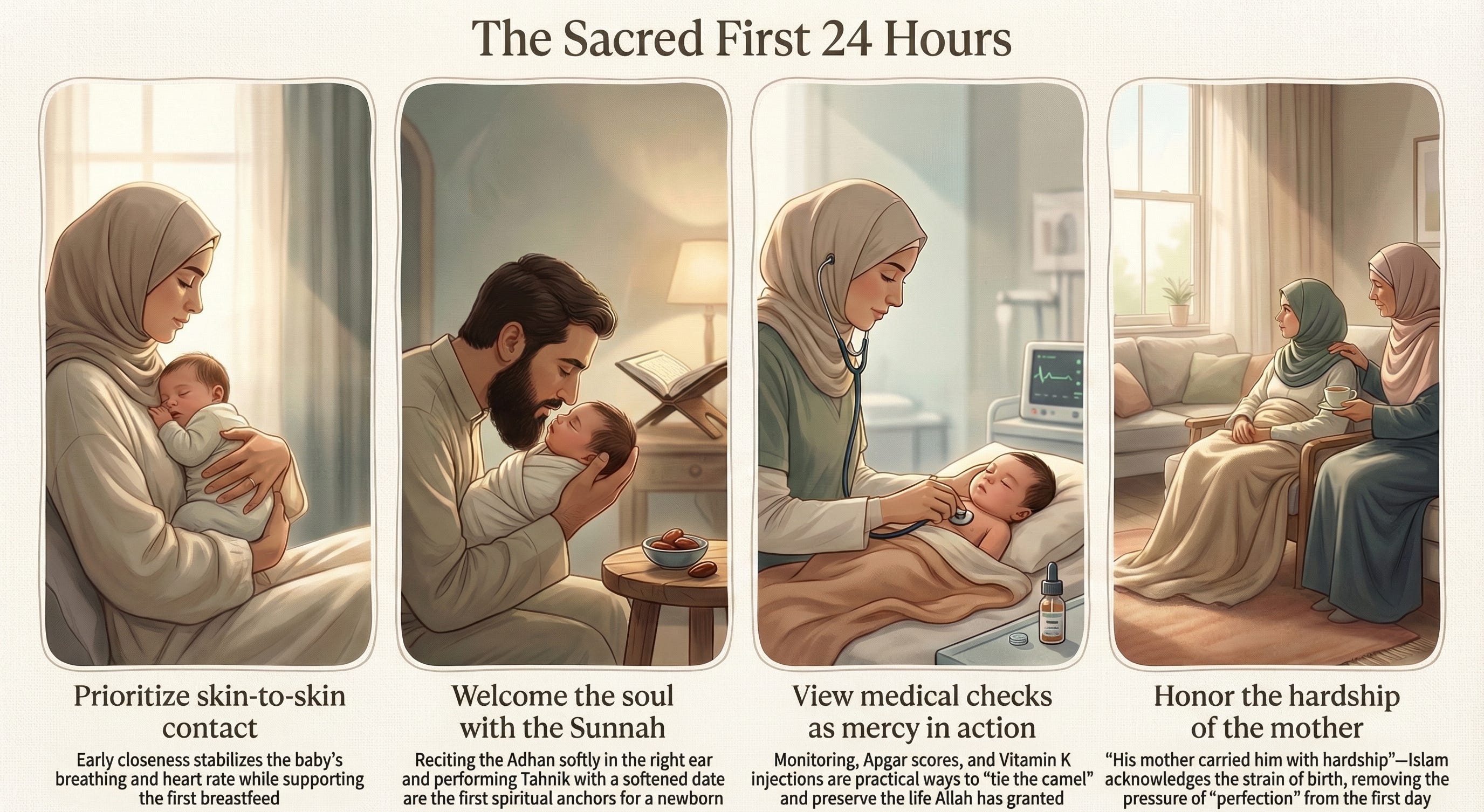
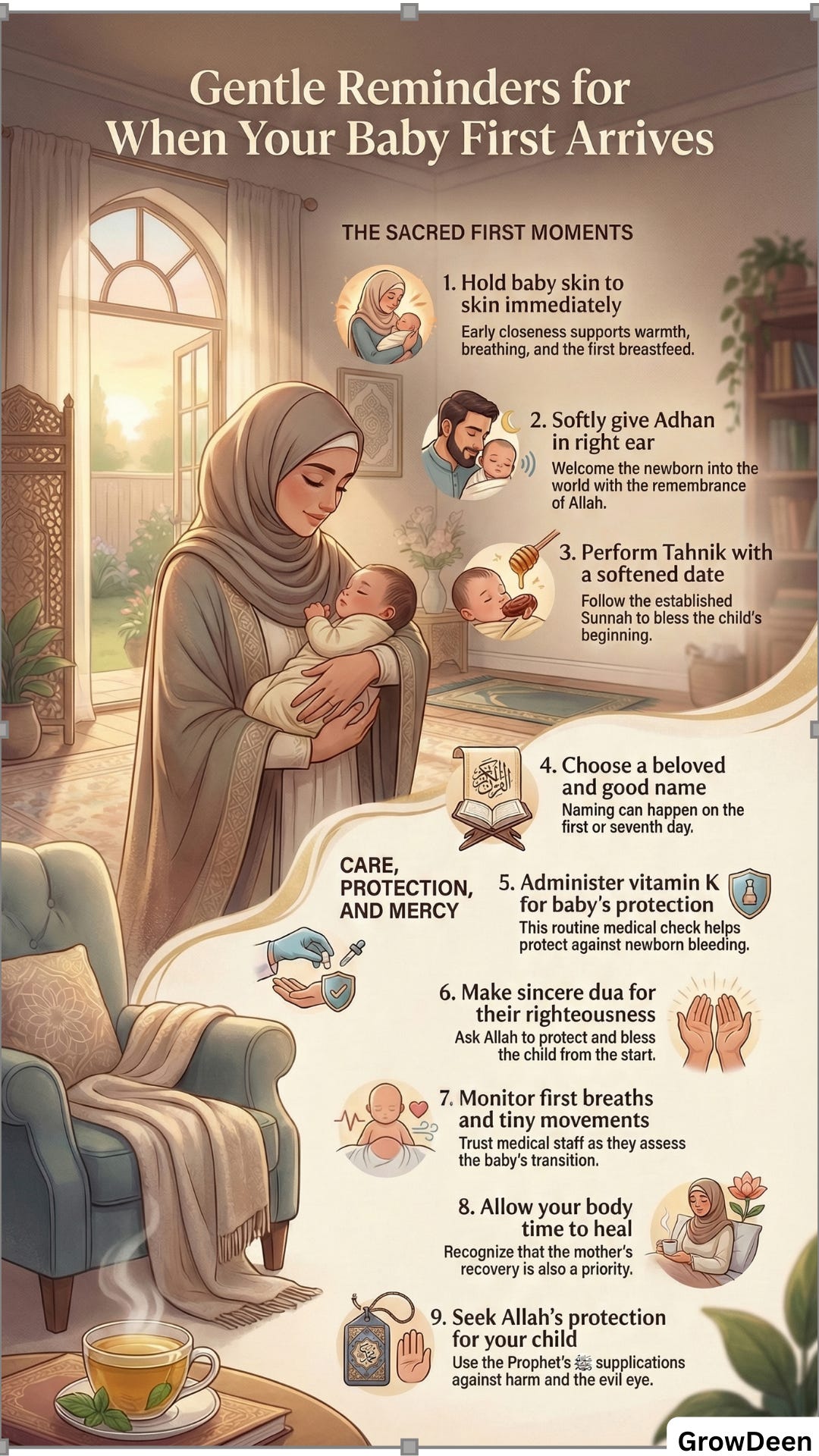
If the baby is born well and breathing strongly, they are often placed skin to skin on the mother’s chest right away. That early closeness helps with warmth, breathing, heart rate, and the first breastfeed. It also supports bonding in a very tender, human way. [10]
If instruments were used, or if birth happened by caesarean, the first hold may still happen early, but sometimes the baby needs a brief check first. And sometimes medical care comes before cuddles.
That can sting.
But it does not mean the beginning is less loving.
Allah’s wisdom in the beginning you did not plan
Some births unfold gently. Some do not.
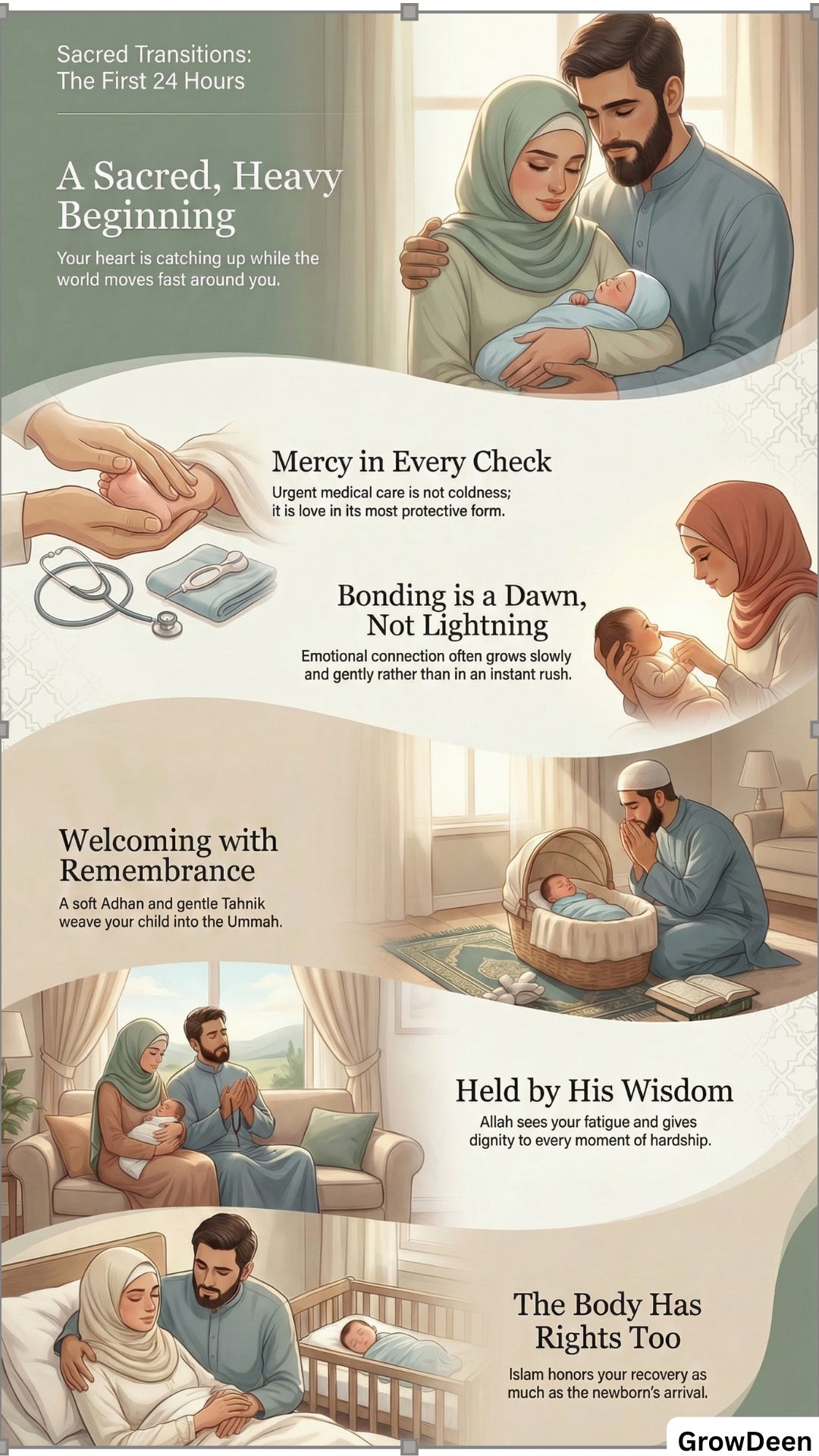
Sometimes the first imagined cuddle is delayed because staff need to help the baby breathe, warm the baby, or assess how they are doing. Preserving life comes first. That urgency is not coldness. It is mercy in action.
Allah says, “His mother carried him with hardship and gave birth to him with hardship.” [14]
That verse gives dignity to the strain around birth. It also gives you room to stop demanding perfection from the moment.
And if the first hour looks different than you hoped, it is still held by Allah’s wisdom.
Because love is not only the skin to skin moment.
Sometimes love looks like rapid medical care.
The cord, the colour, and those first unusual minutes
After birth, the umbilical cord is clamped and cut. If the baby is well, there is often a short delay before this happens, often around one to five minutes. Delayed cord clamping has been linked with benefits for circulation and haemoglobin in healthy term babies. [4] [7] [9]
Then there is the baby’s colour.
A newborn may look bluish, purplish, or dark red at first, then pink up as breathing and circulation settle. Hands and feet can stay blue for longer, even up to a day. [1] [13]
If you remember wondering whether that look was normal, you were not overreacting. You were simply seeing a newborn become a newborn.
If the baby is stable, those early moments often include skin to skin, drying, warmth, and sometimes the first breastfeed. Early essential newborn care has been linked with better breastfeeding outcomes. [8] [10]
And if you did not feel an instant emotional rush, that is okay too.
Bonding is not always lightning.
Sometimes it is dawn.
What the Apgar score is really trying to tell you
Soon after birth, staff often assess the baby with the Apgar score. It looks at heart rate, breathing, muscle tone, response to stimulation, and colour. [3] [5]
For parents, it can sound very clinical.
But underneath it, the question is simple.
How is this baby doing right now, and what help do they need.
That is all.
Some babies need help right away. This is more likely if they are not breathing well, their heart rate is low, or they feel floppy. Sometimes support is simple, like drying, stimulation, and gentle breaths through a mask. Only a very small number need more advanced resuscitation. Most improve with simpler measures. [1] [2] [13]
If your baby needed help at birth, it is normal if that memory still sits heavily in your chest.
A hard beginning is still a beginning wrapped in mercy.
The Prophet ﷺ taught, “Tie it and trust in Allah.” [18]
In a delivery room, tying it looks like skilled staff, warming, oxygen, monitoring, and fast decisions.
The first sunnahs many parents want to hold onto
Alongside the medical care, many Muslim parents also want to welcome the baby with the first beautiful etiquettes of Islam.
Many scholars recommend giving the adhan softly in the baby’s right ear soon after birth, based on the narration of Abu Rafi’ رضي الله عنه about the Prophet ﷺ giving the adhan in the ear of Hasan رضي الله عنه. [21] [22] The narration about iqamah in the left ear is much weaker, so if parents want to follow the strongest evidence, adhan in the right ear is sufficient. [23]
Tahnik is a more firmly established Sunnah. The Prophet ﷺ performed tahnik for newborns with a softened date. [24] [25] Scholars mention beauty in asking a righteous person to do it, but parents may also do it themselves.
This is also a time for du‘a. Asking Allah to bless the child, make them righteous, and protect them is part of the softness of this beginning. [26]
And choosing a good name matters. The Prophet ﷺ encouraged good names, and he taught that the most beloved names to Allah are Abdullah and Abdur Rahman. [27] [28] Naming may happen on the first day or on the seventh day, and both are reported in the Sunnah. [29]
The checks, injections, and small decisions of the first day
Within the first hours, the baby is usually identified with name bands, weighed, briefly examined, and monitored for the first wees and poos.
Parents are also often asked about vitamin K and the hepatitis B birth immunisation. Vitamin K helps protect against bleeding caused by vitamin K deficiency in newborns. [6]
Even here, there can be gentleness.
Skin to skin and breastfeeding can reduce pain during injections. If that is not possible, a tiny amount of oral sucrose may help lessen discomfort. [6]
These can feel like very quick decisions in a very emotional moment. Even then, you are still allowed to pause, ask, and understand.
If this kind of calm, grounded support would help you through early parenthood, subscribe for free so the next article meets you in your inbox when you need it.
Gratitude, protection, and the days just after
The first 24 hours are only the beginning. Very soon after come other beautiful Sunnahs parents often ask about.
Showing gratitude to Allah is one of the greatest of them. The Qur’an teaches us to ask for gratitude for Allah’s favour upon us and our parents. [14]
Seeking protection for the baby is also from the Sunnah. The Prophet ﷺ used to seek Allah’s protection for Hasan and Husayn with the well known du‘a against every devil, harmful creature, and evil eye. [30]
Then in the days that follow come the well known acts of aqeeqah, shaving the head on the seventh day and giving charity equal to the weight of the hair in silver, and for boys, circumcision as part of the fitrah. [29] [31] [32] [33]
You do not have to carry all of that at once in the delivery room.
You only have to know that Islam welcomes this child with mercy, meaning, and remembrance of Allah.
The first day asks a lot from a family
The first 24 hours after birth are not only about the baby. They are also about a mother who has just passed through hardship. A parent who may be overwhelmed. A family trying to understand what just happened.
Islam does not ask you to pretend this is easy.
It gives honour to hardship. It gives meaning to intention. It gives weight to mercy. It reminds you that the body has rights too. [19]
And when the room feels full, and the hours long, and your heart unsteady, Allah’s words still stand.
Allah does not burden a soul beyond its capacity. [20]
So if the first day after birth felt beautiful and blurry, gentle and frightening, sacred and clinical all at once, that does not mean you understood it wrongly.
It means you were living through one of the biggest transitions a human being can witness.
GIFTS FOR YOU, DEAR PARENT
If you’ve reached this part of the page, it tells me something meaningful about you.
You weren’t just skimming or passing time. You stayed because something here felt relevant to your real life.
Because you care.
Because you want to do things with more awareness.
Because you’re trying, even when it feels overwhelming.
That is not small.
So I didn’t want this article to remain just words on a page. I wanted it to gently step into your daily life in practical ways. That’s why we prepared these Life Gifts for you.
Not as extras.
Not as decorations.
But as simple tools to help you hold onto what mattered most in what you just read.
Here’s what you’ll find inside:
Gentle Understanding Card
A clear and simplified summary of the core concept from this article, so you can revisit the main idea anytime without rereading everything.
Heartfelt Dua Card
A carefully chosen dua connected to this stage of life, because we know that real strength and ease ultimately come from Allah’s help.
Gentle Actions Card
Practical examples to help you translate knowledge into action, so what you learned becomes part of your daily rhythm.
Gentle Reminders Card
Short, steady reminders drawn from the key points, designed to be printed or saved and placed somewhere you’ll see often.
These were designed slowly and thoughtfully, with time, care, and sincere dua. We created them because we genuinely want to walk alongside you, not just through one article, but through every stage of this lifelong journey.
If these gifts support you even in a small way, I would love for you to continue receiving them.
Subscribe so that each new Gift arrives directly in your inbox whenever we release the next stage. That way, you won’t miss the tools designed to support you right where you are.
May Allah place barakah in your effort, accept your intention, and make this path easier and more rewarding than it feels right now.
Please share it with a family/friend who may benefit from this knowledge.
What is one moment with your child that feels hardest lately, and what kind of support would make it feel lighter?
If you want gentle, benefit focused support for the earliest days of parenting, subscribe for free so the next article and the next set of Gifts arrive quietly in your inbox.
References
[1] Australian and New Zealand Committee on Resuscitation (ANZCOR). Newborn Resuscitation: Guideline 13.3 – Assessment of the Newborn (2025).
[2] Australian Institute of Health and Welfare (AIHW). Australia’s Mothers and Babies: Active Resuscitation Method (2025).
[3] Australian Institute of Health and Welfare (AIHW). Australia’s Mothers and Babies: Apgar Score at 5 Minutes (2025).
[4] Bruckner, M., Katheria, A.C., and Schmölzer, G.M. (2021). Delayed cord clamping in healthy term infants: More harm or good? Seminars in Fetal & Neonatal Medicine, 26(2), 101221.
[5] Casey, B.M., McIntire, D.D., and Leveno, K.J. (2001). The continuing value of the Apgar score for the assessment of newborn infants. New England Journal of Medicine, 344(7), 467 to 471.
[6] Children’s Hospital of Eastern Ontario (CHEO). Be Sweet to Babies: Newborn Screening and Immunizations Are Important, But They Don’t Need to Hurt.
[7] Hooper, S.B., Binder-Heschl, C., Polglase, G.R., Gill, A.W., Kluckow, M., Wallace, E.M., Blank, D., and te Pas, A.B. (2016). The timing of umbilical cord clamping at birth: Physiological considerations. Maternal Health, Neonatology and Perinatology, 2, 4.
[8] Li, Z., Mannava, P., Murray, J.C.S., Sobel, H.L., Jatobatu, A., Calibo, A., Tsevelmaa, B., Saysanasongkham, B., Ogaoga, D., Waramin, E.J., Mason, E.M., Obara, H., Tran, H.T., Tuan, H.A., Kitong, J., Yaipupu, J.M., Cheang, K., Silvestre, M.A., Kounnavongsa, O., et al. (2020). Association between early essential newborn care and breastfeeding outcomes in eight countries in Asia and the Pacific: A cross sectional observational study. BMJ Global Health, 5(8), e002581.
[9] Marrs, L., and Niermeyer, S. (2022). Toward greater nuance in delayed cord clamping. Current Opinion in Pediatrics, 34(2), 170 to 177.
[10] Moore, E.R., Bergman, N., Anderson, G.C., and Medley, N. (2016). Early skin to skin contact for mothers and their healthy newborn infants. Cochrane Database of Systematic Reviews, 2016(11), CD003519.
[11] Stevens, J., Schmied, V., Burns, E., and Dahlen, H.G. (2019). Skin to skin contact and what women want in the first hours after a caesarean section. Midwifery, 74, 140 to 146.
[12] Victorian Newborn Resuscitation Project: NeoResus. Assessing the Newborn (2021).
[13] Wyckoff, M.H., Wyllie, J., Aziz, K., Fernanda de Almeida, M., Fabres, J., Fawke, J., Guinsburg, R., Hosono, S., Isayama, T., Kapadia, V.S., Kim, H.S., Liley, H.G., McKinlay, C.J.D., Mildenhall, L., Perlman, J.M., Rabi, Y., Roehr, C.C., Schmölzer, G.M., Szyld, E., et al. (2020). Neonatal life support: 2020 international consensus on cardiopulmonary resuscitation and emergency cardiovascular care science with treatment recommendations. Circulation, 142(16), S185 to S221.
[14] Qur’an: Surah Al Ahqaf 46:15.
[15] Hadith: Sahih al Bukhari 1 and Sahih Muslim 1907.
Also: Sahih Muslim 1907
[16] Hadith: Sahih al Bukhari 5997 and Sahih Muslim 2318.
Also: Sahih Muslim 2318
[17] Qur’an: Surah Al Ma’idah 5:32.
[18] Hadith: Jami at Tirmidhi 2517.
[19] Hadith: Sahih al Bukhari 5199.
[20] Qur’an: Surah Al Baqarah 2:286.
[21] Sunan Abu Dawud 5105. Adhan in the newborn’s ear.
[22] Jami at Tirmidhi 1514. Adhan in the ear of Hasan ibn Ali.
[23] IslamQA. Adhan in the ear of the newborn.
[24] Sahih al Bukhari 5467. Tahnik for the newborn.
[25] Sahih Muslim 2145. Tahnik and naming the child Ibrahim.
[26] Al Adab Al Mufrad. Du‘a for the newborn.
[27] Sunan Abu Dawud 4948. Give yourselves good names.
[28] Sahih Muslim 2132. The most beloved names to Allah are Abdullah and Abdur Rahman.
[29] Sunan Abu Dawud 2838 and Jami at Tirmidhi 1522. Aqeeqah, shaving the head, and naming on the seventh day.
Also: Jami at Tirmidhi 1522
[30] Sahih al Bukhari 3371. Protective du‘a for Hasan and Husayn.
[31] Jami at Tirmidhi 1519. Shave his head and give charity equal to the weight of his hair in silver.
[32] Sahih al Bukhari 5891. Circumcision is part of the fitrah.
[33] Sahih Muslim 257. Circumcision among the acts of fitrah.