
Tie It and Trust Allah: Preventing Falls in Early Childhood
Protecting Little Climbers Without Parenting in Fear

Free gift for you! A practical companion resource is waiting for you near the end of this article to help you remember, apply, and benefit from what you read. Don’t forget to download!
Preventing falls in babies and young children means staying close, noticing each new skill as it appears, and quietly changing the home around that child with the mercy and responsibility Allah entrusted to you.
You turn away for one second.
Maybe it is for the towel.
Maybe the wipes.
Maybe your older child calls you from the doorway, and your body answers before your mind has even finished the thought.
Then you hear it.
That small, hard sound. Then the cry.
And even after you scoop your child up and check their face and head and little hands, something else settles in your chest. Not just fear. That other feeling loving parents know too well.
How did that happen so fast?
Because that is the trouble with little children.
Yesterday they could not do it.
Today they can.
Yesterday they couldn’t reach it
A baby can change almost overnight. One week they are rolling. Then pulling to stand. Then climbing onto a chair with the confidence of someone who has lived in that body much longer than they actually have.
Falls are common in early childhood, and many are minor. But some lead to fractures, head injuries, hospital visits, or lasting harm. Younger children are especially vulnerable because their balance, judgment, and awareness of danger are still developing. Safer environments, close supervision, and practical changes around the home genuinely reduce risk, especially in the under-five years. [1][4][7][10]
That is why hearing your child from the next room is not the same as watching them. So many falls happen in the middle of ordinary care. During a nappy change. In the bath. While climbing onto furniture. While being carried downstairs. While leaning out of a stroller. In the normal minutes, not the dramatic ones. [4][6]
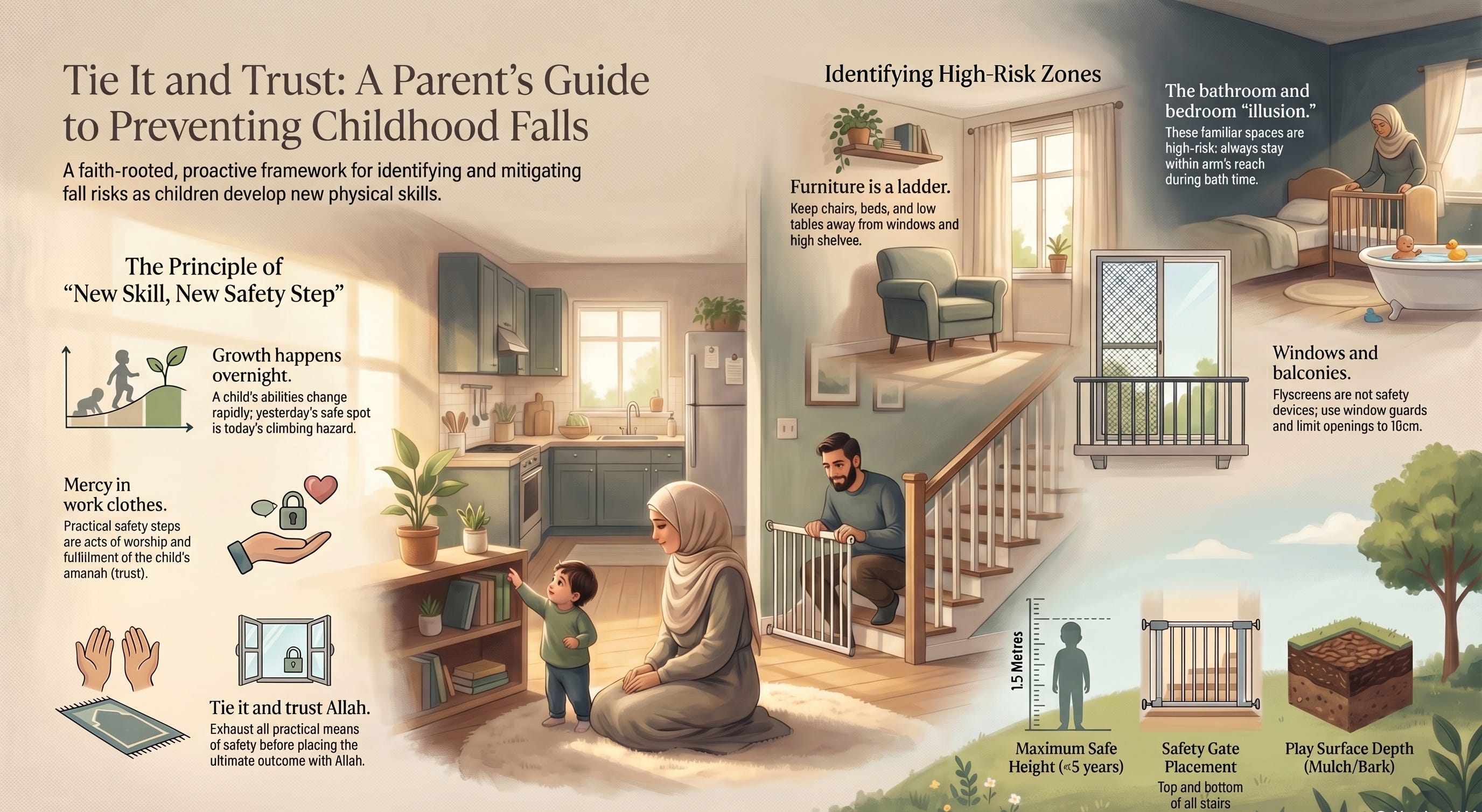
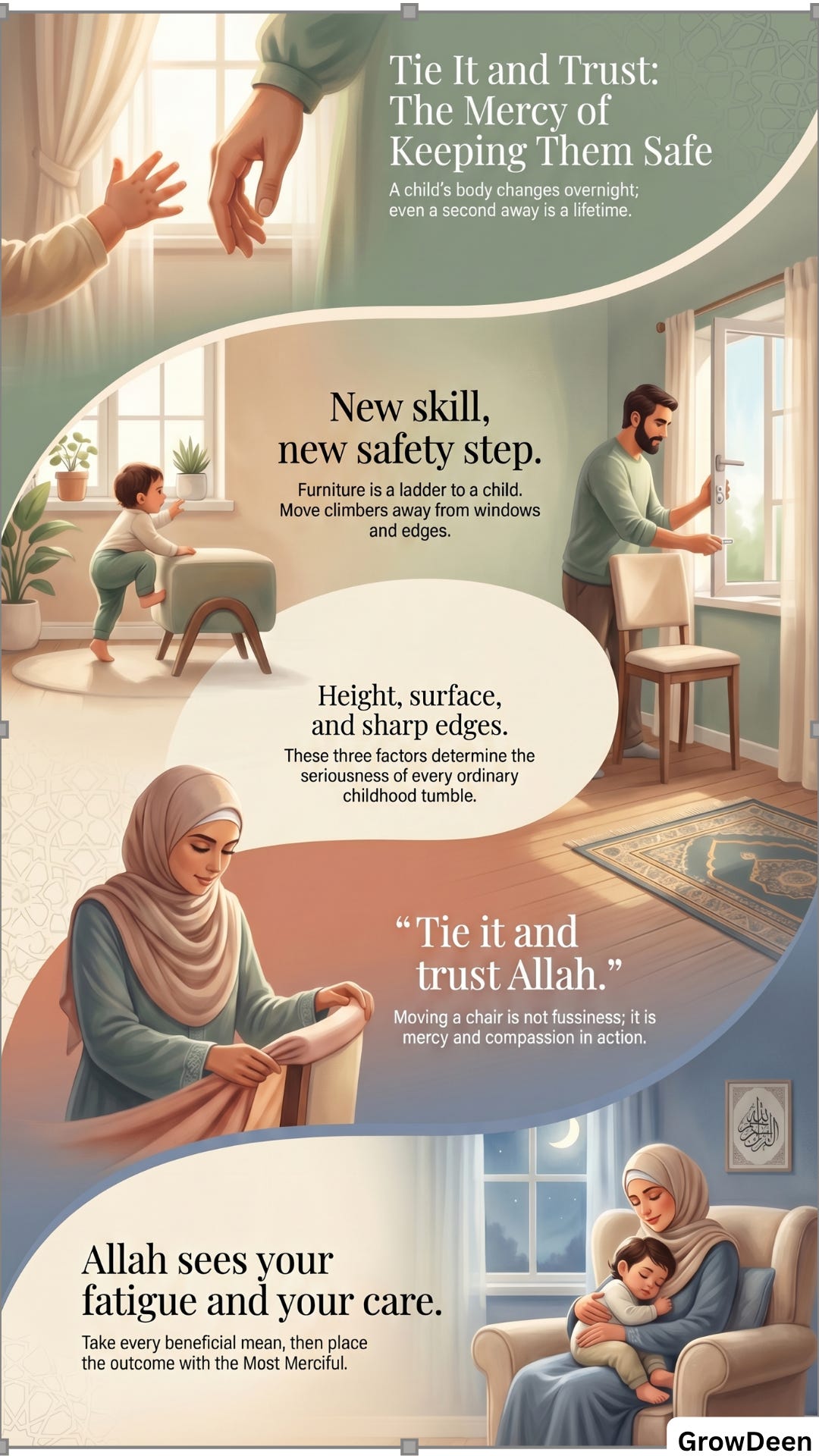
A sentence worth keeping close is this: new skill, new safety step.
It sounds small.
It is not.
The rooms that look harmless first
Bathrooms fool us because they are familiar. But a wet floor, a slippery tub, and a wriggly little body are enough. A child reaches for a toy, tries to stand, twists, and suddenly they are down.
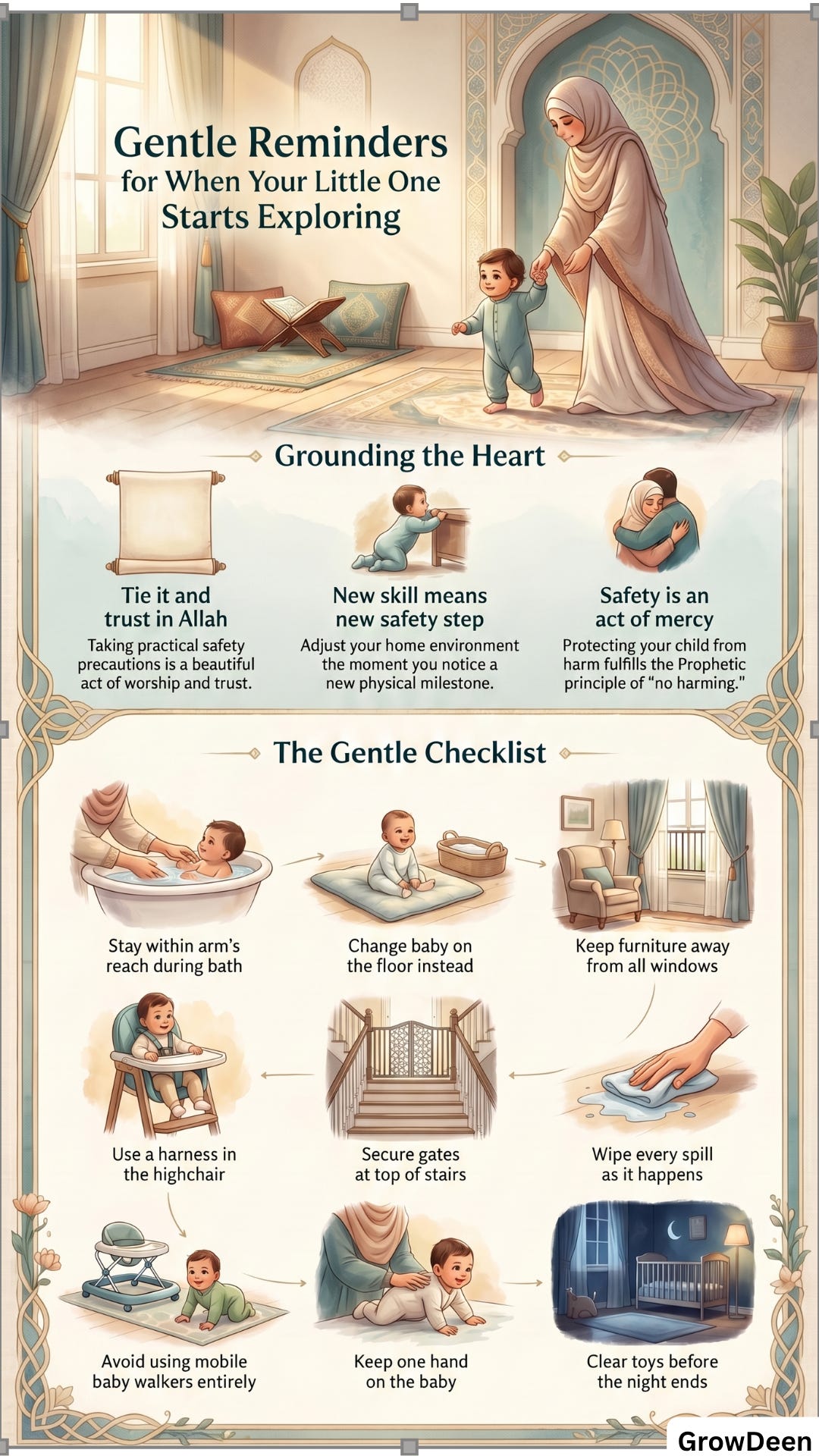
So in the bath, stay within arm’s reach. Encourage sitting rather than standing. Use a non-slip surface. Slow right down when lifting your child in or out, especially if the floor is wet. These are simple precautions, but bathroom falls happen in simple moments too. [4][13]
Bedrooms can look gentle and safe because they are soft and quiet. But beds become launch points quickly. Toys left in a cot can become a step. A child who has just learned one new move will try it in the bedroom before you have even finished noticing it.
When your child moves from a cot to a bed, use guard rails or even a mattress on the floor for a while. Use a night light if they are likely to get up in the dark. Move or lock away anything they might climb on, or anything they can use to get somewhere unsafe. And bunk beds need far more caution than families sometimes realise. They are not suitable until a child is over 9 years old, and the top bunk needs to be a very clear no-play zone. [5][6][13]
A chair is a ladder in a small child’s mind
Adults see furniture.
Children see steps.
A chair beside a shelf is not just a chair. It is the first half of a plan. A bed near a window is not just where they sleep. It is a way up. This is why rooms matter so much. Keep furniture away from other objects so your child cannot climb from one thing to another. Put the things they want low enough to reach. And if one piece of furniture keeps becoming a problem, move it somewhere your child does not use, or put a secure barrier in place. [5][6][7]
Some of the most preventable falls happen during everyday care. The safest place to change a baby is the floor. If you use a change table or a bed, keep one hand on your baby the whole time. Never leave a baby unattended on an adult bed or couch. And if you are using a change table, its raised sides should be at least 100 mm higher than the changing surface. [4][6]
The same goes for equipment people stop noticing because they use it every day. A bouncer or bouncinette belongs on the floor, never on a bench, table, bed, or anything above floor level. And if you need to move it, take your baby out first. Do not carry the bouncer with your child inside. In a highchair, use the 5-point harness every time and stay close while your child is in it. [4][6]
When you leave the house, the rules do not disappear. Use the 5-point harness in prams, strollers, and supermarket trolleys. If a trolley does not have a proper seat with a 5-point harness, use your pram or stroller instead, or a baby carrier or sling. Do not let your child ride on the side of the trolley or sit where the shopping goes. And at the playground, stay present. Falls there can lead to fractures and dislocations, and both the surface underneath and the suitability of the equipment for your child’s age matter. [2][10]
If it would help to have this kind of calm, practical, Islamically grounded support arriving in your inbox, you can subscribe for free. The hope is simple: less noise, more steadiness for the real moments you are actually living.
The shortcuts that put both of you at risk
Stairs are one of those places where tiredness shows up immediately.
If you are carrying your child downstairs, using a baby carrier can help because it leaves at least one hand free for the banister. It is also wise to skip socks, flip-flops, slippers, and anything else that makes slipping more likely. One adult stumble on the stairs can become two injuries very quickly. [4][6]
Once your child can crawl, stairs stop being part of the house and start being an invitation. Use securely attached safety gates at both the top and bottom. Keep them there until your child is very good at walking up and down independently. Open the gate every time instead of stepping over it. That reduces your own risk of tripping, and children notice the habits we repeat. One more thing that matters here: not every gate is safe for the top of stairs, so follow the manufacturer’s instructions carefully and use the right gate in the right place. [4][6]
Trip hazards deserve more respect than they get because they are so boring. Electrical cords across the floor. Toys left out at the end of the day. A spill somebody means to wipe later. A rug that slides when a sleepy foot lands on it in the dark.
Pick up the cords. Put the toys away before bedtime so nobody is tripping on the way to the toilet at night. Wipe spills as soon as they happen. Use anti-skid mats under rugs and floor coverings, or roll the rugs away for now. Quiet risks are still risks. [4][6]
Some places need a firmer no
Windows, balconies, and the doors that open onto them need a stronger tone, because the consequences there can be devastating. Children are treated in hospital every year after falling from windows and balconies, and these are not the kinds of injuries a parent forgets. [3][9][13]
Lock windows, or shield them with proper window guards. In a multistorey home, make sure windows can open no more than 10 cm. A flyscreen is not a safety device. It will not hold a child back. [3][9][13]
Move climbable things away from windows. Beds. Chairs. Change tables. Pot plants. Anything that becomes a foothold. Keep entrances to balconies locked. Supervise your child on balconies every time, not casually, not from across the room. Install safety guards across balcony entries, and make sure there are no horizontal bars or footholds a child can climb to reach the balcony itself. [3][9][13]
Balcony furniture matters too. Keep it away from the railings so your child cannot use it to climb up and over. Heavier furniture is better because it is harder for a child to drag into position. And the railings themselves matter. They should be vertical, at least 1 metre high, with gaps no wider than 12.5 cm. [3][9][13]
This is the kind of place where a clear sentence helps.
We look from here.
We do not climb there.
I will hold your hand.
Why one fall becomes a hospital visit
Not every fall carries the same risk. Three things change the seriousness of it.
The height matters.
The surface matters.
And what your child hits on the way down matters.
As a rule of thumb, children under 5 should not have access to heights above 1.5 metres, and older children should not have access to heights above 2 metres. Concrete, ceramic tiles, and even compacted sand are harder landings than parents sometimes realise. Under play equipment, tan-bark or pine mulch gives a softer landing, but it needs depth. Around 30 cm. [2][9][10]
Then there are the sharp edges waiting halfway through a fall. Coffee tables. Bedside tables. Anything pointed and solid at head height. Put sharp-edged furniture in places where children are less likely to fall on it, and use corner protectors where they help. [3][9]
And baby walkers really do deserve a plain warning. They are not recommended. If a walker tips over or goes down the stairs, the injuries can be serious. Head injuries. Fractures. Access to danger a child could not have reached on their own. Sometimes the safest sentence is the simplest one: do not use the walker. [8][10]
Mercy lives in the precautions nobody praises
In Islam, this kind of care is not separate from tawakkul. It is part of it.
Allah reminds us to think about weak offspring with fear of Him and with justice in how we deal with them. He also warns us not to be careless with life, and tells us that He is Merciful to us. [11][12] So moving a chair away from a window is not fussiness. Wiping a spill straight away is not overreacting. Latching the gate, fastening the harness, using the banister, rolling up the rug for a while. This is mercy in compassion in action.
The Prophet ﷺ gave us a principle that reaches right into these ordinary home moments: there should be neither harming nor reciprocating harm. [14] So much of fall prevention lives exactly there. In the harm nobody intended, but could have reduced.
And then there is that beautiful balance. Tie it and trust in Allah. [15] You take the means. You stay close in the bath. You keep a hand on the baby during changes. You skip the walker. You move the bed away from the window. Then you place the outcome with Allah.
That balance matters, because not every tumble means you failed. Children do fall. They misjudge. They rush. They try something before their bodies are ready. The goal is not to raise a frightened child or turn your home into a place where nothing can be touched. The aim is steadier than that. Reduce what is preventable. Leave room for growth. Keep learning the child in front of you now, not the one you had three months ago. Parenting support and home adjustments reduce injury without turning childhood into a locked box. [4][7]
When your heart starts to race, a few quiet sentences can help.
New skill, new safety step.
I do not need to rush this.
This is not for climbing. I will help you somewhere safe.
Allah does not ask you to live in panic. He intends ease for you, not hardship. [16] And the Prophet ﷺ taught us to be keen on what benefits us. [17] So keep taking the beneficial means, one ordinary precaution at a time.
That work counts.
It is part of the amanah.
It is part of love.
GIFTS FOR YOU, DEAR PARENT
If you have reached this part of the page, it tells me something beautiful about you.
You were not just passing time. You stayed because this touched real life for you.
Because you care.
Because you want to move through parenting with more awareness.
Because even when it feels heavy, you are still trying.
That is not a small thing.
I did not want this article to remain something you read once and then lose in the rush of the day. I wanted it to come a little closer to your real life. I wanted it to gently step into your daily rhythm in practical ways. That is why we prepared these Life Gifts for you.
Not as extras.
Not as decoration.
As simple tools to help you hold onto what mattered most in what you just read.
Gentle Understanding Card
A clear, simplified reminder of the heart of this article, so you can come back to the main idea whenever you need it without rereading everything.
Heartfelt Dua Card
A carefully chosen dua for this stage of life, because real strength and real ease come from Allah’s help before anything else.
Gentle Actions Card
Practical examples that help you turn knowledge into action, so what you learned can start settling into the way you move through your days.
Gentle Reminders Card
Short, steady reminders drawn from the key points of this piece, designed to be saved or printed and kept somewhere you will actually see them.
These were made slowly and thoughtfully, with time, care, and sincere dua. They were created because the hope here is not to meet you in one article and disappear. It is to walk beside you through every stage of this long, sacred journey.
If these gifts support you, even a little, I would love for them to keep reaching you.
Subscribe so each new Gift arrives directly in your inbox when the next stage is released. That way, the support prepared for the season you are in can reach you while you are still in it.
May Allah place barakah in your effort, accept your intention, and make this path easier and more rewarding than it feels right now.
Please share this with a family member or friend who may benefit from it.
Subscribe for free if you would like more calm, practical, faith-rooted support for the parenting moments that ask a lot from your heart.
What is one small safety change at home that would help you breathe easier this week?
References
[1] Australian Institute of Health and Welfare (AIHW). Trends in hospitalised injury, Australia 2007–08 to 2016–17
[2] Cassell, E., & Clapperton, A. (2014). Preventing serious fall injury in children (1): Overview and playground equipment. Hazard, 77, 1–20
[3] Cassell, E., & Clapperton, A. (2014). Preventing serious fall injury in children (2): Falls involving furniture, skateboards and scooters. Hazard, 78, 1–20
[4] Jullien, S. (2021). Prevention of unintentional injuries in children under five years. BMC Pediatrics, 21(Suppl. 1), Article 311
[5] Kendrick, D., Maula, A., Reading, R., Hindmarch, P., Coupland, C., Watson, M., Hayes, M., & Deave, T. (2015). Risk and protective factors for falls from furniture in young children: Multicenter case-control study. JAMA Pediatrics, 169(2), 145–153
[6] Kendrick, D., Maula, A., Stewart, J., Clacy, R., Coffey, F., Cooper, N., Coupland, C., Hayes, M., McColl, E., Reading, R., Sutton, A., Towner, E.M.L., & Watson, M.C. (2012). Keeping children safe at home: Protocol for three matched case-control studies of modifiable risk factors for falls. Injury Prevention, 18(3), Article e3
[7] Kendrick, D., Mulvaney, C.A., Ye, L., Stevens, T., Mytton, J.A., & Stewart-Brown, S. (2013). Parenting interventions for the prevention of unintentional injuries in childhood. Cochrane Database of Systematic Reviews, 2013(3), CD006020
[8] Monroe, K., Smola, C., Schmit, E., Jeffries, K., Burks, A.R., & Nichols, M. (2022). Important advances in pediatric injury prevention. Southern Medical Journal, 115(8), 630–634
[9] Young, B., Wynn, P.M., He, Z., & Kendrick, D. (2013). Preventing childhood falls within the home: Overview of systematic reviews and a systematic review of primary studies. Accident Analysis & Prevention, 60, 158–171
[10] World Health Organization. Step Safely: Strategies for Preventing and Managing Falls Across the Life-Course; World Health Organization. Falls fact sheet
[11] Qur’an, Surah An-Nisa 4:9
[12] Qur’an, Surah An-Nisa 4:29
[13] UNICEF Parenting. How to babyproof your home
[14] Forty Hadith of Imam an-Nawawi, Hadith 32, “There should be neither harming nor reciprocating harm”; Encyclopedia of Translated Prophetic Hadiths, “There should be no harm or reciprocal harm”
[15] Jami` at-Tirmidhi 2517, “Tie it and trust in Allah”
[16] Qur’an, Surah Al-Baqarah 2:185
[17] Sahih Muslim 2664