
Three Months Postpartum And I Feel Like A Stranger In My Own Life
Will I Ever Feel Like Myself Again After Birth?

Feeling like a stranger to yourself three months postpartum is often a sign of deep transition and nervous system strain, not a broken identity, and Allah sees you clearly even when you cannot recognize you.
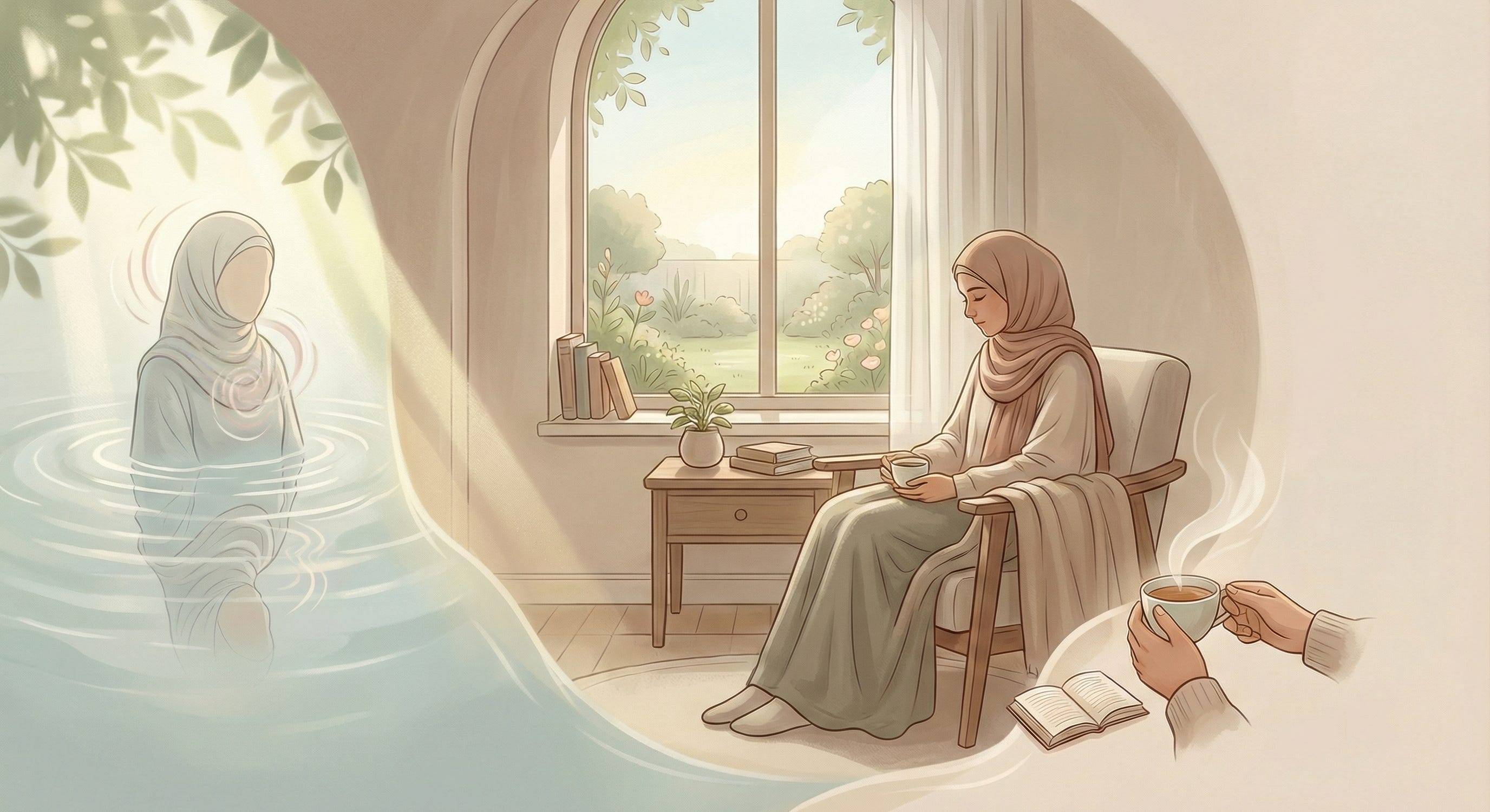
You catch yourself in something reflective.
Not even a proper mirror. The microwave door. The black screen of your phone. A window at night.
For a second you do not recognize what you see.
It is not “I look different.” It is not about beauty.
It is stranger than that.
It is the feeling of, who is that.
And then the answer arrives, quietly. That is me.
But it does not land inside you the way it used to.
You fix your hijab. Tug your shirt down. Do the normal motions. Your hands still know your body.
Then the baby cries and you move instantly, no debate, no hesitation, like your muscles know exactly who you are even when your mind does not.
After the baby settles again, the quiet comes back. And in that quiet, the question you keep swallowing rises on its own.
Will I ever feel like myself again.
You do not say it out loud because it sounds ungrateful.
But it keeps living in your throat anyway.
It is not just change, it is disorientation
Most people expect postpartum to be hard in obvious ways.
Tiredness. A sore body. A messy house. A learning curve.
What catches you off guard is the identity wobble.
You can handle mess.
You can handle learning.
You can handle loneliness some days.
But feeling like a stranger to yourself makes the whole world feel slightly less reliable, like you are walking on a floor that used to be solid and now it has give.
You keep functioning, which makes it worse.
Because if you are functioning, your brain argues, then why do I feel missing.
Postpartum is a real life shift across physical, social, and psychological changes. It is a season of adaptation, not a quick return. [1]
That sentence is true, but it does not always comfort.
At two in the morning, you do not want a framework.
You want your anchor back.
The shame tries to name the problem for you
The shame always arrives like it knows you personally.
It whispers, you are dramatic.
It whispers, you should be grateful.
It whispers, other mothers manage.
It whispers, you are failing at being you.
And because this is the identity category, the shame has extra power.
It does not just say you are struggling.
It says you are becoming someone you do not like.
That is why this hurts.
Not because you are vain. Not because you are shallow.
Because you miss the feeling of being at home inside yourself.
When stress and sleep blur your sense of self
Sometimes this strange distance has language in medicine too.
People describe it as feeling detached from yourself, like you are watching your life from a step back. [3] [4]
I am not saying that is definitely what is happening to you.
I am saying you are not the first woman to describe this exact sensation, which means you do not have to sit in silence thinking you are uniquely broken. [3] [4]
Postpartum can be a perfect storm for disconnect.
Stress is high.
Your body is healing.
Sleep is fragmented.
Your nervous system lives on alert.
There is research showing that higher postpartum stress is linked with changes in how first time mothers regulate emotion, more suppression and less access to certain coping strategies. It can get harder to reach yourself when you are under pressure. [5]
Sleep in the perinatal period is also deeply tied to mood and mental health. [6]
So no, this is not automatically a bad heart problem.
It can be an exhausted human problem.
And still, it hurts.
Because explanations do not hug you.
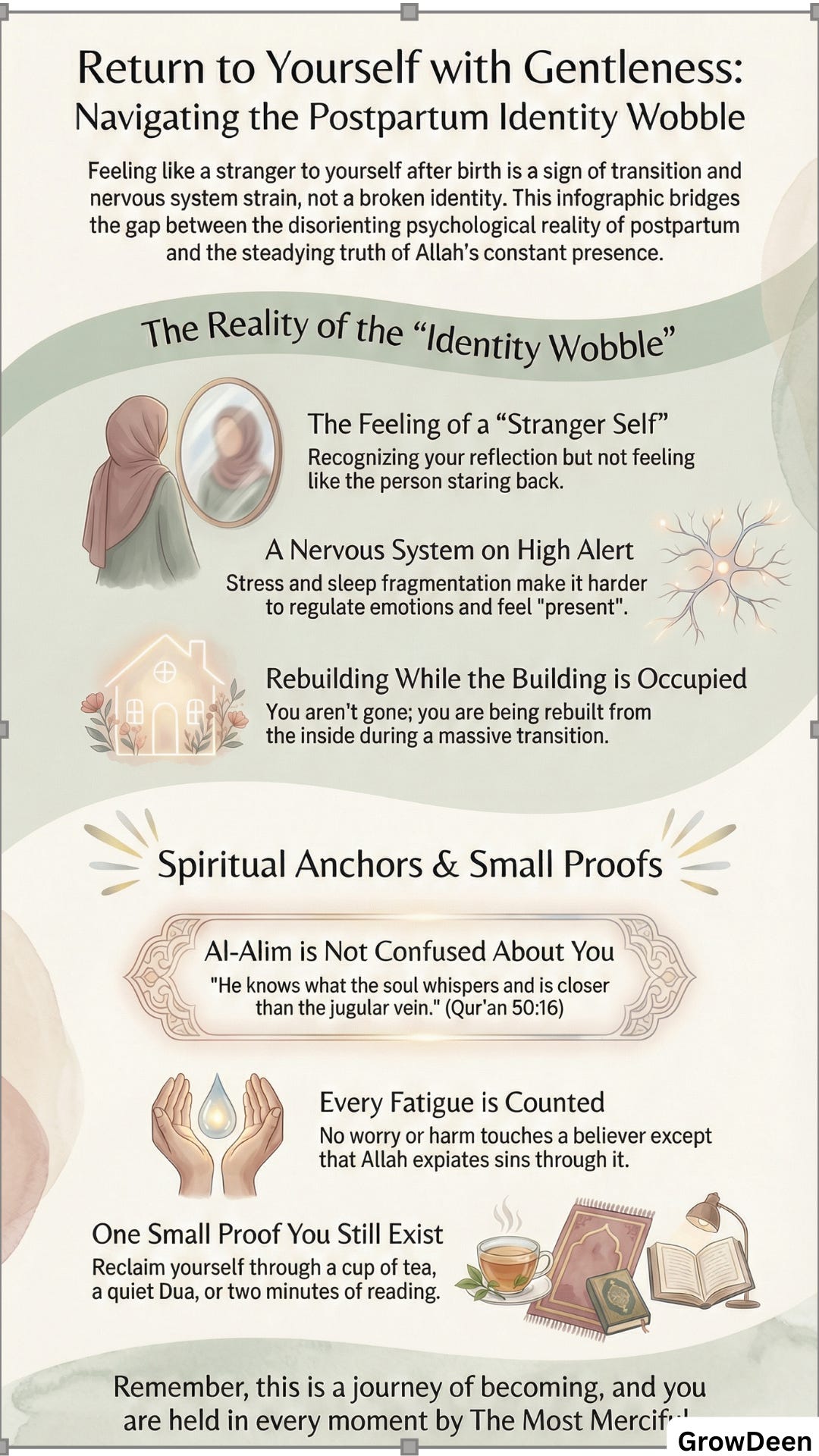
The new you is being built while the building is occupied
Here is the first mercy I want to offer you.
You are not gone.
You are in transition.
Transitions feel disorienting. That is what they do.
The instinct is to panic and dig.
What is wrong with me.
Why can I not snap out of it.
Why do I feel like I am watching myself.
But panic usually pushes you further away.
A softer move is to get concrete.
Ask yourself, gently, what exactly feels unfamiliar.
Is it your patience.
Your attention span.
The way joy does not arrive on command.
The way time feels chopped into pieces.
The way your body does not feel like yours yet.
Because “I am a stranger” is often really, I do not recognize my nervous system.
Postpartum nervous systems can be intense.
You startle easily.
You live on alert.
You feel touched out.
You do not finish thoughts.
You do not rest the way you used to.
Of course you do not feel like the old you. The old you had uninterrupted minutes. The old you was not listening for cries in your sleep.
You might miss your old self like you miss a house you used to live in.
But you cannot move back in. The floorplan changed.
That does not mean you will never feel like you again.
It means you is being rebuilt from the inside while the building is already occupied.
If you want gentle postpartum identity reminders like this, you can subscribe for free. It is a quiet way to keep support nearby, especially on days you do not have words.
One small proof that you still exist
When you feel like a stranger, the temptation is to demand a grand return.
A glow up.
A before and after moment.
But postpartum rarely gives that.
Instead, look for one small proof that you still exist as you.
Not productive.
Not pretty.
Not impressive.
Just yours.
A cup of tea the way you like it.
Two minutes reading something that used to feel like you.
A short walk to the mailbox with your face turned toward the air.
One page of Qur’an with no performance.
One voice note to someone safe where you do not pretend.
Tiny proofs matter because they interrupt the lie that you disappeared.
And if this stranger feeling is persistent, frightening, or paired with significant depression or anxiety symptoms, you deserve real support. Perinatal depression can include feeling empty, disconnected, or unlike yourself, and help is available. [2]
This is not about labeling you.
This is about not leaving you alone with something heavy.
Postpartum mental health challenges can persist beyond the early weeks, which is why ongoing support and coordinated care matter. [7]
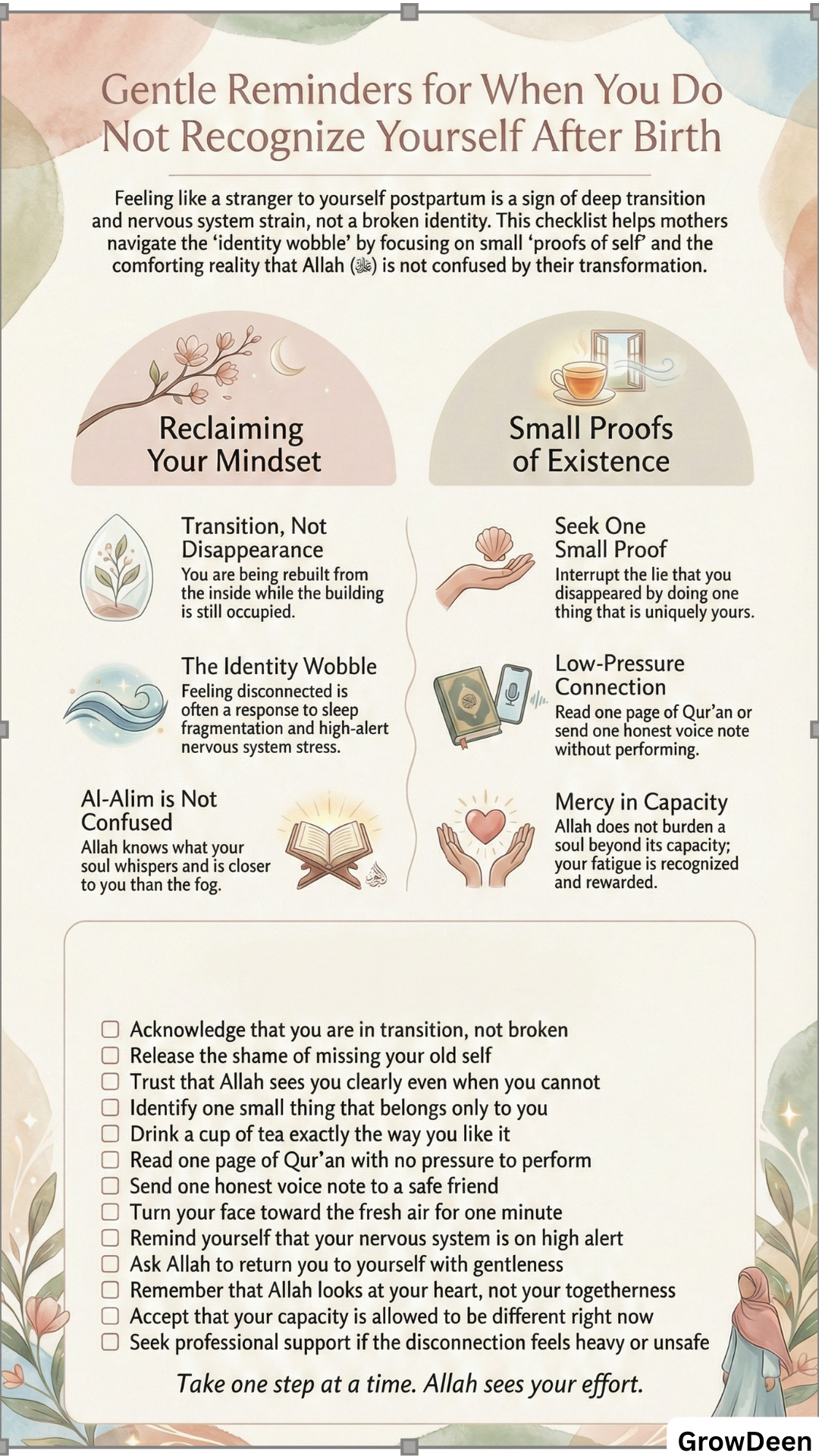
Al Alim is not confused about you
This is where the fear gets spiritual.
If I do not recognize myself, maybe I am far from Allah.
Or maybe Allah is far from me.
But Allah is not confused about you.
Allah says we were created and He knows what the soul whispers, and He is closer than the jugular vein. (Qur’an 50:16) [8]
Closer than the fog.
Closer than the identity wobble.
Closer than the part of you that feels unfamiliar.
Allah also tells you something that can steady your chest when you are measuring yourself harshly.
Allah does not burden a soul beyond what it can bear. (Qur’an 2:286) [9]
Not as a scolding.
As recognition that capacity changes, and Allah knows the exact weight of your day.
The Prophet ﷺ said Allah does not look at bodies or forms, but He looks at hearts and deeds. [10]
Not your togetherness.
Not your mood.
Your heart, your sincerity, your turning, even if you feel foggy while turning.
And the Prophet ﷺ said that no fatigue, illness, worry, grief, or harm touches a Muslim except that Allah expiates sins through it. [11]
So even the version of you that feels lost is still seen, still counted, still held.
A gentle way to meet yourself today
Pick one moment today to meet yourself on purpose.
Just one.
When the fear shows up, what if I never come back, say one line to Allah.
Ya Allah, return me to myself with gentleness.
Then do one small thing that belongs to you, not to productivity, not to proving, not to performing.
Something that says, I am still here.
If the disconnection ever feels intense or comes with feeling unsafe, seek urgent help through local emergency services or crisis supports and contact your healthcare provider. If it is persistent and heavy, bring it to a clinician as a postpartum mental health concern. You deserve support, not just endurance. [2] [7]
Allah, I do not recognize myself some days, but You recognize me. Hold me while I am rebuilding. Return me to steadiness without rushing me, and let this new life become a home inside my chest again. Ameen.
Reflection and Action Gifts
If you have been quietly carrying this strange identity ache, I want you to take something practical with you from this page.
Not a lecture.
Not a perfect mindset.
Just gentle supports you can return to on the days you catch your reflection and feel that small throat tightening again.
These Reflection and Action Gifts are meant to be saved, revisited, and used in tiny moments.
The moments that do not look like breakthroughs, but still shape you.
They are for the mother who is functioning, but missing herself.
For the mother who loves her baby, but does not recognize her own inner voice yet.
For the mother who is rebuilding while life keeps knocking.
📥 Download your Reflection and Action Gifts
This gift pack includes 👇:
Gentle Understanding Card
Gentle Reminders Card
Everyday Reflections Card
Dua Card
Subscribe for free if you want more support for postpartum identity moments like this, written gently and sent to you as you need them.
What is the smallest moment lately that made you feel a little like you again.
References
[1] ACOG — Optimizing Postpartum Care (Committee Opinion, 2018) (notes postpartum adaptation across physical, social, psychological changes). https://www.acog.org/clinical/clinical-guidance/committee-opinion/articles/2018/05/optimizing-postpartum-care
[2] NIMH — Perinatal Depression (symptoms can range mild–severe; help is available). https://www.nimh.nih.gov/health/publications/perinatal-depression
[3] Mayo Clinic — Depersonalization-derealization disorder: Symptoms & causes (feeling emotionally disconnected; surroundings unreal). https://www.mayoclinic.org/diseases-conditions/depersonalization-derealization-disorder/symptoms-causes/syc-20352911
[4] Cleveland Clinic — Depersonalization-Derealization Disorder (feeling disconnected from thoughts, feelings, body). https://my.clevelandclinic.org/health/diseases/9791-depersonalization-derealization-disorder
[5] Grande, L. et al. (2021). Postpartum Stress and Neural Regulation of Emotion (perceived stress linked with less cognitive reappraisal, more suppression). https://pmc.ncbi.nlm.nih.gov/articles/PMC8565500/
[6] Ross, L.E. et al. (2005). Sleep and perinatal mood disorders: a critical review (sleep changes tied to postpartum mood disorders). https://pmc.ncbi.nlm.nih.gov/articles/PMC1160560/
[7] Government of Canada — Maternity and Newborn Care Guidelines: Postpartum Care (Chapter 5) (notes postpartum mental health problems can persist; coordinated care). https://www.canada.ca/en/public-health/services/publications/healthy-living/maternity-newborn-care-guidelines-chapter-5.html
[8] Qur’an 50:16 https://quran.com/50/16
[9] Qur’an 2:286 https://quran.com/2/286
[10] Sahih Muslim 2564 — “Allah does not look at your bodies… but at your hearts and deeds.” https://sunnah.com/muslim:2564
[11] Sahih al-Bukhari 5641–5642 (meaning: afflictions expiate sins for the believer). https://sunnah.com/bukhari:5641