
This Common Kitchen Mistake Can Burn a Child Fast
The Hidden Burn Danger in Everyday Home Routines

Free gift for you! A practical companion resource is waiting for you near the end of this article to help you remember, apply, and benefit from what you read. Don’t forget to download!
Most childhood burns can be prevented by close supervision, safer home routines, and knowing to cool a burn under cool running water for 20 minutes if one happens.
Burns happen fast.
A mug left too close to the edge.
A pan handle turned outward.
A heater that seems harmless until a child gets close.
A barbecue that looks finished long before it has actually cooled.
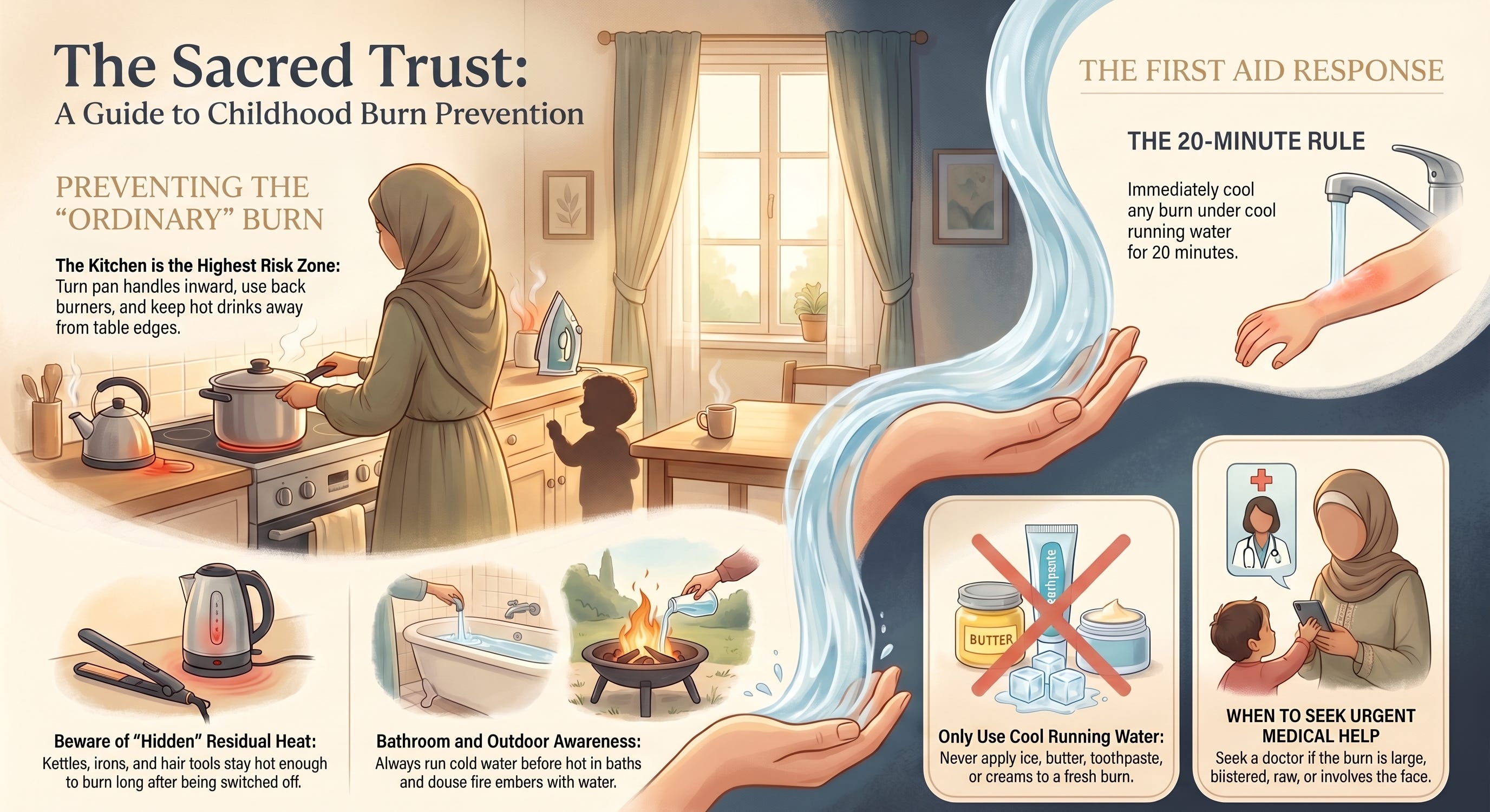
That is part of what makes burn prevention so important in family life. Many serious burns begin in moments that did not feel dramatic at all. They began in a kitchen. A living room. A backyard. An ordinary part of the day when the adults were doing normal things and the child was simply nearby. [1][2][6][7][10][11][12][13][14]
Children move toward heat before they understand it
The first thing worth holding onto is this: a burn is not only flame touching skin.
In children, many burns are scalds from hot liquids. But contact burns from ovens, stove tops, heaters, irons, hair tools, fireplaces, barbecues, exhaust pipes, and hot playground equipment are also common. [3][6][7][8][11][12][13][14]
Young children are especially vulnerable because their skin is thinner, their reactions are slower, and curiosity gets there before caution does. They do not see danger the way adults do. They see what is shiny, warm, reachable, new. They move first. Understanding comes later.
That is why close supervision around heat matters so much. Not because children are reckless. Because they are children.
The kitchen does not have to look chaotic to become dangerous
The kitchen is one of the most important places to think clearly about prevention.
Not because it is always chaotic.
Because it is often ordinary.
A parent stirring something on the stove.
A kettle boiling.
A cup of tea cooling, but not nearly enough.
A child walking in and out while dinner is being made.
That is how many injuries begin.
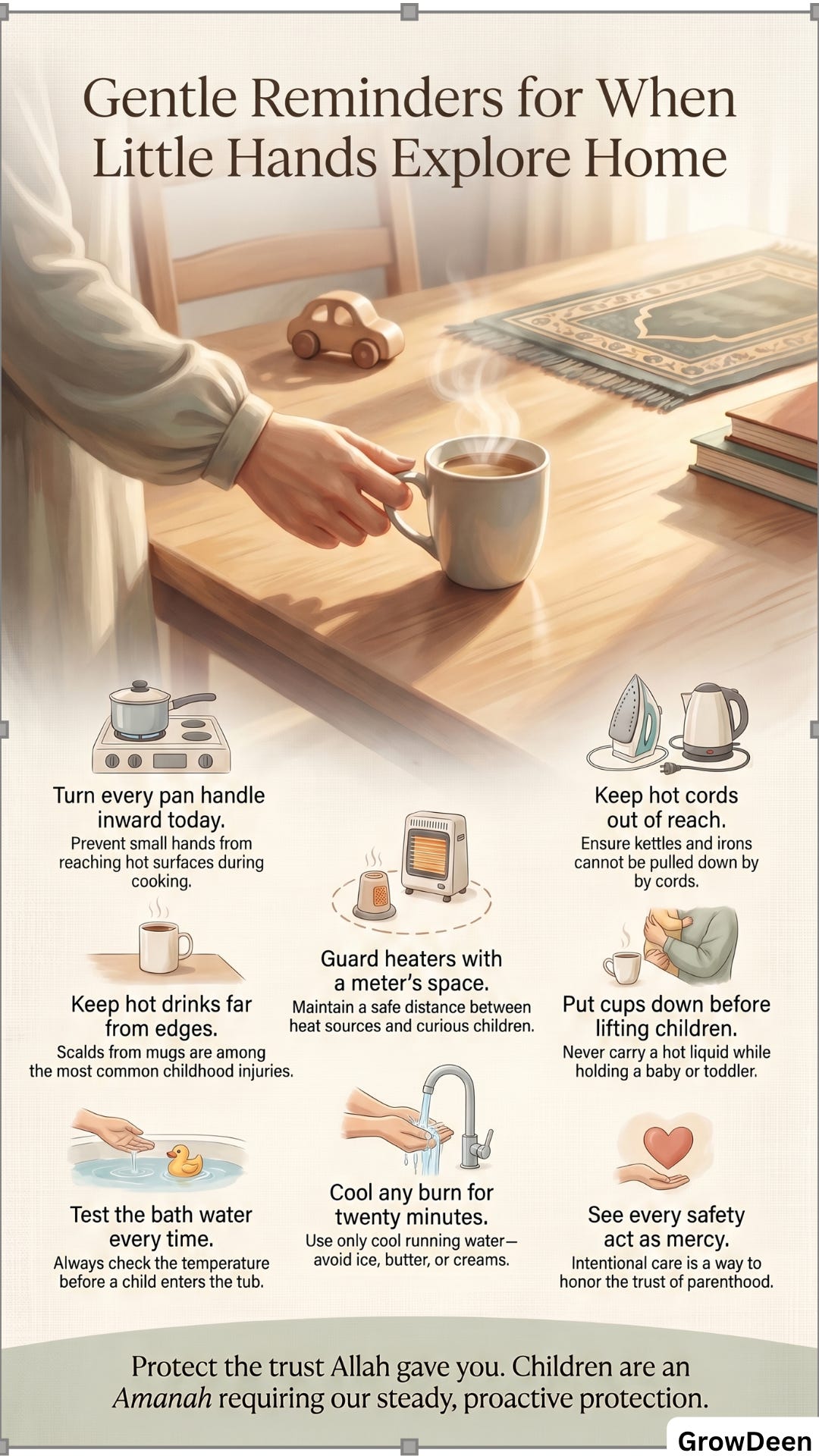
The safer habits are not glamorous, but they matter. Do not leave the kitchen unattended when hot appliances or pans are in use. Keep children’s play areas away from cooking spaces. Use the back burners first. Turn pan handles inward. Keep kettle cords short and out of reach. Put hot drinks down before picking up a baby. [7][8][12][13]
These are small choices, but they are exactly the sort of choices that reduce hot-drink and cooking-related burns. And hot drinks deserve their own seriousness. Adults know tea and coffee are hot, but often forget how long they stay hot enough to scald a child. A hot drink can still burn badly well after it has been made. That is why tablecloths are risky around children, and why placemats are often safer. One pull from a toddler can bring the whole thing down in a second. [6][7][12][13]
Heat stays behind after the adult thinks the danger has passed
Appliances deserve more suspicion than many families give them.
Kettles, toasters, sandwich presses, slow cookers, rice cookers, irons, hair straighteners, and curling tools can all injure a child after they are switched off because they stay hot while cooling. [7][8][12][13]
That is one of the crueler things about burns. The danger is often still there after the adult has mentally moved on.
This is why cords should be kept out of reach. Why devices should be turned off at low power points. Why ironing is better saved for times when children are not nearby. Why hot tools should not be left within easy reach, even “just for a minute.”
Bedrooms and living spaces can be deceptive in the same way. They feel quieter. Safer. Less obviously hazardous than kitchens. But heaters, lamps, electric blankets, open fires, candles, incense burners, and heated packs all carry real risk. Close-fitting, low-fire-danger sleepwear matters. Bedside lamps should stay out of reach. Heaters in children’s bedrooms should be turned off once the child is in bed. Electric blankets and hot water bottles should not be used for babies and very young children in unsafe ways. Heaters and open fires should have fixed guards. Curtains, clothes, and toys should stay at least one metre away from heat sources. [8][11][12][13]
Outdoors is not automatically safer just because the heat is visible
Burn risk shifts outdoors, but it does not disappear.
Barbecues, campfires, patio heaters, embers, ashes, exhaust pipes, heated seatbelt buckles, lawnmowers after use, blow torches, soldering irons, and even playground equipment in hot weather all belong in the burn conversation. [6][7][8][11][12][13][14]
The source guidance is wise here. Patio gas heaters should be braced. Children should be watched closely around barbecues and campfires. Accelerants such as petrol or kerosene should not be used to light or relight fires. Embers and ashes can stay dangerously hot for hours. Water, not dirt alone, should be used to put fires out properly before ashes are raked to cool faster. [8][11][13]
And playground equipment deserves more attention than many adults give it. Not only metal, but also some plastics and rubber surfaces can become hot enough to burn skin even when the weather does not feel extreme. [14]
Children do not need dramatic danger to get badly burned.
They just need heat, access, and a few unsupervised seconds.
If a burn happens, the first minutes matter more than most people realize
This is the rule that needs to stay plain because panic makes people forget plain things.
If a burn happens, cool the burn under cool running water for 20 minutes. [1][2][4][9][10][11][12][13]
That advice is well supported. A systematic review and meta-analysis found benefit from 20 minutes of cool running water within three hours of thermal burn injury. [4] Other guidance agrees on the same essentials and also agrees on what not to do.
Do not use ice.
Do not use butter.
Do not use oils, toothpaste, creams, or powders on a fresh burn. [4][9][10][11]
Sometimes families still reach for remedies that feel familiar or traditional. But in those first minutes, familiarity is not the test. Benefit is.
Cool running water helps.
Guesswork does not.
Urgent medical help is needed if the burn is large, blistered, raw, severe, or involves the airway, face, hands, or genitals. [4][5][9][11][12][13] That is not overreaction. It is the sort of careful judgment children deserve.
Baths, cups, and everyday routines carry more risk than people think
One thing that improves any home-burn conversation is remembering that bathroom safety belongs inside it too.
Hot tap water is a major scald risk. Bath water should be tested carefully. Cold water should run first, then hot. Delivered tap temperature should be controlled where possible. Bathroom scalds are among the most common preventable injuries in younger children. [6][7][10][11][12][13]
That same pattern runs through most childhood burns, really. It is not usually a dramatic disaster. It is ordinary domestic life.
A bowl of noodles too close to an edge.
A mug carried while also carrying a child.
A pan left where a small hand can reach.
A heater that was meant to warm the room, not injure someone in it.
That is why prevention matters as much as first aid. Home-based changes, safer hot-water habits, careful handling of hot liquids, and greater awareness all reduce risk. [6][7][8][10][11]
If writing like this helps you feel steadier in the real work of caring for children, subscribe for free so the next article and companion resources arrive quietly in your inbox.
Allah’s mercy is in the carefulness that prevents the injury
From an Islamic perspective, this topic fits naturally under amanah.
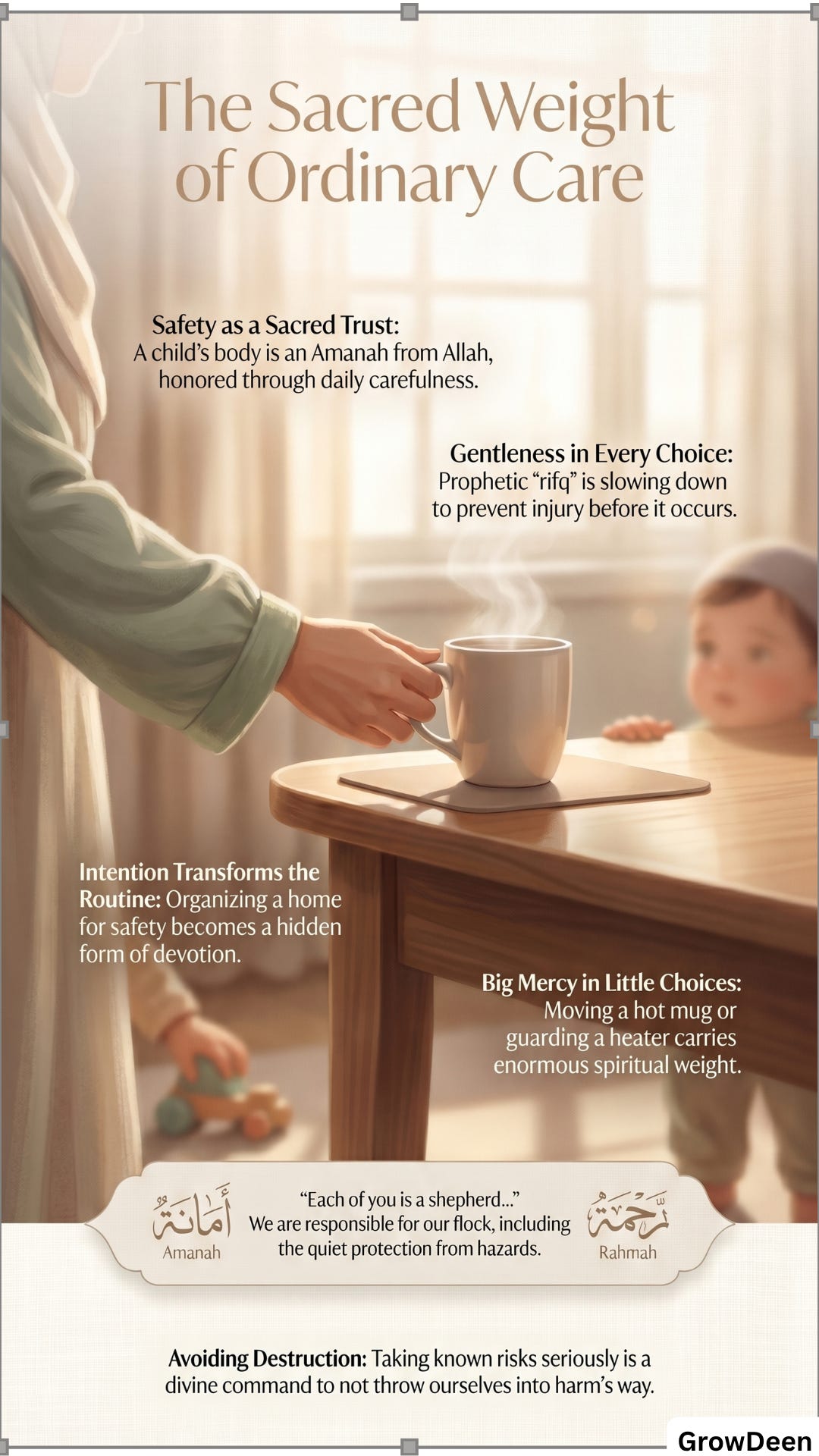
A child’s body is a trust from Allah, and ordinary household safety is part of how that trust is honored. Allah says, “Indeed, Allah commands you to render trusts to whom they are due.” [15]
And He says, “Do not throw yourselves with your own hands into destruction.” [16]
These verses speak directly to preventable harm. Burn risks are often known risks. Ignoring them is not wisdom.
The Prophet ﷺ said, “Each of you is a shepherd, and each of you is responsible for his flock.” [17]
That responsibility appears in very small places. Turning a pan handle inward. Moving a mug farther back. Guarding a heater. Putting out candles properly. Checking the barbecue area twice. None of these things look grand. But they are part of what it means to care for those who cannot yet protect themselves.
And the Prophet ﷺ said, “Allah is gentle and loves gentleness in all matters.” [18]
Gentleness here is not softness without caution. It is carefulness. It is slowing down enough to prevent the injury instead of scrambling after it.
And intention deepens it all. “Actions are only by intentions.” [19]
A parent who organizes the home more safely, learns burn first aid, and watches children closely around heat is doing ordinary work with potentially enormous benefit. Much of parenting is like that. Quiet prevention. Little choices. Big mercy.
In the end, the heart of burn prevention is not complicated
Supervise closely around heat.
Make the kitchen and living spaces harder for children to get burned in.
Treat hot drinks like real hazards.
Guard fires and heaters.
Be more cautious outdoors than you think you need to be.
And if a burn happens, cool it under running water for 20 minutes and get help quickly when the injury is serious. [1][2][4][5][9][10][11][12][13]
That is not a dramatic philosophy.
It is simply the kind of carefulness children need.
GIFTS FOR YOU, DEAR READER
If you’ve reached this part of the page, that tells me something meaningful about you.
You stayed with this.
You did not just skim it and move on.
And usually that means something here felt close to real life. Maybe it made you think about your own kitchen. Maybe it brought to mind a child who moves faster than your heart can keep up with. Maybe it simply reminded you how much of caregiving lives in small acts of prevention that no one else ever sees.
That effort matters.
Your willingness to read carefully, reflect honestly, and take ordinary household risks seriously is not small. It says something beautiful about the kind of care you are trying to give.
I did not want this article to remain only words on a page.
I wanted it to stay with you a little longer than that.
To move with you into the kitchen.
Into bath time.
Into backyard evenings.
Into the ordinary domestic places where a burn can begin quickly and where the right habits can quietly stop it before it starts.
So we prepared a small companion pack for you.
Not as decoration.
Not as pressure.
But as a few thoughtful resources designed to help this stay close to daily life. Something you can save, revisit, print, reflect on, or keep nearby when you want the heart of this guidance in a form that is easier to carry into the day.
The hope is simple.
Not just that you read.
But that what you read becomes easier to remember, easier to apply, and easier to return to when you need it.
These companion resources were made slowly, thoughtfully, with care and sincere du’a. They were prepared because some kinds of guidance are too important to leave as a passing impression. They deserve something steadier. Something that helps bridge the gap between knowing and doing.
So please do download the companion pack.
And if it supports you, subscribe for free so future articles and companion resources arrive directly in your inbox. That way, the next time something is published for a real stage of care, responsibility, and protection, it reaches you without extra effort from you.
And if someone comes to mind while you are reading, a parent, grandparent, teacher, caregiver, or anyone responsible for children around kitchens, heaters, baths, and outdoor heat, share it with them too.
May Allah place barakah in your effort, accept your intention, and make the care you give more protective, more merciful, and more rewarded than it feels in the moment.
What is one ordinary burn risk in family life that you think people stop noticing because it feels too familiar?
Subscribe for free if you’d like future articles and companion resources that help Islamic wisdom and practical care stay close to real life.
References
[1] Burgess, J., Watt, K.A., Kimble, R.M., & Cameron, C. (2018). Knowledge of childhood burn risks and burn first aid: Cool runnings
[2] Davies, M., Maguire, S., Okolie, C., Watkins, W., & Kemp, A.M. (2013). How much do parents know about first aid for burns?
[3] Gabbe, B.J., Watterson, D.M., Singer, Y., & Darton, A. (2015). Outpatient presentations to burn centers: Data from the Burns Registry of Australia and New Zealand outpatient pilot project
[4] Griffin, B., Cabilan, C.J., Ayoub, B., Xu, H.G., Palmieri, T., Kimble, R., & Singer, Y. (2022). The effect of 20 minutes of cool running water first aid within three hours of thermal burn injury on patient outcomes: A systematic review and meta-analysis
[5] Kassira, W., & Namias, N. (2008). Outpatient management of pediatric burns
[6] Riedlinger, D.I., Jennings, P.A., Edgar, D.W., Harvey, J.G., Cleland, M.H.J., Wood, F.M., & Cameron, P.A. (2015). Scald burns in children aged 14 and younger in Australia and New Zealand – An analysis based on the Burn Registry of Australia and New Zealand (BRANZ)
[7] Thompson, R., Budziszewski, R., Nanassy, A.D., Meyer, L.K., Glat, P., & Burkey, B. (2021). Evaluating an urban pediatric hospital’s scald burn prevention program
[8] Turner, C., Spinks, A., McClure, R., & Nixon, J. (2004). Community-based interventions for the prevention of burns and scalds in children
[9] Varley, A., Sarginson, J., & Young, A. (2016). Evidence-based first aid advice for paediatric burns in the United Kingdom
[10] Wood, F.M., Phillips, M., Jovic, T., Cassidy, J.T., Cameron, P., Edgar, D.W., & Steering Committee of the Burn Registry of Australia and New Zealand (BRANZ). (2016). Water first aid is beneficial in humans post-burn: Evidence from a bi-national cohort study
[11] World Health Organization. Burns fact sheet
[12] American Academy of Pediatrics / HealthyChildren.org. Burn Treatment & Prevention Tips for Families
[13] NHS. Burns and scalds – Prevention
[14] U.S. Consumer Product Safety Commission. Playground Burn Fact Sheet
[15] Qur’an, Surah An-Nisa 4:58
[16] Qur’an, Surah Al-Baqarah 2:195
[17] Sahih al-Bukhari 7138
[18] Sahih Muslim 2593
[19] Sahih al-Bukhari 1, Sahih Muslim 1907