
The Toys You Choose Today Shape the Child You Raise Tomorrow
A Parent’s Gentle Guide to Toys That Build Skills and love for Allah

Free gift for you! A practical companion resource is waiting for you near the end of this article to help you remember, apply, and benefit from what you read. Don’t forget to download!
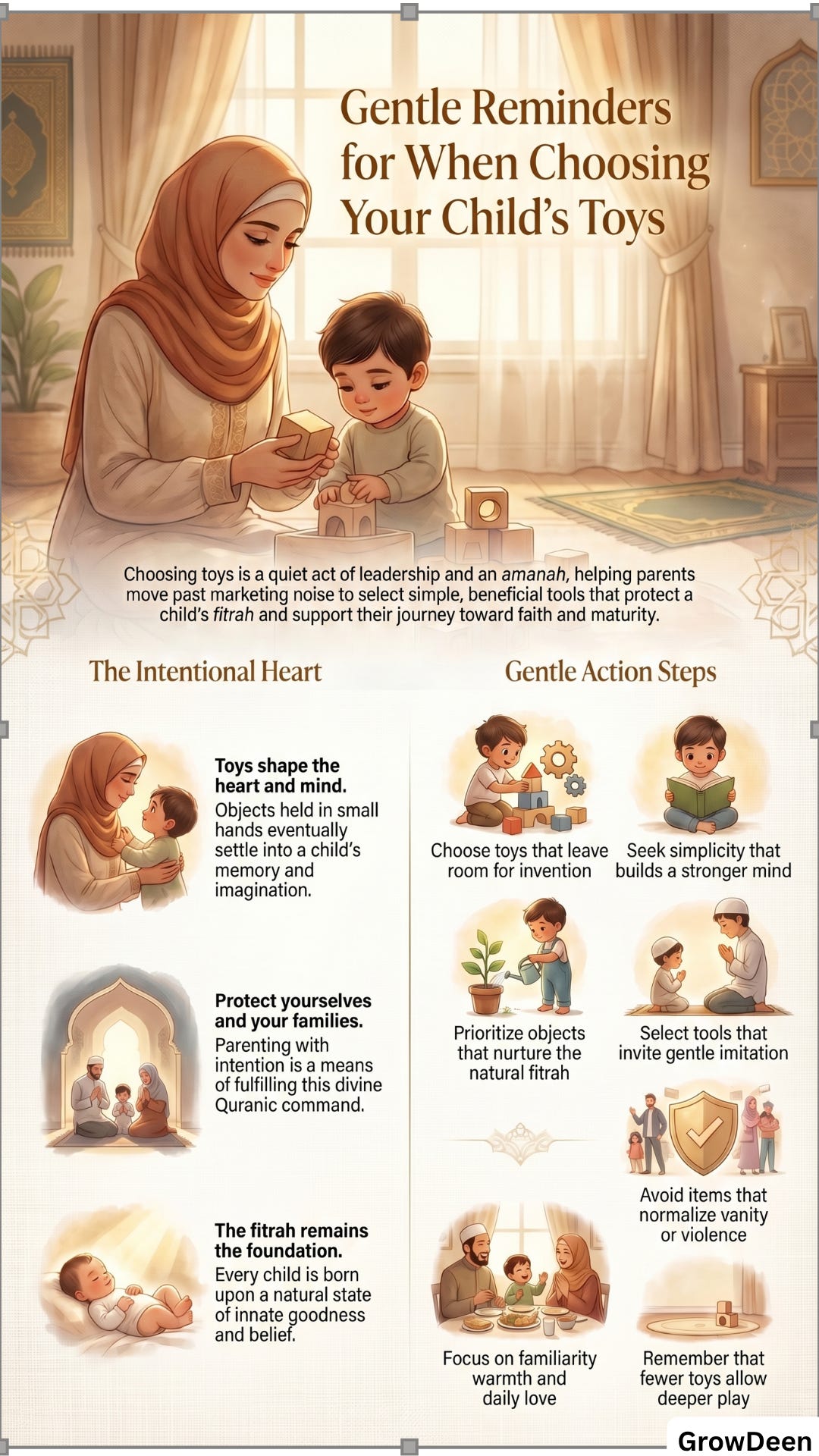
Choosing toys with intention is a quiet but powerful way to support your child’s development, protect their values, and gently nurture their connection with Allah.
You’re watching your child play.
Completely absorbed.
Same toy. Same story. Same little world they’ve built again.
You’ve seen this before.
Maybe a hundred times.
And something about it makes you pause.
Because it’s not just play, is it?
Something is forming here.
Quietly.
Without asking your permission.
The Toy That Stays Longer Than You Think
Choosing toys for a child is never only about keeping them busy.
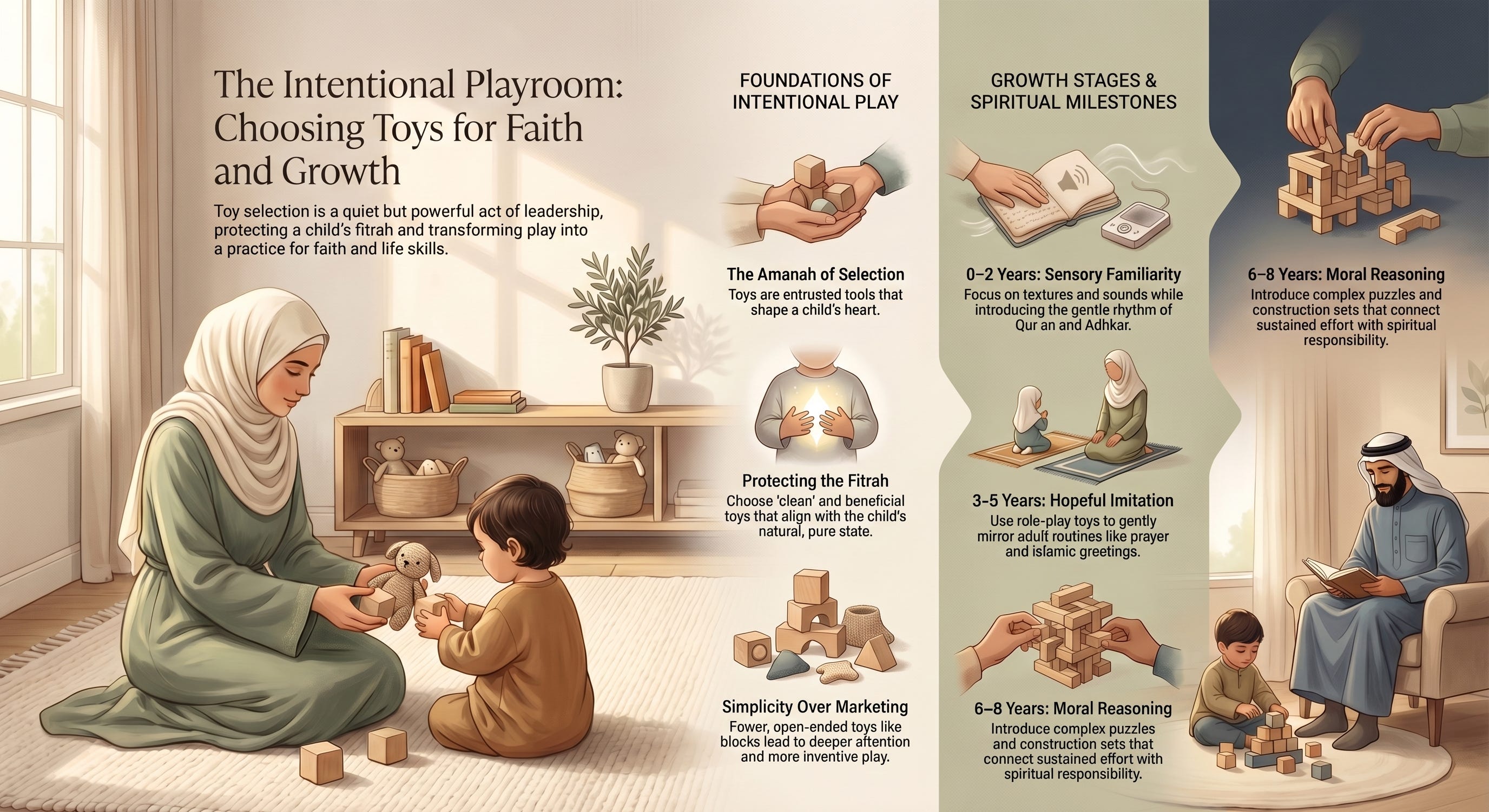
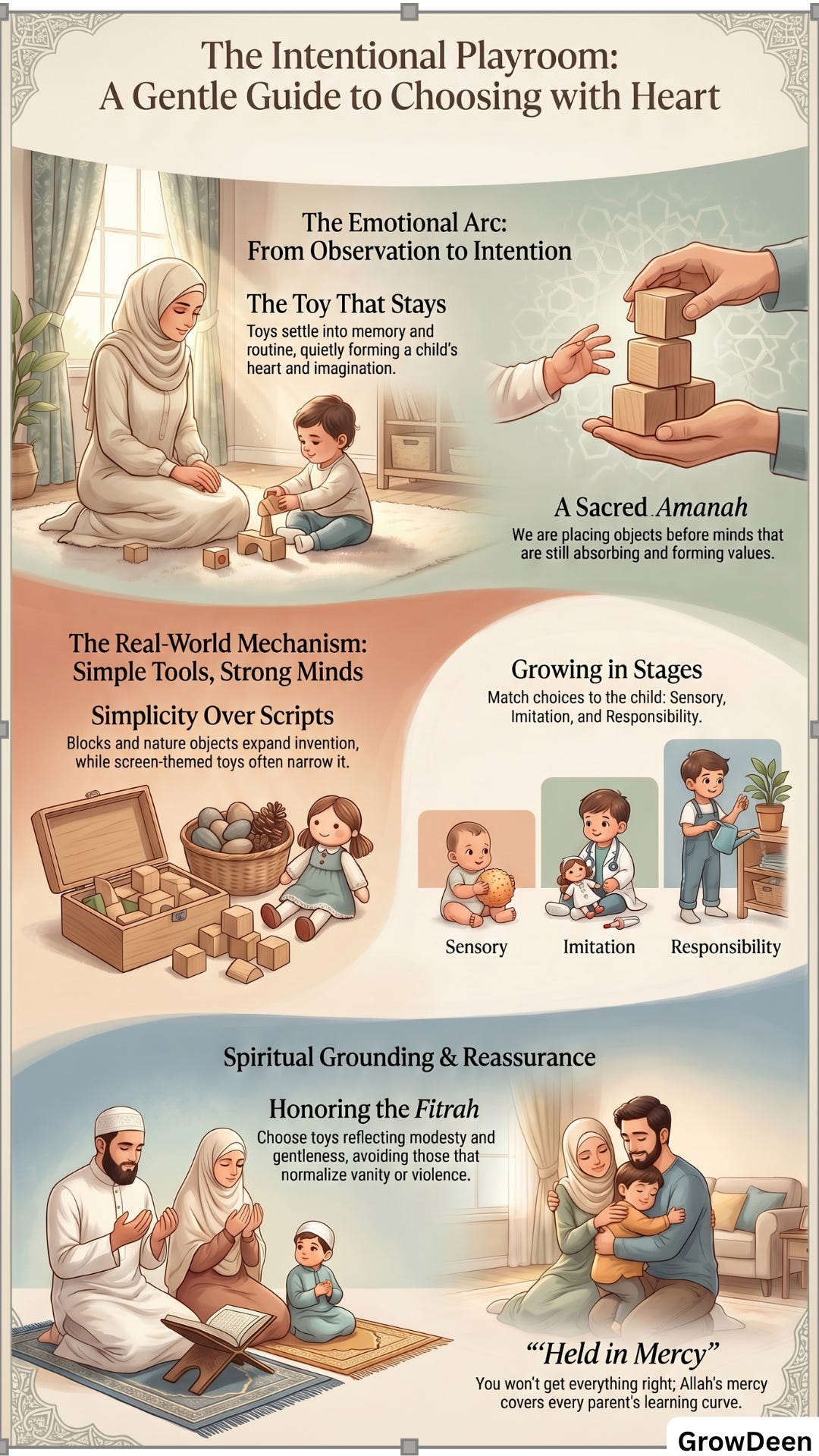
Toys sit in little hands, but they also settle into memory, routine, language, and imagination.
A child returns to the same object again and again, and each return shapes something: attention, patience, movement, confidence, storytelling, problem-solving, even taste.
That is why good toy selection deserves more thought than whatever happens to be popular or loudly marketed.
Play supports cognitive, physical, social, and emotional development, and the strongest toys are usually the ones that leave room for a child to do something with them rather than simply react to them.
The Amanah You Carry in Small Decisions
In a Muslim home, that care goes even deeper.
A child is not simply being entertained; a child is being entrusted to us.
Allah says:
“Protect yourselves and your families from a Fire…” [14]
And He says:
“Command your family to pray and be steadfast in it.” [15]
That does not mean childhood should feel heavy or joyless.
It means a parent chooses with intention.
We are not only putting an object into a child’s hand.
We are placing something in front of a heart and mind that are still receiving, absorbing, and forming.
The Prophet ﷺ taught that every child is born upon the fitrah [17].
So the question is not only whether a toy is engaging, but whether it is clean, beneficial, and worthy of becoming familiar to the child.
Not All Toys Help a Child Grow the Same Way
The usual advice about toys still matters: choose things that are safe, durable, suited to the child’s stage, and open enough to support real play.
Age guidance is not a perfect rulebook, but it is useful because children’s abilities change quickly in the early years.
Good toy choices match those changes.
A baby needs sensory comfort and human interaction.
A preschooler needs room for pretending, building, naming, repeating.
An older child often needs more challenge, more sequencing, more creative independence, and more chances to practise patience with something that does not instantly reward them.
Safety Comes First, Quietly and Firmly
Safety comes first, quietly but firmly.
Check age labels.
Be wary of small parts, long cords, poorly secured battery compartments, strong magnets, and anything brittle or breakable.
Button batteries deserve special caution; accessible coin or button batteries can cause severe internal injury if swallowed, which is why current safety guidance emphasizes secure battery compartments and careful supervision.
Some Toys Shape Values You Never Chose
The harder questions, though, are usually not about screws or plastic.
They are about what kind of ideas a toy normalises.
Some categories are better avoided altogether, even if they are common in the market.
Toy weapons do not deserve a place simply because they are popular.
Nor do dolls or figures designed with inappropriately dressed, adult-styled features.
Nor toys built around vanity, mock violence, crude messaging, or glamour that teaches children to admire what should not be admired.
A parent does not need to “test” these categories first in order to reject them.
If the category itself conflicts with the values of modesty, gentleness, dignity, and clean-hearted upbringing, that is already enough reason to step back.
The goal is not panic.
It is clarity.
Children do not need everything that is available to them.
When Simplicity Builds Stronger Minds
That same caution applies to marketing.
Advertised toys often narrow play instead of expanding it.
They pull children into imitation rather than invention.
A toy tied too tightly to a screen character, a combat theme, or a status image may hold attention for a moment but leave little behind.
The better path is often simpler: blocks, dolls with childlike features, puzzles, pretend-play materials, art supplies, books, loose parts, nature objects, construction pieces, household items repurposed with care, and tools that let the child lead the play rather than follow a script.
A Child Grows in Stages, Not All at Once
It helps to organise toy choice by age, because a parent with a two-year-old is not really asking the same question as a parent with an eight-year-old.
The developmental goals are different.
The kinds of toys that support faith are different too.
What follows is one practical way to think about the early years from birth to age eight.
The Gentle Beginnings: Learning Through the Senses (0–2 Years)
From 0 to 2 years, the central work is sensory development, attachment, early language, movement, and trust.
At this age, children are learning through looking, grasping, mouthing, listening, reaching, banging, carrying, and repeating.
They benefit from rattles, textured books, soft balls, stacking cups, nesting containers, large blocks, cloth books, mirrors made for babies, simple sound toys, and sturdy objects they can safely hold and explore.
Household items often work beautifully here: wooden spoons, soft scarves, empty containers, safe lids, and baskets of textured objects.
The value lies in repetition and interaction, not novelty.
At this same stage, Islamic development is not about formal teaching.
It is about familiarity, warmth, and love.
A baby or very young toddler can begin hearing the Qur’an, short adhkar, gentle nasheeds, simple Arabic sounds, and words of remembrance tied to daily life.
Allah says that He brought us from our mothers’ wombs knowing nothing, then gave us hearing, sight, and hearts [16].
The child begins by receiving.
The Imitation Years: When Play Becomes Practice (3–5 Years)
From 3 to 5 years, children usually surge in language, imagination, role-play, and fine-motor control.
They want to imitate adults, assign roles, build little worlds, and make sense of the routines around them.
This is a rich age for pretend kitchens, child-safe cooking tools, dolls with modest and childlike features, animal figures, dress-up clothes, puppets, train sets, beginner puzzles, matching games, magnetic drawing boards, chunky art supplies, clay, lacing toys, pegboards, building blocks, and simple cooperative games.
For Islamic growth, this is often the age when children love imitation in a hopeful way.
They want to “do what the grown-ups do.”
That makes it an ideal stage to introduce prayer routines gently, simple duas, Arabic letters, Islamic greetings, and everyday adab through play.
The Prophet ﷺ showed tenderness to children [18].
The Growing Years: Thinking, Patience, and Responsibility (6–8 Years)
From 6 to 8 years, children often become more capable of sustained attention, structured problem-solving, collaborative play, and early moral reasoning.
They can follow multi-step games, work through more complex puzzles, and begin connecting effort with outcome.
This is a strong age for construction sets, pattern games, larger puzzles, logic games, storytelling kits, crafts, and exploration materials.
Spiritually, this age begins to carry more responsibility, though still with gentleness.
The Prophet ﷺ said:
“Command your children to pray when they become seven years old…” [19]
You Don’t Need More Toys—Just More Thought
What matters most across all these age groups is that the Islamic toy should still be a good toy.
It should not just make noise.
It should invite engagement.
It should match the child’s level.
It should support a home where faith is already alive.
No toy can replace a parent’s example.
But the right toy can reinforce what the child is already seeing and hearing.
It is also worth remembering that children usually do better with fewer toys than adults assume.
When there are too many, attention scatters.
When there are fewer, children tend to go deeper.
If reflections like this support you, you’re always welcome to subscribe so these reminders reach you when you need them most.
Allah’s Mercy Covers the Learning Curve
In the end, choosing toys is really an act of quiet leadership.
You look at your child.
You think about what they are growing toward.
And you choose accordingly.
You will not get everything right.
And that’s okay.
The Prophet ﷺ was gentle with children [18].
And Allah is gentle with you.
GIFTS FOR YOU, DEAR PARENT
If you’ve reached this part of the page, it tells me something meaningful about you.
You weren’t just skimming or passing time. You stayed because something here felt relevant to your real life.
Because you care.
Because you want to do things with more awareness.
Because you’re trying, even when it feels overwhelming.
That is not small.
So I didn’t want this article to remain just words on a page. I wanted it to gently step into your daily life in practical ways. That’s why we prepared these Life Gifts for you.
Not as extras.
Not as decorations.
But as simple tools to help you hold onto what mattered most in what you just read.
Here’s what you’ll find inside:
Gentle Understanding Card
A clear and simplified summary of the core concept from this article, so you can revisit the main idea anytime without rereading everything.
Heartfelt Dua Card
A carefully chosen dua connected to this stage of life, because we know that real strength and ease ultimately come from Allah’s help.
Gentle Actions Card
Practical examples to help you translate knowledge into action, so what you learned becomes part of your daily rhythm.
Gentle Reminders Card
Short, steady reminders drawn from the key points, designed to be printed or saved and placed somewhere you’ll see often.
These were designed slowly and thoughtfully, with time, care, and sincere dua. We created them because we genuinely want to walk alongside you, not just through one article, but through every stage of this lifelong journey.
If these gifts support you even in a small way, I would love for you to continue receiving them.
Subscribe so that each new Gift arrives directly in your inbox whenever we release the next stage. That way, you won’t miss the tools designed to support you right where you are.
May Allah place barakah in your effort, accept your intention, and make this path easier and more rewarding than it feels right now.
Please share it with a family/friend who may benefit from this knowledge.
What is one moment with your child that feels hardest lately, and what kind of support would make it feel lighter?
Final Reflection
You don’t need to follow every trend.
You don’t need to buy everything.
You just need to pause… and choose with intention.
Subscribe for free to receive gentle, practical reminders like this.
What is one toy you feel unsure about right now—and why?
REFERENCES
[1] Healey, A., & Mendelsohn, A. (2019). Selecting appropriate toys for young children in the digital era. Pediatrics, 143(1), e20183348.
[2] Cheng, T.L., Brenner, R.A., Wright, J.L., Sachs, H.C., Moyer, P., & Rao, M. (2003). Community norms on toy guns. Pediatrics, 111(1), 75-79.
[3] Cupit, C.G. (2013). Play and quality in early childhood: Educators, superheroes and fairy princesses. Early Childhood Australia.
[4] Daly, L., & Beloglovsky, M. (2019). Loose Parts 4: Inspiring 21st Century Learning. Redleaf Press.
[5] Daly, L., & Beloglovsky, M. (2018). Loose Parts 3: Inspiring Culturally Sustainable Environments. Redleaf Press.
[6] Dauch, C., Imwalle, M., Ocasio, B., & Metz, A.E. (2018). The influence of the number of toys in the environment on toddlers’ play. Infant Behavior & Development, 50, 78-87.
[7] Levin, D.E., & Carlsson-Paige, N. (2006). The War Play Dilemma: What Every Parent and Teacher Needs to Know (2nd ed.). Teachers College Press.
[8] Lindon, J., & Hughes, C. (2013). Play and learning in the early years. Mark Allen Group.
[9] American Academy of Pediatrics. HealthyChildren.org. How to Buy Safe Toys.
[10] NAEYC. Good Toys for Young Children by Age and Stage.
[11] UNICEF & The LEGO Foundation. Learning Through Play.
[12] McMullen, M.B., & Brody, D. Play Materials That Facilitate Thinking and Problem-Solving Skills.
[13] U.S. Consumer Product Safety Commission. Button Cell and Coin Battery Information Center; Toy Safety and Recall Guidance.
[14] Qur’an, Surah At-Tahrim 66:6.
[15] Qur’an, Surah Ta-Ha 20:132.
[16] Qur’an, Surah An-Nahl 16:78.
[17] Sahih Muslim 2659a.
[18] Sahih al-Bukhari 5997.
[19] Sunan Abi Dawud 495.
[20] Quran Cube. Official product information for children’s Qur’an and dua audio products.
[21] Goodword Books. Official children’s Islamic storybook collections and early-learning products.
[22] My Salah Mat. Official product information for interactive prayer-learning mats and Arabic-learning tools.
[23] My Quran Pad. Official product information for interactive Arabic and Qur’an learning pads.
[24] Desi Doll Company. Official product information for talking Muslim dolls and Islamic sound books.
[25] Imaan Kidz. Official product information for Arabic alphabet learning tools, dua sound books, Islamic dolls, and children’s educational toys.