
The Toys In Your Home May Be Teaching More Than You Think
When Play Looks Ordinary but Is Quietly Shaping Your Child

Free gift for you! A practical companion resource is waiting for you near the end of this article to help you remember, apply, and benefit from what you read. Don’t forget to download!
From birth to 8 years, age appropriate games and toys help children learn, imagine, move, communicate, and bond, and in a Muslim home these can be gently adapted to include Islamic language, routines, stories, and worship.

Sometimes a toy looks so ordinary that an adult almost misses what is happening.
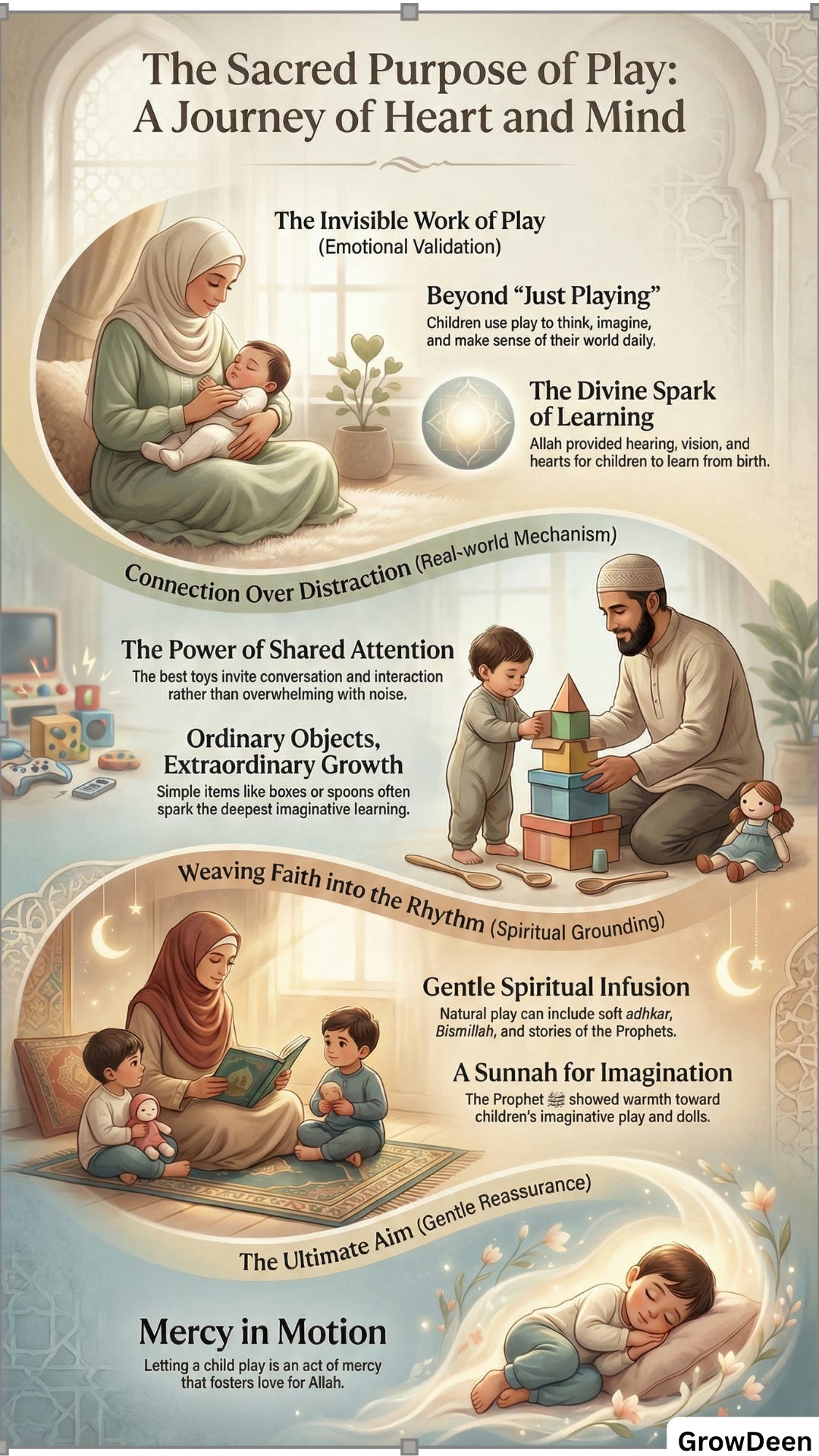
A child lines up cups across the floor and talks to them as if they are old friends. A teddy gets wrapped in a blanket and told to sleep. A few blocks become a masjid, then a train, then something else entirely five minutes later. From the outside, it can look like “just playing.”
But children are rarely “just” playing.
They are thinking, imagining, moving, trying out language, rehearsing relationships, and making sense of the world in ways that do not always announce themselves.[1][2][4][5]
Toys are not the center, but they do shape the room
Games and toys matter because play matters. Children do not only use toys. They think with them, move with them, imagine through them, and talk around them.[1][2][4][5] The American Academy of Pediatrics keeps returning to the same point: the best toys are usually the ones that support real interaction between a child and a caregiver, not the ones that overwhelm the room with noise, lights, or screen like distraction.[1][2][4][5]
That sits beautifully in a Muslim home.
A child is not just being entertained. A child is being formed. Allah says, “And Allah has extracted you from the wombs of your mothers not knowing a thing, and He made for you hearing and vision and hearts.”[16] He also says, “Wealth and children are the adornment of worldly life.”[18] So toys and games are not the center of tarbiyah, but they can become part of it when they help a child experience warmth, language, imagination, movement, and gentle familiarity with Islam.
The best toys usually come alive when you enter the play
The best games are often the ones you play together.
A rhyme with actions. Sorting spoons and cups by size. A teddy bear tea party. Building a tower and laughing when it falls. These small moments build relationship as much as skill.[1][2][3][7] And in an Islamic adaptation, that same principle still stands. The developmental power is still in shared attention and responsiveness. The Islamic layer enters through what you say, what you name, what you repeat, and what meanings you gently attach to the play.[1][2][7][8]
It is also wise to offer variety, because different toys invite different kinds of learning. Blocks and puzzles support problem solving. Dress ups and figures support imagination. Art materials support fine motor control and creativity. Outdoor toys support movement and confidence.[2][3][4][6][7]
Not every toy labeled Islamic will actually do much
For Muslim families, one more principle helps. Not every Islamic toy is equally useful.
Some current Muslim retailers do helpfully group products by age bands, which can make browsing easier. Muslim Memories currently separates Baby and Toddler Books for 0 to 5 years and also has a games collection. My Salah Mat currently sells a learning bundle featuring My Quran Pad. Darussalam Canada has a board games and puzzles collection, and Eastern Toybox currently separates Early Years 0 to 5yrs from School Years 6 to 12yrs.[9][11][13][14][15]
That is useful. But age labels are not a full philosophy of play.
A better test is this: does the toy still leave room for conversation, pretend play, movement, repetition, and caregiver involvement?[4][5][9][11][13][14][15]
In the newborn months, the toy is still mostly you
For a newborn, the most important “toy” is still you.
Your face. Your voice. Your pause. Your response.
Newborns learn through close human interaction far more than through objects. They may enjoy a bright mobile, a light rattle, or a soft cloth book, but the main event is still the relationship around the play.[1][2][3][7][16]
Sensory toys can still help. At this age, simple high contrast objects, soft textures, curved patterns, and light rattles make sense because newborn vision and attention are still very early. Keep objects close, because newborns see best at a short distance.[4][5]
For sound play in a Muslim home, this does not need to revolve around music. You can use calming recitation, humming gentle adhkar, softly spoken rhymes, or repeated phrases like Bismillah, Alhamdulillah, and Allah in a warm rhythmic voice. The developmental principle stays the same: repetition, shared attention, gentle rhythm, and emotional safety. And spiritually, it sits well with Allah’s words, “Unquestionably, by the remembrance of Allah hearts find rest.”[19]
For this stage, simple baby and toddler Islamic board books, cloth books, or sound books can help, as long as they stay part of shared play rather than replacing the caregiver’s own voice.[9][10] And if the baby looks tired or overwhelmed, stop. That pause is part of good play too. The Prophet ﷺ said, “He is not one of us who does not show mercy to our young.”[24]
If you find these kinds of gentle, Islamically grounded reflections helpful, subscribe for free so new pieces can reach you quietly when you need them most.
By the toddler years, play gets louder, busier, and more purposeful
From a few months onward and through toddlerhood, many children start enjoying a wider variety of toys: push along toys, ride ons, soft balls, cuddly toys, board books, simple puzzles, blocks, and cause and effect toys.[1][3][4] Children begin learning that their actions make things happen, and that is a big moment in development.[4][5]
Here too, you can adapt wisely. Instead of toys built mainly around music, Muslim families can favour toys that use letters, words, Arabic sounds, animal sounds, simple phrases, or just physical action without a musical soundtrack.[4][5] The developmental value is still there in agency, surprise, repetition, and attention.
Books become even more valuable here. Babies and toddlers love being held close, turning thick pages, looking at bright pictures, and hearing the same words again and again.[3][9][10] The Bismillah Children’s Sound Book currently sold by Muslim Memories is one example of a toy like book that introduces Islamic phrases with sound support.[10]
By the later part of this stage, more explicitly Islamic learning toys begin to appear. My Salah Mat’s current product pages describe My Quran Pad as an interactive Arabic learning tool, and its interactive learning bundle is currently marketed for children aged 2 to 5.[11] Even then, these tools work best when an adult sits nearby, names things, repeats them, and turns the toy into a shared experience.[4][5][11]
And ordinary household objects still matter. Pots, pans, scarves, cardboard boxes, spoons, plastic containers. These can be some of the best toys in the room if they are safe and supervised.[4][5] Outdoor play belongs here too. Rolling a ball, splashing and pouring, walking on grass, digging in sand, chasing bubbles. These are rich forms of early learning.[1][6]
Preschool years open the door wider for imagination
Preschoolers often love building, taking things apart, rebuilding, experimenting, and role play. Blocks, ramps, playdough, cardboard creations, dress ups, puzzles, shared drawing, and simple board games all fit beautifully here.[2][3][4][5]
This is also one of the richest ages for Islamic toy adaptation, because imagination opens up. A child can turn a box into a masjid, a train, a mailbox, or a Kaaba scene. A mat can become a pretend salah space. Water play can become playful wudu imitation. Story baskets can be built around prophets, animals, helping, travel, and family life. A recent conceptual literature review on Islamic based play learning highlighted role play around prophetic stories and worship simulation as examples of Islamic play that can support cognition in early childhood.[8]
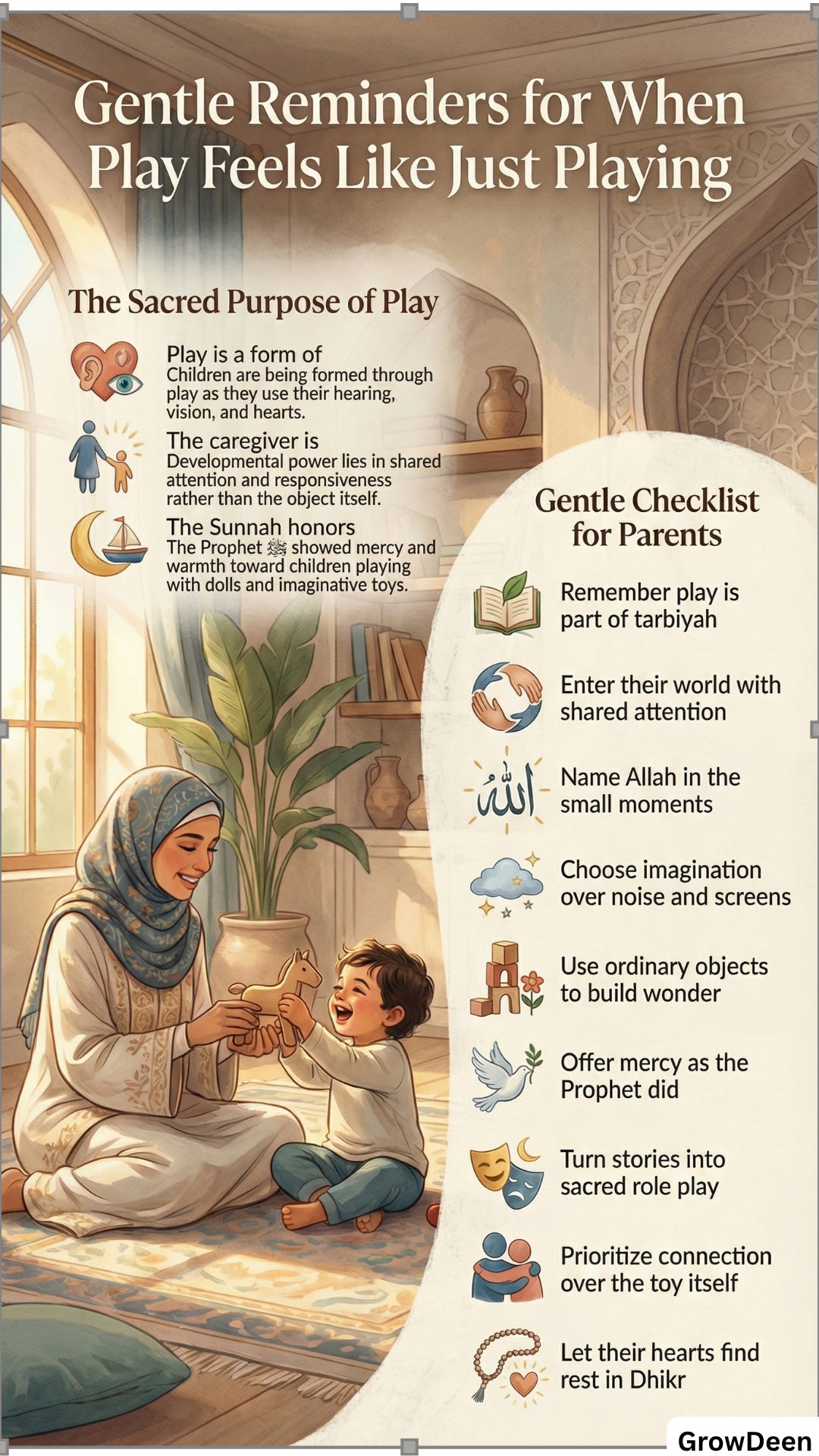
And the Sunnah gives this more than enough room. Aisha رضي الله عنها said she used to play with dolls in the presence of the Prophet ﷺ, and he allowed her friends to join her.[21] In another narration, he saw among her dolls a horse with wings made of rags and laughed warmly at it.[22] That matters. It tells Muslim parents that children’s imaginative play was not treated as spiritually out of place.
This is also the age where clearly Islamic toy examples become easier to use. Joy and Jannah’s current Wooden Kaaba and Peg Doll Play Set is described as open ended Hajj and Umrah play and is currently listed as suitable for ages 3+ with supervision.[12] Toys like this can help bring Hajj, Umrah, Islamic landmarks, and symbolic worship scenes into the child’s hands, not only into adult explanation.
And where some play advice suggests homemade musical instruments, a Muslim adaptation can instead lean into sound and rhythm play through rice shakers, tapping bowls, voice based call and response, gentle recitation rhythm, or hummed adhkar.[2][3][4][19]
By 5 to 8, toys can stretch into stories, skills, and family games
For children aged 5 to 8, many classics are still excellent: books, art supplies, construction sets, puzzles, balls, skipping ropes, bikes, cricket sets, and board games.[2][4][5] The AAP still favours hands on, imaginative, relational toys over digital toys pretending to be more educational than they really are.[2][4][5]
This is also the stage where Islamic toy ecosystems become more structured. Darussalam Canada, Eastern Toybox, and Muslim Memories all currently show clearer age and category organisation than many years ago, including games, puzzles, and age grouped books.[13][14][15] So age wise Islamic toys do exist now in more usable ways.
For this age band, strong additions include family board games with Islamic themes, Arabic and Qur’an learning games, story collections, quiz cards, Hajj themed builds, and construction activities that let a child design a masjid, map a journey, or retell stories in their own words.[8][13][14][15]
And even here, your child still benefits from playing with you. Kicking a ball after school, doing a puzzle together, reading aloud, building side by side, or playing a short family game before bed still matters. In the well known report of Abu ‘Umair and his little bird, the Prophet ﷺ noticed a child’s sadness and entered his small world with tenderness.[23]
Choosing toys in an Islamic home
So when you choose toys for your family, think about age, interests, safety, and values. But also think about what kind of life the toy is quietly teaching.
Is it opening imagination or shutting it down.
Is it pulling the child toward shared play or isolation.
Is it helping the child move, build, narrate, remember, and wonder.
Or is it mostly noise.[4][5]
Islamically, the aim is not to label every toy “Islamic” and feel satisfied. The deeper question is whether the toy helps the child grow in a home where Allah is remembered, prayer is seen, language is softened by dhikr, and childhood is treated with mercy. Allah says, “Protect yourselves and your families from a Fire,”[17] and He says, “And enjoin prayer upon your family and be steadfast therein.”[20]
So the best Islamic toy philosophy may be simpler than it first sounds.
Keep the developmental wisdom.
Keep the child led joy.
Keep the open ended play.
Then gently infuse the child’s world with Qur’an, dua, adab, Arabic, worship familiarity, prophetic stories, and love.
The Prophet ﷺ said, “He is not one of us who does not show mercy to our young.”[24]
Mercy is not only in discipline.
It is also in how we let children play.
GIFTS FOR YOU, DEAR PARENT
If you’ve reached this part of the page, it tells me something meaningful about you.
You weren’t just skimming or passing time. You stayed because something here felt relevant to your real life.
Because you care.
Because you want to do things with more awareness.
Because you’re trying, even when it feels overwhelming.
That is not small.
So I didn’t want this article to remain just words on a page. I wanted it to gently step into your daily life in practical ways. That’s why we prepared these Life Gifts for you.
Not as extras.
Not as decorations.
But as simple tools to help you hold onto what mattered most in what you just read.
Here’s what you’ll find inside:
Gentle Understanding Card
A clear and simplified summary of the core concept from this article, so you can revisit the main idea anytime without rereading everything.
Heartfelt Dua Card
A carefully chosen dua connected to this stage of life, because we know that real strength and ease ultimately come from Allah’s help.
Gentle Actions Card
Practical examples to help you translate knowledge into action, so what you learned becomes part of your daily rhythm.
Gentle Reminders Card
Short, steady reminders drawn from the key points, designed to be printed or saved and placed somewhere you’ll see often.
These were designed slowly and thoughtfully, with time, care, and sincere dua. We created them because we genuinely want to walk alongside you, not just through one article, but through every stage of this lifelong journey.
If these gifts support you even in a small way, I would love for you to continue receiving them.
Subscribe so that each new Gift arrives directly in your inbox whenever we release the next stage. That way, you won’t miss the tools designed to support you right where you are.
May Allah place barakah in your effort, accept your intention, and make this path easier and more rewarding than it feels right now.
Please share it with a family or friend who may benefit from this knowledge.
What is one moment with your child that feels hardest lately, and what kind of support would make it feel lighter?
Subscribe for free if you would like more gentle, practical, Islamically grounded support for the real moments of raising children.
References
[1] Yogman, M., Garner, A., Hutchinson, J., Hirsh-Pasek, K., & Golinkoff, R.M. (2018). The Power of Play: A Pediatric Role in Enhancing Development in Young Children. Pediatrics, 142(3), e20182058.
[2] American Academy of Pediatrics. The Power of Play: How Fun and Games Help Children Thrive.
[3] Lindon, J., & Hughes, C. (2013). Play and Learning in the Early Years. Mark Allen Group.
[4] American Academy of Pediatrics. Toy Buying Tips for Babies & Young Children.
[5] American Academy of Pediatrics. Ignore the Flashing Screens: The Best Toys Go Back to the Basics.
[6] Little, H., Elliott, S., & Wyver, S. (2017). Outdoor Learning Environments: Spaces for Exploration, Discovery and Risk Taking in the Early Years.
[7] World Health Organization. Nurturing care for early childhood development.
[8] Suhartini, W., Wandira, A., Norlia, S., Putri, S., & Putri, H. (2024). Islamic-Based Play Learning for Early Childhood Cognitive Development: A Conceptual Literature Review.
[9] Muslim Memories. Baby/Toddler Books (0-5 years).
[10] Muslim Memories. Bismillah Children’s Sound Book by Desi Doll.
[11] My Salah Mat. Interactive Pads Bundle / My Quran Pad.; My Salah Mat. My Quran Pad.
[12] Joy and Jannah. Wooden Kaaba & Peg Doll Play Set – Hajj & Umrah Learning Through Play.
[13] Darussalam Canada. Board Games & Puzzles.
[14] Eastern Toybox. Early Years 0-5yrs / School Years 6-12yrs.; Eastern Toybox. Books: 6-12 yrs.
[15] Muslim Memories. Games.
[16] The Qur’an, Surah An-Nahl 16:78
[17] The Qur’an, Surah At-Tahrim 66:6
[18] The Qur’an, Surah Al-Kahf 18:46
[19] The Qur’an, Surah Ar-Ra’d 13:28
[20] The Qur’an, Surah Ta-Ha 20:132
[21] Sahih al-Bukhari 6130; Sahih Muslim 2440a
[22] Sunan Abi Dawud 4932
[23] Sahih al-Bukhari 6129; Sunan Ibn Majah 3720
[24] Jami` at-Tirmidhi 1919, graded Hasan Sahih