
The Tired Signs Most Parents Miss
And Why Those 15 Minutes Matter

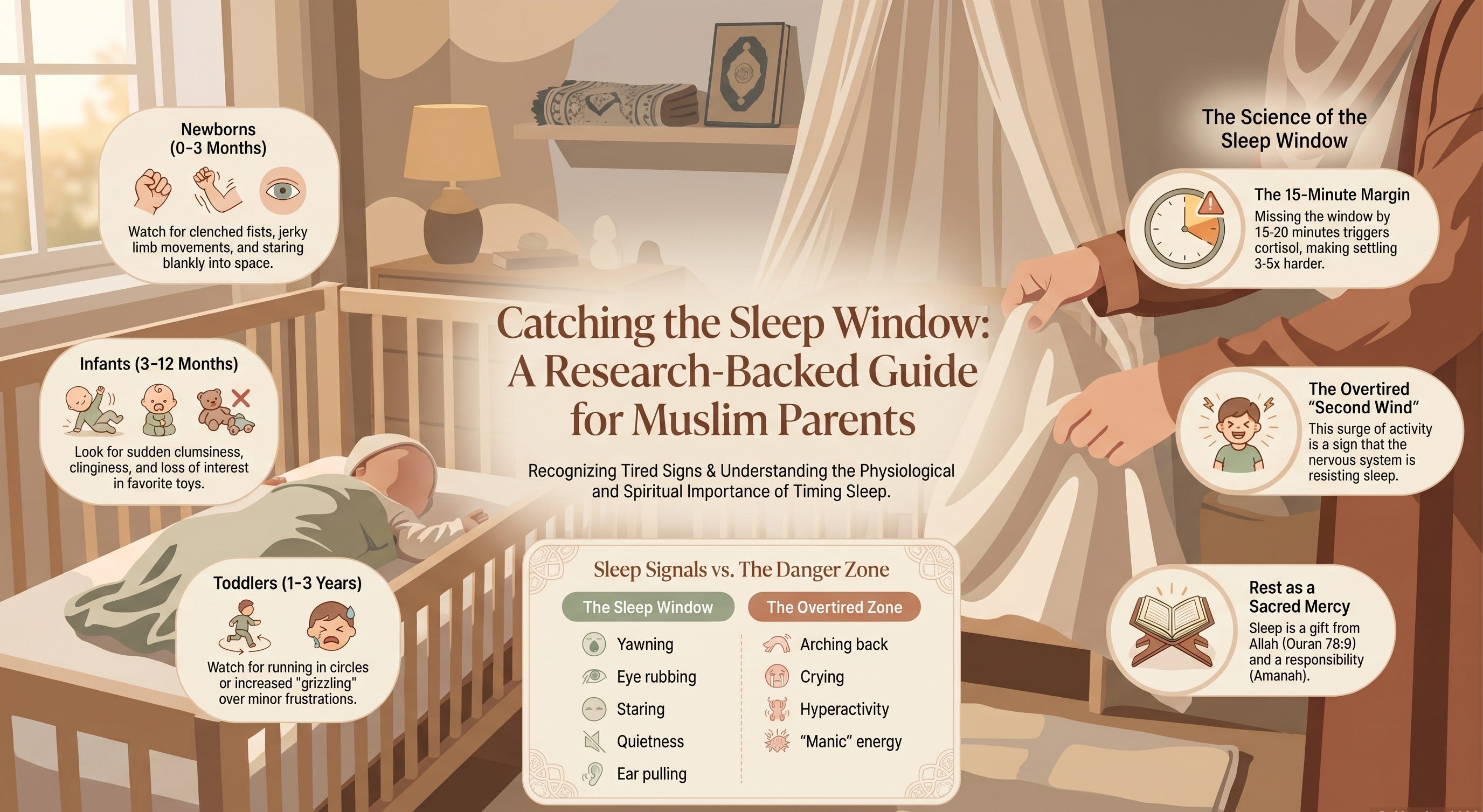
Research on infant sleep physiology shows that missing your child’s tired signs by just 15-20 minutes triggers cortisol production that makes settling 3-5 times harder. [1] This guide shows you the exact signals to watch for at every age—from newborn through toddler—so you can catch the sleep window before it closes.
Your baby’s rubbing her eyes. You think: maybe five more minutes of play.
Your toddler’s suddenly running circles around the living room. You think: he’s got energy to burn.
Here’s what I wish someone had told me earlier: those aren’t signs to keep going. They’re your child’s body saying the window for easy sleep is about to slam shut.
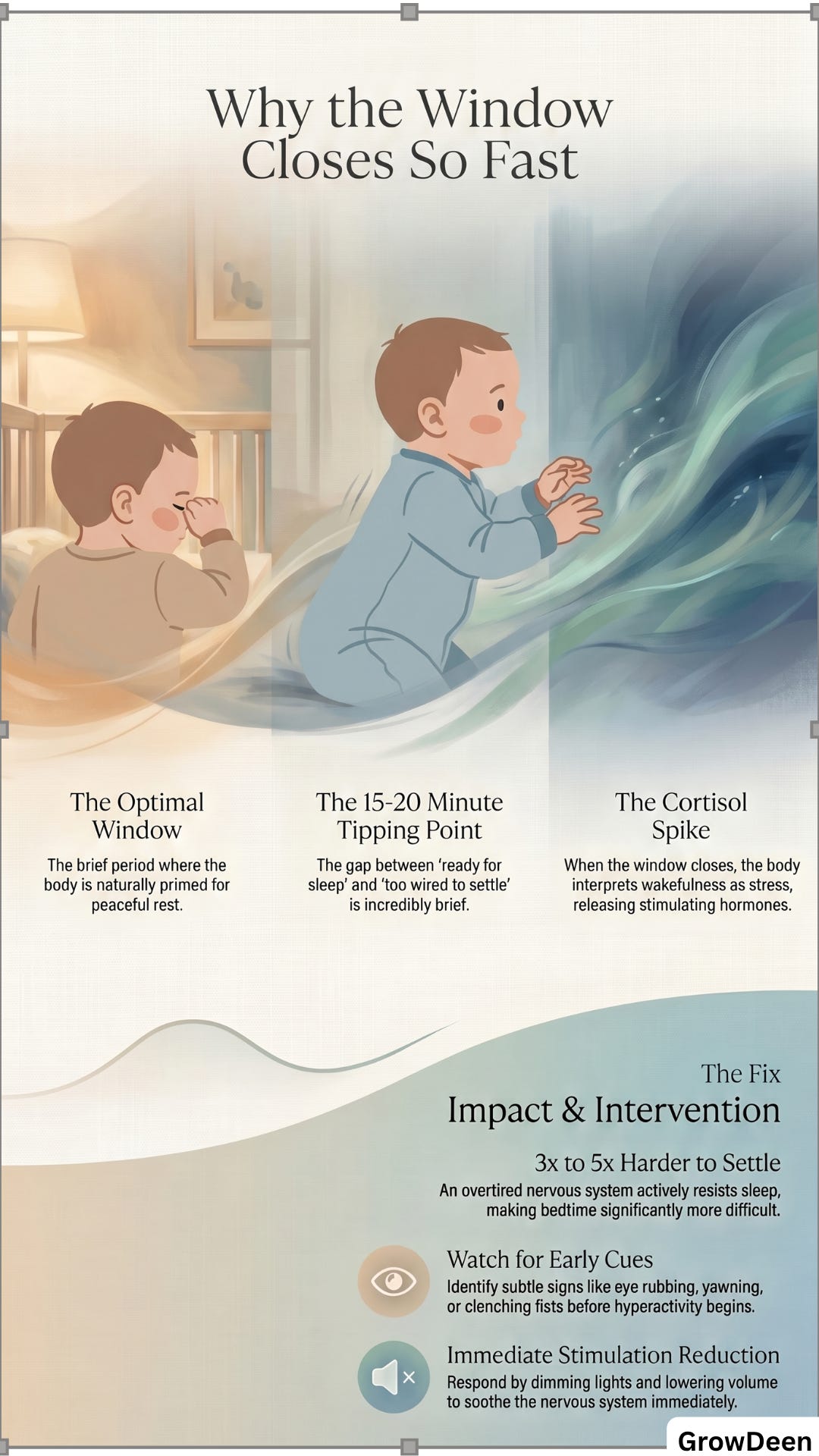
When I started studying infant sleep research, one finding stopped me: the difference between a child who drifts off peacefully and one who fights sleep for an hour often comes down to fifteen minutes. [2] Fifteen minutes of missing the signals your baby’s already sending.
The challenge isn’t that the signs don’t exist. It’s that they look different at different ages, and some of them—like that burst of hyperactivity—seem like the opposite of tiredness.
Why This Guide Is Different From Generic Sleep Advice
Scientific backing from current research. Every recommendation comes from peer-reviewed studies on infant sleep physiology published between 2015-2024, including research from the American Academy of Sleep Medicine and longitudinal Australian sleep studies. [2,3]
Islamic perspective woven throughout. This isn’t just about sleep schedules—it’s about honoring the amanah of your child’s wellbeing, recognizing rest as a mercy from Allah, and responding to their needs with the attentiveness our faith calls us to.
Practical reference tool included. You’ll get a free Tired Signs Quick Reference Card to print and keep in your nursery—age-by-age signals you can glance at when you’re too exhausted to remember everything.
What Happens When You Miss the Window
Here’s the thing about tiredness: it doesn’t just keep building gently. There’s a tipping point.
When your child stays awake past their natural sleep window, their body treats it like a stress situation. Cortisol levels rise. Their nervous system shifts into a state that actively resists rest, even though rest is exactly what they need. [2]
You’ve probably seen this. A baby who was drowsy twenty minutes ago is now wide-eyed and wired. A toddler who was yawning is suddenly manic, bouncing off furniture.
That’s not a second wind. That’s their system fighting to stay awake because the easy entry point into sleep has already passed.
Research on toddler sleep physiology shows that when children miss their regular nap time, nighttime sleep quality deteriorates measurably—they take longer to fall asleep, wake more frequently, and sleep less overall. [4] The effects compound. One missed window makes the next one harder to catch.
But here’s what matters more: when you learn to read tired signs early and respond by creating calm, you’re working with your child’s biology instead of against it. You’re not fighting their nervous system. You’re supporting it.
The Signals Your Newborn Is Sending
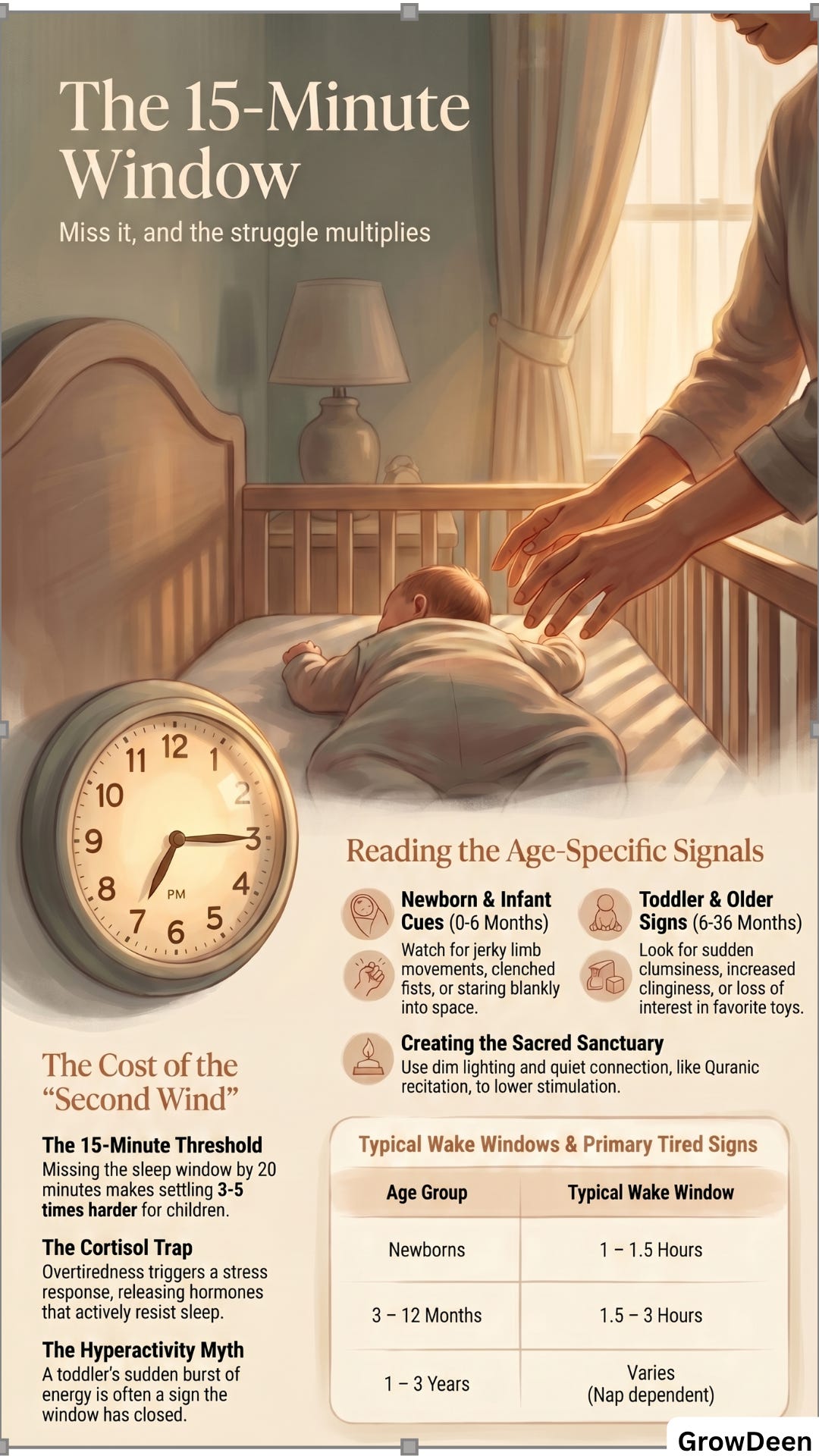
Newborns tire fast. Some are ready for sleep after just one hour of wakefulness. Others can handle closer to two hours before exhaustion sets in.
Learning your specific baby’s rhythm takes time. But while you’re figuring that out, watch for these signs:
Your newborn pulls at their ears or makes jerky, uncoordinated movements with their arms and legs. Their fists clench repeatedly. They yawn—though not always dramatically. Their eyelids flutter, or they stare blankly into space, unable to focus on your face anymore.
Some babies arch their back when tired. It can look like discomfort, but often it’s overstimulation.
One sign that’s actually encouraging: finger sucking. When your newborn brings their hand to their mouth and sucks their fingers, they might be trying to self-soothe. This is good. It means they’re learning to settle themselves. [5]
The key is catching these before they escalate. A yawning baby is easier to settle than an arching, crying baby.
How Tired Signs Change as Babies Grow
Between three and six months, babies can typically stay awake for one and a half to three hours before needing sleep. By six to twelve months, that window extends to two or three hours.
The signals shift too. Older babies rarely pull at ears or make jerky newborn movements. Instead, watch for:
Clumsiness that wasn’t there before. Your crawler who usually navigates the room confidently suddenly bumps into everything. Your usually coordinated baby starts tripping over their own feet.
Sudden clinginess. A child who was happily exploring independently now wants to be held constantly, following you from room to room.
Grizzling instead of normal communication. Small frustrations that they’d usually handle without much fuss now trigger whining or tears.
Boredom with favorite toys. You offer the book they love, the puzzle they usually enjoy—they push it away, unable to settle into play.
Food battles. A child who normally eats reasonably well suddenly refuses everything, fussing over every bite.
And here’s the one that tricks parents most: increased activity. Some tired children don’t slow down—they speed up. They run in circles, bounce off furniture, seem wound up and full of energy.
This isn’t energy. It’s their nervous system making a last effort to stay awake. If you see this, your child is already overtired.
What About Toddlers?
Toddlers between one and three years might show tiredness if they miss their regular nap, even if they’ve only been awake a few hours.
The signs mirror what you see in older babies: clumsiness, clinginess, grizzling, demanding attention in ways that feel more urgent and less rational than usual.
But toddlers add a new dimension: they can fight sleep even when exhausted, because they don’t want to miss what’s happening around them. Your job isn’t to convince them they’re tired. It’s to recognize the signals their body is sending and create the conditions for rest—whether they think they need it or not.
I know this is a lot to remember, especially when you’re already managing everything else parenthood demands. That’s why I’ve created a free Tired Signs Quick Reference Card—a one-page guide organized by age with visual cues you can glance at in the moment. Keep reading to download it at the end of this article—it’s designed to live on your nursery wall, ready when you need it most.
Tired or Hungry? How to Tell the Difference
Sometimes the signs overlap. Grizzling can mean either.
Here’s a practical test: If your baby has fed within the last two hours and is now fussy, tiredness is more likely than hunger. Offer a feed to check. If they take only a little milk and remain unsettled, sleep is probably what they need.
Babies cry for many reasons. Hunger. Discomfort. Pain. Illness. The need to be held. When crying feels hard to interpret, start by ruling out pain or sickness. Then consider timing—when did they last eat? How long have they been awake? [6]
The answer isn’t always obvious. That’s okay. You’re learning your child. Every parent learns as they go.
How to Respond: Creating the Conditions for Sleep
Once you notice tired signs, your goal is simple: reduce stimulation.
Take your child to the place where they usually sleep. Put toys away. Close curtains or blinds. Turn off overhead lights—use a dim lamp if you need visibility. Speak quietly, using a calm, soothing tone.
Consider playing Quranic recitation or gentle adhkar softly in the background. This does two things: it creates a peaceful atmosphere, and it masks sudden household noises that might startle your child awake during the transition into sleep.
As your child grows, you can narrate what’s happening in simple language. “I see you rubbing your eyes. You look tired. Let’s put the books away and get ready for rest.”
Describing their experience helps them begin to recognize their own tiredness. Over time, this builds self-awareness—and eventually, the capacity to self-soothe. [7]
The Transition: Quiet Time Before Sleep
Even after you’ve dimmed the lights and reduced noise, most children need a brief transition period before they’re truly ready for bed.
This is quiet time: a few minutes of gentle connection that helps them shift from alertness to relaxation.
It might be a soft cuddle, a short story told in a hushed voice, or quietly reciting familiar adhkar together. Some children need only two or three minutes. Others, especially if they’re coming from a noisy, active environment, may need longer.
A predictable routine reinforces this transition. When the steps leading to sleep are consistent, your child’s body begins to anticipate rest. Routine creates safety. Safety supports sleep. [6]
The Islamic Frame: Rest as Sacred Trust
When I reflect on the verse where Allah says, “O you who have believed, protect yourselves and your families from a Fire” (Quran 66:6) [8], I think about how protection takes many forms.
Keeping our children safe isn’t only about physical dangers we can see. It includes protecting them from the unseen harm of chronic tiredness, from developmental disruption that comes when their basic needs go unmet because we didn’t understand what they were communicating.
The Prophet Muhammad ﷺ said, “All of you are shepherds, and each of you is responsible for his flock.” (Sahih al-Bukhari 7138) [9] Our children are part of that flock. Responding to their tiredness with attentiveness is part of fulfilling that responsibility.
Sleep itself is a mercy. Allah reminds us: “And We made your sleep as a means of rest.” (Quran 78:9) [10] When we help our children receive this mercy by recognizing when they need it and creating space for it, we’re participating in something aligned with how Allah designed us.
Parenting is built from small, repeated acts of care that no one else witnesses. Reading tired signs, dimming lights, speaking softly, holding space for a child to settle—these aren’t glamorous. But they’re profound.
The hadith teaches us that “The best of you are those who are best to their families.” (Sunan al-Tirmidhi 3895, Hasan) [11] Being best to our families doesn’t mean perfection. It means presence. It means learning our children well enough to meet their needs before those needs become crises.
For the Parent Learning as They Go
If you’re realizing you’ve been missing your child’s signals, be gentle with yourself.
You’re learning. Every parent does. Children are resilient enough to handle our learning curve.
Start now. Watch more closely. Try earlier bedtimes or earlier nap transitions. Notice what happens when you catch the signs sooner.
This isn’t about getting it perfect. It’s about getting it more right, more often, with patience for yourself and your child.
Your Free Tired Signs Quick Reference Card
Remembering all of these signals in the moment—especially when you’re exhausted—isn’t realistic. That’s why I created this companion resource.
Inside the Tired Signs Quick Reference Card (one comprehensive PDF, 1 page):
The card is organized by age group (newborn, 3-6 months, 6-12 months, 1-3 years) with the specific signals to watch for at each stage—designed like a laminated reference card you can keep on your nursery wall or tape inside a cabinet door where you’ll actually see it when bedtime approaches.
This isn’t information to read once and file away. It’s a tool designed to stay visible in the space where you need it most—so you can glance at it in the moment and know: yes, those are tired signs, it’s time to start winding down.
This Tired Signs Quick Reference Card is what every GrowDeen subscriber receives with each article. We cover the full journey of raising Muslim children, all backed by research and rooted in wisdom.
If you’re a Muslim parent who wants both evidence-based guidance and Islamic perspective, subscribe for free so future resources arrive in your inbox before you need them—whether that’s understanding your toddler’s emotional meltdowns, establishing Salah habits, or recognizing developmental delays early.
You’ll receive guidance only, no clutter, just guidance when there’s something worth sharing.
May Allah place barakah in your effort, grant you patience in the small moments, and make the care you give more rewarding than it feels in the tiredness.
Share This With Someone Who Needs It
Think of one person right now: a new mother in your family whose baby fights sleep every night, a friend with a toddler who’s exhausted but doesn’t know why bedtime has become a battle, or a sister who keeps saying “my child just doesn’t need much sleep” when you can see the tiredness in both their faces.
This article could give them the one insight that changes their evenings. Share it with them today—not as advice-giving, but as support. Sometimes the most loving thing we can do is pass along what finally worked for us.
Frequently Asked Questions
Q: My baby seems tired but won’t sleep. What am I doing wrong?
A: You’re probably not doing anything wrong—you might be catching the signs after they’ve already become overtired, which makes settling harder. When cortisol levels rise past the natural sleep window, babies can appear tired but be physically unable to settle. [2] Try watching for earlier, subtler signs tomorrow (like the first yawn or eye rub) and start your wind-down routine then. The goal is to begin settling before they’re fighting it.
Q: How long can a newborn actually stay awake?
A: Most newborns can handle 1 to 1.5 hours of wakefulness, though some can go closer to 2 hours before showing tired signs. [3] This includes feeding time—so if your baby feeds for 30 minutes, they may only have another 30-60 minutes of alert time before they need to sleep again. Watch your specific baby’s signals rather than following a rigid schedule.
Q: Why does my toddler get hyper when tired instead of slowing down?
A: This is actually a sign of being overtired, not having extra energy. When children stay awake past their natural sleep window, their body releases cortisol and adrenaline as a stress response, creating what looks like a “second wind.” [2] This hyperactivity means you’ve already missed the earlier, calmer tired signs. For tomorrow, watch for the quieter signals (clinginess, clumsiness, loss of interest in toys) that come before the manic phase.
Q: Is it normal for sleep needs to vary day to day?
A: Yes. A baby who usually handles 2 hours awake might only manage 1.5 hours on a day when they’ve had a lot of stimulation, are fighting a cold, or didn’t sleep well the night before. Rather than watching the clock rigidly, watch your child—their signals will tell you what they need that specific day. [7] Flexibility within structure works better than strict schedules for most families.
Q: Should I wake my baby from a nap to protect nighttime sleep?
A: This depends on age and your specific situation. For newborns, let them sleep—they need the rest and their circadian rhythm isn’t established yet. For older babies and toddlers, very long late-afternoon naps can push bedtime too late, so capping naps may help. But if your child is showing tired signs early the next day, they probably need that nap length. [4] For personalized guidance, talk to your pediatrician—every child’s sleep needs are different.
References
[1] Bathory, E., & Tomopoulos, S. (2017). Sleep regulation, physiology and development, sleep duration and patterns, and sleep hygiene in infants, toddlers, and preschool-age children. Current Problems in Pediatric and Adolescent Health Care, 47(2), 29-42. https://doi.org/10.1016/j.cppeds.2016.12.001
[2] Lassonde, J.M., Rusterholz, T., Kurth, S., Schumacher, A.M., Achermann, P., & LeBourgeois, M.K. (2016). Sleep physiology in toddlers: Effects of missing a nap on subsequent night sleep. Neurobiology of Sleep and Circadian Rhythms, 1(1), 19-26. https://doi.org/10.1016/j.nbscr.2016.08.001
[3] Centre for Community Child Health. (2015). Sleep and the early years. Community Paediatric Review, 23(4), 1-3. Retrieved from https://www.rch.org.au/uploadedFiles/Main/Content/ccch/CPR-vol23-no4.pdf
[4] Price, A.M., Brown, J.E., Bittman, M., Wake, M., Quach, J., & Hiscock, H. (2013). Children’s sleep patterns from 0 to 9 years: Australian population longitudinal study. Archives of Disease in Childhood, 99(2), 119-125. https://doi.org/10.1136/archdischild-2013-304150
[5] St James-Roberts, I., Roberts, M., Hovish, K., & Owen, C. (2015). Video evidence that London infants can resettle themselves back to sleep after waking in the night, as well as sleep for long periods, by 3 months of age. Journal of Developmental Pediatrics, 36(5), 324-329. https://doi.org/10.1097/DBP.0000000000000166
[6] American Academy of Sleep Medicine. (2006). Behavioral treatment of bedtime problems and night wakings in infants and young children. Sleep, 29(10), 1263-1276. https://doi.org/10.1093/sleep/29.10.1263
[7] Ngala. (2004). Secrets of good sleepers: A guide to sleep for families of children 0-5 years. Ngala Family Resource Centre.
[8] Quran, Surah At-Tahrim 66:6
[9] Sahih al-Bukhari 7138
[10] Quran, Surah An-Naba 78:9
[11] Sunan al-Tirmidhi 3895 (Hasan)