
The Sun Safety Mistake That Increases Skin Cancer Risk By 80%
What Every Parent Should Know Before Outdoor Play

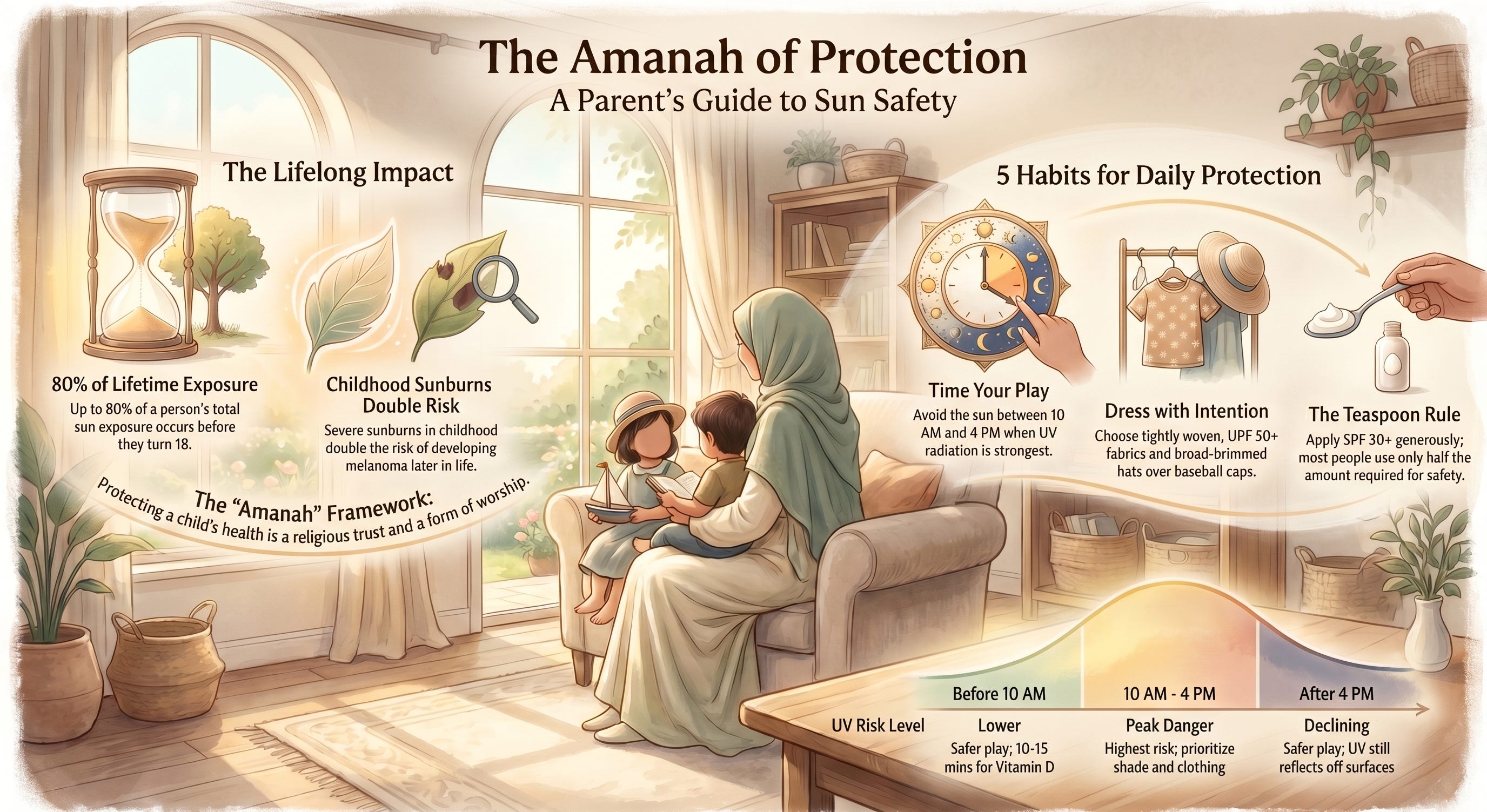
Research shows that up to 80% of lifetime sun exposure occurs before age 18, and severe childhood sunburns double the risk of melanoma later in life. [1] This guide reveals the 5 protection habits that matter most and the timing mistakes parents make every day.
Sunlight feels harmless most days. Warm, familiar, part of life. Children run into it without hesitation, and honestly, we don’t always stop them.
It doesn’t look dangerous. It doesn’t sound dangerous. But here’s what I learned when I studied recent dermatology research: too much sun exposure in childhood can lead to sunburn, long-term skin damage, eye damage, and significantly increase the risk of skin cancer and weakened immunity later in life. [1][2][3]
You’re being careful: I know you are. But the challenge is this: that damage builds slowly, exposure by exposure, often starting in the very years when we think sun is just “healthy play.”
The truth is, up to 80% of a person’s lifetime sun exposure happens before age 18. [1] And severe sunburns in childhood don’t just hurt in the moment — they double the risk of melanoma decades later. [4]
So the question isn’t whether your child should be outside. Of course they should. The question is: how do you protect them without taking away the joy of outdoor play?
Why This Guide Is Different From Generic Sun Safety Tips
Current dermatology and cancer prevention research: Every recommendation is backed by melanoma studies, UV exposure research, and pediatric sun safety guidelines (2011-2023).
Islamic framework woven throughout: This isn’t just SPF numbers — it’s about fulfilling the responsibility of protecting the body as an amanah (trust) through both practical habits and spiritual awareness.
Action-focused protection plan included: You’ll get a free Sun Safety Family Guide with timing charts, clothing recommendations, and seasonal adjustments, not just information, but a system you’ll actually use.
The Balance Between “Enough Sun” and “Too Much Sun”
Here’s something most people don’t realize: sunlight isn’t the enemy. Your body needs a small amount of it to produce vitamin D, which supports bone strength and muscle function. [1][5]
But the line between “enough” and “too much” is thinner than most parents think.
Research suggests that even brief daily exposure: as little as 10-15 minutes on the face and arms a few times a week, can meet vitamin D needs. [5] But excessive exposure contributes to long-term skin damage that accumulates over years. [2][3]
So the goal isn’t avoidance. It’s balance.
The Timing Mistake Most Parents Make
That balance changes depending on the time of day, the season, and where you live.
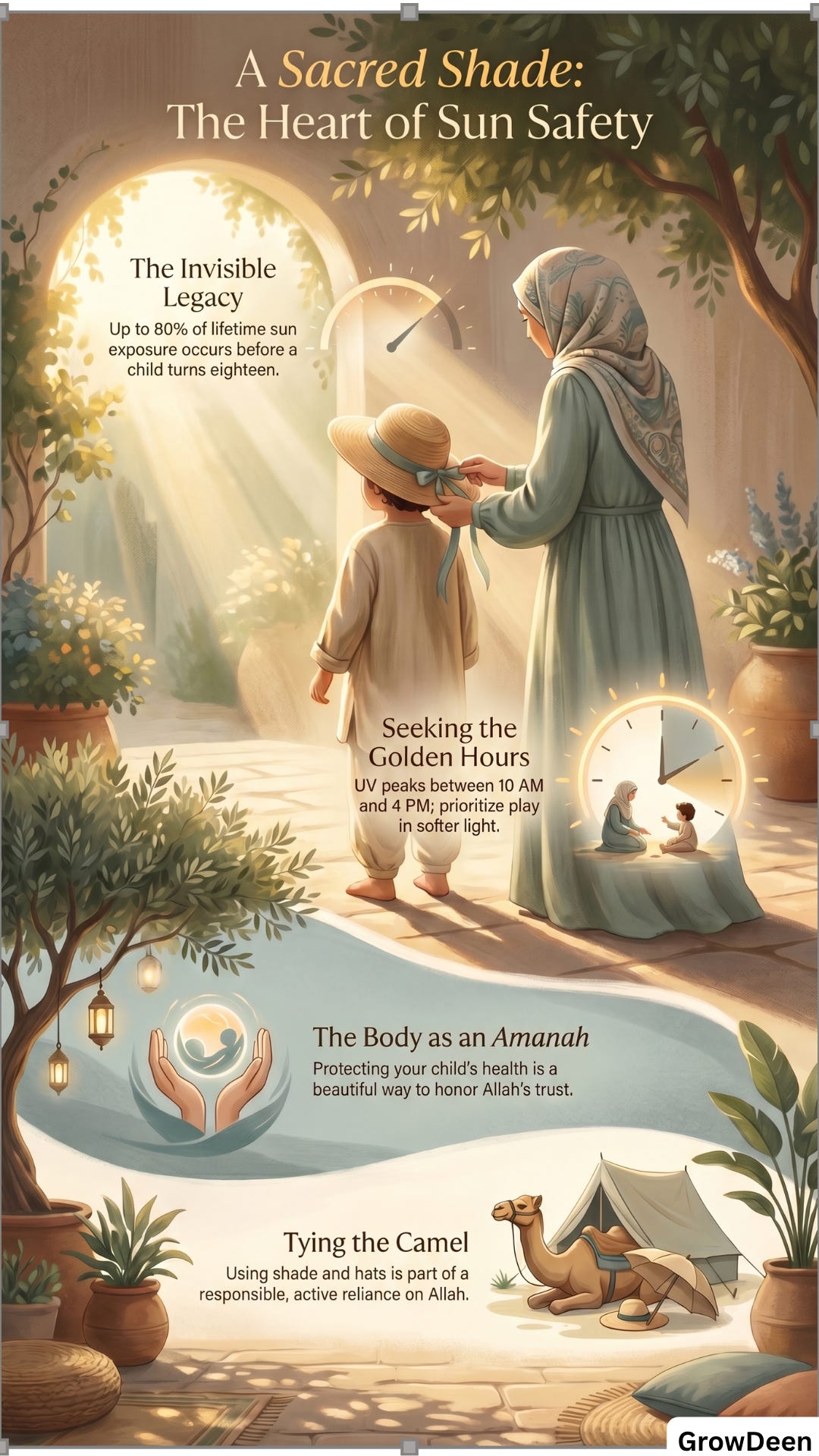
Here’s what caught my attention when I reviewed UV radiation data: ultraviolet (UV) radiation tends to be strongest during the middle of the day, typically between 10 AM and 4 PM. [1] And here’s the part that catches parents off guard: you don’t need bright sun to be exposed.
UV radiation can still reach your child’s skin on cloudy days. It reflects off water, sand, concrete, and even buildings. [1][2]
So sun protection isn’t about waiting for a “hot day” or “beach day.” It’s about being aware of exposure every day.
Planning helps more than reacting. Outdoor play in early morning (before 10 AM) or later afternoon (after 4 PM) reduces UV exposure significantly. [1] It’s a small adjustment in timing, but it changes the risk level in a meaningful way.
Why Shade Alone Isn’t Enough
Shade helps, but here’s what most people don’t know: it’s not complete protection.
UV radiation can still reach the skin even in shaded areas, especially if the shade is light or scattered. [1] Dense shade is better, the kind that actually casts a dark shadow under a tree or solid structure.
But even then, shade should work alongside clothing and sunscreen, not replace them.
Sometimes shade isn’t available, especially during travel or outdoor activities. In those moments, creating shade, with an umbrella, canopy, or structured cover — becomes necessary.
But here’s one caution that matters: covering prams or strollers with blankets or cloths can trap heat and raise temperatures to unsafe levels. [1] It’s one of those well-intentioned actions that quietly creates a different kind of risk.
I know this feels like a lot to remember when you’re just trying to get outside with your kids. That’s why I’ve created a free Sun Safety Family Guide a visual chart showing safe play times by season, clothing recommendations by age, and a quick SPF reference. Keep reading to download it at the end it’s designed to take the guesswork out of daily protection.
The 5 Protection Habits That Actually Work
Habit 1: Choose Clothing with Real UV Protection
Clothing plays a bigger role than most parents expect.
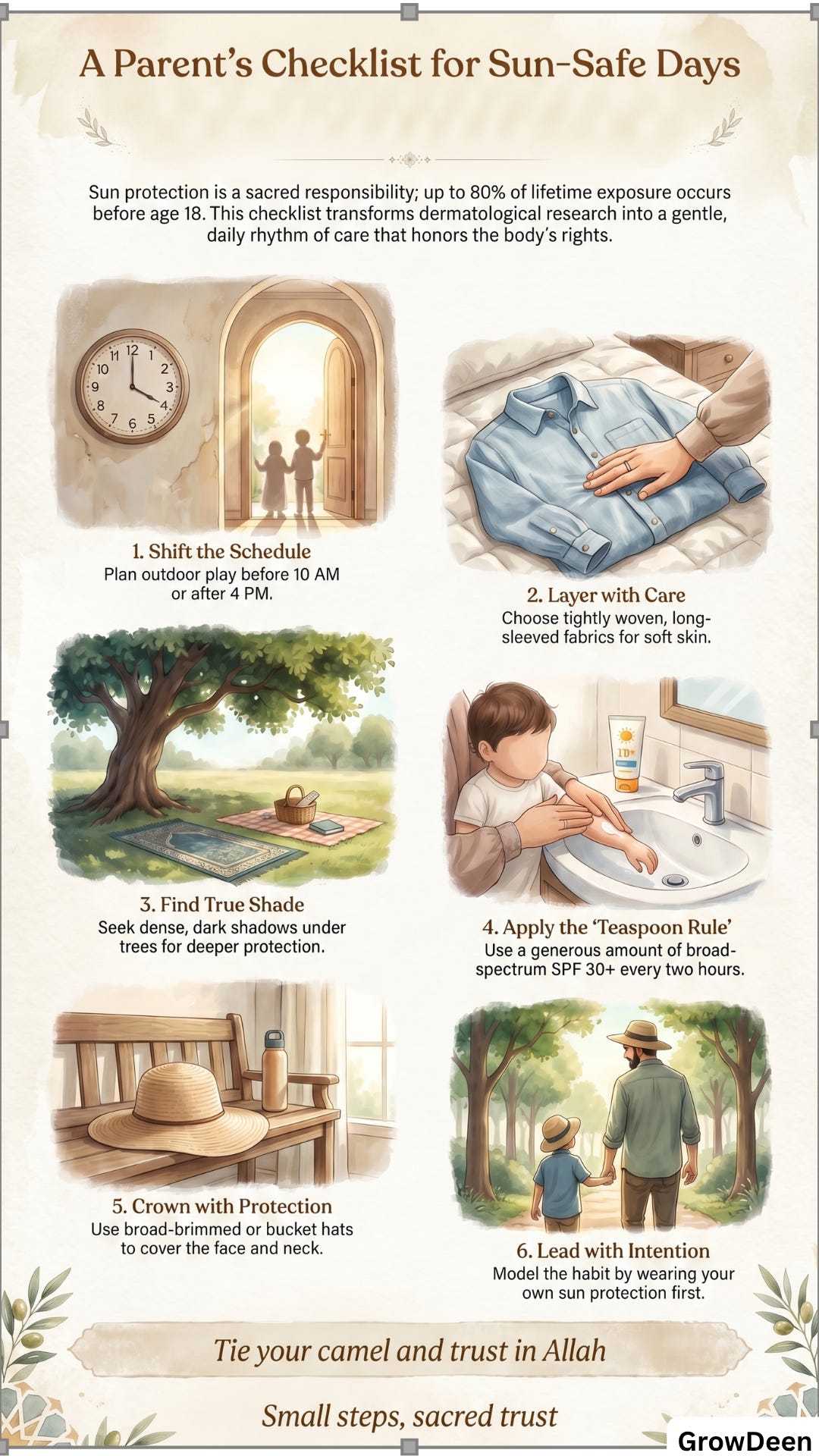
Tightly woven fabrics and clothing with a high ultraviolet protection factor (UPF) offer the best protection. [1][6] Long sleeves, longer shorts or pants, and specially designed swimwear like rash vests significantly reduce UV exposure — especially during water activities where reflection increases exposure. [1][2]
Even simple things matter. Hold fabric up to light. If a lot of light gets through, UV protection is likely weaker.
For babies and toddlers, comfort matters too. Lightweight, breathable fabrics with UPF 50+ keep them protected without overheating.
Habit 2: Get the Hat Right
Not all hats work equally well.
Broad-brimmed, bucket, or legionnaire-style hats provide better protection for the face, neck, and ears compared to caps, which leave parts exposed. [1]
With babies, a hat that stays on gently is better than one constantly pulled off. And small details — like ensuring straps don’t pose a choking risk — make a difference in real use.
Habit 3: Protect Their Eyes Too
Sunglasses are often overlooked in children, but they shouldn’t be.
Prolonged UV exposure can affect eye health, contributing to conditions like cataracts later in life. [1][2] Close-fitting sunglasses that block UV rays add another layer of protection, especially in bright outdoor environments.
Look for sunglasses labeled “UV400” or “100% UV protection.” If your child won’t keep them on, try letting them choose a fun pair themselves — ownership often helps with compliance.
Habit 4: Use Sunscreen Correctly (Because Most Parents Don’t)
Sunscreen is where most parents feel they’re “covered,” but it’s only part of the picture.
Use broad-spectrum sunscreen with SPF 30 or higher, applied generously to exposed skin, and reapplied every two hours. [1][7]
Studies consistently show that people tend to use less sunscreen than needed — often about half the recommended amount — which significantly reduces its effectiveness. [7] And even when used correctly, sunscreen filters UV. It doesn’t block it completely.
For babies under six months, sunscreen is not usually recommended. [1] At that stage, physical protection — shade, clothing, and hats — is more important.
For older children and teenagers, consistency becomes the challenge. Giving them their own sunscreen — especially portable ones they can carry — can make a difference in whether they actually use it. [1]
Habit 5: Model the Behavior You Want to See
Here’s something I wish more parents understood: children don’t follow instructions as much as they follow examples.
If you avoid sunscreen, ignore shade, or seek tanning, your child notices. If you consistently take precautions, they absorb that too. [1]
That influence becomes even more important as children grow older and start making their own choices. Teenagers especially may resist protective clothing or hats because of appearance.
At that stage, it’s less about control and more about conversation — listening, adjusting, finding a middle ground that still protects.
The Islamic Framework for Sun Safety
When I reflect on the verse where Allah says, “And do not throw yourselves with your own hands into destruction” [8], I think about how sun damage doesn’t feel like destruction in the moment but long-term harm often begins with small, repeated exposures we could have prevented.
Another verse reminds us: “Indeed, Allah loves those who are mindful of Him and those who are careful.” [9] Carefulness here isn’t fear. It’s awareness, understanding risk and responding to it with intention.
The Prophet ﷺ said, “Your body has a right over you.” [10] That right includes protection. It includes not exposing the body unnecessarily to harm when the means to reduce it are already known.
He also said, “Tie your camel and trust in Allah.” [11] That balance is important. Taking precautions — using shade, clothing, sunscreen — is not a lack of trust. It is part of responsible reliance on Allah.
And Allah reminds us: “Allah does not burden a soul beyond that it can bear.” [12] Sun safety doesn’t require perfection. It requires effort. Small, consistent steps that reduce harm over time.
Protection That Doesn’t Take Away Play
In the end, sun safety is not about controlling every moment your child spends outside. It’s about shaping the conditions around them — when they go out, what they wear, what habits they see — so that exposure becomes safer without taking away the experience of being outside.
Because children should still run in the sun. They just shouldn’t be left unprotected in it.
If you’ve read this far, you’re the kind of parent who takes long-term health seriously, not as paranoia, but as protective love. That tells me something beautiful about you.
Your Sun Safety Family Guide
Inside the Sun Safety Family Guide (one comprehensive PDF, 3 pages):
Page 1: Daily UV Protection Chart — A visual timeline showing safe play hours by season (spring, summer, fall, winter) with UV index levels and recommended protection by time of day — designed so you can plan outdoor activities at a glance.
Page 2: Age-by-Age Protection Checklist — Specific sun safety recommendations for babies (0-6 months), toddlers (6 months-3 years), young children (3-8 years), and teens (8-18 years) including clothing, sunscreen, and supervision guidance — organized by developmental stage so you know exactly what your child needs now.
Page 3: Sun Protection Du’as for Daily Routines — Du’a before going outside, (Arabic, transliteration, English) integrated into your daily rhythm so sun safety becomes both physical and spiritual practice.
This isn’t just a PDF to download and forget. It’s a reference guide designed to stay with you through every season and stage of childhood.
This Sun Safety Family Guide is what every GrowDeen subscriber receives with each article. We will cover the full journey of raising Muslim children, inshaAllah, all backed by research and rooted in wisdom.
If you’re a Muslim parent who wants both research/evidence-based guidance AND Islamic perspective, subscribe for free so future resources arrive in your inbox before you need them.
You’ll receive just guidance when there’s something worth sharing.
May Allah place barakah in your effort, accept your intention, and make the care you give more protective, more merciful, and more rewarded than it feels in the moment.
Share This With Someone Who Needs It
Think of one person right now: a parent who spends every weekend at the park, a friend whose family lives near the beach, a relative whose children play soccer outdoors every afternoon, or someone planning a summer vacation with young kids.
This article could protect their children decades from now. Share it with them today, not because you’re being preachy, but because you care. Sometimes the most loving thing we can do is pass along knowledge that prevents harm we can’t yet see.
References
[1] Australian Government Department of Health. Sun safety: babies, children and teenagers. Raising Children Network.
https://raisingchildren.net.au/
[2] Neale, R.E., Lucas, R.M., & Barnes, P.W. (2023). Effects of solar radiation on human health: An update. Photochemical & Photobiological Sciences, 22, 1-12.
[3] Raimondi, S., Suppa, M., & Gandini, S. (2020). Melanoma epidemiology and sun exposure. Acta Dermato-Venereologica, 100, adv00136.
[4] Cordoro, K.M., Gupta, D., Frieden, I.J., McCalmont, T., & Kashani-Sabet, M. (2013). Pediatric melanoma: Results of a large cohort study and proposal for modified ABCD detection criteria. Journal of the American Academy of Dermatology, 68(6), 913-925.
[5] Misra, M., Pacaud, D., Petryk, A., Collett-Solberg, P.F., & Kappy, M. (2008). Vitamin D deficiency in children and its management. Journal of Clinical Endocrinology & Metabolism, 93(2), 497-509.
[6] SunSmart. (2022). Sun-protective clothing guidance. Cancer Council Victoria.
https://www.sunsmart.com.au/
[7] Li, H., Colantonio, S., Dawson, A., Lin, X., & Beecker, J. (2019). Sunscreen application, safety, and sun protection: The evidence. Journal of Cutaneous Medicine and Surgery, 23(4), 357-369.
[8] Quran, Surah Al-Baqarah 2:195
[9] Quran, Surah At-Tawbah 9:108
[10] Sahih al-Bukhari 5199
[11] Jami’ at-Tirmidhi 2517 (Hasan)
[12] Quran, Surah Al-Baqarah 2:286