
The Stage No One Warned You About in Bilingual Parenting
Consistency Over Pressure The Bilingual Path That Actually Lasts

Raising a child with two or more languages is slow, mercy filled work that keeps family bonds and identity alive through warm, steady home language exposure without turning it into a daily battle.
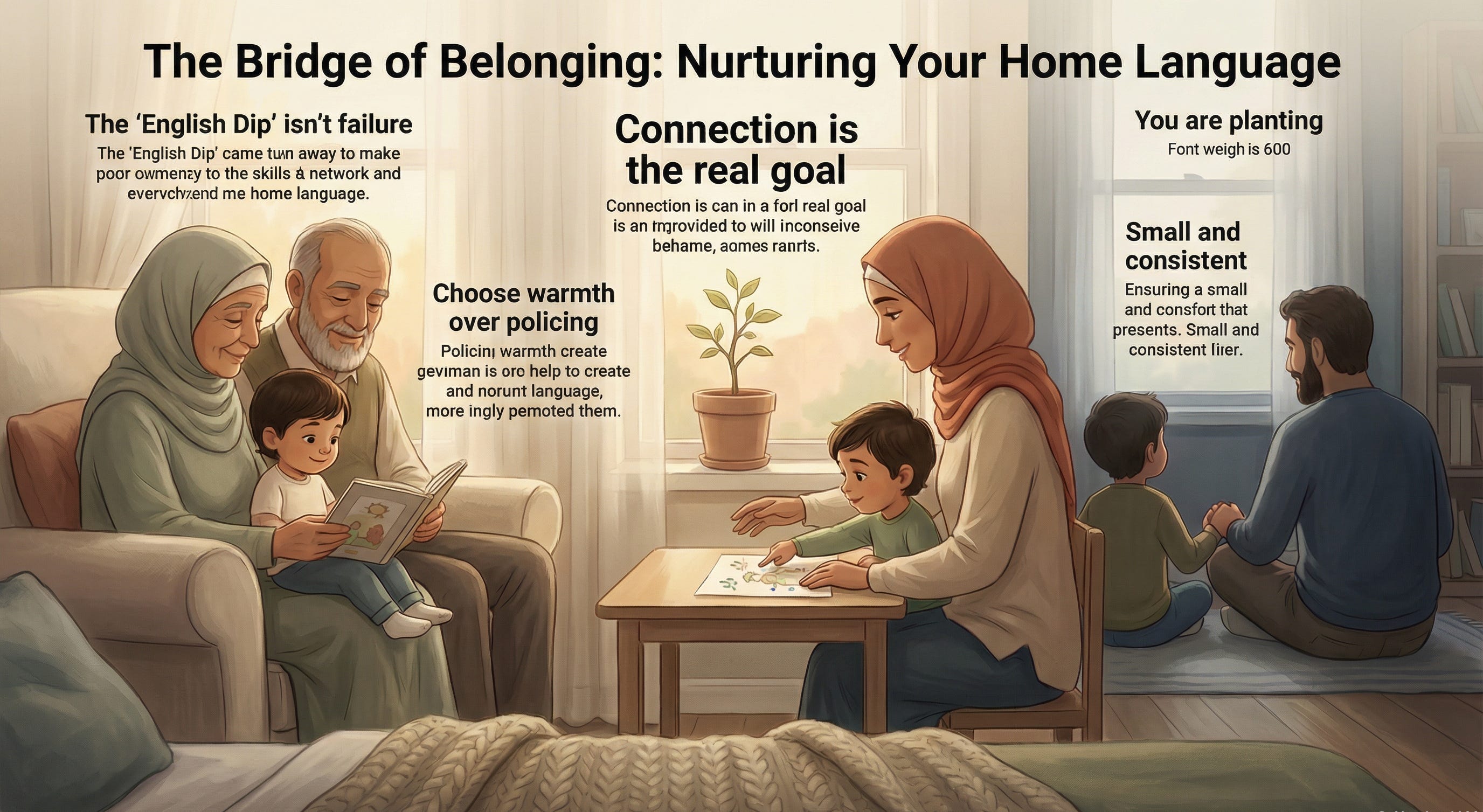
You call your child from the kitchen.
Something small. Shoes. Snack. Come here for a second.
And they answer you in English again.
Not rude. Not dramatic. Just simple. Automatic. Like it is the easiest door to walk through.
Your chest does that little drop.
Because you did not only hear a language. You felt a distance.
You know you are not losing your child. But you worry you are losing a bridge. A bridge to grandparents. To jokes that only work in your language. To duas whispered the way your mother whispered them to you.
You start asking yourself if you waited too long, if you should push harder, if you somehow did this wrong.
You did not do it wrong.
This is what it often looks like when a child is growing up between worlds.
The goal was never vocabulary
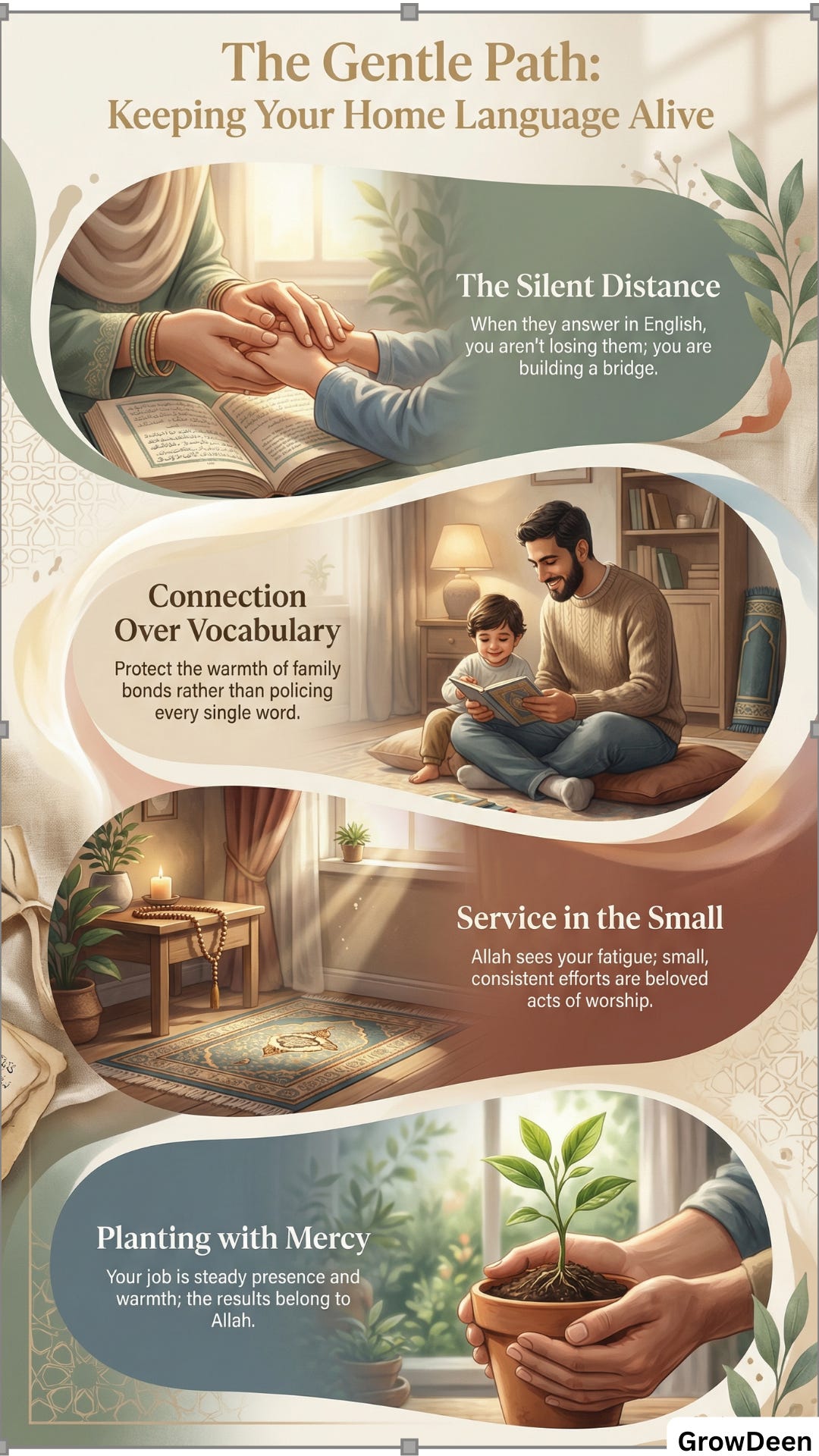
Most parents who hold onto a home language are not chasing a party trick. They are trying to protect connection.
Language keeps family warmth intact. It lets a child belong inside the conversations, not stand on the edge of them. It helps grandparents feel like home instead of a formal visit. Researchers and educators describe how bilingualism can support parts of thinking and literacy over time, even though children can move through uneven phases as one language temporarily pulls ahead. [1] [2] [3]
So if your child is mixing languages, or drifting toward English, it does not mean the home language failed.
A lot of old fears about bilingual children being confused have been challenged again and again. What looks messy is often development in motion. Children can build two language systems early on, even if the balance between them shifts depending on school, friends, and daily life. [4] [5]
What you are really trying to protect
From our deen, this effort can carry a quiet beauty.
Keeping family ties strong is not optional in Islam. Allah warns against severing ties of kinship. [6]
If part of maintaining those ties means keeping a shared language alive, then your daily words can become service. Not loud service. Not heroic service. The kind that shows up in ordinary moments.
And the Prophet ﷺ taught us that deeds are judged by intentions. [7]
A bedtime story. A short conversation with your child in your home language. A gentle translation for your mother on a video call.
With intention, this becomes worship.
Two paths that usually work better than endless rules
Families usually land in one of two patterns, even if they do not name it.
One is based on the parent. One parent consistently speaks one language, the other parent consistently speaks another. This can work beautifully when the child experiences each language as part of a real relationship, not an activity. [8]
The other is based on the environment. The heritage language is the home language, and English is for school and outside life. That approach can feel simpler because the house itself carries the rule. [9]
Neither model is perfect. What matters most is something much less dramatic.
Your child needs enough exposure and enough real reasons to use the language in actual life. [10] [11]
That is it.
Not pressure. Not policing.
Enough warmth. Enough consistency. Enough need.
The dip is not a disaster
There is a stage many parents hit.
Early childhood feels hopeful. The child repeats words, sings little phrases, talks to grandparents, answers you in the home language.
Then school starts. Friends. Media. Identity.
And suddenly the child understands the home language, but answers in English.
This is one of the most common moments where parents panic. They start turning language into a correction project.
But many family guides advise not to panic here. Continued exposure still matters. Hearing the language regularly continues to settle into a child over time, even when their replies drift toward English. [8] [11]
This is where you need a different kind of strength.
Not intensity. Not control.
Steady presence.
Allah tells us that He does not burden a soul beyond what it can bear. [12]
You can do what is realistic for your home.
Allah’s gentleness in slow progress
This work asks for patience, but not the dramatic kind.
The everyday kind.
The patience of repeating yourself without bitterness.
The patience of choosing warmth over power.
The Quran tells the believers to seek help through patience and prayer, and reminds us that Allah is with those who are patient. [13]
And the Prophet ﷺ reminded us that the deeds Allah loves most are the ones done consistently, even if they are small. [14]
So if you only manage ten minutes of home language conversation today, but you do it with love, that matters.
Small and consistent beats big and exhausting.
A gentle mid article note, dear parent. If this topic feels close to your real life, you might like having more reflections like this waiting for you, especially on the days you feel tired and unsure. You can subscribe for free so you receive the next piece quietly in your inbox when it is ready.
The simple supports that actually change the feel of your home
Language grows through life, not lectures. [8]
So instead of turning the home language into a “lesson,” try giving it living space.
Speak it during routines that already happen. Breakfast. Car rides. Bedtime.
Use stories. Picture books. Family stories from your childhood. Story based interaction is repeatedly described as a natural way to build vocabulary and comfort. [1] [8]
Use play. Games that make language light again. Guessing games. “I spy.” Silly role play. [8]
Use community when you can. Playgroups. Weekend programs. Friends who speak the language. Peer life matters. [10]
And if you use technology, keep it purposeful. Some families use child friendly apps or personalised stories in the heritage language. It can help when it supports real conversation rather than replacing it. [1]
In Islam, we are also careful with speech itself. The Prophet ﷺ warned that a person can say a word carelessly, not thinking much of it, and it can carry huge weight. [15]
So part of “language time” is not only which language, but what kind of atmosphere and words you are feeding the heart with.
If you can bring Islamic meaning into the home language, even gently, it adds warmth. Allah describes the Quran as healing and mercy for believers. [16]
A short surah meaning shared in your language. A seerah story told softly. A dua translated so your child feels its sweetness.
That does not just build language.
It builds belonging.
A script for the moment you feel yourself tightening
Sometimes the pressure rises in your chest and you can hear your own tone changing.
Try this internal self talk first.
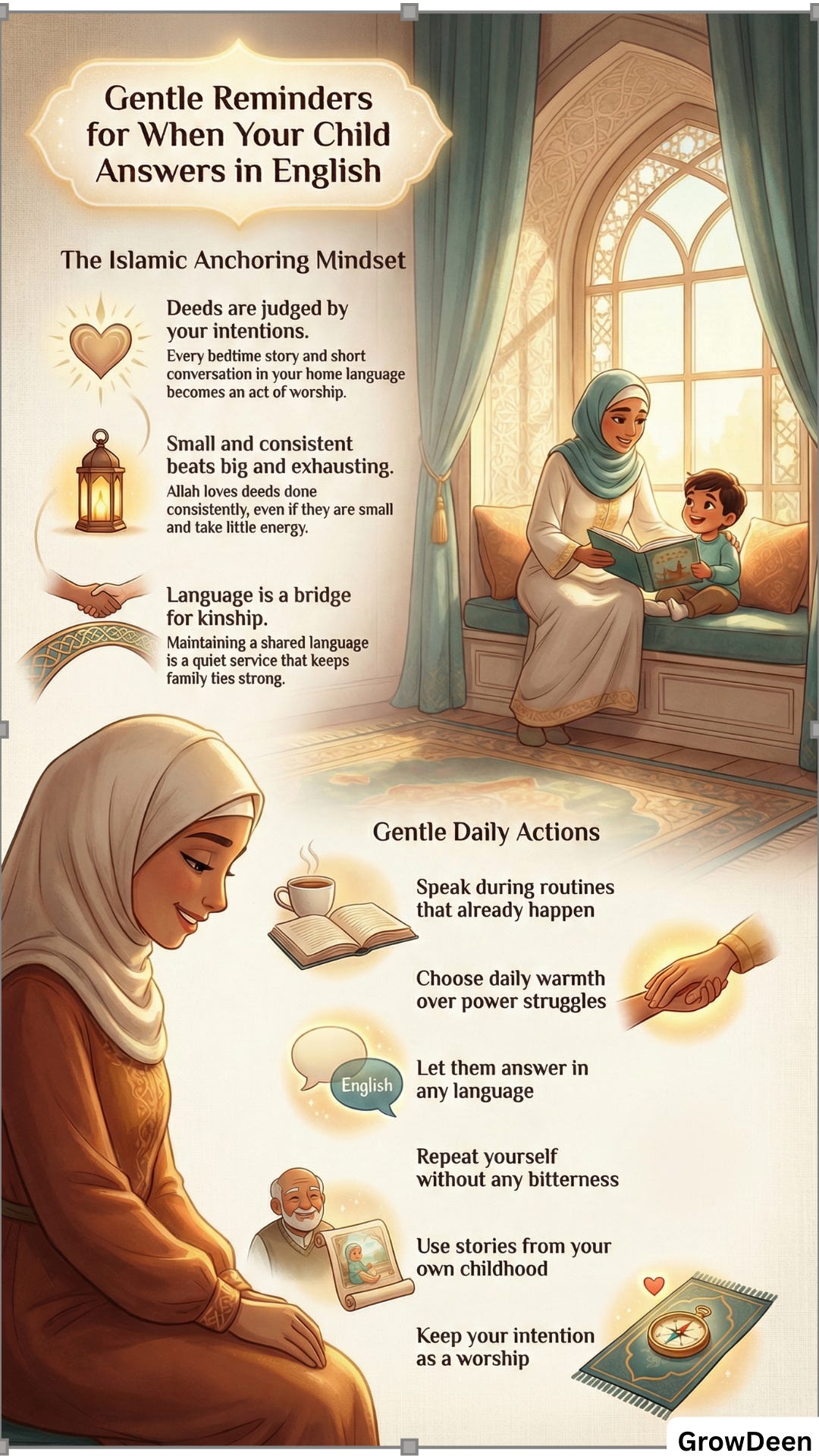
I am not losing them. I am planting.
I will keep speaking with warmth.
My child is allowed to be in process.
Consistency is my job, not control.
Then, if you need a simple outward script, keep it light.
In our home, I will keep speaking to you in this language. You can answer in any language you want.
That one line protects the relationship while protecting the habit.
And if grandparents or relatives are involved, remember the wider meaning too.
Allah created us as peoples and tribes so that we may know one another. [17]
Language is one of the tools that makes that knowing real.
You are building a bridge, not a performance
Your child might not show you the results right away.
But hearing the home language settles into them. It becomes familiar. It becomes safe. It becomes part of how they understand love.
If they push back, stay calm. Keep inviting. Keep it warm.
Allah sent the Prophet ﷺ as a mercy to the worlds. [18]
A trace of that mercy belongs in our parenting too.
Not fear. Not harshness. Not turning language into proof of loyalty.
Mercy, steadiness, and trust in slow growth.
And if you feel you have failed because your child answers in English today, I want you to hear this clearly.
Today is not the end of your story.
It is just a chapter.
GIFTS FOR YOU, DEAR PARENT
If you’ve reached this part of the page, it tells me something meaningful about you.
You weren’t just skimming or passing time. You stayed because something here felt relevant to your real life.
Because you care.
Because you want to do things with more awareness.
Because you’re trying, even when it feels overwhelming.
That is not small.
So I didn’t want this article to remain just words on a page. I wanted it to gently step into your daily life in practical ways. That’s why we prepared these Life Gifts for you.
Not as extras.
Not as decorations.
But as simple tools to help you hold onto what mattered most in what you just read.
Here’s what you’ll find inside:
Gentle Understanding Card
A clear and simplified summary of the core concept from this article, so you can revisit the main idea anytime without rereading everything.
Heartfelt Dua Card
A carefully chosen dua connected to this stage of life, because we know that real strength and ease ultimately come from Allah’s help.
Gentle Actions Card
Practical examples to help you translate knowledge into action, so what you learned becomes part of your daily rhythm.
Gentle Reminders Card
Short, steady reminders drawn from the key points, designed to be printed or saved and placed somewhere you’ll see often.
These were designed slowly and thoughtfully, with time, care, and sincere dua. We created them because we genuinely want to walk alongside you, not just through one article, but through every stage of this lifelong journey.
If these gifts support you even in a small way, I would love for you to continue receiving them.
Subscribe so that each new Gift arrives directly in your inbox whenever we release the next stage. That way, you won’t miss the tools designed to support you right where you are.
May Allah place barakah in your effort, accept your intention, and make this path easier and more rewarding than it feels right now.
Please share it with a family or friend who may benefit from this knowledge.
Comment question
What is one small home language habit you could keep consistent this week without turning it into pressure?
References
[1] Mark Antoniou, “Debunking common myths about raising bilingual children,” The Conversation (archived on Western Sydney University). Link
[2] Colin Baker and Wayne E. Wright, Foundations of Bilingual Education and Bilingualism (7th ed.). Link
[3] Di Biase, B., and Qi, R., “Why speaking two languages is advantageous for the speaker,” China Language Strategies 2(1), 23 to 29 (2015). Link
[4] Annick De Houwer, Bilingual First Language Acquisition. Link
[5] George Saunders, Bilingual Children: From Birth to Teens. Link
[6] Qur’an, Surah Muhammad 47:22 to 23. Link
[7] Hadith on intentions, Sahih al Bukhari 1 and Sahih Muslim 1907a. Bukhari link Muslim link
[8] Una Cunningham, Growing Up with Two Languages: A Practical Guide for Multilingual Families and Those Who Support Them (4th edn). Link
[9] Anita Pauwels, Language Maintenance and Shift. Link
[10] Jürgen Meisel, Bilingual Children: A Guide for Parents. Link
[11] Qi, R., The Bilingual Acquisition of Chinese Children (2022). Link
[12] Qur’an, Surah Al Baqarah 2:286. Link
[13] Qur’an, Surah Al Baqarah 2:153. Link
[14] Hadith on consistency, Sahih al Bukhari 6465 and Sahih Muslim 783. Bukhari link Muslim link
[15] Hadith on careless speech, Sahih al Bukhari 6478 and Sahih Muslim 2988. Bukhari link Muslim link
[16] Qur’an, Surah Al Isra 17:82. Link
[17] Qur’an, Surah Al Hujurat 49:13. Link
[18] Qur’an, Surah Al Anbiya 21:107. Link
[19] Clyne, M., Australia’s Language Potential (2005). Link
[20] Festman, J., Poarch, G., and Dewaele, J. M., Raising Multilingual Children. Link
[21] Guo, Q., and Qi, R., “A Study of Bilingual Acquisition of Wh Questions of a Mandarin English Bilingual Preschool Child from China to Australia,” Education Sciences 14(9), 978 (2024). Link
[22] King, K., and Mackey, A., The Bilingual Edge: Why, When, and How to Teach Your Child a Second Language. Link