
The Sneezing, Swelling, Itching Days That Quietly Wear a Parent Down
When Your Child Keeps Reacting and You Still Do Not Have Clear Answers

Free gift for you! A practical companion resource is waiting for you near the end of this article to help you remember, apply, and benefit from what you read. Don’t forget to download!
Non food allergies in children can move from annoying everyday symptoms to frightening emergencies, so Muslim parents need clear eyes, wise avoidance, proper treatment, and calm readiness when a reaction turns serious.
You send your child outside for a little fresh air, and they come back rubbing their eyes.
Or maybe it is not outside. Maybe it is a balloon at a party. A new cream. A bee sting. A cat at someone else’s house. A school plaster on the skin that leaves behind a red angry patch.
And because the trigger is not food, it can take longer to notice the pattern.
Some allergies enter family life very quietly
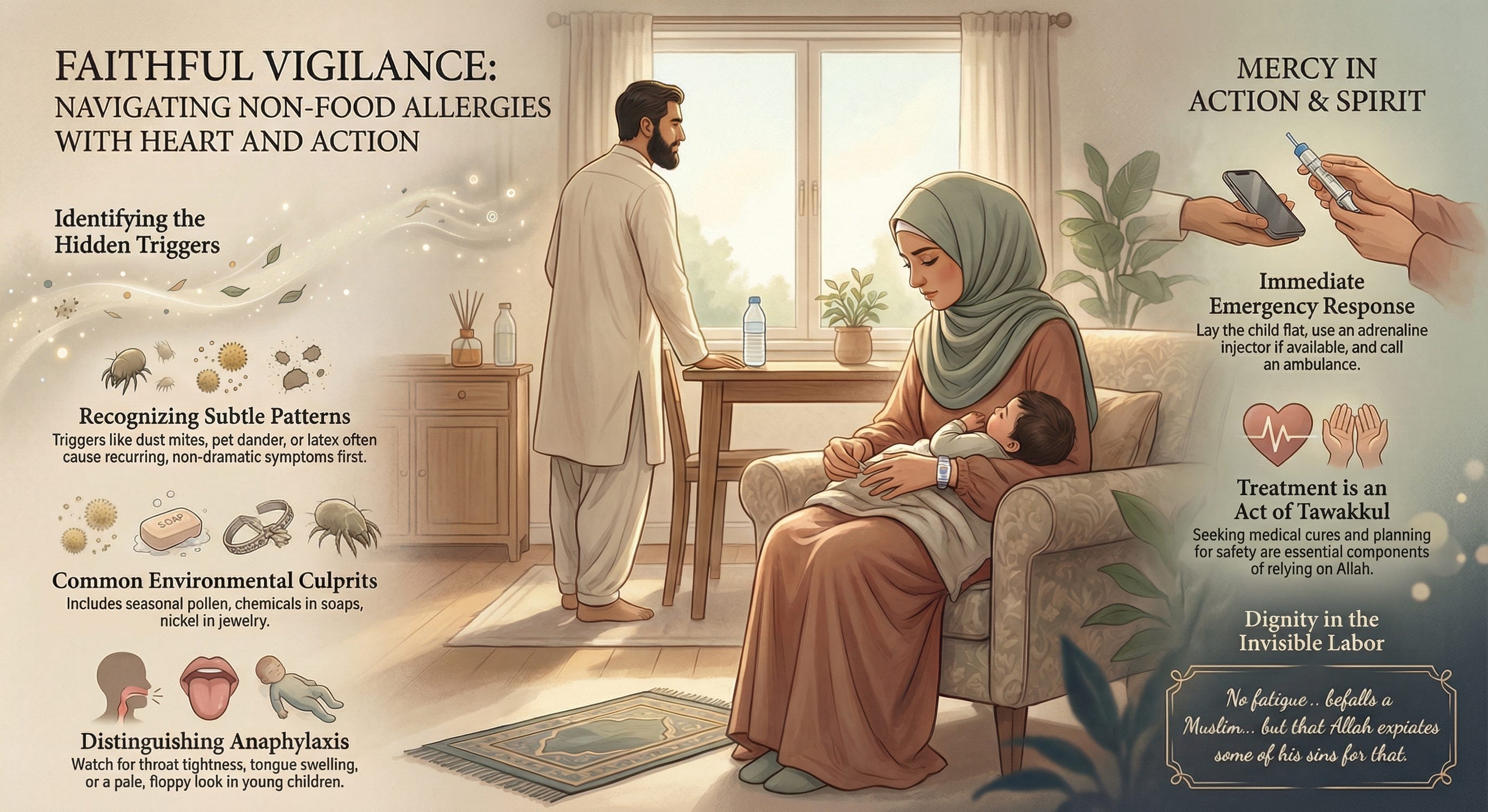
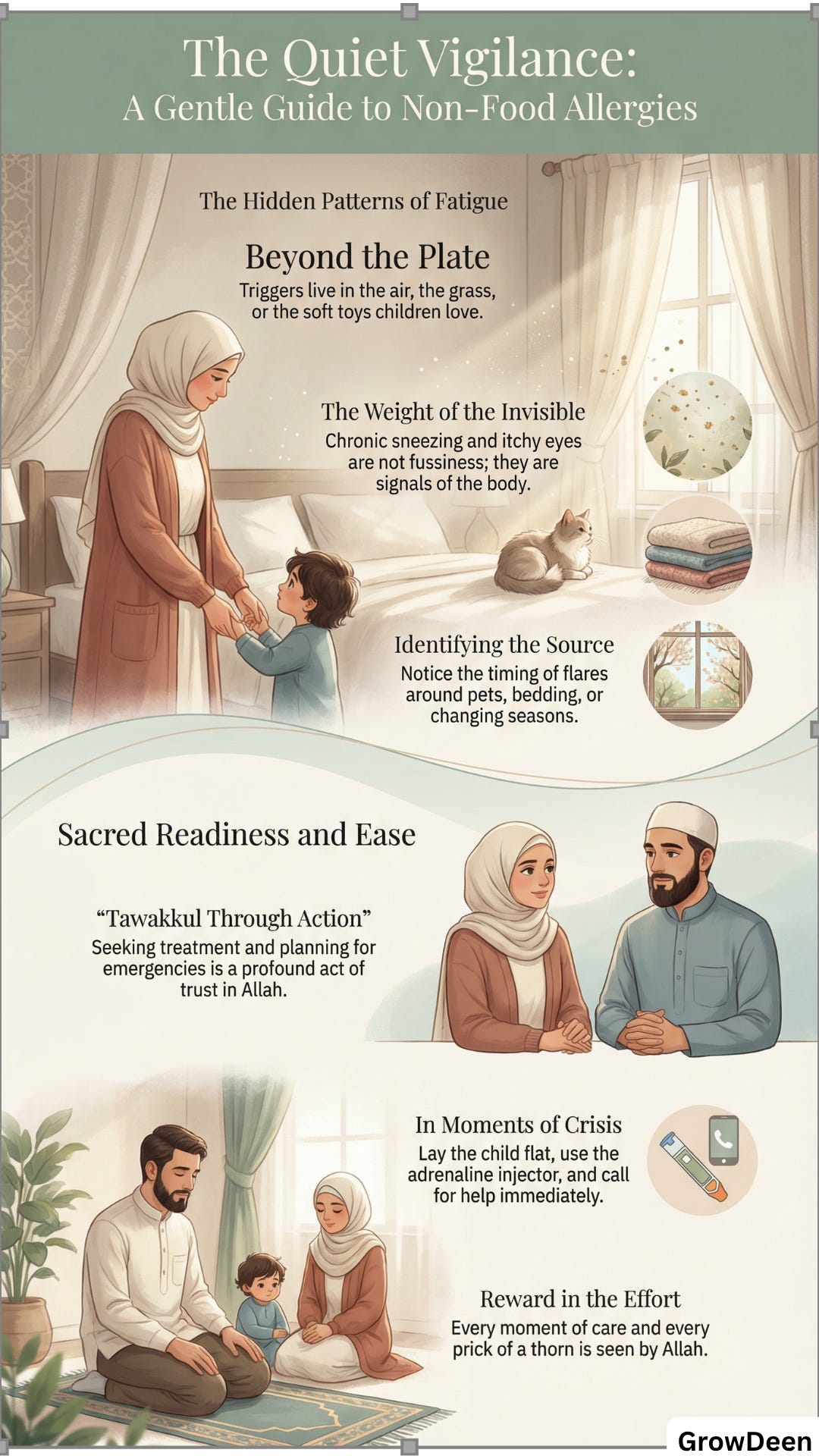
Non food allergies often arrive through ordinary life. Dust in a bedroom. Grass on a windy day. Animal dander. An insect sting. Latex. A medicine. Chemicals in things children touch every day.[1][2][3][6][11]
Most reactions are not dramatic. A child may get hives, swollen lips or eyelids, itchy skin, a runny or blocked nose, watery eyes, coughing, or worsening eczema and asthma symptoms.[3][5][8][13] Still, even the milder reactions can wear a family down because they keep coming back.
That is usually where this story begins. Not with sirens. With patterns.
When quick action becomes part of mercy
Severe allergic reactions are different. Anaphylaxis can bring difficult breathing, throat tightness, wheeze, tongue swelling, collapse, or a pale floppy look in a young child.[3][5][8] After an insect sting, severe stomach pain or repeated vomiting can also be part of it.[2][3][5][8][14]
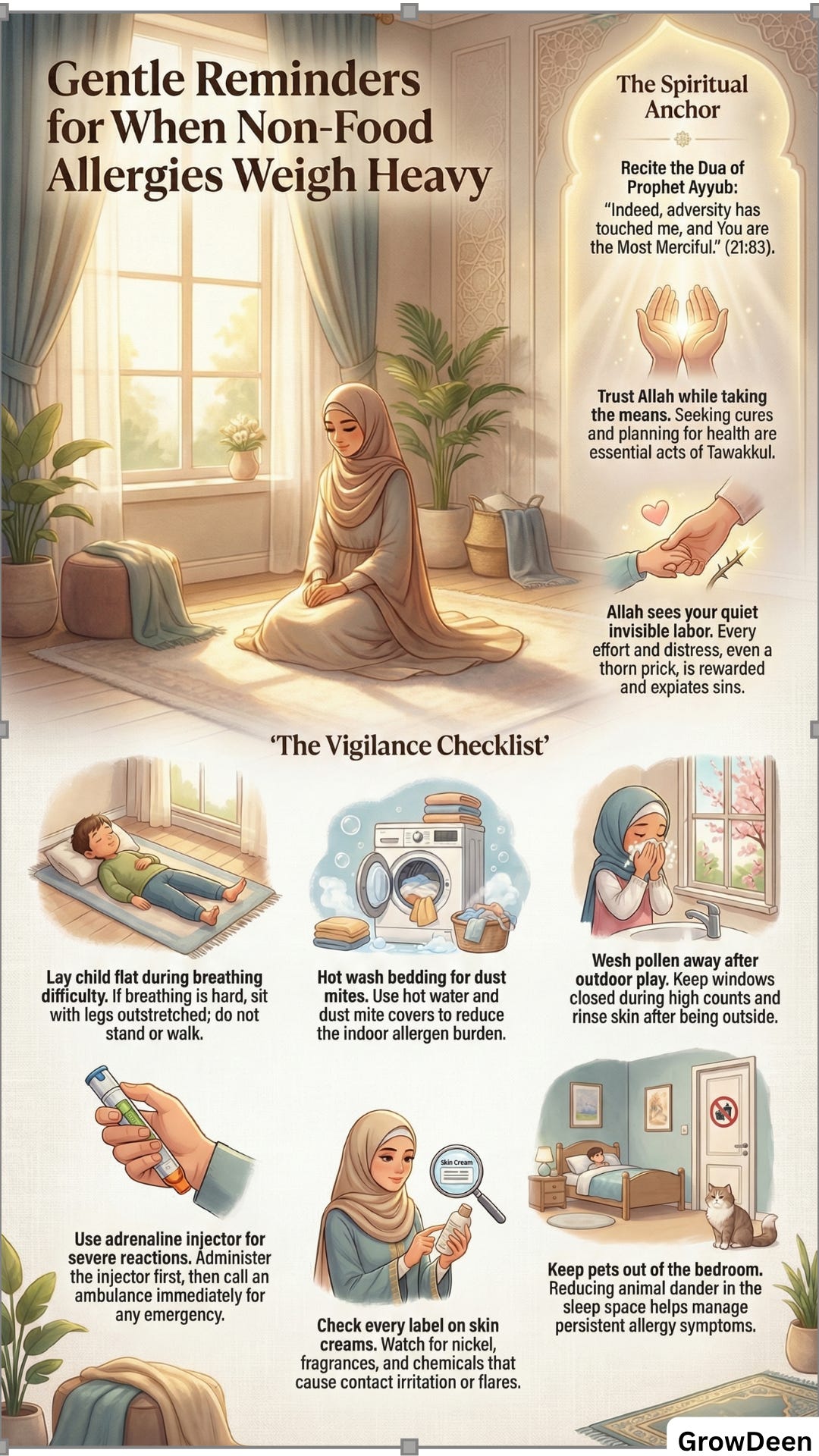
If that happens, time matters. The child should be laid flat. If breathing is difficult, they may sit with legs outstretched. They should not stand or walk. If an adrenaline injector is available, use it, then call an ambulance immediately.[3][5][8]
Ayyub عليه السلام called upon Allah, “Indeed, adversity has touched me, and You are the Most Merciful of the merciful.”[16] That verse belongs here. Not to make a parent passive, but to steady the heart while the hands do what must be done.
The home itself can sometimes be part of the problem
Some non food allergies are woven right into daily surroundings.
Dust mites settle into mattresses, pillows, bedding, carpets, soft toys, and upholstered furniture. Children with dust mite allergy may have year round sneezing, blocked noses, itchy eyes, eczema flares, asthma symptoms, and sometimes even snoring when the nose stays chronically blocked.[1][12][13] What helps is not perfection. It is reducing the burden where it matters most, especially around the bed. Hot washing bedding, using dust mite covers, keeping soft toys limited around sleep space, lowering indoor humidity, and vacuuming well can all help.[1][12]
Then there is contact irritation and contact allergy. Jewellery, metal fasteners, glues, dressings, creams, dyes, ointments, and sunscreens can all irritate or inflame the skin.[6][10] Nickel is a classic culprit in children.[10] These reactions are rarely life threatening, but they can be stubborn and miserable.
Strong fragrances can also make a home feel heavier than it needs to. Sometimes a less perfumed routine is kinder to the skin and nose.[1][6]
If gentle, evidence based parenting support like this helps you feel less alone in the everyday hard parts, you can subscribe for free so the next article reaches you before the next difficult moment does.
Seasons, pollen, pets, and stings can change the whole day
Pollen allergies come and go with the seasons, but when they come, they can really come. Grass, tree, and weed pollens often bring sneezing, itchy nose, blocked nose, and watery eyes, and they may aggravate asthma too.[1][4][13] High pollen days, windy weather, and thunderstorms can make things worse.[1][4]
Practical steps matter here. Watch pollen conditions. Keep windows closed when counts are high. Wash off pollen after outdoor play. Avoid mowing or being around freshly cut grass when symptoms flare.[1][4] For children with persistent allergic rhinoconjunctivitis, allergen immunotherapy may sometimes be considered under specialist care.[4][7]
Pet allergy can feel more emotional because the trigger may be loved. Children can react to animal dander, saliva, and fur with itchy skin, hives, runny nose, itchy eyes, or worsening eczema and asthma.[1][13] If the family pet is the trigger, keeping the animal out of the child’s bedroom usually helps most.[1]
Insect allergies are different again. They arrive suddenly. A sting may cause pain, swelling, or hives, and a very small number of children go on to anaphylaxis.[2][3][14] Most bites and stings can be managed with simple measures like removing the sting carefully, washing the area, using a cold pack, and giving appropriate medicine for itch or pain.[2][8][14] But breathing symptoms, collapse, or significant vomiting after a sting should never be brushed aside.[3][5][8]
Treatment is not the opposite of tawakkul
Latex allergy, though less common, matters because it can show up in places parents do not always think about first. Balloons, rubber gloves, bottle teats, and dummies can all be triggers.[11] Health professionals need to know if latex is a concern, especially before medical or dental care.[11]
Medicine allergy is another area where confusion is common. A rash after antibiotics may be from the medicine, but it may also be from the illness itself. Vomiting or diarrhoea much later is often more likely to be a side effect or a separate illness than a true allergy.[9][15] Beta lactam antibiotics, including penicillins, are especially well known for this confusion.[9][15] That is why it is wise not to permanently label a child “allergic” after one unclear event without proper assessment.
The Prophet ﷺ said, “Allah has not made a disease except that He has also made for it a cure.”[19] So treatment, planning, and avoidance are not signs of weak tawakkul. They are part of it.
Allah sees the invisible labour of all this
For many families, the hardest part is not one dramatic moment. It is the long stretch of vigilance.
Checking labels on creams. Carrying the injector. Reminding relatives. Updating school. Watching pollen. Washing bedding. Keeping a child from rubbing itchy eyes. Explaining, again, that this is not fussiness.
That labour is real.
The Prophet ﷺ said, “No fatigue, nor disease, nor sorrow, nor sadness, nor hurt, nor distress befalls a Muslim, even if it were the prick he receives from a thorn, but that Allah expiates some of his sins for that.”[20] That does not remove the weight of care, but it gives dignity to the quiet effort.
Allah also says, “Cooperate in righteousness and piety.”[18] In allergy care, that can look very practical. Parents, teachers, relatives, child care staff, and doctors all working from one serious plan. One child, many hands, one shared responsibility.[1][2][3][5]
So if non food allergies are part of your child’s life, do not let fear become the ruler of the home. Notice the pattern. Reduce exposure where you can. Treat what needs treating. Prepare for emergencies if your child is at risk. And keep placing your heart with Allah while taking the means He has put in front of you.[1][3][5][7][11]
Allah says, “For indeed, with hardship will be ease. Indeed, with hardship will be ease.”[17] Sometimes that ease comes as cure. Sometimes it comes as clarity. Sometimes it comes as a plan that helps your home breathe again.
GIFTS FOR YOU, DEAR PARENT
If you have reached this part of the page, it tells me something meaningful about you.
You were not just skimming or passing time. You stayed because something here felt close to your real life.
Because you care.
Because you want to move through these moments with more awareness.
Because even when it feels tiring, you are still trying.
That is not small.
So I did not want this article to remain just words on a page. I wanted it to gently step into your daily life in practical ways. That is why these Life Gifts were prepared for you.
Not as extras.
Not as decoration.
But as simple tools to help you hold onto what mattered most in what you just read.
Gentle Understanding Card
A clear and simplified summary of the core idea from this article, so you can revisit the main point anytime without rereading everything.
Heartfelt Dua Card
A carefully chosen dua connected to this stage of life, because real strength and ease ultimately come from Allah’s help.
Gentle Actions Card
Practical examples to help you turn knowledge into action, so what you learned can become part of your daily rhythm.
Gentle Reminders Card
Short, steady reminders drawn from the key points, designed to be printed or saved and placed somewhere you will see often.
These were designed slowly and thoughtfully, with time, care, and sincere dua. They were created because we genuinely want to walk alongside you, not just through one article, but through every stage of this lifelong journey.
If these gifts support you even in a small way, I would love for you to continue receiving them.
Subscribe so that each new Gift arrives directly in your inbox whenever we release the next stage. That way, you will not miss the tools designed to support you right where you are.
May Allah place barakah in your effort, accept your intention, and make this path easier and more rewarding than it feels right now.
Please share it with a family member or friend who may benefit from this knowledge.
Subscribe for free if you would like more gentle, evidence based, Islamically grounded support for real parenting moments.
What kind of non food allergy situation feels heaviest for your family lately?
References
[1] Australasian Society of Clinical Immunology and Allergy (ASCIA). Allergen minimisation.
[2] Australasian Society of Clinical Immunology and Allergy (ASCIA). Allergic reactions to bites and stings.
[3] Australasian Society of Clinical Immunology and Allergy (ASCIA). Anaphylaxis.
[4] Bousquet, J., Schünemann, H.J., Togias, A., Bachert, C., Erhola, M., Hellings, P.W., Klimek, L., Pfaar, O., Wallace, D., Ansotegui, I., Agache, I., Bedbrook, A., Bergmann, K.C., Bewick, M., Bonniaud, P., Bosnic Anticevich, S., Bossé, I., Bouchard, J., Boulet, L.P., et al. (2020). Next generation allergic rhinitis and its impact on asthma guidelines. Journal of Allergy and Clinical Immunology, 145(1), 70 to 80.e3.
[5] Cardona, V., Ansotegui, I.J., Ebisawa, M., El Gamal, Y., Fernandez Rivas, M., Fineman, S., Geller, M., Gonzalez Estrada, A., Greenberger, P.A., Sanchez Borges, M., Senna, G., Sheikh, A., Tanno, L.K., Thong, B.Y., Turner, P.J., & Worm, M. (2020). World Allergy Organization anaphylaxis guidance 2020. World Allergy Organization Journal, 13(10), 100472.
[6] Choi, H., Schmidbauer, N., Sundell, J., Hasselgren, M., Spengler, J., & Bornehag, C.G. (2010). Common household chemicals and the allergy risks in pre school age children. PLOS ONE, 5(10), e13423.
[7] Dhami, S., Nurmatov, U., Arasi, S., Khan, T., Asaria, M., Zaman, H., Agarwal, A., Netuveli, G., Roberts, G., Pfaar, O., Muraro, A., Ansotegui, I.J., Calderon, M., Cingi, C., Durham, S., Gerth van Wijk, R., Halken, S., Hamelmann, E., Hellings, P., et al. (2017). Allergen immunotherapy for allergic rhinoconjunctivitis: A systematic review and meta analysis. Allergy, 72(11), 1597 to 1631.
[8] Frith, K., Smith, J., Joshi, P., Ford, L.S., & Vale, S. (2021). Updated anaphylaxis guidelines: Management in infants and children. Australian Prescriber, 44(3), 91 to 95.
[9] Har, D., & Solensky, R. (2017). Penicillin and beta lactam hypersensitivity. Immunology and Allergy Clinics of North America, 37(4), 643 to 662.
[10] Hsu, J.W., Matiz, C., & Jacob, S.E. (2011). Nickel allergy: Localized, id, and systemic manifestations in children. Pediatric Dermatology, 28(3), 276 to 280.
[11] LaMontagne, A.D., Radi, S., Elder, D.S., Abramson, M.J., & Sim, M. (2006). Primary prevention of latex related sensitisation and occupational asthma: A systematic review. Occupational and Environmental Medicine, 63(5), 359 to 364.
[12] Nurmatov, U., van Schayck, C.P., Hurwitz, B., & Sheikh, A. (2012). House dust mite avoidance measures for perennial allergic rhinitis: An updated Cochrane systematic review. Allergy, 67(2), 158 to 165.
[13] Reddel, H.K., Bacharier, L.B., Bateman, E.D., Brightling, C.E., Brusselle, G.G., Buhl, R., Cruz, A.A., Duijts, L., Drazen, J.M., FitzGerald, J.M., Fleming, L.J., Inoue, H., Ko, F.W., Krishnan, J.A., Levy, M.L., Lin, J., Mortimer, K., Pitrez, P.M., Sheikh, A., et al. (2022). Global Initiative for Asthma strategy 2021: Executive summary and rationale for key changes. American Journal of Respiratory and Critical Care Medicine, 205(1), 17 to 35.
[14] Tankersley, M.S., & Ledford, D.K. (2015). Stinging insect allergy: State of the art 2015. The Journal of Allergy and Clinical Immunology: In Practice, 3(3), 315 to 322.
[15] Torres, M.J., & Blanca, M. (2010). The complex clinical picture of beta lactam hypersensitivity: Penicillins, cephalosporins, monobactams, carbapenems, and clavams. Medical Clinics of North America, 94(4), 805 to 820.
[16] The Qur’an, Surah Al Anbiya 21:83
[17] The Qur’an, Surah Ash Sharh 94:5 to 6
[18] The Qur’an, Surah Al Ma’idah 5:2
[19] Sahih al Bukhari 5678
[20] Sahih al Bukhari 5641; Sahih Muslim 2573