
The Small Moments That Build A Child’s Trust
Your Child Remembers Your Face More Than Your Rules

Strong parent child relationships grow when a child repeatedly experiences your steady presence, meaningful shared moments, and trust built through warmth, respect, and reliability.
It is one of those days where you feel like you are doing everything at once.
A message comes in. Something is boiling. The baby needs you. The older one is asking a question you have already answered twice.
And then your child does that thing that gets under your skin. The whining. The interruption. The pushing.
You feel the snap rising.
Not because you do not love them.
Because you are tired. Because you are human. Because nobody taught us how to hold a child’s heart while managing a whole home.
And still, right there in that moment, your child is learning something from you.
Not from what you say.
From what it feels like to be near you.
Your child learns what life feels like through you
A child does not absorb safety through lectures.
They absorb it through the way you look at them when they walk in.
Through what happens when they are upset.
Through whether home feels steady.
When children have strong, loving relationships with parents and carers, they tend to grow and learn better. Those relationships quietly teach them whether the world is safe, whether they are wanted, what love looks like, and what to expect when they cry, laugh, or get it wrong. [4]
And yes, the relationship changes as they grow. A toddler needs closeness. A school age child needs attention. A teen needs respect and steadiness.
The job stays the same. The shape of it keeps changing.
Presence is not more time, it is more you
When people say, be present, it can sound impossible.
As if you need to clear your calendar, turn into a calm person, and never be distracted again.
That is not what I mean.
Presence is a small decision you keep making.
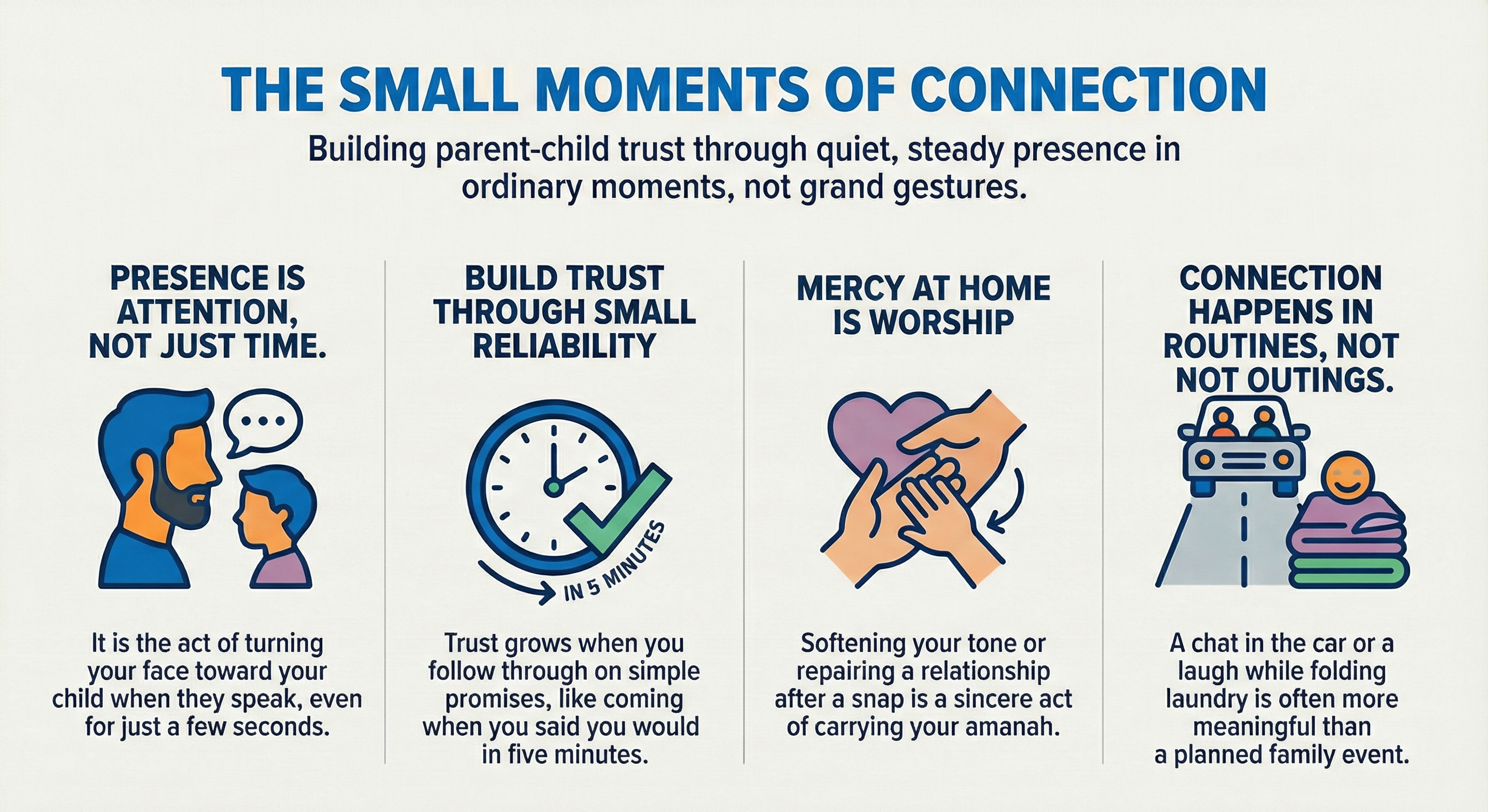
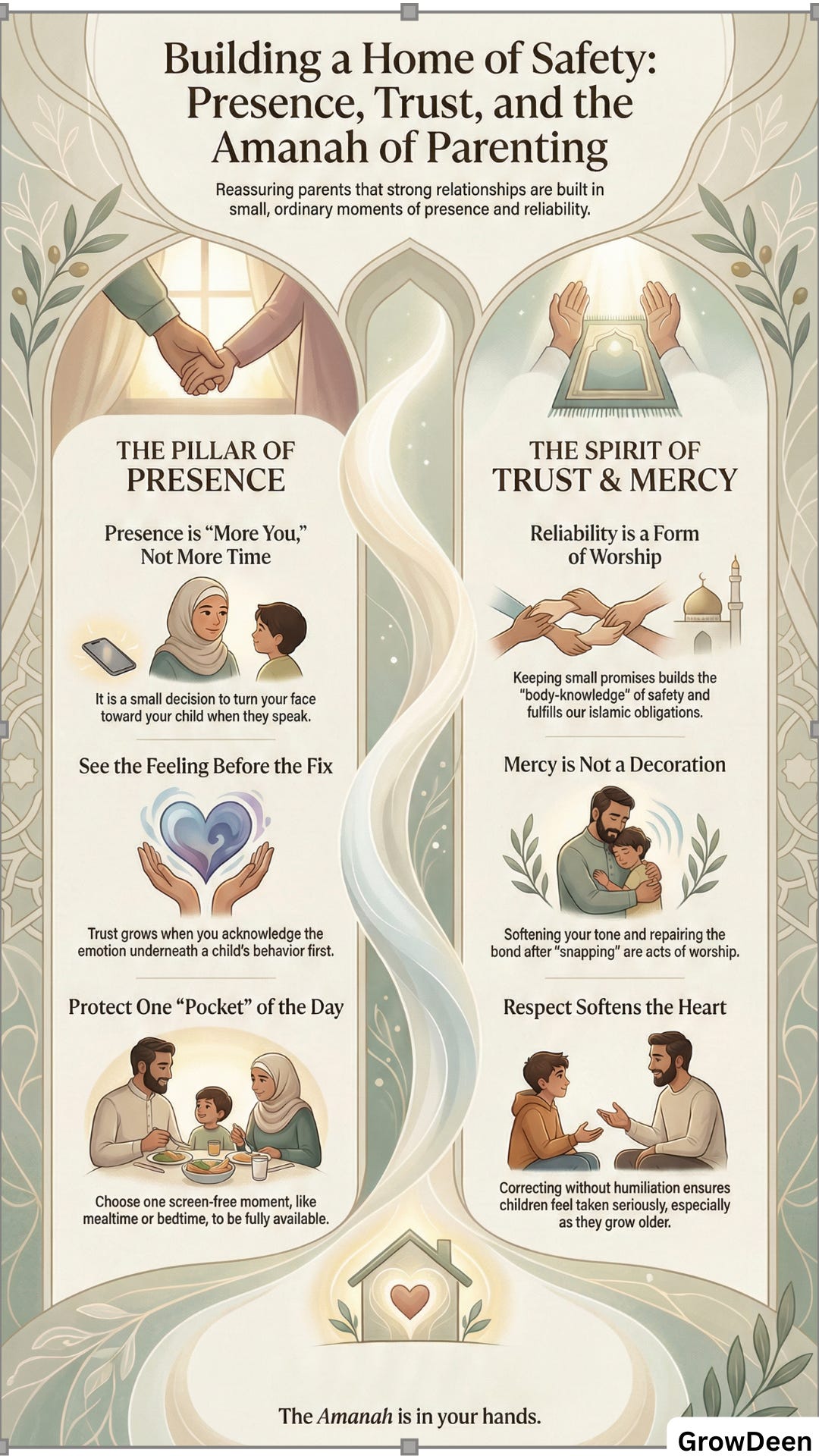
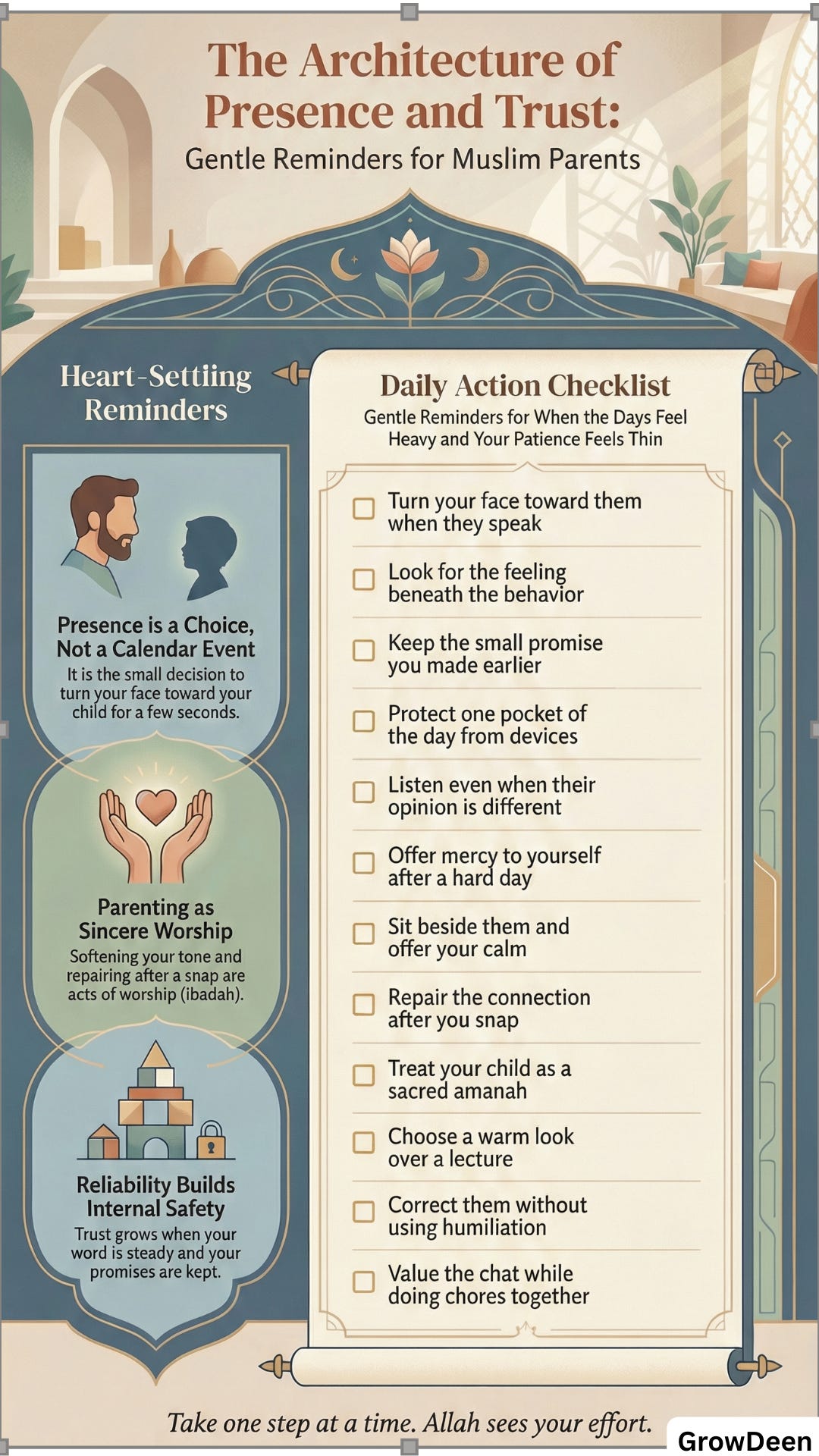
It is turning your face toward your child when they speak, even if only for a few seconds.
It is noticing what is underneath behaviour, not only the behaviour itself.
It is being willing to see the feeling before you fix the problem.
Some research describes mindful parenting approaches as improving how parents tune in and regulate emotions during everyday interactions. [2] You do not have to become a peaceful robot. You are simply trying to be a little less automatic.
A little more available.
If you have ever felt guilty reading parenting content, please hear this gently.
The aim is not to do everything.
The aim is to return more often.
Trust grows when your word feels steady
Trust is built in ordinary moments.
Your child watches whether you do what you said you would do.
They notice whether your promises mean something.
They notice whether you show up.
Even in small things.
If you say, I will come in five minutes, and you really come.
If you say, I will listen after I finish this, and you actually do.
If you promised to attend something important to them and you tried your best to be there.
A child might not name it as trust, but their body learns it.
In our deen, keeping promises and commitments matters. Allah tells us to fulfil our obligations. [7] At home, that often looks like reliability, not grand speeches.
It is also okay to be honest when you cannot keep something.
I cannot do that today. But I will do this instead.
That honesty protects trust too.
Quality time is usually small, not fancy
Quality time is not always a family outing with matching outfits.
It is often a chat in the car.
A laugh while you fold laundry.
A few minutes sitting on the bed while they talk about school.
The quality of time, not only the quantity, shapes how children experience connection. [4] Sometimes the most meaningful moments happen inside routines you already have.
One thing that quietly steals these moments is devices. Research has explored how screens can pull families away from each other right when connection could have happened naturally, especially around mealtimes. [1]
You do not need a dramatic phone ban to fix that.
You can choose one pocket of the day and protect it.
A meal.
Bedtime.
The first ten minutes after school.
Just one.
If you would like, you can subscribe for free so you have a gentle reminder like this arriving at the right time, especially in seasons when you feel stretched thin. No pressure. It is simply a way to keep support close without having to search for it.
Allah’s Protection is part of this amanah
Islam does not frame family life as a side project.
Allah tells the believers to protect and care for their families. [5] That includes the emotional atmosphere you build at home, not only food and clothing.
Your child is an amanah.
And you are not asked to carry it perfectly.
You are asked to carry it sincerely.
Mercy is not optional decoration in an Islamic home. It is part of faith and character. The Prophet ﷺ said that Allah shows mercy to those who show mercy. [6]
So when you soften your tone after a hard day, that is worship.
When you repair after snapping, that is worship.
When you sit beside your child and let them feel your calm, that is worship.
Respect keeps the relationship alive as they grow
As children grow older, they need something that feels very simple and very rare.
They need to feel respected.
Not agreed with.
Taken seriously.
Respecting your child means you do not punish honesty.
It means you listen even when their opinion is different.
It means you do not mock their feelings.
It means you correct them without humiliating them.
Family rules can support trust when they are firm and fair. Rules are not only control. They can communicate consistency and safety, which children rely on while they are still learning how the world works. [4]
And when you do need to correct, try not to let correction become the only kind of attention they receive.
Children soften in the warmth of relationship.
Even older ones.
Especially older ones.
Ending, gently
If your child could describe what home feels like, what would you want them to say.
Not perfect.
Not always happy.
But safe.
Warm.
Steady.
You can build that, slowly, through presence, time, and trust.
And if today was messy, that does not cancel your motherhood or fatherhood.
Return again.
That return is where love becomes real.
Gifts For You, Dear Parent
If you’ve reached this part of the page, it tells me something meaningful about you.
You weren’t just skimming or passing time. You stayed because something here felt relevant to your real life.
Because you care.
Because you want to do things with more awareness.
Because you’re trying, even when it feels overwhelming.
That is not small.
So I didn’t want this article to remain just words on a page. I wanted it to gently step into your daily life in practical ways. That’s why we prepared these Life Gifts for you.
Not as extras.
Not as decorations.
But as simple tools to help you hold onto what mattered most in what you just read.
Here’s what you’ll find inside:
Gentle Understanding Card
A clear and simplified summary of the core concept from this article, so you can revisit the main idea anytime without rereading everything.
Heartfelt Dua Card
A carefully chosen dua connected to this stage of life, because we know that real strength and ease ultimately come from Allah’s help.
Gentle Actions Card
Practical examples to help you translate knowledge into action, so what you learned becomes part of your daily rhythm.
Gentle Reminders Card
Short, steady reminders drawn from the key points, designed to be printed or saved and placed somewhere you’ll see often.
These were designed slowly and thoughtfully, with time, care, and sincere dua. We created them because we genuinely want to walk alongside you, not just through one article, but through every stage of this lifelong journey.
If these gifts support you even in a small way, I would love for you to continue receiving them.
Subscribe so that each new Gift arrives directly in your inbox whenever we release the next stage. That way, you won’t miss the tools designed to support you right where you are.
May Allah place barakah in your effort, accept your intention, and make this path easier and more rewarding than it feels right now.
Please share it with a family or friend who may benefit from this knowledge.
What is one moment with your child that feels hardest lately, and what kind of support would make it feel lighter?
References
[1] Chitakunye, P., and Takhar, A. (2014). Consuming family quality time: The role of technological devices at mealtimes. British Food Journal, 116(7), 1162–1179.
[2] Kakhki, Z.B., Mashhadi, A., Yazdi, S.A.A., and Saleh, S. (2022). The effect of mindful parenting training on parent child interactions, parenting stress, and cognitive emotion regulation in mothers of preschool children. Journal of Child and Family Studies, 31(11), 3113–3124.
[3] River, L.M., O’Reilly Treter, M., Rhoades, G.K., and Narayan, A.J. (2022). Parent child relationship quality in the family of origin and later romantic relationship functioning: A systematic review. Family Process, 61(1), 259–277.
[4] National Scientific Council on the Developing Child. (2004). Young children develop in an environment of relationships. Working Paper No. 1. Center on the Developing Child, Harvard University.
[5] Qur’an 66:6.
[7] Qur’an 17:34.