
The Small Everyday Dangers That Can Change a Child’s Life in Seconds
When Childhood Accidents Happen Fast: A Muslim Parent’s Guide to Staying Ready

Free gift for you! A practical companion resource is waiting for you near the end of this article to help you remember, apply, and benefit from what you read. Don’t forget to download!
Childhood injuries are often frighteningly ordinary, but with calm preparation, safer routines, and trust in Allah, a parent can reduce many risks and respond with steadiness instead of panic.
One minute your child is racing down the hallway in socks, laughing like nothing in the world could touch them.
The next, there is a cry that makes your whole body go cold.
Sometimes it is only a bump and a few tears. Sometimes it is worse. A fall from the bed. A hot drink pulled down in an instant. A coin in the mouth. A bucket you forgot was still full. A driveway that looked empty until it wasn’t.
This is one of the hardest parts of parenting. So much love. So much vigilance. And still, danger can hide inside ordinary moments.
The danger usually looks small at first
Most childhood injuries do not begin with something dramatic.
They begin with the familiar. A chair near a counter. A loose blind cord. A stroller strap. A pan handle turned the wrong way. A medicine bottle left out because you meant to put it away in a minute.
That is what makes this topic heavy for parents. Not because you are careless. Not because you do not care. But because children move quickly, learn suddenly, and reach farther than they could yesterday.
Minor scrapes and bruises are part of childhood. We all know that. But serious injuries are also a real part of childhood across the world, and many of them are preventable with practical, repeated, unglamorous habits that quietly protect life every day. [1][2][9][12][13]
A child’s world changes before your safety plan does
One of the strangest things about raising children is how fast risk changes.
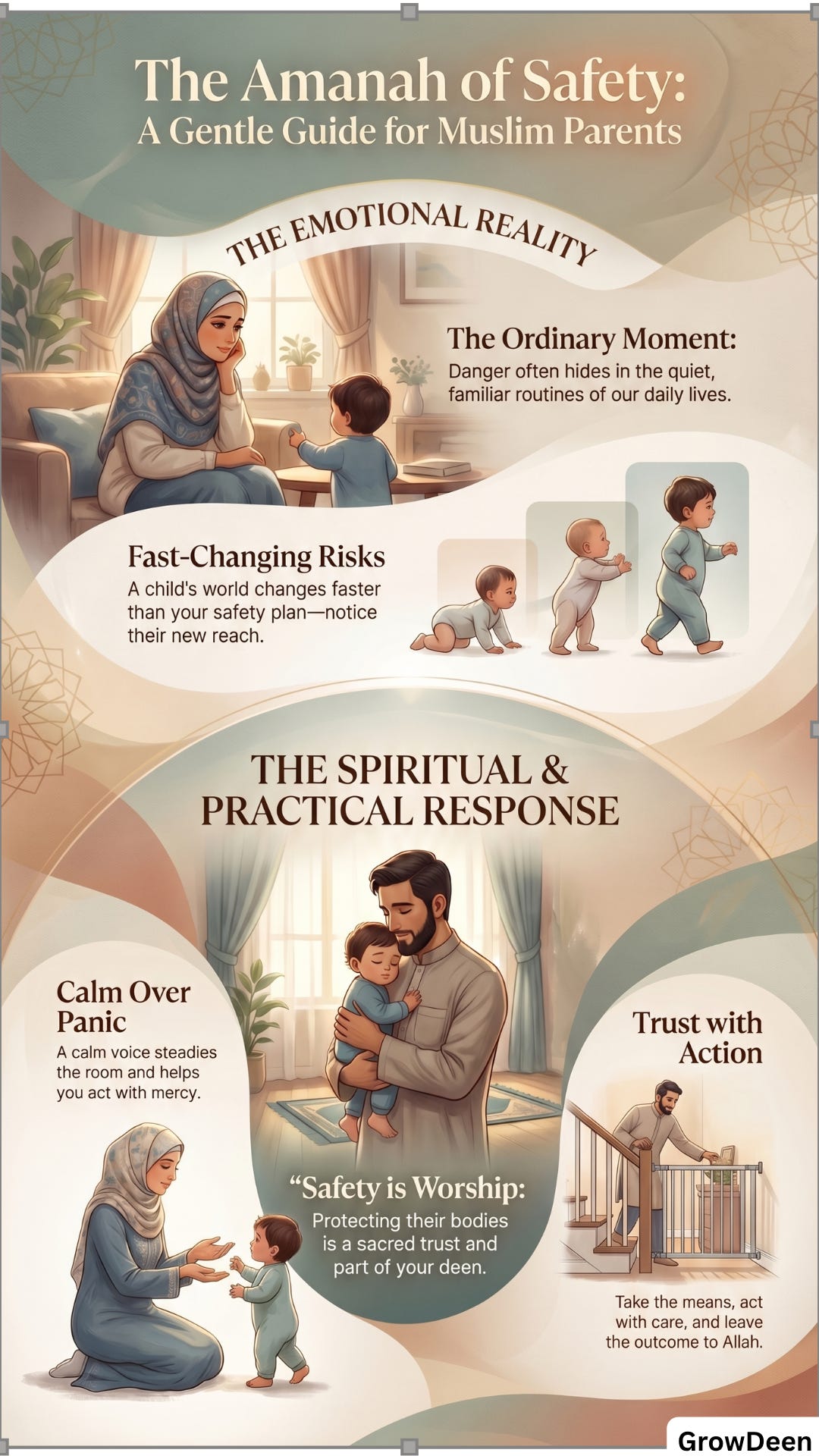
Yesterday your baby could not roll. Today they can. Yesterday your toddler could not climb onto the sofa. Now they are halfway to the windowsill. Yesterday the mug on the table felt out of reach. Today it is exactly where a little hand will tug.
Falls remain one of the most common causes of childhood injury. Road traffic incidents are still among the most devastating. Drowning, poisoning, burns, scalds, choking, strangulation, suffocation, trapping, crushing, and fire injuries continue to harm children across age groups. The details change with age, but the deeper truth does not. A child’s surroundings matter. Supervision matters. Preparation matters. [2][8][10][16]
A parent often feels tired reading a list like that. I understand. But this is not a call to fear everything. It is a call to notice what your child can do now, not what they could do last month.
Allah’s protection is sought through the means He gave you
For a Muslim parent, keeping a child safe is not separate from deen.
It sits right inside it.
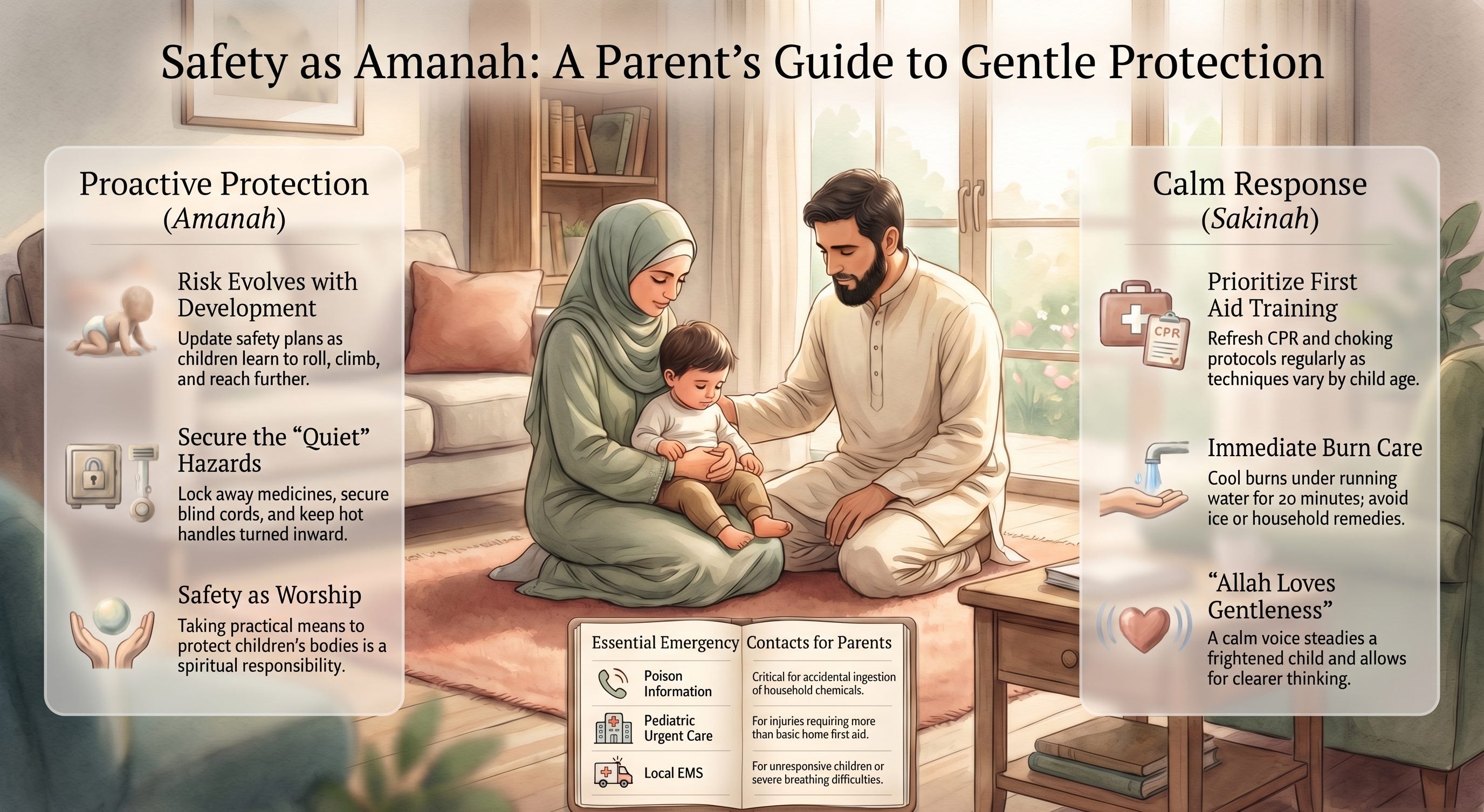
Allah says, “O you who believe, protect yourselves and your families from a Fire…” [17] That protection is spiritual in the deepest way, yes. But part of protecting your family is also protecting their bodies, their wellbeing, their safety, their daily lives.
And Allah says, “And do not throw yourselves with your own hands into destruction.” [18]
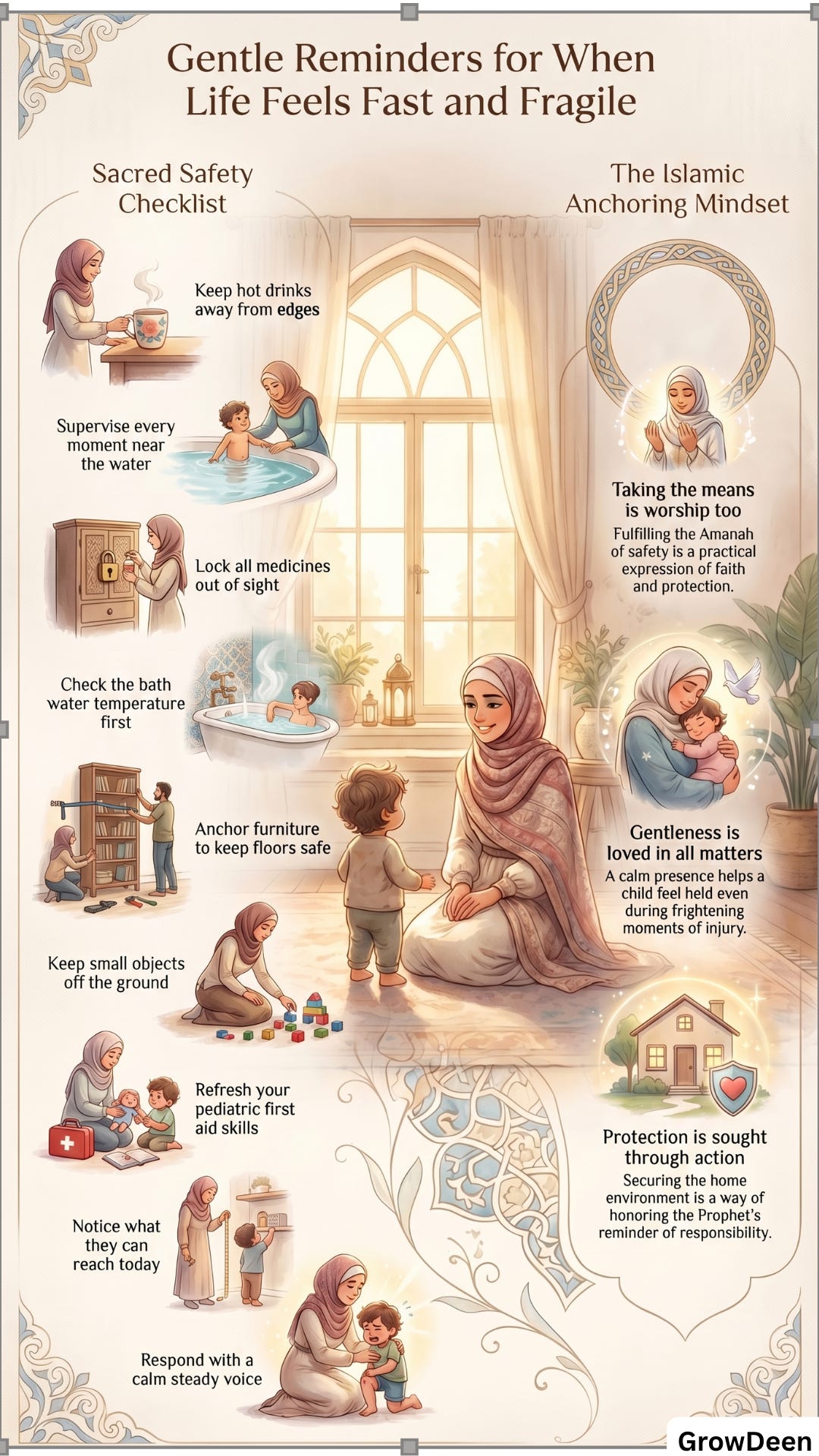
That reaches into ordinary parenting more than we sometimes admit. Securing medicines. Locking chemicals away. Watching closely near water. Learning CPR. Checking bath temperature. These are not merely household tasks. They are part of amanah.
The Messenger of Allah ﷺ said, “Each of you is a shepherd, and each of you is responsible for his flock.” [19]
That hadith lands differently once you become a parent.
Not as pressure to control every outcome. No one can do that. But as a tender, weighty reminder that vigilance is part of love.
Some places become dangerous in a heartbeat
Water is one of them.
What terrifies many parents is that drowning is often silent. Not dramatic. Not loud. A bath, a bucket, a backyard pool, a pond, a beach, a river. These all ask for the same thing: uninterrupted adult attention. Not nearby. Not half-listening. Not checking your phone while assuming you will hear trouble.
Kitchens carry their own cluster of risks. Hot tea. Soup. Oil. Cleaning products under the sink. Sharp utensils. A child underfoot while you are carrying something hot. Burns and poisonings often happen in places that feel routine because adults know how to move through them. Children do not. [5][7][11][12][14][16]
Then there are the hazards that feel almost too small to count until they are not. Coins. Buttons. Toy parts. Hard round foods. Blind cords. Straps. Gaps in furniture. Unsafe sleep spaces. Driveways where a small child is easy to miss. These are the ordinary details that can turn a normal day upside down. [5][7][11][12][14][16]
A safer home is usually built from noticing small things before they become big things.
Calm matters almost as much as speed
When a child is hurt, panic rushes in before thought does.
Your heart pounds. Your hands shake. You replay the last thirty seconds, wondering what just happened. In that moment, a parent does not need shame. A parent needs clarity.
This is one reason first-aid training matters so much. Not because it makes you fearless. It does not. But it gives your fear somewhere to go.
A stocked first-aid kit at home and in the car helps. So does keeping emergency numbers somewhere visible and easy to grab. It is wise to keep local emergency medical services, poison information support, nearby hospitals or urgent care, fire services, police, and trusted family contacts readily available. CPR training should be refreshed regularly because skills fade when they are not revisited. [9][20]
A little preparation changes the first few minutes of an emergency. And sometimes the first few minutes matter more than anything else.
What to remember when the injury is real
Burns and scalds need quick, steady action. Cool the burn under cool or cold running water as soon as possible, ideally for 20 minutes. Remove clothing or jewelry near the area if it is not stuck to the skin. Do not put ice, butter, toothpaste, or household remedies on it. Cover it with a clean, non-fluffy dressing or cling film where appropriate, and seek urgent medical help for larger burns, burns affecting the face, hands, genitals, major joints, chemical or electrical burns, or any significant burn in a very young child. Early cooling can reduce pain and may lessen burn depth. [21][22][23]
Choking is different depending on the child’s age, and this is exactly why parents should learn it before they ever need it. For babies under one year, severe choking is managed with infant-specific first-aid steps, including back blows and chest thrusts while supporting the baby carefully. Blind finger sweeps should not be done because they can push the object farther in. If the baby becomes unresponsive, emergency help is needed and infant CPR should begin. Young children are especially vulnerable to choking because they explore with their mouths and do not always chew well. [24][25]
For children over one year, the response changes. Severe choking is commonly managed with back blows first, followed by abdominal thrusts according to the age-appropriate protocol. If the child becomes unresponsive, emergency help and CPR are needed immediately. Prevention still sits underneath all of this. Seat children while eating. Supervise meals. Keep small objects and age-inappropriate toys away from little ones. [26][27]
CPR for babies is not the same as CPR for older children, and neither is the same as adult CPR. The exact technique matters, which is why accredited training is worth every effort. But the most important thing for a parent to remember is this: if a child is unresponsive and not breathing normally, do not freeze and do not wait for certainty before acting. [20][28][29]
For sprains, strains, and painful swollen limbs, parents often hear some version of rest, protection, cooling with wrapped ice, compression when appropriate, and elevation. That can be useful in the early period after a soft-tissue injury. But not every swollen limb is “just a sprain.” If a child cannot bear weight, has significant swelling, deformity, numbness, severe tenderness, persistent pain, or reduced use of the limb, they need medical assessment. Fractures are sometimes missed when adults assume too much too soon. Ice should never touch bare skin directly. [30][31][32]
Allah loves gentleness, even in emergencies
There is a tenderness our children need from us when they are hurt.
Not denial. Not slowness. Not pretending everything is fine when it is not. But gentleness.
The Prophet ﷺ said, “Allah is gentle and loves gentleness in all matters.” [33]
A calm parent helps a child feel held even when pain is frightening. A calm voice steadies the room. It helps you think. It helps your child trust you. It turns a moment of chaos into one where mercy is still present.
And there is another principle that belongs here too: “There should be neither harming nor reciprocating harm.” [34]
That reaches far beyond obvious violence. It enters the daily life of the home. Once a pattern of risk becomes known, it should not be ignored. Once a hazard is noticed, it should not be left there. Once help is needed, it should not be delayed out of embarrassment or denial.
If this kind of writing helps you breathe a little easier and parent with more clarity, subscribe for free so each new piece comes straight to you when you need it.
Safety is not perfection
This may be the part your heart needs most.
Children will still fall.
They will still run too quickly, climb before they are ready, miss a step, crash into furniture, surprise you with what they can reach, and get hurt in ways no parent could have fully prevented. This is not failure. This is childhood.
The goal is not to remove all risk from life. The goal is to remove the avoidable risks, prepare for the real ones, and refuse the kind of negligence that turns small hazards into life-changing harm.
Road injuries are less likely when children are buckled properly, taught road safety over time, watched closely near driveways, and never assumed to be visible to drivers. Drowning risk drops when there is active supervision and physical barriers around water. Poisoning risk drops when medicines, detergents, chemicals, and cosmetics are kept high, locked, and out of sight. Burns and scalds become less likely when hot drinks and pans are kept out of reach, bath water is checked carefully, and adults do not carry children while handling hot food or liquids. Falls are reduced with stair gates, window guards, better furniture placement, and closer supervision during each new developmental stage. [6][7][12][13][14][15][16]
And when there is violence in a home, or a parent fears they may hurt a child, that too must be taken seriously. Some injuries are accidental. Some are not. Immediate support should be sought through local emergency services, child protection systems, domestic violence services, medical professionals, or trusted family support. Protecting a child includes protecting them from deliberate harm as well. [2][17][19]
Allah says, “Allah does not burden a soul beyond what it can bear.” [35]
You are not being asked to control the future.
You are being asked to take the means, learn what you can, act with care, and place your trust in Allah without neglecting responsibility.
That is a noble way to parent.
That is worship too.
GIFTS FOR YOU, DEAR PARENT
If you stayed all the way to this part, that tells me something beautiful about you.
You were not just passing through.
You stayed because something here touched your real life. Because you care deeply. Because you want to move through parenting with more awareness, more steadiness, and more intention, even on the days that feel like too much.
That matters more than you know.
I did not want this to remain only an article you read and then forget by tomorrow afternoon. I wanted it to become something that could quietly support you in real moments, inside ordinary days, when your child is climbing too high, running too fast, or crying in your arms and you are trying to stay calm.
That is why these Life Gifts were prepared for you.
Not as extras.
Not as decoration.
But as simple, thoughtful tools to help you hold onto what mattered most in what you just read.
Inside, you’ll find:
The Gentle Understanding Card
A simple, clear summary of the heart of this article, so you can come back to the main idea whenever you need it, without having to reread everything from the beginning.
The Heartfelt Dua Card
A carefully chosen dua connected to this season of parenting, because real ease, strength, and protection always come from Allah before they come from anything else.
The Gentle Actions Card
Practical examples to help you turn insight into action, so what you learned here can begin to live inside your daily routine.
The Gentle Reminders Card
Short, steady reminders drawn from the core truths of this piece, made to be saved, printed, or placed somewhere you will see often when you need them most.
These were not rushed.
They were made slowly, with care, thought, and sincere dua.
They were created because the hope was never just to write something helpful once. The hope was to walk beside you, gently, through each stage of this long and sacred journey of raising children.
If these gifts support you even a little, I would love for you to keep receiving them.
Subscribe so each new Gift arrives in your inbox when the next stage is released, and you do not miss the support prepared for you right where you are.
May Allah place barakah in your effort, accept your intention, and make this road gentler and more rewarding than it feels today.
Please share this with a family member or friend who may need it too.
What is one moment with your child that has felt especially hard lately, and what kind of support would make that moment feel lighter?
A final comfort before you go: you do not have to parent in a state of panic to be a responsible parent. You do not have to be perfect to be protective. You do not have to know everything to become more prepared than you were yesterday.
May Allah make your home a place of safety, mercy, and sakinah. May He protect your children when they are in front of you and when they are out of your sight. May He place wisdom in your decisions and calm in your hands when your child needs you most.
Subscribe for free if you’d like more gentle, practical support rooted in both real life and our Islamic values.
References
[1] Australian Institute of Health and Welfare (AIHW). Australia’s children, Australian Institute of Health and Welfare (AIHW). Trends in injury deaths, Australia 1999–00 to 2016–17
[2] Australian Institute of Health and Welfare (AIHW). Trends in injury deaths, Australia 1999–00 to 2016–17
[3] Benning, S., & Webb, T. Taking the fall for kids: A journey to reducing pediatric falls
[4] Bierbaum, M., Lystad, R.P., Curtis, K., & Mitchell, R. Incidence and severity of head injury hospitalisations in children over a 10-year period
[5] Cassell, E., & Clapperton, A. Preventing serious fall injury in children (1): Overview and playground equipment
[6] Cassell, E., & Clapperton, A. Preventing serious fall injury in children (2): Falls involving furniture, skateboards and scooters
[7] Kendrick, D., Ablewhite, J., Achana, F., et al. Keeping children safe: A multicentre programme of research to increase the evidence base for preventing unintentional injuries in the home in the under-fives
[8] Kim, E.J., Kim, G.M., & Lim, J.Y. A systematic review and meta-analysis of fall prevention programs for paediatric inpatients
[9] Mitchell, R.J., Curtis, K., & Foster, K. A 10-year review of child injury hospitalisations, health outcomes and treatment costs in Australia
[10] Mack, K.A., Liller, K.D., Baldwin, G., & Sleet, D. Preventing unintentional injuries in the home using the Health Impact Pyramid
[11] Morrongiello, B.A., McArthur, B.A., & Bell, M. Managing children’s risk of injury in the home: Does parental teaching about home safety reduce young children’s hazard interactions?
[12] Peden, A.E., & Franklin, R.C. Child injury prevention: It is time to address the determinants of health
[13] The Royal Children’s Hospital. Safety: Preventing falls
[14] Turner, S., Arthur, G., Lyons, R.A., Weightman, A.L., Mann, M.K., Jones, S.J., John, A., & Lannon, S. Modification of the home environment for the reduction of injuries
[15] Wynn, P.M., Zou, K., Young, B., Majsak-Newman, G., Hawkins, A., Kay, B., Mhizha-Murira, J., & Kendrick, D. Prevention of childhood poisoning in the home: Overview of systematic reviews and a systematic review of primary studies
[16] Young, B., Wynn, P.M., He, Z., & Kendrick, D. Preventing childhood falls within the home: Overview of systematic reviews and a systematic review of primary studies
[17] Qur’an, Surah At-Tahrim 66:6
[18] Qur’an, Surah Al-Baqarah 2:195
[19] Sahih al-Bukhari 7138
[20] American Heart Association. 2025 Guidelines for CPR and ECC, American Red Cross pediatric CPR guidance
[21] British Red Cross. First aid for a baby or child with a burn
[22] American Red Cross. Burn Cooling Advisory
[23] American Academy of Pediatrics. HealthyChildren.org. Burn Treatment & Prevention Tips for Families
[24] British Red Cross. First aid for a baby who is choking
[25] American Red Cross. Infant Choking: How to Help
[26] British Red Cross. First aid for a child who is choking
[27] Resuscitation Council UK. Guidance: Choking
[28] American Red Cross Guidelines Database. Pediatric CPR: Techniques and Process
[29] American Red Cross. How to Perform Child and Baby CPR
[30] Nemours KidsHealth. Strains and Sprains: First Aid
[31] Royal Berkshire NHS Foundation Trust. RICE: Care of bumps, bruises, sprains and strains
[32] NHS. Sprains and strains
[33] Sahih Muslim 2593
[34] Sunan Ibn Majah 2340