
The Sleep Pattern No One Warns You About
And Why Your Newborn Wakes Every 40 Minutes

The National Sleep Foundation’s 2015 research found that newborns need 14-17 hours of sleep in every 24-hour period, but it arrives in 40-minute cycles, not long stretches. [1] This guide explains why your baby wakes so often, what’s happening in each sleep cycle, and how to respond without losing your mind.
3 AM. Your baby is crying again. You just put her down 40 minutes ago. You’re wondering what you’re doing wrong.
Here’s what I wish someone had told me in those first weeks: you’re not doing anything wrong. Your baby’s sleep isn’t broken. This is how newborn sleep works.
When I studied the research on infant sleep patterns, one number kept appearing: 40 minutes. [2] That’s the length of a newborn sleep cycle. Not two hours. Not even 90 minutes like adults. Forty minutes. And at the end of each cycle, your baby briefly wakes. Sometimes they can drift back to sleep on their own. Most of the time in these early weeks, they can’t.
Why This Guide Is Different
Current research meets Islamic wisdom. Every recommendation is backed by peer-reviewed studies from the National Sleep Foundation, AAP, and recent cohort research on normal infant sleep development.
Amanah-centered approach. This isn’t just sleep science—it’s about honoring the sacred trust of your baby’s needs through both practical action and spiritual awareness.
Practical support included. You’ll get a free Newborn Sleep Survival Guide (details at the end)—a 3-page reference you can keep on your nightstand when you need it most.
What Newborn Sleep Actually Looks Like
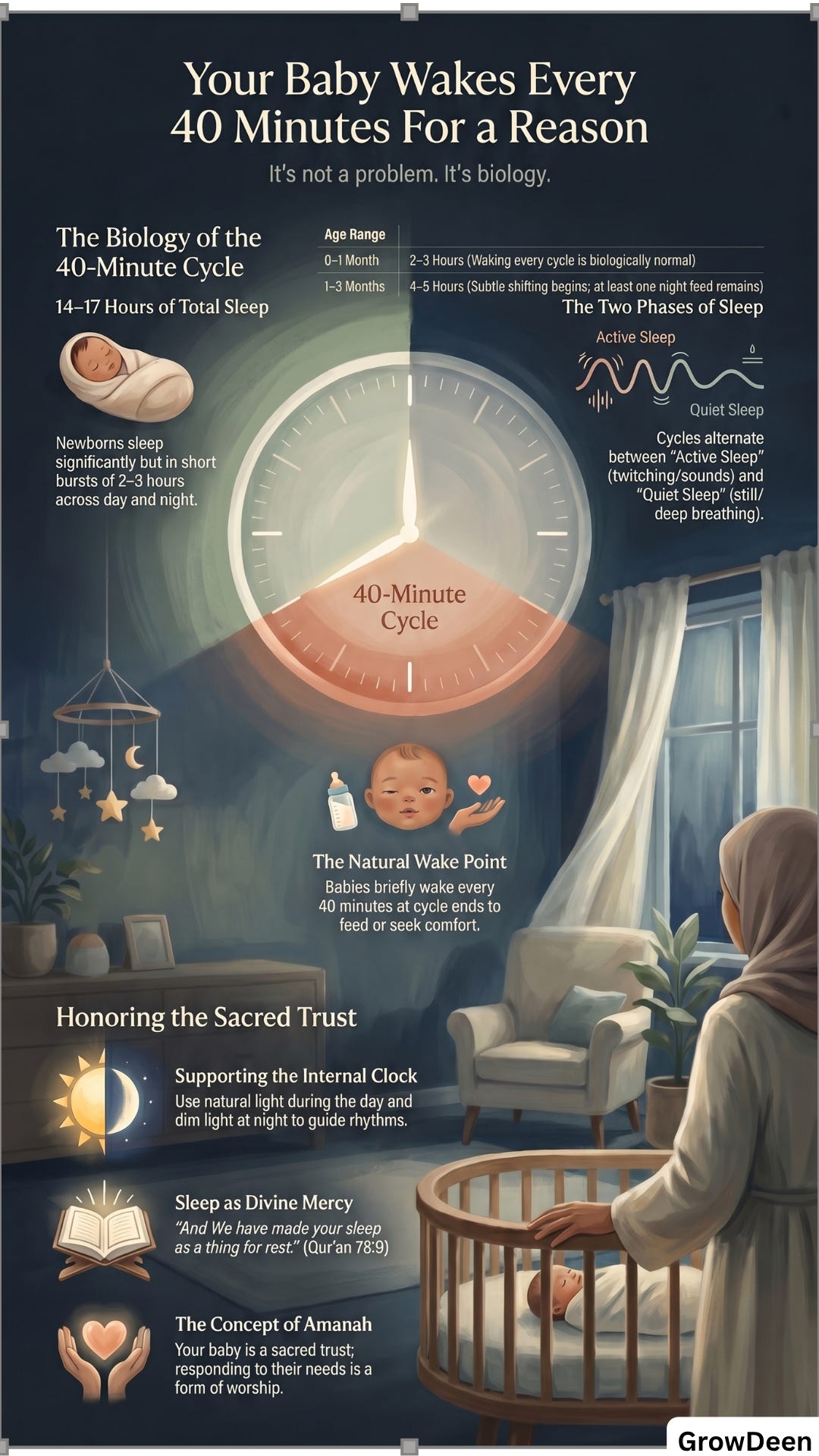
Most newborns sleep between 14 and 17 hours across each 24-hour period. [1] But this sleep doesn’t arrive in one tidy chunk.
It comes in bursts. Two to three hours at a time, sometimes four. [3] Your baby wakes, feeds, maybe stays alert for a little while, then sleeps again. The cycle repeats, day and night, without regard for what time the clock says.
Here’s why:
Your baby’s stomach is tiny. They need to feed often to sustain growth and keep blood sugar stable. [4] After feeding, some babies drift straight back to sleep. Others stay awake just long enough for gentle interaction—watching your face, listening to your voice, stretching on a blanket—before fatigue sets in again.
You might notice your baby becoming tired after only 60 to 90 minutes of wakefulness. This is normal. Their capacity to stay alert is still developing.
When I reflect on the verse where Allah says, “And it is He who made the night for you as clothing and sleep a rest,” [5] I think about how even in these chaotic early weeks, there’s divine wisdom in rest. Sleep isn’t downtime. It’s when growth happens, when neural connections form, when the body repairs itself.
The 40-Minute Cycle That Changes Everything
Newborn sleep operates in cycles, each lasting approximately 40 minutes. [2] Within each cycle, your baby moves through two types of sleep: active sleep and quiet sleep.
During active sleep, you’ll see movement. Twitching. Small sounds. Shifting position. Fluttering eyelids. Their breathing may be irregular. In this state, they’re easily roused.
Quiet sleep looks different. Your baby lies still. Breathing becomes deep and rhythmic. Their body relaxes completely. Waking them during this phase is much harder.
But here’s what makes newborn sleep particularly demanding:
At the end of each 40-minute cycle, your baby briefly wakes. [6] Sometimes they stir, grizzle, or cry before transitioning into the next cycle. Often, they need your help to settle again.
This isn’t a sleep problem. It’s how newborn sleep works. You’re not creating dependency by responding—you’re meeting a biological reality.
The Prophet Muhammad ﷺ said, “None of you truly believes until he loves for his brother what he loves for himself.” [7] When we extend this to our children, it transforms how we view their nighttime needs. We wouldn’t want to be left alone when we need comfort. Why expect different from someone who’s been in this world only days or weeks?
When Sleep Starts to Shift (And When It Doesn’t)
In the first few months, waking multiple times at night for feeds is standard. [8] Between 1 and 3 months, you may start noticing subtle changes. Your baby might begin sleeping for slightly longer stretches at night—perhaps 4 or 5 hours at once.
But even as these longer periods emerge, expect at least one nighttime wake-up to continue. This is normal, not a setback.
If your baby was born prematurely, has low birth weight, or has specific health concerns, your pediatrician may give different guidance. They might recommend waking your baby after a certain number of hours to ensure adequate feeding and weight gain. Premature babies, especially those who spent time in neonatal intensive care, may face additional sleep challenges. [9] If you’re concerned, reach out to your healthcare provider.
What Helps (And What Doesn’t)
One thing research shows clearly: natural and artificial light patterns begin shaping a baby’s emerging circadian rhythm even in the first month of life. [10]
You can’t force a day-night schedule onto a newborn. But you can gently support the process.
During daytime feeds and play, let natural light into your space. At night, keep lighting dim and interactions calm. Over time, these environmental cues help your baby’s internal clock begin distinguishing day from night.
The Qur’an reminds us, “And We have made your sleep as a thing for rest.” [11] This verse speaks to sleep as mercy, as recovery, as divine provision. When your nights feel long and broken, remembering that sleep—even interrupted sleep—serves a restorative purpose can offer a measure of peace.
Some newborns are naturally more settled. Others are more sensitive, waking more frequently or needing more help between cycles. Neither pattern indicates a problem. Temperament, neurological development, feeding patterns, and environmental factors all play a role.
The Sacred Work of 3 AM
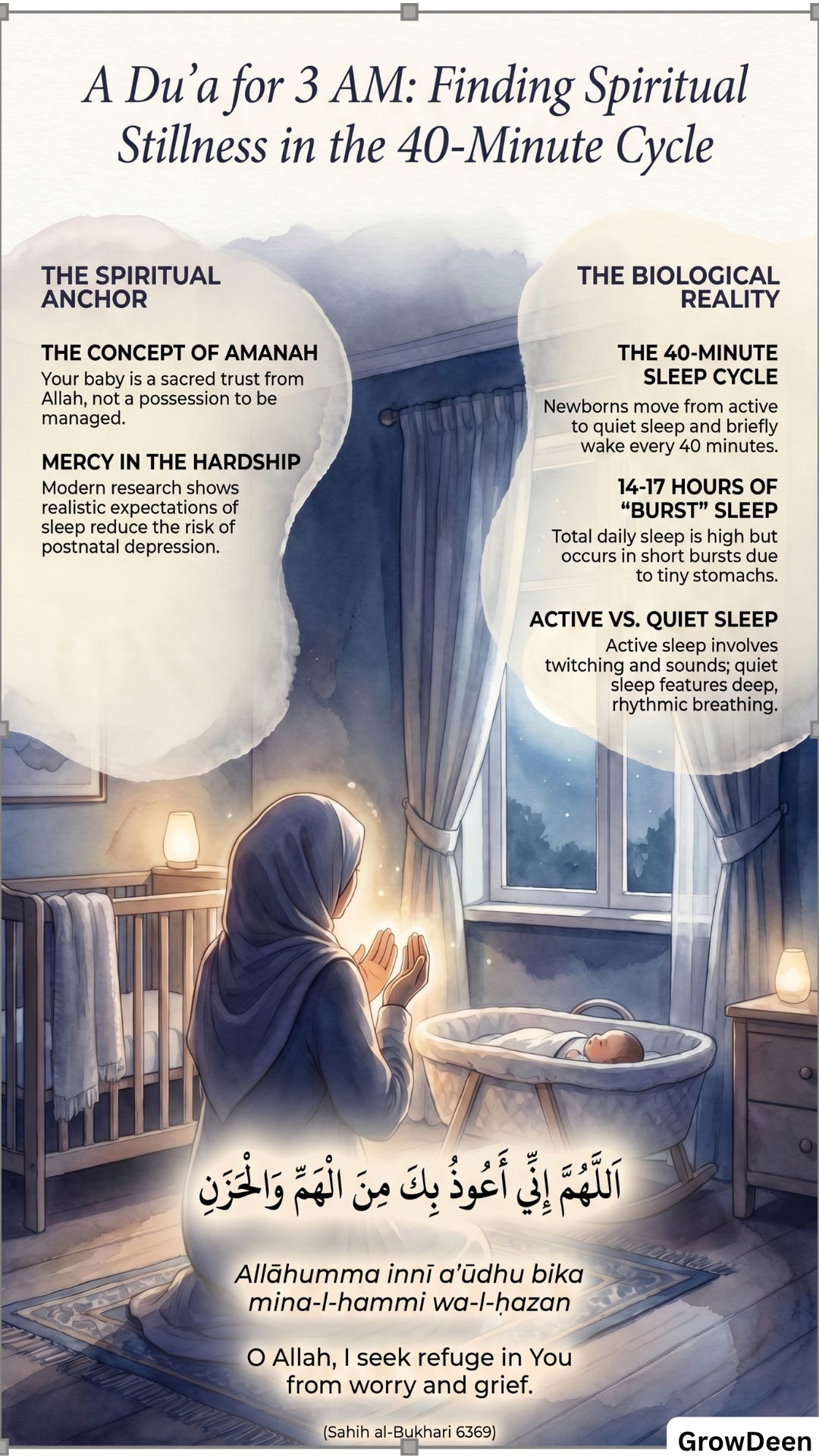
The concept of amanah—sacred trust—applies deeply here.
Your baby is not your possession but a trust from Allah, placed temporarily in your care. Part of honoring that trust is meeting their needs with patience, even when those needs arrive at 2 AM, and again at 4 AM, and again at 6 AM.
Studies show that realistic expectations around infant sleep reduce parental stress and decrease the risk of postnatal depression. [12] Knowing what’s normal helps you manage your own expectations. Newborn sleep isn’t linear. Some nights will feel harder than others, and that doesn’t mean you’re doing something wrong.
The Qur’an says, “So verily, with the hardship, there is relief. Verily, with the hardship, there is relief.” [13] The repetition is intentional. Relief surrounds difficulty on both sides. The exhaustion you’re experiencing is real, but it’s also temporary, and ease will come.
As the weeks pass, you’ll begin noticing patterns. You’ll learn your baby’s sleepy cues—yawning, eye rubbing, turning away from stimulation, fussiness. Responding before your baby becomes overtired often makes settling easier. Newborns have very little capacity to self-regulate when they’re overstimulated or exhausted. They need you to read their signals and help them wind down.
This is sacred work. It may not feel sacred at 3 AM when you’re swaying a crying baby for the fourth time that night. But it is.
Every time you meet your baby’s need for comfort, every time you offer presence instead of leaving them to manage alone, you’re fulfilling the trust Allah has placed in your hands.
The Newborn Sleep Survival Guide
I know this is a lot to hold in your mind, especially when you’re managing night wakings and trying to function on broken sleep. That’s why I’ve created a free Newborn Sleep Survival Guide — a practical reference you can keep on your nightstand when you need it most.
Inside the Newborn Sleep Survival Guide (one comprehensive PDF, 2 pages):
Page 1: Quick Reference Card — The 40-minute sleep cycle explained, active vs. quiet sleep visual guide, normal wake windows by week, and sleepy cues to watch for — designed like a laminated card you can keep beside your bed.
Page 2: The 3 AM Reassurance Sheet — What’s normal vs. when to call the doctor, gentle settling techniques that actually work, and a du’a for exhausted nights when you need spiritual grounding.
Page 3: Du'as for Night Wakings — Authentic supplications organized by the nighttime journey (before sleep, during wake-ups, seeking patience, for your baby) with Arabic, transliteration, and translation — designed to keep on your nightstand or folded inside your Quran for spiritual grounding at 3 AM.
This isn’t just a PDF to download and forget. It’s a tool designed to stay on your nightstand where you’ll actually use it when you’re too tired to remember what’s normal.
This Newborn Sleep Survival Guide is what every GrowDeen subscriber receives with each article. We cover the full journey of raising Muslim children, all backed by research and rooted in wisdom.
If you’re a Muslim parent who wants both evidence-based guidance AND Islamic perspective, subscribe for free so future resources arrive in your inbox before you need them.
You’ll receive one article when it’s ready—no daily emails, no clutter, just guidance when there’s something worth sharing.
Tonight, when your baby wakes at the end of another 40-minute cycle, remember: this is normal. This is biology. This is temporary.
You’re not failing. You’re responding to a trust.
May Allah place barakah in your effort, grant you patience in the exhaustion, and make these broken nights a means of drawing closer to Him.
Share This With Someone Who Needs It
Think of one person right now: a new mother in your family who’s struggling with night wakings, a friend whose baby is three weeks old and she’s wondering if this exhaustion ever ends, a sister at the masjid who confided that she’s not sleeping more than two hours at a stretch.
This article could ease their burden. Share it with them today—not as advice-giving, but as support. Sometimes the most loving thing we can do is share what helped us understand.
Frequently Asked Questions
Q: How long do newborn sleep cycles last? A: Newborn sleep cycles last approximately 40 minutes. [2] At the end of each cycle, your baby briefly wakes and often needs help transitioning to the next cycle. For more detail, see “The 40-Minute Cycle That Changes Everything” above.
Q: Is it normal for my newborn to wake every 2-3 hours at night? A: Yes, this is completely normal. [8] Newborns have tiny stomachs and need to feed frequently. Most wake several times a night in the first few months, and many continue waking at least once nightly even around 3 months of age.
Q: When will my baby start sleeping longer at night? A: Between 1 and 3 months, many babies begin having longer sleep stretches at night—around 4-5 hours. [8] But every baby is different, and even with longer stretches, expect at least one nighttime wake-up to continue.
Q: How much total sleep does a newborn need? A: The National Sleep Foundation recommends 14-17 hours of sleep in every 24-hour period for newborns. [1] This sleep comes in short bursts of 2-3 hours throughout the day and night.
Q: What’s the difference between active sleep and quiet sleep? A: During active sleep, your baby moves, makes sounds, and wakes easily. During quiet sleep, they’re still with deep, regular breathing and are harder to wake. [2] Each 40-minute cycle includes both types.
Q: My baby was premature—will their sleep be different? A: Premature babies often face additional sleep challenges, particularly if they spent time in NICU. [9] Their sleep patterns may take longer to mature. If you’re concerned about your premature baby’s sleep, speak with your pediatrician for personalized guidance.
References
[1] Hirshkowitz, M., Whiton, K., Albert, S.M., et al. (2015). National Sleep Foundation’s sleep time duration recommendations: Methodology and results summary. Sleep Health, 1(1), 40-43.
[2] Joseph, D., Chong, N.W., Shanks, M.E., et al. (2015). Getting rhythm: How do babies do it? Archives of Disease in Childhood. Fetal and Neonatal Edition, 100(1), F50-54.
[3] Paavonen, E.J., Saarenpaa-Heikkila, O., Morales-Munoz, I., et al. (2020). Normal sleep development in infants: Findings from two large birth cohorts. Sleep Medicine, 69, 145-154.
[4] Davis, K.F., Parker, K.P., & Montgomery, G.L. (2004). Sleep in infants and young children: Part One: Normal sleep. Journal of Pediatric Health Care, 18(2), 65-71.
[5] Qur’an, Surah Al-Furqan 25:47
[6] Blunden, S., Thompson, K., & Dawson, D. (2011). Behavioural sleep treatments and night time crying in infants: Challenging the status quo. Sleep Medicine Reviews, 15, 327-334.
[7] Sahih al-Bukhari 13, Sahih Muslim 45
[8] Pennestri, M.H., Burdayron, R., Kenny, S., et al. (2020). Sleeping through the night or through the nights? Sleep Medicine, 76, 98-103.
[9] Lyu, J., Groeger, J.A., Barnett, A.L., et al. (2022). Associations between gestational age and childhood sleep: A national retrospective cohort study. BMC Medicine, 20(1), Article 253.
[10] Iwata, S., Fujita, F., Kinoshita, M., et al. (2017). Dependence of nighttime sleep duration in one-month-old infants on alterations in natural and artificial photoperiod. Scientific Reports, 7, Article 44749.
[11] Qur’an, Surah An-Naba 78:9
[12] Hiscock, H., Cook, F., Bayer, J., et al. (2014). Preventing early infant sleep and crying problems and postnatal depression: A randomized trial. Pediatrics, 133(2), 346-354.
[13] Qur’an, Surah Ash-Sharh 94:5-6