
The Quiet Moments That Are Already Building Your Baby’s World
The First Kind of Play Your Newborn Needs Is Mostly You

Free gift for you! A practical companion resource is waiting for you near the end of this article to help you remember, apply, and benefit from what you read. Don’t forget to download!
In the first 3 months, newborn play is built through warm, repeated interaction, including touch, voice, movement, gentle adhkar, and calm Qur’an recitation, helping a baby grow in bonding, movement, language, and early learning.
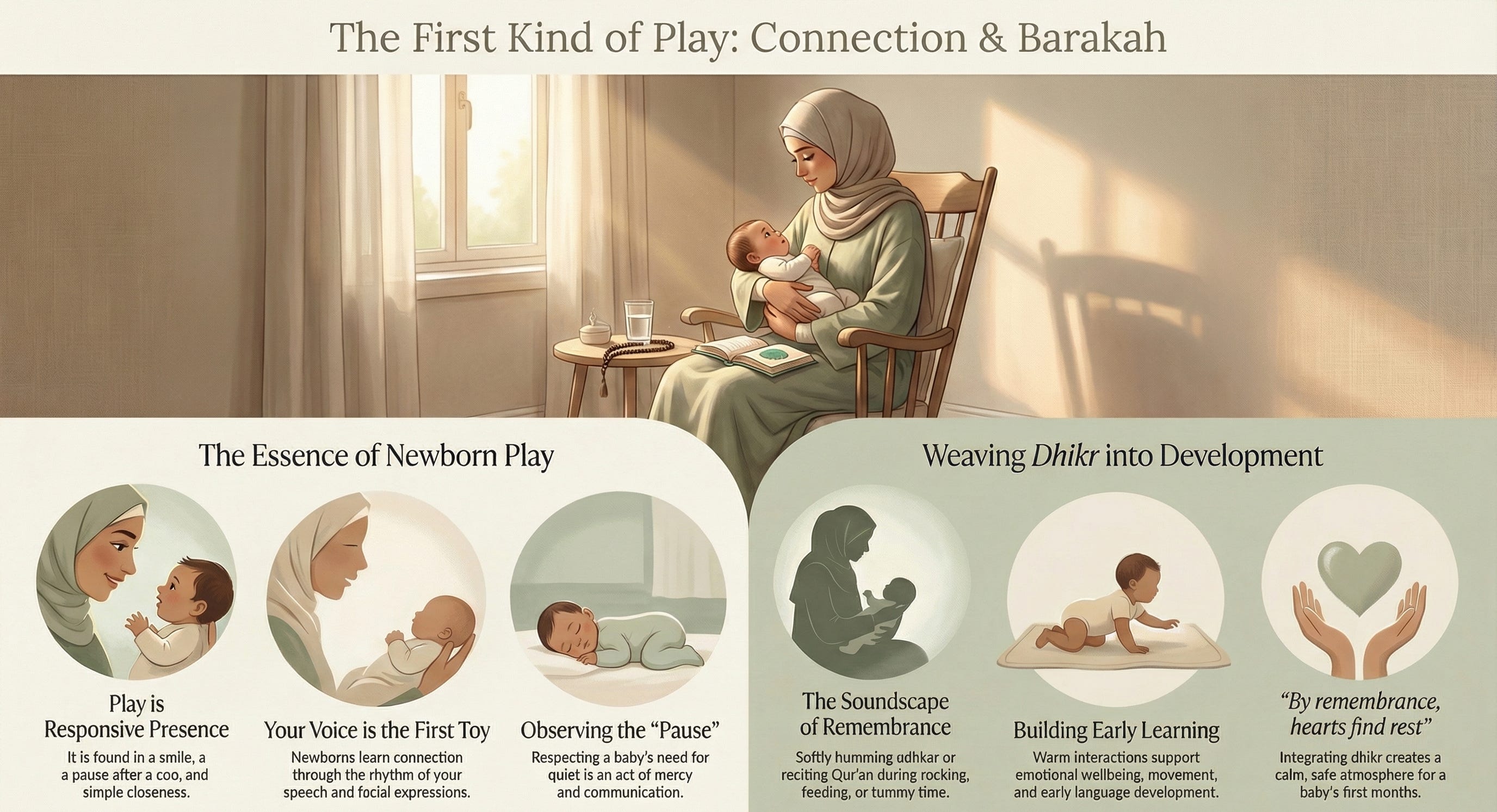
You are holding your baby after a feed, maybe swaying a little without even thinking.
The house is not fully in order. You are not fully rested. Nothing about the moment looks impressive from the outside. Then your baby opens their eyes and studies your face, and you say something soft. Their name. A little rhyme. A quiet SubhanAllah. A few calm verses you know by heart.
And somehow the room changes.
It looks small. It is not small.
What play looks like when a baby is still so new
In the first 3 months, play does not usually look like what people imagine. There are no games to explain, no clever setup, no need to impress anyone. A lot of the time, it is just closeness. A face near a face. A smile. A pause after a tiny sound. A gentle cuddle. A soft voice answering a small movement.[1][2][3][6][7][8][9][11][12]
That is already real play.
And it matters more than it seems. In these early weeks, warm interaction supports development, emotional wellbeing, movement, bonding, and early learning.[1][4][6][8][9][11][12] So when you talk to your baby while changing them, or smile while holding them, or respond to a coo with your own little sound, you are not filling time. You are building something.
Your face and your voice are already enough
A newborn begins learning from the beginning. Not later. Now.
Through repeated, gentle interaction, babies start to know voices, notice faces, feel comfort, and slowly experience the world as something safe enough to keep meeting.[1][4][6][8][9][11][12] That is why newborn play is mostly about you. Not toys first. Not entertainment first. You.
Your eyes.
Your voice.
Your touch.
Your timing.
When you speak and then pause, when you answer your baby’s sounds, when you hold them in a calm and responsive way, you are helping them learn the shape of connection.[1][4][5][8][9][12] Trust begins to grow there. A baby starts to feel that someone is here, someone notices, someone responds.
And for a tired parent, there is relief in this. You do not need a performance. Your responsive presence already matters deeply.
The remembrance of Allah can quietly become part of play
For Muslim families, this early closeness can also carry remembrance.
Along with chatting, smiling, and cuddling, a parent can softly hum gentle adhkar while holding the baby. Quiet phrases like SubhanAllah, Alhamdulillah, Allahu Akbar, or La ilaha illa Allah can become part of the baby’s early soundscape. A calm recitation of Qur’an while rocking, feeding, carrying, or settling the baby can also become part of these first months.
This does not need to feel forced.
It can be very simple. Very natural. Just the sound of a parent’s calm voice carrying the words of remembrance through ordinary care.
Allah says, “And Allah brought you out of the wombs of your mothers not knowing a thing, and He made for you hearing and sight and hearts that perhaps you would give thanks.”[14] A baby enters the world unable to do anything alone, yet already prepared by Allah to hear, receive, notice, and begin learning.
And Allah says, “Unquestionably, by the remembrance of Allah hearts find rest.”[19] That verse speaks first to hearts that understand, yes, but it also gives Muslim homes a direction. Let remembrance live in the air. Let the home sound like dhikr. Let the child become familiar, from the beginning, with the calmness of Qur’an and the softness of a parent remembering Allah.
There is no need to turn this into pressure or performance. Just let it be woven gently into holding, settling, swaying, feeding, and play.
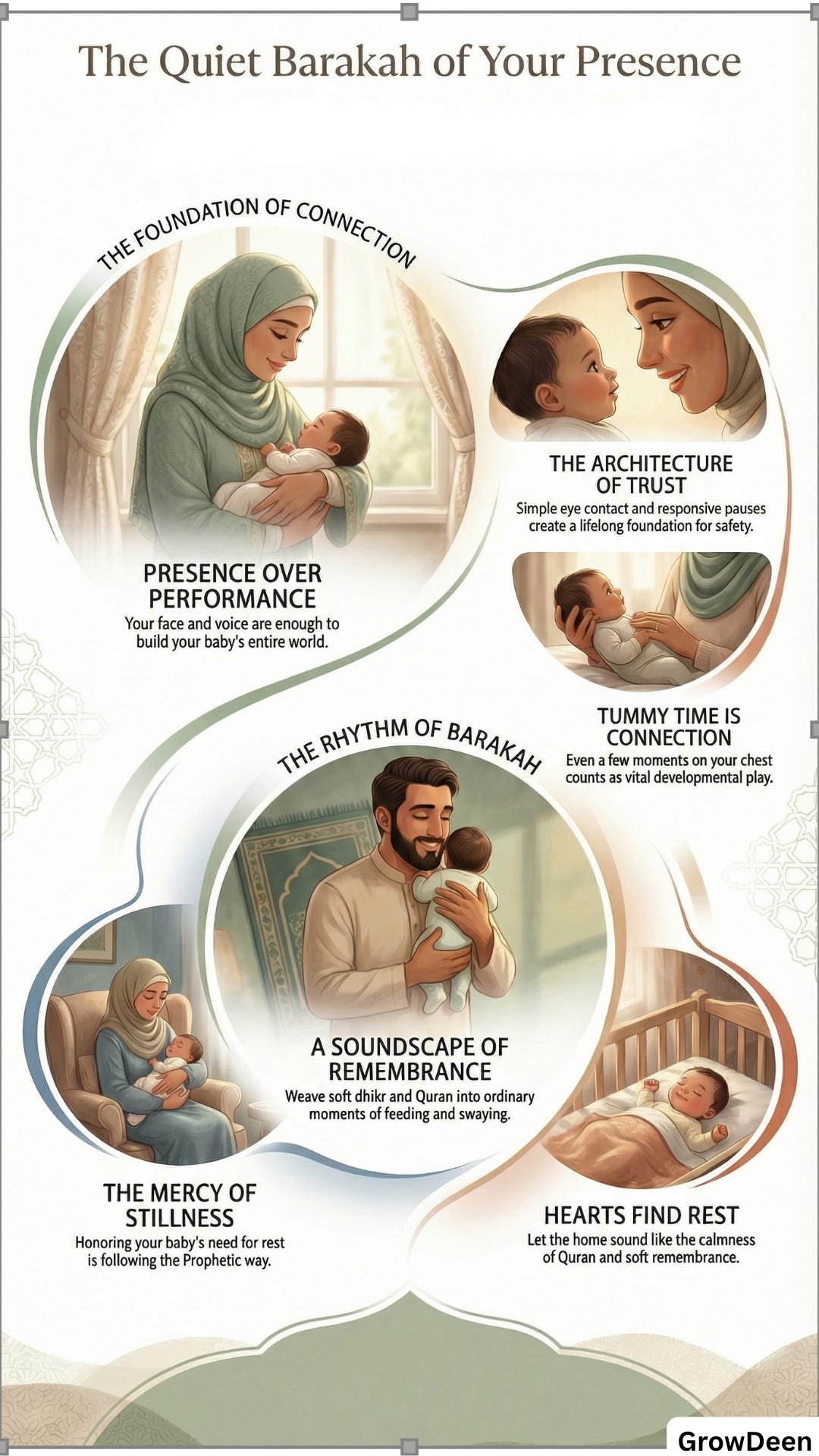
A rhyme, a little dhikr, a window, your smile
Simple play is often the best kind for a newborn.
You can sing. Chat. Count tiny fingers. Stroke little hands. Read a cloth book. Smile and wait for your baby to study your face. Make expressions. Raise your eyebrows. Pause after a coo as if you are already in conversation.[1][4][5][8]
And in a Muslim home, this can naturally include soft recitation and gentle adhkar too. A parent may recite a few familiar verses. They may quietly repeat morning or evening adhkar while carrying the baby. They may softly say Bismillah before beginning care, or Alhamdulillah while rocking a little one who has finally settled. These moments are not outside play. They are part of the warmth, rhythm, and repeated closeness through which a baby starts to know the world.
Reading counts too, even now. So does recitation. The baby does not need to “understand” the words yet for the moment to matter. What matters is the closeness, the sound of the voice, the rhythm, and the atmosphere of calm attention.[4][5][9][12][20]
There is something very beautiful in how Anas رضي الله عنه described the Prophet ﷺ speaking playfully to a small child, saying, “O Abu ‘Umayr, what happened to the little bird?”[16] It is such a tender moment. He noticed children. He entered their world gently. That teaches us something important. Warm, playful affection is not small. It is part of noble character.
Tummy time can stay small and still matter
Tummy time is one of the most helpful early play practices because it supports head, neck, and upper body strength and gives babies a different way to move and look at the world.[4][5][6][8][10][12] It should only happen when the baby is awake and watched.[10]
Some babies take to it quickly.
Some do not.
That is alright. You can begin with small stretches. A little time on your chest. A few moments across your lap. A short try on the floor before baby has had enough.[4][5][8][10] It still counts.
And sometimes a parent will softly talk, recite, or hum adhkar during tummy time too, helping the baby stay settled with the comfort of a familiar voice. The point is not to fill every second with sound. The point is to let these moments feel warm, safe, and gently connected.
For sleep, of course, babies should still be placed on their backs.[10][12]
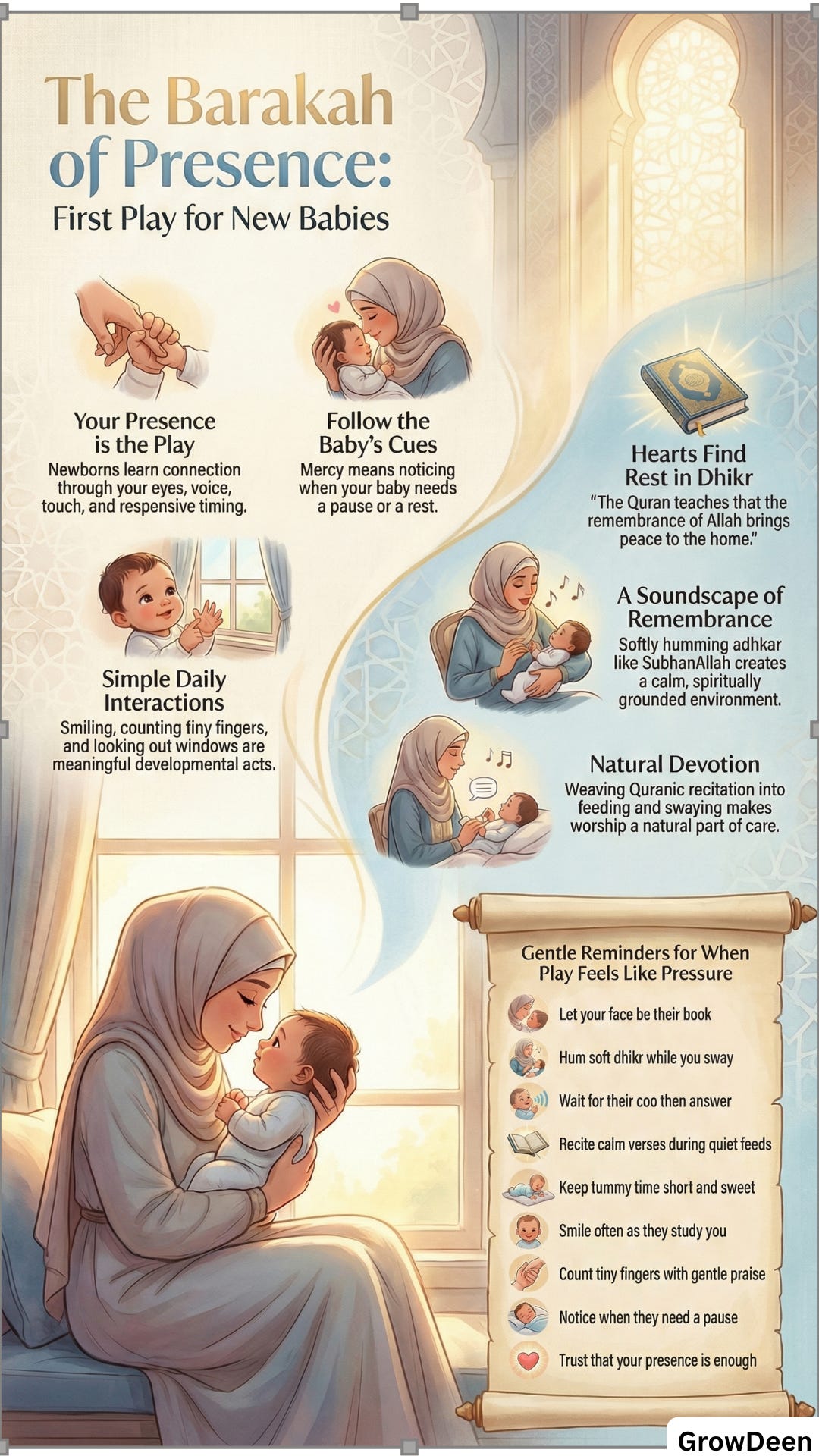
Mercy also means noticing when your baby has had enough
Newborn play should not become pressure. Babies need pauses. They can get tired, overstimulated, fussy, or simply done for the moment.[2][4][8][11][12] One baby stays engaged longer. Another looks away almost immediately. That is not failure. That is communication.
The Prophet ﷺ said, “He is not one of us who does not show mercy to our young and respect our elders.”[17] Mercy in this stage includes not pushing a baby beyond what they can bear. It includes noticing when they need quiet, stillness, or sleep.
And parents need mercy too.
Allah says, “His mother carried him with hardship and gave birth to him with hardship.”[15] So if you are tired, touched out, or unable to do elaborate activities, your baby is not being deprived of what matters most. A newborn does not need a show. They need responsive presence. A face. A voice. Safe holding. A little play. A little rest. Then again.
There is another tender Prophetic example here. The Prophet ﷺ said he would begin the prayer intending to lengthen it, but when he heard a child crying, he would shorten it because he knew the distress that the crying would cause the mother.[18] That is remarkable sensitivity. It shows that paying attention to babies, adjusting around them, and responding with mercy are not interruptions to good character. They are part of it.
So let newborn play stay simple enough to be real.
Smile at your baby.
Talk to them.
Let them study your face.
Give them a few moments of tummy time.
Read a cloth book.
Sit by the window.
Hum soft adhkar.
Recite Qur’an calmly while holding them.
If the moment is warm, responsive, and gentle, then something important is already being built.
GIFTS FOR YOU, DEAR PARENT
If you have reached this part of the page, it tells me something meaningful about you.
You were not just skimming or passing time. You stayed because something here felt relevant to your real life.
Because you care.
Because you want to do things with more awareness.
Because you’re trying, even when it feels overwhelming.
That is not small.
So I did not want this article to remain just words on a page. I wanted it to gently step into your daily life in practical ways. That is why we prepared these Life Gifts for you.
Not as extras.
Not as decorations.
But as simple tools to help you hold onto what mattered most in what you just read.
Here is what you will find inside:
Gentle Understanding Card
A clear and simplified summary of the core concept from this article, so you can revisit the main idea anytime without rereading everything.
Heartfelt Dua Card
A carefully chosen dua connected to this stage of life, because we know that real strength and ease ultimately come from Allah’s help.
Gentle Actions Card
Practical examples to help you translate knowledge into action, so what you learned becomes part of your daily rhythm.
Gentle Reminders Card
Short, steady reminders drawn from the key points, designed to be printed or saved and placed somewhere you will see often.
These were designed slowly and thoughtfully, with time, care, and sincere dua. We created them because we genuinely want to walk alongside you, not just through one article, but through every stage of this lifelong journey.
If these gifts support you even in a small way, I would love for you to continue receiving them.
Subscribe so that each new Gift arrives directly in your inbox whenever we release the next stage. That way, you will not miss the tools designed to support you right where you are.
May Allah place barakah in your effort, accept your intention, and make this path easier and more rewarding than it feels right now.
Please share it with a family member or friend who may benefit from this knowledge.
Subscribe for free if you would like more gentle, research rooted, Islamically grounded support for the real moments of raising a child.
What is one small thing you already say or recite around your baby that you would love to make part of your daily rhythm?
References
[1] Bruce, T. (2011). Learning Through Play: For Babies, Toddlers and Young Children (2nd ed.).
[2] Fleer, M. (2021). Play in the Early Years (3rd ed.). Cambridge University Press.
[3] Fromberg, D.P. (2021). Play from Birth to Twelve: Contexts, Perspectives, and Meanings (4th ed.). Routledge.
[4] Hollman, L. (2021). Playing with Baby: Research Based Play to Bond with Your Baby from Birth to Year One.
[5] Howard, J. (2017). Mary D. Sheridan’s Play in Early Childhood: From Birth to Six Years (4th ed.). Routledge.
[6] Lui, C., Solis, S.L., Jensen, H., Hopkins, E.J., Neale, D., Zosh, J.M., Hirsh-Pasek, K., & Whitebread, D. (2017). Neuroscience and learning through play: A review of the evidence. The LEGO Foundation.
[7] Lynch, S., Pike, D., & à Beckett, C. (Eds.). (2017). Multidisciplinary Perspectives on Play from Birth and Beyond. Springer Nature.
[8] Manning-Morton, J., & Thorp, M. (2003). Key Times for Play: The First Three Years. Open University Press.
[9] Miller, L., Cable, C., & Goodliff, G. (Eds.). (2014). Supporting Children’s Learning in the Early Years. Routledge.
[10] American Academy of Pediatrics. Back to Sleep, Tummy to Play.
[11] World Health Organization. Nurturing care for early childhood development.
[12] Centers for Disease Control and Prevention. Milestones by 2 Months.
[13] The Qur’an, Surah Al-Furqan 25:74
[14] The Qur’an, Surah An-Nahl 16:78
[15] The Qur’an, Surah Al-Ahqaf 46:15
[16] Sahih al-Bukhari 6203; Sahih Muslim 2150
[17] Jami` at-Tirmidhi 1919, graded Hasan Sahih
[18] Sahih al-Bukhari 709; Sahih al-Bukhari 710
[19] The Qur’an, Surah Ar-Ra’d 13:28
[20] The Qur’an, Surah Al-Isra 17:82